Unflinching Look at Big Family Sharing Small Space

Several years ago I sublet an apartment deep in Manhattan’s Lower East Side. The railroad style-apartment was roughly 500 sq ft and had one bedroom, a kitchen/dining area and a living room. It was oodles of space for me. A boy named Kenny frequently knocked on my door seeking company and wanting to play games on my computer. He lived with six other family members in an apartment across the hallway that was the same size as mine.

Kenny and his family were, from all I could surmise, recent Chinese immigrants. And while sharing such tight quarters was most likely driven by available financial resources, there was surely a strong cultural component that allowed them to live together. For some cultures, living with your family in a small space is not so unusual. A new book called “The Lams of Ludlow Street: The Photobook” is taking a long look at one of these families and the culture that surrounds them.

lams-of-ludlow-bath

The Lams are a Chinese family of five that at one point shared a meager 350 sq ft apartment, also in New York’s Lower East Side. Filmmaker Thomas Holton, in an effort to better understand his own Chinese heritage, has been photographing and getting to know the Lams for the last 12 years. The photobook, which he is funding through Kickstarter, tracks the family’s life through images and narrative.

lams-of-ludlow-study

The Lams of Lulow isn’t necessarily a romance story of families sharing small spaces. The parents eventually get divorced (not a phenomenon limited to couples sharing small spaces, of course) and Holton speaks of witnessing, at certain points, a family that “seemed broken up physically and emotionally.” Rather, the book is meant to be an intimate and stereotype-free account of a family and culture that might seem very foreign to outsiders. It’s a view people who aren’t part of this Chinese community seldom get.

The campaign has already surpassed its $28K with 16 days left to go. Head on over to the book’s Kickstarter page and Holton’s site to see more images.

Betabook: The Notebook for the Digital Age

While the digital world offers many replacements for items like books, receipts, calendars and other clutter-creating paper goods, sometimes the digital versions can leave us longing for the tactility of yesterday (well not the receipts). If you’re a scribbler or doodler, the Betabook might offer a nice middle ground between lightweight digitalism and tactile goodness.

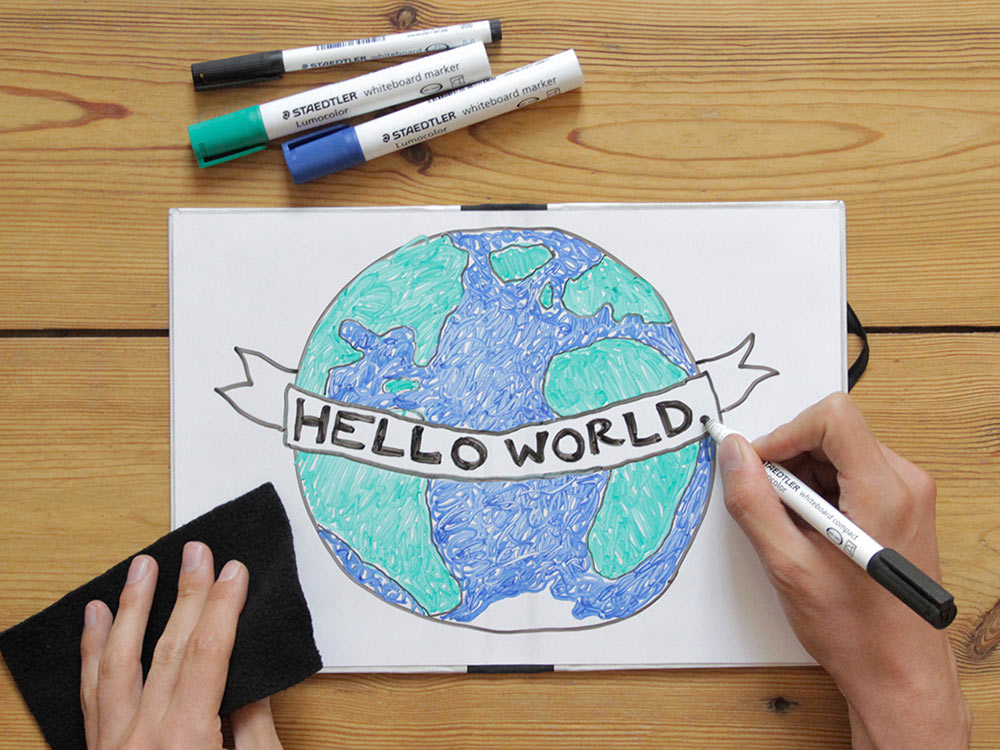
The Betabook is essentially a portable dry-erase board designed to be used in concert with your mobile device. Betabook inventor Jay Cousins found that of the many notebooks he filled out, there were only a few items worth saving. Rather than having a complete paper archive, giving equal real estate to good and not-so-good ideas (alpha and beta, if you will), he wanted to make a notebook that would enable you to parse out the good ideas and clear out the others.

You can take a snapshot with your phone of the ephemeral contents of the Betabook. If it’s a decent idea, you have a volume-free digital archive with the pic. Even if it’s a lousy idea, sorting through digital files is an easier task that rifling through countless paper notebooks.

Betabook_02_small

Cousins sent me a Betabook to try out for a bit. It was the smaller of the two sizes (8.3″ x 11.7″), which is roughly the size of a Molskine notebook, but far lighter. Admittedly, I’m not a prolific scribbler or doodler, so I wasn’t necessarily the ideal tester. I mainly use notebooks for, well, notes; the marker included wasn’t necessarily ideal for writing text (I used to be on the debate team, so my script runs on the small side).

betabook-fire-truck

However the Betabook became a staple in my bag of tricks for entertaining my 2.5 year old son. At home as well as on several long train rides, we drew countless fire trucks. The whiteboard was easily wiped completely clean, making various drawings of fire trucks easy to replicate. I liked the fact that I wasn’t using a bunch of paper for drawings whose novelty wouldn’t last as long as an airplane contrail. In fact, Cousins estimates a Betabook, if it replaced 1000 sheets of paper, would spare ⅛ of a tree per year.

If you want to get a Betabook, visit their Kickstarter campaign page. They’ve already received $60K of their $15K goal–a decent index for a good idea. A $30 pledge will get you their basic book, pen and wipe cloth.

World’s Slimmest Wallet and How to Design Minimalism into Your Life

There are four items I rarely leave the house without: keys, cellphone, a pen and wallet. As these things are all kept in my front pockets (it’s a New York thing), I try to keep bulk to a minimum. I only carry the keys I need for the day (I have a few sets clipped to a carabiner and add or subtract sets as needed). My cellphone and pen (iPhone 5 and Uni-Ball Vision, respectively) have sorta absolute volumes–i.e. removing the phone’s screen or the pen’s cap won’t help save space without serious functional drawbacks. But there is a lot of room for space saving with the wallet. Depending on type (bifold, trifold, no-fold, portfolio, money clip, etc) material and contents, I can either have a dinghy or a frigate floating around in my pockets. Reducing wallet volume and contents is the idea behind the Panel Wallet, an ultra-thin, RFID-blocking, American-made “anti-wallet” that was recently launched on Kickstarter.

panel-wallet-slimThere’s not too much to the Panel Wallet. It’s a thin piece of machined aircraft quality billet aluminum (there will be a titanium version available as well) with a silicon band that wraps around to secure cash and cards. There are two indentations on the panel to keep the silicon band in place.

The aluminum and titanium serve as RFID-blockers. If you weren’t aware, many cards have RFID chips (radio frequency identification) in them. Nefarious folks can “skim” card information even when the card is in your pocket.

I swapped my wallet for a Panel Wallet a couple days ago and here are my impressions.

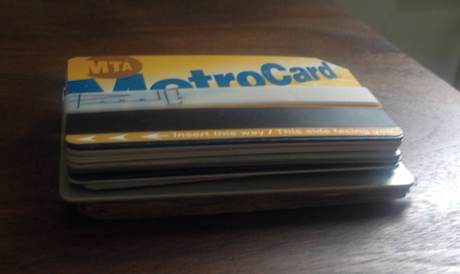
My current wallet is made of oiled canvas and isn’t particularly bulky, though the Panel Wallet definitely takes the cake in terms of minimal volume. It felt appreciably smaller in my pocket. I transferred the entire contents of my wallet: my driver’s license, two credit cards, one debit card, a health insurance card, a Park Slope Food Coop ID, a Brooklyn Children’s Museum membership card, a Metrocard, two gift cards, a credit-card-shaped USB thumb-drive and a recent-trip-to-the-ATM’s worth of cash (side note: read Tim O’Brian’s “The Things They Carried“). Though the Panel Wallet folks recommend only having 5-6 cards, the band handled those 11 cards pretty easily.
panel-wallet-4

The minimal bulk in my pocket was nice, and as anyone who uses a rubber band to hold their cards and cash together, the silicon provides friction against the interior of your pocket, making it feel secure.

Getting cards out of the wallet was relatively easy, though it seemed like putting your most-used cards one or two cards deep made the most sense; this way the outer card would absorb most of the band’s friction. I did halve the number of cards as per their recommendation and stuff came out a lot easier.

Getting cash out was a little trickier as it requires you to take the whole wad out to access bills. This was similar to a business card holder I used to use as a wallet; cash had to be neatly folded in order to fit into the holder. This would require a little adjustment for people used to jamming cash into their wallet.

One interesting aspect of the wallet is the effect of its exoskeletal design. By seeing the contents of my wallet, I felt far more inclined to reduce them. Likewise, similar to living in a tiny house, the minimal volume inspired a far greater level of organization and economy of stuff. There was no space for disorganization and clutter. A couple old receipts I had been carrying around in my old wallet were promptly discarded when I switched to the Panel Wallet.

The Panel Wallet and other products like it show the inextricable relation between design and lifestyle choice. For some, making an intellectual decision to live a life with less stuff is enough–they can live in McMansions with no stuff without the temptation to fill empty spaces. But many of us need design constraints support our choices; we don’t get rid of stuff until we downsize our homes; we won’t get rid of clothes until we have smaller closets; we won’t clear clutter from our wallets until we get a slimmer wallet (or much tighter pants).

To get your Panel Wallet, visit their Kickstarter page. A $25 pledge will get you a basic Panel Wallet, $45 for a copper or brass plated one, $75 for a titanium and up.

Eat, Strain and Store in One Bowl

Are you a big consumer of ramen noodles? Are you frequently miffed that there isn’t a simpler way of making this simplest-of-preparation foods easier to prepare? Yeah, me neither…but I still think a new product called the OneBowl is pretty genius.

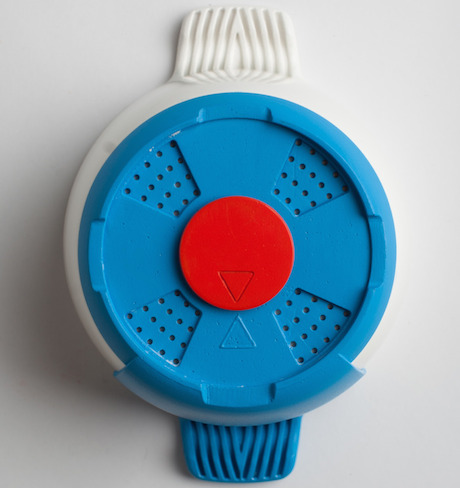
The OneBowl is the brainchild of recent college grad Justin Herd, a frequent v of ramens and budding inventor. He was frustrated that it took so many components to prep a bowl of ramen: bowl, strainer, storage container (where applicabl vce). He wondered if there might be a simpler, more streamlined solution, one that combined those three components in one elegant (well “practical” might be a more apt term) solution. The OneBowl is his answer to that question.

The OneBowl has three components. There’s a base that, when twisted, allows for the passage of water through the bottom acting as a strainer; alternately, the base can be locked out making it a water-tight bowl. There’s a BPA-free, dishwasher and microwave-safe bowl, also perforated to match the holes of the base, which is used for both food prep and eating. Lastly, there’s a lid that makes the whole thing into food storage.

OneBowl-base

The OneBowl is designed for ramens, but I’d imagine it would work great for other types of pasta, vegetables or even things like grapes, which often need to be rinsed in a strainer then transferred to a bowl. Besides dorm rooms (its most logical application) we think it’d be brilliant on camping trips.

Like many products worth having nowadays, the OneBowl is launching through Kickstarter. Herd is looking to raise $50K to start up production. They still have a $16 early bird special that’ll fetch you a OneBowl. $75 will get you a bowl and OneBowl cookbook.

We love stuff that doubles and triple duties, especially when that stuff is as simply executed as the OneBowl. Should it take off, we hope Herd considers making metal or ceramic versions that’d work on cooktops and ovens for the non-ramen set.

Designing the Perfect City Bike

What would the perfect city bike look like? It’d be compact to fit into small apartments. It’d be thief proof. It’d have electric assist for longer commutes or when you might be too lazy to pedal after a day’s work or evening drink. It’d be relatively upright and grease free so as not to ruin your freshly pressed Men’s Warehouse suit. Well you can stop waiting for this mythical, two-wheeled wonder. The Gi-Bike has all of those things and more.

gi-bike-function

Here are some of the Gi-Bike’s features:

  • Folds from 6′ 6″ L x 3′ 4″ H into 3′ L x 3.4′ H in three seconds.
  • Wheels that lock up if your smartphone is more than ten feet away from bike; you can also give friends access to the bike via its smartphone app.
  • Electric assist with a lithium-ion battery that can go 40 miles between charges.
  • Available in manual (pedal-powered) version.
  • Gates Carbon belt drive for greaseless operation.
  • Smartphone holster and USB port to charge on the go.
  • Weighs 17 kg (37.4 lb) for the electric version and 12 kg (26.5 lb) for the manual.
  • Integrated rear LED light and LED front wheel lights.
  • 26″ wheels that quell typical folding bike squirreliness.
  • A mudguard and briefcase holders are in the works.

What could make it a better city bike? (Note: we have not seen or ridden a Gi-Bike in person).

  • Fenders. Hard to have serious commuter outside the dessert without em.
  • Why no LED headlight?
  • A little flashy. Thieves might be prevented from stealing by its locking wheels, but they’ll probably sniff around before being deterred.
  • They might consider handlebars that turn like the Schindelhauer ThinBike of pivot down for better storage.
  • The one-available-size, in this 6′ 3″ author’s opinion, will likely not fit all.

Like most interesting products nowadays, the Gi-Bike is launching through Kickstarter. Their campaign starts today. A pledge of $2590 gets you a manual Gi-Bike and a pledge of $2990 gets you the e-bike (only 10 available at that price. Normally $3390). We realize many people can’t wrap their heads around spending more than $75 for a bike, but as we’ve noted here before, making a bike that legitimately replaces a car or other motorized transport might cost some coin. If the Gi-Bike serves your transport needs–and we think it might do so for many–we can think of much worse ways of spending $3K.

Make Any Surface a Table

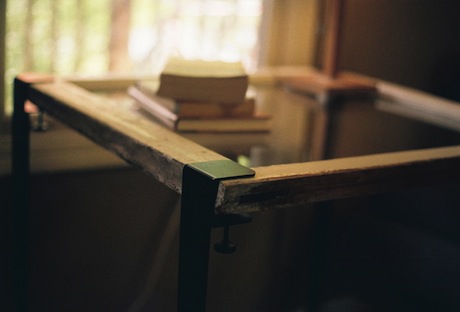
One of the marvels of Kickstarter is that successful products tend to be either: A. common products done well (backpacks, dress shirts, etc) or B. products whose usefulness is so profoundly obvious, you wonder why no one made it up until now. The Floyd Leg is an example of B. It’s a table leg that clamps onto any board to make an instant table.

floyd-leg-detail

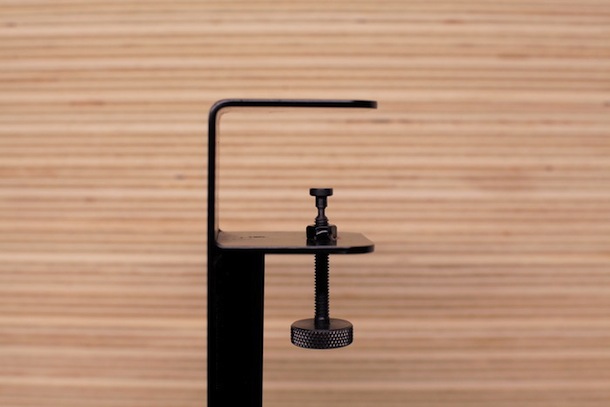
There’s not a whole heck of a lot to say about the Floyd Legs. They will be available in both 29″ dining and 16″ coffee table heights. They feature a clean design and will be available in multiple powder-coated colors. They will have a machined F-clamp attached to an 11 gauge cold-rolled steel leg shaft. Kyle Hoff and Alex O’Dell, the guys behind the project, say they are ideal for light to medium use, such as a desk or planter table. Because of a lack of cross-bracing, they say that making them into a dining table is not ideal, though we suspect it’d work if the surface wasn’t too big.

We see the Floyd Leg as a perfect compliment to small space living. Because of their svelte size, you can hide them away if you don’t need a table most of the time. You could keep a couple easy-to-store boards around to suit whatever function you needed on a particular day. If you move to a larger space–or a smaller one for that matter–all you need to do is switch out the surface to make an appropriate sized table.

The project has has met an amazing $165K of its $18K funding goal. A $189 pledge will get you a set of 16″ or 29″ legs. Projected delivery is late April of this year. See more on their Kickstarter page.

Kickstarter and the Future of Shopping

Earlier this last year, I found myself at a Macy’s department store. As I walked through the aisles lined with polo shirts, twinsets and butter dish cozies, a big sign flashed overhead, urging me to “Be Impulsive.” Apparently, this was a campaign to promote their Impulse line of clothes–a play on words, but also a message: don’t think, buy. The definition of impulsive is, “acting or done without forethought”–surely a great strategy for making a satisfying, useful purchase.

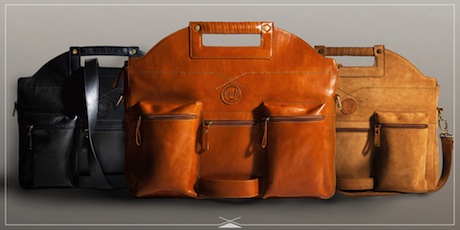
Because we have featured a number of products that are being developed through Kickstarter, several new projects have contacted us to promote themselves. The other day, a new venture called Chivote let us know about a plain leather bag they are trying to bring to production. The bag, dubbed the “Boombox” because of its resemblance to 80s-era portable stereo equipment, acts as clutch, handbag, shoulder bag or backpack. It is classically styled, has all the features a modern bag should have (laptop and tablet sleeves, charger pockets, additional space for your sundries), is handmade in England and available in subtle, timeless colors. It’s simple, useful, classic and brilliant.

chivote

Chivote’s multi-functional design makes it a decent fit for the LifeEdited ethos of doing more with less. But a number of other Kickstarter ventures have reached out to us that don’t have an obvious place on our site, which is not to say they aren’t good ideas.

There was Huckleberry, which makes affordable, American made, customized shirts; Upstate Stock, which makes handmade woolen accessories; and Ledge stainproof pants, which makes, um, pants that don’t stain. All three successfully met their funding goals without our help. They did so because they were well made, smartly designed, stylish products. Presumably, the products that are not so well made, smartly designed or stylish do not get funded (though we’re sure some slip through the Kickstarter cracks).

What does this have to do with Macy’s “be impulsive” cri du guerre?

Kickstarter takes the exact opposite tack as traditional retail. It presents a product idea. It lets people decide whether this product needs to be made at all. It communicates with the people who might use the product. It lets those people invest in the product. If enough people invest and think it’s worth existing, you wait several months to receive the product. If not enough people think it’s a good idea and do not invest, you get your money back sans product. It’s a slow, deliberate process. It’s anything but impulsive.

Unfortunately for holiday shoppers, Kickstarter does not offer gift certificates (though you could give successfully funded projects as gifts). Much more important than addressing the temporal concerns of holiday shoppers, Kickstarter offers a different way to approach shopping any time of year. It begs us to ask whether something needs to exist. It asks us to invest time and money. It ties us to a greater body to determine something’s usefulness to the world, not just ourselves. More than anything, it discourages us from being impulsive (doesn’t the world have enough impulsively purchased products?). If Kickstarter were a store, it’d urge us to “be patient.” This is a good thing.

photo © Arno Mayorga

Basic, Done Right

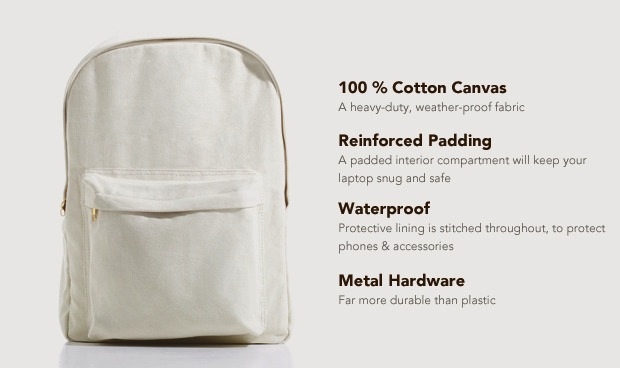
Have you ever noticed how difficult or expensive it is to get basic stuff done simply? A pair of pants in a classic cut with durable fabric. Sneakers without neon colors or a huge logo emblazoned upon it. Fashion tends to value timely over timeless design, thereby imposing planned obsolescence, replacement and greater profits. Designer Daniel Eckler and his company MIJLO (my-lō) seem to understand this situation, and have created a response in the form of a product called “A Better Backpack.” Rather than creating a crazily festooned pack with secret pockets made of kevlar reinforced recycled bamboo fibers, they are making a simple canvas bag, classically styled, with just enough features to get the job done.

The bag’s exterior is made of 100% cotton canvas with a waterproof lining to protect electronics and paper. There is an internal padded sleeve for a laptop–a necessity nowadays. All hardware is metal to ensure durability. It is available in four muted, fad-resistant colors. There are not many more features than that.

MIJLO sees the bag as a response to “disposable design.” From their website:

In recent years, fashion retailers have been moving designs from the runway to the rack faster than ever before – feeding a fashion cycle that appears to have no end in sight. At MIJLO, we believe that fashion doesn’t have to be fast, or disposable, or temporary. We believe it should begin and end with a classic collection of well-designed essentials. And we’re starting that collection with a backpack – A Better Backpack. Since we believe a product’s lifespan should be as timeless as its design–simplicity and sustainability were an integral part of our design process.

While they want people to hold onto the bag forever, they also know sometimes people get rid of things, so they offer a 10% buyback for your old bag when you’re through with it. Materials are then recycled for future products.

Like many products we’ve been featuring lately, A Better Bag is being promoted and funded through a Kickstarter campaign. You can purchase a bag with a $39CAD ($37US) pledge. With almost 40% funding received in a day of campaigning, it seems as though a lot of people want things that last longer than a whim.

The Better Bike Lock

Now that you can get into your house without a key, why not do away with your clunky bike lock and key? A new Kickstarter project called Lock8 wants to replace your awkward and archaic cable or u-lock with their keyless, smartphone-activated bike lock.

Lock8’s compact lock fits in your bike’s rear-dropout and has a coil lock that extends from its base. The lock has several innovative features:

  • Its built in geo-locator tells you where your bike is at all times.
  • If the lock is tampered with, cut, sawed, torched or cooled with freon, sensors in the lock will set off an alarm and a push notification will be sent to your phone.
  • You can send notifications to friends in case you’re not near your bike.
  • You can walk away from the bike unlocked, and push notifications will be sent if your bike is moved.
  • You can connect with Facebook to give your friends an e-key to borrow your bike.

The whole unit will only weigh about a pound. A built-in battery will charge via induction. There is no subscription charge unless you rent your bike to multiple parties (+5). They expect that charge to be around $2/month.

Lock8 is available with a £79 ($126) pledge and they will ship to the US and Europe. With £42K pledged of a £50K goal and 21 days remaining of their campaign, Lock8 will surely get its funding, which makes a lot of sense to us. If you’re spending a lot of dough on your bike, why not give it the best, most advanced, protection you can?

Via Engadget

Electrify Your Bike with these Revolutionary Wheels

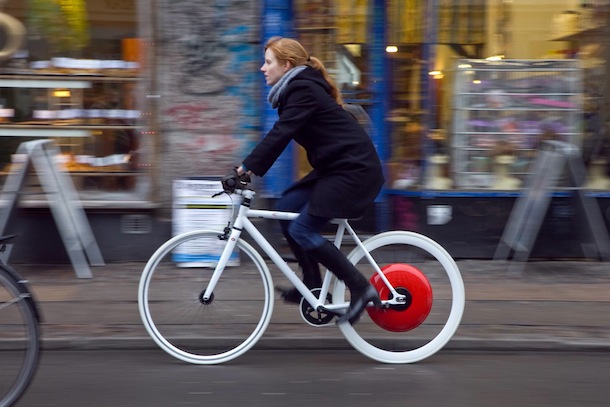
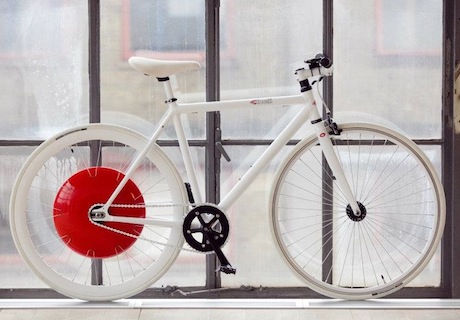
If your commute is too far for a bike ride, but too short for a drive, you may have considered an electric bike. E-bikes promise less carbon, effort, hassle and expense than a car. But buying another bike, particularly one of the ungainly e-bikes that seem to be popular, might not be so appealing. A couple new products are offering the perfect solution: by slipping in a special wheel, they turn your existing bike into an e-bike.

copenhagen-wheel

The Copenhagen Wheel by Superpedestrian actually measures your power output and automatically determines when you need an extra jolt. Power is derived in the same way hybrid cars get theirs. The wheel “captures the energy dissipated when you brake or go downhill, storing it in a lightweight and high-capacity lithium battery,” according to SP’s website. The company reports that the battery has a 15 mile range when fully charged (it’s not clear why it can’t be continuously charging).

The wheel also feature a Software Development Kit (SDK), which enables app developers to hack the wheel to make it do things like pollution monitoring and navigating.

The wheel was invented at MIT’s SENSEable City Laboratory and unveiled at the 2009 Copenhagen Climate Talks. The team behind the wheel decided to form a company late last year. The NY Times reported the other day that the company just received $2.1M in funding. The wheel is set to be released in late November. Pricing unavailable at this point.

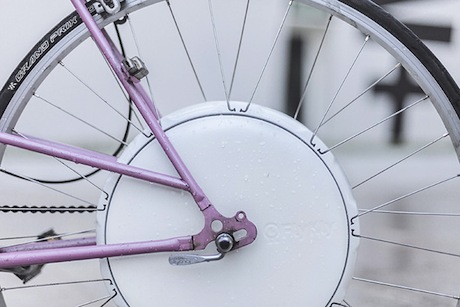
The other wheel is called the FlyKly. The wheel’s development is being funded through a Kickstarter campaign (it has long since passed its $100K goal). It is packed with bells and whistles (figuratively speaking). It is available in 26″ and 29″ varieties and weighs 9 lbs. You can plug in the FlyKly for additional power and achieve a 30 mile range. You can lock the wheel remotely. They have their own SDK for hackability. It also has an available light that is charged via a dynamo, which also has a USB port where you can plug and charge your phone. FlyKly is projected to ship in April or May of next year, and you can buy one with a $590 pledge.

flykly

These wheels look and perform remarkably similar to one another, and one (we won’t say which) might be derivative of the other. That’s okay with us. Just as there are Toyota Prius’ and Honda Insights, the world can probably stand to have more than one ultra-efficient, bicycle-based mode of transportation.

Via Fast Company