Open Source Real Estate

Cities like New York and San Francisco are incomparable incubators for culture, facilitators of connection and global villages that hold the promise of sustainably supporting large populations. But these cities are also becoming prohibitively expensive for the very people who bring the most life to their streets. There is less and less space (literally and figuratively) for creativity and innovation without profit motive. And just when you’re about to lose hope and move to the country, when another gallery or independent business gets replaced by a bank kiosk, a project like miLES comes along.

We looked at miLES (Made in the Lower East Side) last year when it won the One Prize. The original plan centered around a modular, rentable, low cost cube that could be inserted into any number of vacant, unused or underutilized urban spaces–alleyways, storefronts, etc–converting them into classrooms, rehearsal spaces, dining rooms, stores, etc. We admit that while we thought the idea was great, we weren’t sure how it would come to pass in a litigation-happy city like New York.

We are very happy to have our skepticism debunked. MiLES is making their “Transformer” project a reality through Kickstarter (where else?). For seven weeks, miLES plans to take over a vacant storefront to give seven different people and organizations a low cost forum to present their ideas to the public. The seven weeks are divided into seven categories: show, play, learn, share, make, make, shop and eat, each with their own host.
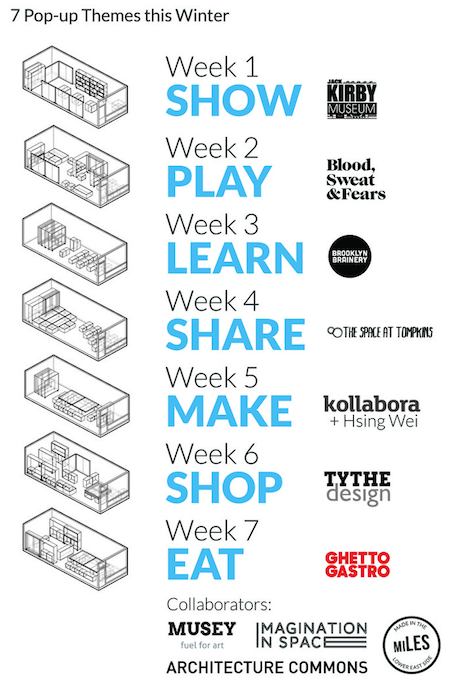
miles

MiLES Transformer will use a modular cube designed by Architecture Commons, similar to the one in their prototype; it will enable the space to be adapted to the various different uses.
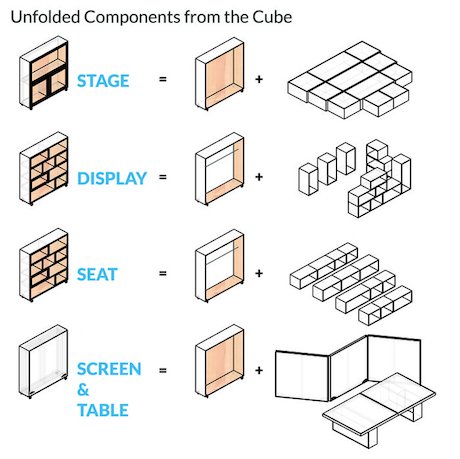
miles-cube

The idea is to have a living demonstration of the concept that shows local realtors that the idea is a viable one. But here’s the deal: they haven’t funded it yet. With 18 days left of their campaign, they have raised $6300 of a $32K goal. In other words, miLES needs your help (aka money), so if you like the idea, please support their Kickstarter project now.

Lighter, Better, Faster, Stronger

Forget Paris and Milan, Kickstarter is the new home of today’s cutting edge fashion. From wrinkle and odor free dress shirts to super socks and now ultralight shoes, the crowdfunding site has the world’s most interesting wearables. A new project called Unbelievable Testing Laboratory is making shoes out of DuPont Tyvek; the paper light, steel strong material allows a pair of shoes to weigh a mere 150 grams (5.3 oz) for a men’s size 11. The properties of Tyvek make the upper super strong, breathable and washable. If the rapidity of meeting its funding goal is any indication of market viability, UT.LAB has a big hit on their hands (or feet). They met 175% of their $15K goal in 48 hours! To date, they’ve raised $106K with 29 days left in their campaign.

UT.LAB has heavier ambitions than lightweight shows. Co-founders and partners Token Hu, Shaun Nath, and Joseph Constanty are out to change the way products are designed, tested, manufactured and marketed. Representative Gabriella Krichevsky says this about the company:

We are a company with a strong R&D foundation in China, have studied and mastered our cooperation with factories so that we can build fantastic footwear with vigorous product development through real-time prototyping at ultra-lean costs, and can bring these shoes to market via non-traditional e-commerce like Kickstarter. In a nutshell, we are not only trying to launch a new brand with an awesome cause [more on that in a second]. But, we are trying to fine tune the design, production, and channel selection for bringing products to market globally.

Basically, onsite R&D makes for a very efficient design-to-production transition. And marketing channels like Kickstarter, which provides realtime market feedback, allow UT.LAB to produce a shoe faster and cheaper that is far less likely to be a market flub.

The awesome cause in question is Teach for America, to whom UT.LAB is donating a portion of its profits with to promote math and science in schools.

While this is not always the case, lighter is usually better. With shoes, lightness adds spring to our steps, subtracts weight from our suitcases and may even have less embodied energy than its heftier competitors.

UT.LAB’s Kickstarter campaign is running through August 1st. A $65 pledge will get you a pair of limited edition ‘Pencil’ shoes (which will retail for $65) along with a Tyvek wallet.

Socks that Don’t Suck

When most of us hear the word technology, we think silicon, batteries and things with glowing apples on them. We don’t think socks–the tubular hosiery, less the infusion of nylon 70 years ago, seem relatively innovation proof. Not so, says Ministry of Supply. The same folks who are trying to reinvent the dress shirt are bringing to bear the latest in material technology and design to the lowly sock.

Here is some of the juice that makes the ATLAS sock so special:

  • Construction of 40% recycled polyester infused with carbonized coffee, 40% cotton, and 20% elastane. The blend is designed to be highly breathable and wicking. The coffee is an odor retardant,  important for a sock with such a high synthetic composition.
  • The sock underwent strain analysis to find out where our feet flex so the sock’s design moves with, not against our foot’s natural flexion points, thereby avoiding bunching and sagging.
  • MoS conducted “pressure mapping,” which helped them “visualize how you apply pressure and where you need extra support in your socks.” Areas are reinforced according to those pressure points.
  • Thermal mapping allowed MoS to see where hot spots most frequently occur and provide additional ventilation accordingly.

MoS told CNET that one of their biggest challenges was finding a facility that could handle the 3D knitting process necessary to manufacture the sock per their design. MoS reports that they “landed on one of the most advanced textile mills on the planet, who works with brands like Patagonia.”

The sock, like their shirt, is a Kickstarter project. They have already raised almost $70K of their $30K goal. A $28 pledge will buy you two pair of socks (loafer and full length version are available). Not cheap, but not ridiculous either. And if the socks live up to their claims, it could be a very worthwhile investment.

One thing MoS did not stress is the durability of the sock, which is a big question mark for us. Great fitting socks are, well, great. But if you tear a hole in them in your first few wears, they’re kinda useless. The resistance to bunching might help avoid strain that leads to holes, but we’re not sure.

We’ve said it once and we’ll say it again, but if designers and engineers exerted a fraction of the creative energy normally reserved for electronics to everyday items like socks, our everyday would be a lot smarter than it currently is. We applaud MoS for thinking outside the LCD box.

The Funk-and-Wrinkle Free Dress Shirt

A fashion startup called Wool and Prince is offering the ideal dress shirt to include in your personal uniform. Their shirt, being launched on Kickstarter, is made of 100% wool that they say will not wrinkle or get all funked up after 100 wears–a claim the founder Mac personally verified through personal wear, sans undershirt. In fact, they gave the shirts to 15 dudes around the world who “did everything from backpacking in the Andes to dancing in ‘Tropical’ NYC clubs.” You can see some of their hijinks on the Wool and Prince’s website.

wool-and-prince

Other salient features include soft-to-skin fibers (they call the particular type of wool “Cotton Soft”), breathability and the availability of several colors and patterns.

The company’s beer-pong chic brand identity might be a bit off-putting to some (their tagline is the “Well Endowed Fiber”), but the shirt, like the Ministry of Supply shirt we looked at a while back, apparently has great appeal. At last check, they raised $299,354 of their $30K goal for the first run of shirts due in November. Before they sold out of their shirts, a $98 pledge would have got you one of their shirts, which isn’t a half-bad price  for a shirt that does double or triple duty (no indication how much they’ll be when they come to market).

What’s so smart about Wool and Prince is that they are thinking about how to make our everyday items better. Men have come to assume that button down shirts need to be washed and pressed after every wear, but maybe not. Maybe you can wear one shirt throughout the week and it’s still fresh enough for the Chris Farley movie retrospective on Friday night.

image via Wool and Prince

Reinventing the Dress Shirt with NASA Technology

In a certain way, men’s business suits are pretty great. They have barely changed in the last 100 years. A man can get away with wearing a decent suit over and over, washing it a few times a year.

Men’s dress shirts are different story. They wrinkle in moments. The nice ones tear like tissue. They stain easily–either getting the ring around the collar, pit stains or showing the slightest splash of coffee.

A company called Ministry of Supply is seeing if they can improve upon this fickle article of clothing. The company, which started as a Kickstarter project, has already raised $430K of its $30K goal–leading us to think that guys are looking for superior dress shirts.

The shirts use a “phase change material” similar to that used in NASA space suits. The material stretches, has an anti-microbial coating to cut the stink, resists stains, breathes and wicks moisture and is wrinkle free. The shirts are 100% made in the USA. They look pretty good to boot.

As they have exceeded their Kickstarter goal, Ministry of Supply is taking orders for August and September deliveries. Available are two dress shirts: the Apollo for $105 and the Agent, at $85. There is a t-shirt and base layer available as well; $40 and $30 respectively.

Like the Outlier dress pants we looked at a while ago, Ministry of Supply is bringing smart design and technology to products we all need and regularly replace. While both companies’ prices might seem expensive to some (Outlier pants range from $135-240), consider that their products will last much longer, can be worn more than once, will be more versatile and comfortable than traditional models. A little extra dough up front seems like a good investment to us.