Seeking Higher Ground with an Elevator Bed

Beds in tiny homes can be a hard to thing to deal with because they take so much space, and you’re not even using them during waking hours. Instead of a lofted option, Ana White of Spruc’d came up with an affordable solution to create more space without sacrificing comfortability. Enter the elevator bed. She constructed a mechanical sleeping system with the use of garage pulleys and sliding door hardware on a budget of $500. The full bed lifts when not in use and also makes enough room for a guest bed underneath.

The building plans for the bed as well as the entire tiny home are available here.

Lighten Up and Get Out of Town with this $150 DIY Bike Camper

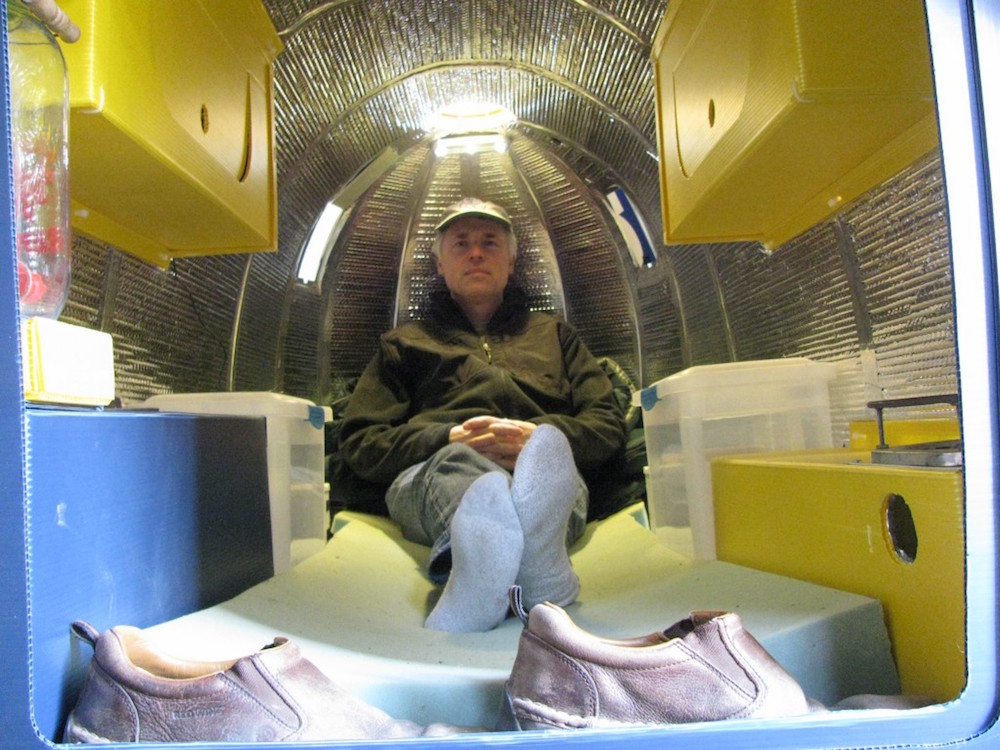
We’ve explored bicycle towed trailers in the past. In particular, the Wide Path Camper seemed like a nice execution of the idea. But as a number of readers noted, it had a couple big liabilities. First, was its weight of 100 lbs. While this is a reasonable weight for a camper, it’s a lot for a human to drag any considerable distance. The next was its high profile, which would catch the wind like nobody’s business. This Micro Airstream bike camper by maker extraordinaire Paul Elkins solves many of these problems, being lighter, sleeker and a lot cheaper than the WPC (or anything else we’ve come across for that matter).

paul-elkins-trailer paulelkins-interior

It has most everything a single tourers/nomad needs. At 45  lbs, it’s a bit heavier than a trailer, but has an insulated sleeping structure that adds a ton of functionality and removes the need for a tent. It has a low, curved profile, which will probably still catch the wind, but not so much as to prove unworkable. Best of all, Elkins offers plans to make the trailer for $150 out of materials such as zip ties and recycled campaign posters (a commodity that will abound in the coming months). Check out the above video by Fair Companies and be sure to visit Elkins other amazing DIY projects.

SHTF Ready Housing Collective Pretty Sweet

Techno-urban utopianists predict a future where people will live in plant-covered high rises that spring up like natural organisms. All transportation will be on demand. Everything will be powered by completely clean fusion power. Goods will be shared and instantaneously accessed through sophisticated technology. All of these systems will cut down our workload, leading to a happier, healthier civilization. This is definitely a direction our planet could be heading in. Then there’s the other direction. In this future our infrastructures, financial systems and climatic balances will collapse, leading to massive energy and food shortages, mass migrations and so on. Should this latter scenario come to pass, we imagine there will be a long line to join The Long Spoon Collective. Located in Saugerties, NY, LSC is a small collective that grows its own food, constructs tiny houses for free for people who want them and is trying to start an economy based on giving instead of money.

The collective’s membership stands at six at the moment. The Saugerties Times explains how the sextet came together:

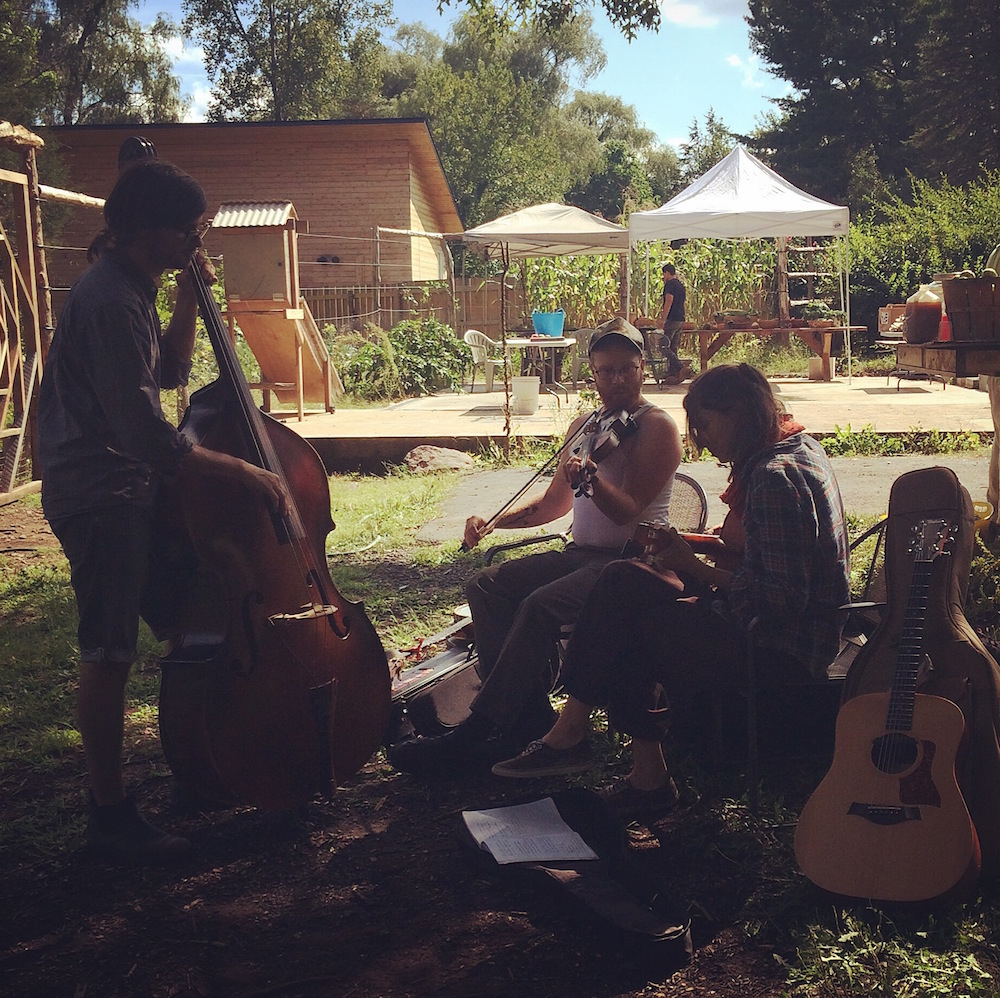
The collective got its start when founder and native Saugertiesian Chase Randell, a Skidmore graduate with a master’s degree in humanistic multicultural education, became involved with the Sustainable Saugerties Transition Town group last summer. He, along with Karuna Foudriat, a former Waldorf school teacher and current divinity school Ph.D. candidate, and a group of supporters, began to grow food on a local farm….Randell and Foudriat were joined by Frank O’Leary, who knew Randell from Skidmore, and recent émigrés from New York City Jared Williams and Lala Montoya, permaculture experts who recently returned from a year in Kenya. Collective members are committed to growing their own food and living as much as possible without using money.

More than mere backup plan for the collapse of the status quo, LSC has a larger goal of addressing “issues of poverty and environmental degradation by meeting the basic need for food and shelter directly.” As such, the food they grow–much of which is grown on once-derelict farms and private gardens–is given away.

LSChouse

Their off grid tiny houses, which some members live in, are made of salvaged materials. They even offer to tear down unused structures on properties in exchange for use of the scrapped materials.

The members do have money coming in from the conventional economy, but their participation is a bit like Peak Oil, i.e. taking the resources of the old way while they’re still available in order to lay the groundwork for the new way. Money is directed toward things like hosting free workshops, fueling trucks to support their projects and so forth. Their ultimate goal is to transition themselves from the normal economy to the giving economy.

Saugerties is a two hour drive from NYC, which the collective sees as a big plus. The proximity gives them access to tons of people who might join the movement. Speaking of, they’re looking for more members. Head on over to their website for more info.

The Untethered Life

Dan Timmerman is an American. He makes his living professionally racing cyclocross. If the combination of those two statements doesn’t impress you, you probably don’t know much about cyclocross. The sport is like steeplechase on a bike, and though popular in Europe, it is still pretty niche this side of the pond. The reason Timmerman can make his living like this is not because of the millions he makes clearing hurdles on his Ridley cross rig. He does it because he and his wife have reduced their living expenses to such an extent that they can do what they damn well please.

Five years ago, the couple bought a cabin on a 10-acre property in rural New York. The cabin is owned outright, so housing costs are negligible. It’s off-grid, relying on solar power, which is stored in batteries when the sun’s not out. Heat and cooking fuel come from chopped wood. Water comes from a well. Poop is composted. They raise chickens, grow veggies and Dan does some hunting, though he says most of their food comes from the grocery store. They have cellphones, which double as their internet connection for their laptops. Paying for the cell phone bill is their only real “bill.”

Beside the profoundly low overhead, their setup allows them to be immersed in nature–one of the main motivations for moving there. “”We have direct access to nature—it’s right there…We’re connected to it every day, not just sitting there observing it,” Timmerman said (full interview on video above).

There are some downsides to their setup, namely that they are pretty remote, which forces them to drive quite a bit. His wife Sam drives 18 miles to Ithaca to work and the nearest town is eight miles away. But Dan says they have a community in the woods, and even though they talk about moving further in, the advantages of having freedom to do what they want and being so close to nature outweigh the disadvantages.

H/T Tim F!

Via Business Insider and DirtWireTV

The Wheels of These Homes Go Round and Round

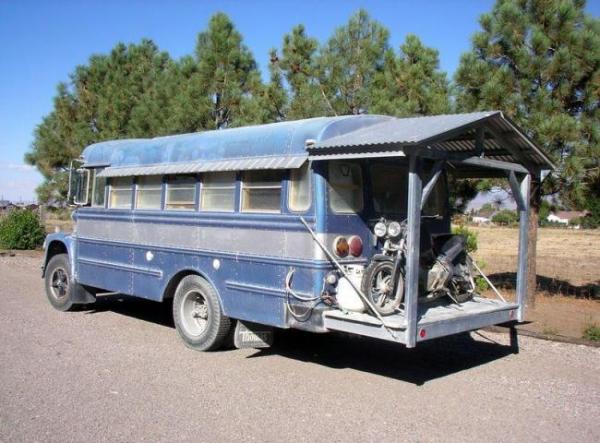
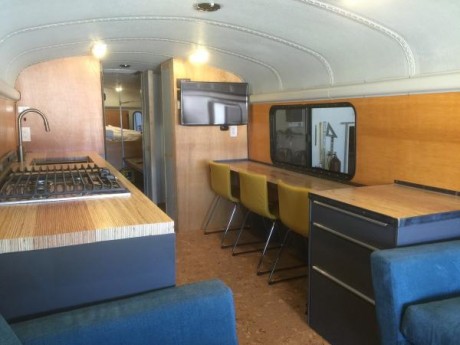
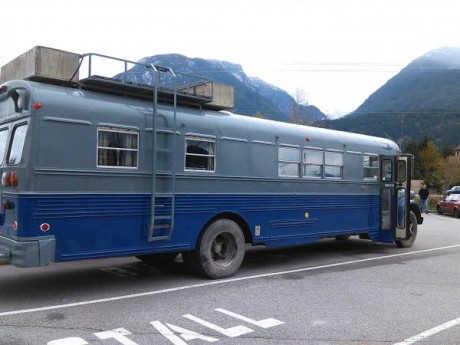
Have you ever thought you understood the world around you, then all of sudden discover hidden subcultures right under your nose? You thought you knew your colleagues and neighbors and then find out they are really, deeply into things like Dungeons and Dragons, trainspotting and Hummels. Well, I thought I had a pretty broad understanding about small space housing. I know tiny houses, yurts, micro-apartments and many things in between. I thought I knew it all until I discovered Skoolie.net, “The School Bus Conversion Network.” Unbeknownst to me, there is a whole population of people turning old school busses into live-in dwellings.

skooklie2skoolie1

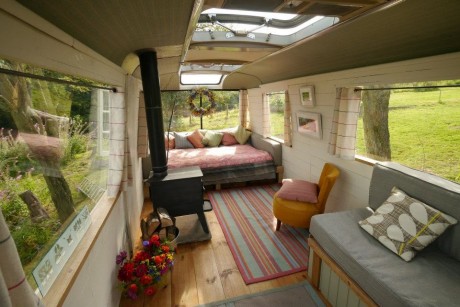
Converting school busses makes sense in many ways. School busses are house sized, measuring up to 45’ long and 8 ½’ wide, giving ample room for living space (you can get smaller ones if so desired). They lend themselves to customization with nice open floor-plans. Their simple structures makes them easy to seal and insulate. They have ample light. They run on stout diesel motors and their mechanicals are engineered for daily use and are appropriately repairable and robust. And they can be had for cheap. You can pick up a used school bus in decent shape for $5-10K. Compare this to a tiny house, whose trailer might cost $5K–and you still need a decent-sized vehicle to port it around.

skoolie4 skoolie5

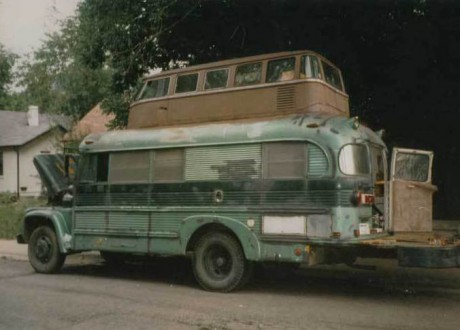
Because they are not purpose-built for habitation, school bus aficionados are more inclined to DIY-ing. In fact if you want a cheap, turnkey mobile place to live, a class C motorhome can be had for less money–and a lot less effort–than a converted school bus. However, a cheap motorhome will, in all probability, be cheaply built, with crappy finishes, fixtures and appliances. And the odds of standing out at the campground in a Winnebago are minimal relative to pulling up with a school bus with a VW Bus grafted to the roof.

skoolie8

School bus conversions do have some drawbacks, as Shawn from Schoolbusdriver.org points out. Standing room usually caps out at six feet in the middle, which is less than ideal for some such as this author. Transmissions are typically geared for stop and go driving, not highway cruising, which can make long trips slow and thirsty. And “Scraping years of petrified boogers and gum from under the seats is less fun than it sounds.”

It’s not entirely clear whether all of the busses on Skoolie are lived in or just a secondary dwelling. Either way, the site and its members present another interesting, mobile form of compact housing from which to choose from.

Images via Skoolie.net

This Truck Is Cruising the Country Honoring the Stuff We Got

There was a time in the not so distant past when people held on to and cared for their stuff. They fixed toasters, darned socks, patched holes and did a variety of things that didn’t involve one-click-shopping for replacements. While those times seem to be a distant memory, Patagonia is trying to bring them back one garment at a time. As part of their Well Worn program, the company is sending out the Worn Wagon, a vehicle whose mission is to spread love to our slightly tattered, but totally useable garments.

The Worn Wagon departed this month from Ventura, CA. The wagon itself, an old Dodge truck that runs on biodiesel is the handiwork of surfer and artist Jay Nelson. The truck’s trailer is made of salvaged wood from wine barrels; solar panels power an industrial sewing machine housed inside. The wagon will be cruising the country looking for garments in need of repair. A repair person manning the wagon will sew your hole or replace your zipper or do whatever needs to be done to your old garment for free–whether it’s Patagonia or not. The wagon will be stopping in stores, trailheads, coffee shops and more (see tour stops here).

worn-wagon-interiorFor someone who is frequently dubious of corporate claims about commitments to consuming less and giving a poop about the environment, I am consistently impressed by Patagonia. They really seem to get it. The realize the way to live with less is buy great stuff from the outset and make it last as long as possible.

Build A Micro Sized/Budgeted Backyard Retreat

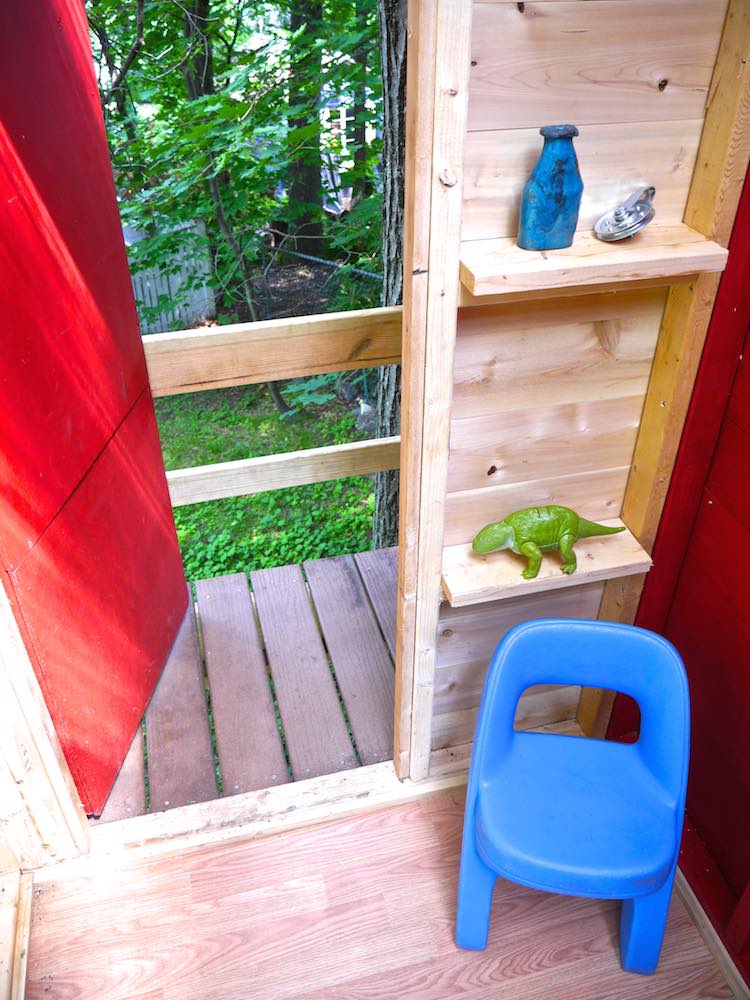
This site tends to focus on tiny residential structures–microscopic pads that people are supposed to live in. But the charms of tiny aren’t limited to houses. Case in point is this tree, um, “structure” built by Derek “Deek” Diedricksen. As his Relaxshacks blog name implies, Deek is a master at building tiny structures, many of which are intentionally recreational: treehouses, off-grid cabins and the like. Almost everything he makes is tiny and most are done on microscopic budgets, making for affordable places to chill out, read, play or hide from screaming kids.

This particular structure was set up in a backyard in the outskirts of Boston. It’s only 32 sq ft and is connected to a pair of oaks. Deek calls it the “RF”, or Robot Face, treehouse for obvious reasons (the robot’s eyes are actually a pair of solar lawn lights). The structure has a removable desk and the blocking framework doubles as shelving. There’s an openable window for light and ventilation, and its position under the two trees keeps it from becoming a hot box in the summer, yet the big window lets in enough passive solar heat to make it feasible during colder months too.

Oftentimes, when people seek more space, they think about moving into a new home. What tiny structures like this show is that you can add a lot–privacy, quiet, fun–with just a little bit of knowhow and some lumber.

If you’re interested in building your own Relaxshack, Deek regularly holds workshops. His next is in Fargo ND. Stop by his site for more info.

Video Tour of Brooklyn Studio to Two Bedroom Conversion

Something about Adam Finkelman’s Brooklyn transformation of an open-floor-planned studio into a two bedroom apartment really resonated with our readers. Perhaps it was his imaginative use of reclaimed materials or the one-month’s rent budget for the conversion or how relatable his situation was (i.e. how do you create a functional, affordable living situation in an expensive neighborhood?). Whatever the reason, people loved the apartment.

Our good friend Kirsten Dirksen from Fair Companies managed to catch up with Adam and his roommate for a video tour of the space. Besides seeing the space itself in living–and moving–color, the two roommates elaborate on the design creativity that went into the space as well as the lifestyle creativity that fuels their lives and pays their bills. The space is used as an popup restaurant, concert/jam session venue and, of course, carpentry lab. Between their various endeavors, they offset their living expenses while maximizing the space’s utility–not to mention living a pretty cool looking life. Check it out.

Decorate Your Small Apartment DIY Modern Furniture

There is often a rift between one’s tastes and one’s access to–or willingness to part with–the kinda money needed to satisfy those tastes. You might want that beautiful, $8K mid-century modern sofa that you know will last a lifetime, but your budget is $800 and you’re in a rental you’re not sure you’ll be in for more than a year. Rather than selling blood and hocking all of your possessions to afford the sofa, you do what most people do: go to IKEA. IKEA has the right price, their stuff looks good enough, functions well enough and if you have to toss it (which is de rigueur for many IKEA purchases within their first five years), you don’t feel so bad about it. “Less, but better” will have to wait for the next time.

A new book called DIY Furniture 2 might have an alternative to IKEA. Industrial designer Christopher Stuart put this book together, which contains step-by-step instructions for making 30 pieces of furniture from different makers, designers and artist. All of the furniture is made from easy-to-source materials. And the DIY-phobic need not be afraid, most of the designs require little or minimal carpentry chops.

diy-modern-furniture-leaning-rack

We’re particularly enamored of the leaning rack by Love Aesthetics, which reminds us of a piece from the IKEA PS2014 collection, albeit sturdier and sleeker. It shows how a few simple, sturdy parts, along with a coat of paint, can make an elegant piece of minimalist furniture.

diy-modern-furniture-pvc-chair

Similarly, Niccolo Spirito’s Diablo Chair is made of common PVC piping, coated in grasshopper-y green paint to give it a funky, modern look. We can’t vouch for its comfort, but it looks pretty cool.

Head on over to Fast Company, where you can see several other of the designs along or pick up the book on Amazon.

Apocalypse-Proof Your Small Home

I know what you’re thinking: this small space living is cool and all, but how will I eat in the event of a societal collapse? Sprawling McMansions with two-acre lots might be an environmental nightmare in times of plenty, but we might be appreciative for all the farming land when SHTF. Fear not, the good folks at Survivopedia have us covered. They have some great suggestions for growing your own food when the grocery store down the block is overrun by zombies.

Here’s what you do:

    1. Get non-GMO, non-hybrid seeds. GMOs, author Theresa Crouse contends, have been linked to disease, which is probably something you want to avoid when trying to survive. Hybrid seeds aren’t stable, and are not predictable for later batches–an important consideration if you want to live longer than one or two growing seasons.
    2. Save your containers. We know you get a thrill out of recycling that empty yogurt jug, but you might need it to plant some sprouts.
    3. Practice container gardening. Probably not a good idea to wait until things fall apart to get that post-apocalyptic thumb green. Crouse says “carrots, radishes, lettuce, onions, and even tomatoes and peppers” are examples of veggies that need very little room to grow.
    4. Plant a small garden. She says you can build a garden as small as 4′ x 4′–plenty small for most small homes. If you’re in apartment, you might be able to create an overhang on your fire escape (assuming the fuzz don’t see you) or, better yet, on the building’s roof.
    5. Preserve Your Food and Your Food Sources. Start growing now, and save what got. Unlike today, the post apocalyptic foodie scene will have its ups and downs, best to preserve and conserve when you can (pun intended).
    6. Get some edible pets. Keeping livestock in your apartment ain’t too kosher nowadays, but when SHTF, pesky animal control officers will have more important things to do than see if that’s a dog or chicken making the stink in your apartment. Crouse suggests having a local farmer act as daycare worker for your livestock, until the (end) time comes.

For a more detailed explanation, visit Crouse’s post at Survivopedia.

Meteor Shower over City image via Shutterstock