What Do Freedom and Independence Mean to You?

Freedom’s just another word for nothing left to lose.

Kris Kristofferson

In the context of 1776 colonial America, freedom and independence meant being free and independent from the tyranny of taxation without representation, illegal search and seizure and other nasty imperialistic institutions (for the sake of economy, we won’t go into the myriad contradictions of our founding fathers).

Today, there are new forces inhibiting our freedom and independence: Bills we cannot keep up with. Mountains of debt. Constant streams of emails, texts, and hyperlinks begging for our attention. Bloated homes we can neither afford nor maintain. Cultural expectations we can never seem to meet.

At LifeEdited, we promote freedom and independence from unimportant stuff.  When we eliminate (or “edit”) that stuff out, the important stuff–relationships, passions, health, great design–naturally moves in.

To get some other perspectives, we asked a few of our friends what freedom and independence meant to them.

From Francine Jay–aka “Miss Minimalist“–we got this response:

To me, freedom is traveling lightly through life. Each extraneous thing I eliminate—be it an unused item, unnecessary purchase, or unfulfilling task—feels like a weight lifted from my shoulders. Paring life down to the essentials is positively liberating!

Joshua Fields Millburn, one of the 2 guys behind “The Minimalists” gave this appropriately minimalist response:

Intentional awareness.

Ari Meisel, a productivity coach and practictioner of “The Art of Less Doing” says this about freedom and independence:

The ability to head half way around the world tomorrow, with no planning, and not knowing if I’ll have Internet access or not and having confidence that my life and business will run itself without interruption.

What about you? What constitutes freedom and independence to you? We’d love your thoughts. Please share below or on our Facebook page. And have a great holiday!

10K Public Bikes Coming to NYC in July

In July, New York City will add its name to the many cities that have public bicycle programs. The Citi Bike program will feature 10K bikes in 600 docking stations around the city, making it the largest such program in the US (the name comes from Citibank, who gave $41M in sponsorship money).

You can either rent bikes by the day, week or sign up for a yearly membership; prices are $10, $25 and $95 respectively. With the yearly, you receive unlimited sub-45 minute rides with nominal charges when that time is exceeded.

Programs like this have been going on for years across the US and the world. Paris has 20K public bikes, London 9K, Montreal 5K, Washington DC 1500 and Hangzhou, China has a whopping 60K+.

Public bikes are ideal for city-dwellers who need to get somewhere quick. The bikes’ upright position and grease-less configuration make them business-attire compatible. They also cover the spaces not covered by public transport. Most importantly, they make biking more accessible and acceptable to larger swaths of the population. They are, as Treehugger puts it, “cycling’s gateway drug”–once you start, you can’t stop.

Do you or have you used a public bike? What was your experience. Let us know.

Via Bloomberg and Treehugger

5 Minimalist Blogs Worth Checking Out

You’re editing your life. You tossed those jeans you haven’t worn since the Clinton administration. You automated your bill payments. You traded in those books for a Kindle. You moved to a home where you could walk to everywhere you need to go.

Beyond editing your physical possessions, you started to evaluate your mental consumption habits. You started to wonder about the quantity and quality of the media you consume. Perhaps those hours spent on TMZ.com might be spent better elsewhere. You want to consume less media in general, and make the stuff you do consume to support your new way of life.

While we know it’s inconceivable that you’d need anything more than LifeEdited.com, there are a number of worthwhile writers and sites singing the less-is-more gospel. Here are just a few that are worth checking out:

  • Zen Habits. Since 2007, Leo Babauta has been dispensing his practical suggestions for simplifying and improving your life.
  • Miss Minimalist. Blogger Francine Jay, according to her website, is a minimalist. Period.  A recent post took on whether having more than 1 child is non-minimalist.
  • The Minimalists. Joshua Fields Millburn and Ryan Nicodemus were a couple corporate types who gave it all up to write heady essays about minimalism and living a meaningful life.
  • Rowdy Kittens. Don’t let the name fool you, blogger/author Tammy Strobel is a serious minimalist and, along with her husband, a tiny house dweller.
  • Project 333. Courtney Carver, who also runs the popular blog Be More with Less, runs this blog focused on fashion of all things. It’s a bit of how-to site, focusing on how to use only 33 pieces of clothing every 3 months.

Of course there are many more, but making an interminable list would sort of defeat the purpose of an edited reading list.

What are you reading? We’d love to hear your favorite sites and publications for minimalist living.

image credit ehow

Combating the Attention-Span Crisis

Just as excessive consumer goods can make our lives more cluttered and complicated, excessive stimulation can make our minds restive and unsettled. And few things deliver excessive stimulation like online media, computers and mobile devices. We text while we pop through our 30 open tabs while we email while we cook dinner.

We came across this 15 min talk by tech entrepreneur and investor Joe Kraus, who explains how our phones and online activity is eroding our already threadbare attention spans. He explains that the human mind cannot multitask–that it shifts its attention from one thing to the next, but it does not and cannot pay attention to more than one thing at a time. Moreover, the more often we shift between various stimuli–i.e. multitask–the dumber we get (-10 IQ pts.) and the harder it becomes to shift in the future. As he says of multitasking, “It’s one of the only things where the more you practice it, the worse you get at it.”

He touches on several other topics like manners and possible solutions to this “crisis of attention” such as weekly media fasts and his SlowTech movement.

In addition to Kraus’ suggestions, here is a comprehensive list from artist/programmer/activist Steve Lambert of online tools that restrain our compulsion to multitask:

  • Self Control. This Mac or PC plugin enables you to block access to email and select websites for a set amount of time.
  • Freedom goes one step further and shuts down your online access altogether for a set time.
  • ColdTurkey blocks access to distracting sites for Windows OS.
  • Spirited Away automatically hides windows you’re not using anymore.
  • Vitamin-R hides applications, uses a timer, encourages goal setting and focus.
  • Concentrate blocks sites, allows sites, launches and quits apps, and more (but you can disable it) by Rocket Software. Free to try, then costs, and not open source.
  • RescueTime scheduled, timetracker, etc.
  • FlexTime is a versatile timer for repetitive activities.

Online media, computers and mobile devices are integral and invaluable parts of our lives. But in a certain way, because they have been introduced so fast, we haven’t had time to cultivate smart habits around their usage. Our primordial minds’ default setting is to get more stuff and receive more stimulation; to think that this setting would be overridden in the 15 or so years we’ve been online is mistaken.

But with consciousness and smart tools, we can start reigning in our attention and edit out useless stimulation for quieter, happier minds.

via Joe Kraus and Steve Lambert

How to Stop Receiving Unwanted Mail

Are you trying to live a more edited life, but your mailbox teems with catalogs, serving as daily reminders of your former excessive ways? Do you receive multiple “Important Information Enclosed” envelopes a day–ones that never contain important information? Does your recycling bin teem with unopened junk mail? Do you want to get rid of it? Then a service called Catalog Choice may be for you.

The service provides 4 ways of combating junk mail:

  1. A free general membership allows users simply create an account and search for companies to opt-out of unwanted catalogs, coupons, credit card offers, donation requests, and other junk mail. You can also enter their zip code to get delisted from phone books. Catalog Choice then acts on users’ behalf to get their opt-outs processed by the senders.
  2. For $20/year they protect your name from being sold by data brokers–the guys who buy and sell your address to direct mail marketers.
  3. For $6.75, you can buy one of their self-addressed envelopes which handles up to 15 places to be unsubscribed from.
  4. MailStop™ Mobile is their free download in the iTunes store that  allows customers to use their mobile devices to take pictures of unwanted mail. Once uploaded, Catalog Choice will process and manage the opt-out requests.

While it might seem easier to just toss the stuff, these daily paper assaults create clutter and confusion in our homes, not to mention a significant amount of waste. By shelling out $30/year or so on Catalog Choice and switching all of your bills to paperless, you can probably achieve a mailbox that stays empty for weeks.

image credit: Smallbiztrends

Correction: Previous version of this post did not include “General Membership” or “MailStop™ Mobile” as part of Catalog Choices options. 

5 Tips for Editing Your Diet

We tend to focus a lot on hard goods like knives and moving walls here at LifeEdited, but one of most urgent places to bring editing is our diets. According to the CDC, today’s average restaurant portion is 4 x’s larger than it was in the 50’s; a 26 lb increase in average weight is surely correlated.

We are always promoting the idea of less and better when it comes to products and architecture. Suffice to say, this principle works with food as well. Here are 5 tips for editing your diet at both restaurants and home:

  1. The CDC suggests ordering the smaller portion wherever possible (i.e. the pint vs the quart of Kung Pao chicken), sharing meals with a friend or wrapping up half your meal from the get-go. These strategies probably works best with higher quality meals that don’t excite your appetites like a Extra Value Meal from McD’s (see tip #5).
  2. Try not ordering a meal for yourself the next time you go out to a restaurant. In order to avoid being branded a mooch, explain your experiment to your meal-mates and get their approval first. Offer to offset the bill. Oftentimes, people either leave a big portion on their plates or eat that extra amount because they don’t want it to go to waste. By taking a portion of their food, you are helping keep their portions sane as well.
  3. Join the “Small Plate Movement.” Seriously, there’s a movement, which, as the name suggests, promotes using small plates to affect dietary habits. One challenge they offer is to eat off of a 10″ plate for a month. One case study they cite found that people ate 53% more snack mix when their bowl was bigger. At the LifeEdited apartment, we searched for a do-it-all plate, finally choosing one by Arzberg called the Tric soup plate. It is 8.3″ diameter with a 1″ rim, so it can work for virtually any course.
  4. You don’t need to be stuffed to be nourished. Many of us don’t consider a meal over until we feel uncomfortably full. Experiment with stopping short of that feeling. Eating fiber-rich foods like greens and other veggies help you feel fuller faster, without the bloat.
  5. Cut out junk food. It’s kinda obvious, but poor quality food is worse than poor design. You just don’t need it.

via Treehugger

8 Tips for Editing Your Life that Work for Any Budget

Yesterday we featured a story about a $275 DIY murphy bed to show that an edited life is by no means for people rich enough to choose less (rather than having less imposed upon them).

Let’s be clear: excess is far from a rich man/woman’s dilemma. Watch an episode or 2 of Hoarders for proof. Cheap housing and consumer goods have made virtually every socioeconomic bracket victims of excess…and crippling debt. The average American household carries $16K of credit card debt!

And sure, we love great architecture and product design–much of which has a steep buy-in cost–but there are infinite things you can do for little or no money to start living an edited life. Here are 8:

  1. Edit your possessions. Go through your closets, drawers, file cabinets. A good rule of thumb is if you haven’t used something in the last year, you probably won’t use it in the next. Toss it, recycle it or, better yet, give it away, get a receipt and use it as a tax break. Is your stuff too expensive to give away? Sell it and make some money.
  2. When you do buy, buy high quality stuff you like and will use. Okay, so this might sound a bit contradictory, but sometimes the way to save money is to spend it. How many times have you skimped on a purchase, buying the inferior thing you don’t like because the high quality one you did was twice as expensive? Then the inferior things breaks, doesn’t get used or becomes the unwanted child of your possessions. If something is 2x as expensive and lasts 4x as long (or is used 4x as much), that’s half the price of the cheaper thing.
  3. Get rid of your books. Few things take up space like books, and eReaders have come a long way, and dropped way down in price; e.g. Kindles start at $79 and have thousands of free titles. Want something cheaper, download a free Kindle app that allows you to read on your phone or computer.
  4. Get rid of paper. Switch all of your bills and statements to online only (put them on autopay if possible). Scan receipts. Work on completely digitizing every form of receipt, bill, statement, etc. This save paper and clears clutter for no additional cost.
  5. Take a walk. We don’t think about cars taking space, but they do–a Honda Civic sedan takes up 85 sq ft. of it. Cars’ collective footprints increase the size of our homes and cities. This is not to mention the ongoing money and stress of things like gas, insurance, upkeep, etc. Few things simplify your life–and save money–like ditching your car. While we know it’s not feasible for many to do this, if you’re moving, consider a place where you can walk, bike or use public transport to the various activities in your life: work, groceries, etc. Your health, planet and pocketbook will thank you.
  6. Get some budget transforming furniture. Sure, it’d be great to have an unlimited budget for furniture, but few of us have that option. There are countless folding tables, sleeper sofas, folding chairs and affordable DIY options that can add tons of utility to a small footprint.
  7. Try a sharing system. Maybe you’re having a baby, try a toy-sharing system. Maybe you need to use a car once or twice a month, use a Zipcar. Maybe you have wedding to go to, rent your dress or tux. Why pay full-time salaries and overhead charges for the stuff you only need to perform part-time duty?
  8. Consider moving into a smaller home. When moving, think about what you really need and trim at least 20%. The amount of stuff we have is not a fixed thing–it expands and contracts depending on the amount of room it has to occupy. Smaller spaces are cheaper to buy and rent, easier to maintain and have built-in safeguards against accumulating too much stuff, and when laid out right, can have all the utility of a much larger space.

image from fopple.com

Fix Your Stuff, Make Friends at Repair Cafe and Fixers Collective

Yesterday we talked about Maui Jim, an eyewear company that provides cheap and swift repairs for their products. While corporate fixery is great–and hopefully, one day, will be expected–many people are taking repair into their own hands.

The other day, the NY Times profiled some of those people–Dutch people to be precise–who hold informal gatherings a couple times a month to fix their broken stuff. According to the article, the “Repair Cafe” started  2 1/2 year ago as a way to reduce waste. In that time, it has grown considerably, having raised $525,000 from a state grant and other contributions; they bought a Repair Cafe bus and have started cafes across the country–sorta like Fight Club, but fixing stuff instead of fighting and not secret and…not similar at all.

All repairs are done by volunteers for free.

On this side of the pond, the Fixers Collective in Brooklyn, NY has been fixing stuff for a few years. They don’t have a foundation or a bus, but they do meet and fix stuff. What’s cool about FC is that they have a hierarchy of fixers, beginning with Master Fixers (your MacGyver types), apprentices and drop-in visitors–each teaching the other the fixing ropes.

Their site descibes their philosophy this way:

The Fixers’ Collective seeks to displace cultural patterns that alienate us from our things, by collectively learning the skills and patience necessary to care for them. Intentionally aligning itself with forces generated in reaction to the current economic crisis, the Fixers’ Collective promotes a counter-ethos that values functionality, simplicity, and ingenuity and that respects age, persistence and adequacy.

And you just wanted to sew a patch in your jeans.

Beyond fixing, waste reduction and connecting with the means-of-production, both groups emphasize the social aspect that comes about while learning how to fix stuff. People hang out, have a coffee or a beer and get to know one another while they repair. Conversely, throwing stuff away does little for one’s interpersonal skills.

While we know you like new stuff for making the ideal edited life, 9 times out of 10, your existing stuff is perfectly good. But that stuff will eventually break, and when it does, before you go out and buy a cheap replacement, consider fixing. Check to see if there’s a fixer group in your area or consider starting one. Your wallet, planet and emotional well-being will thank you.

Via NY Times. Image credit: Krrb Blog

Thanks for tip Karen

Could These Be A Pair of Sunglasses for Life?

Sunglasses seem to some people (like this author) like a real scam. You have to plop down at least $150 for a decent  looking/quality pair. For that considerable amount of money, you get a couple ounces of molded plastic, some screws and 2 polycarbonate or glass lenses (I’m sure I’m missing some rare-earth additive that accounts for their expense). You wear them for a couple years at best until you sit on them or mangle them some other way, at which point you buy a new pair.

While they’re still well north of $100, Maui Jim sunglasses offer something for your money. For $10, you can send them in to be fixed. Perhaps because the company is located in Illinois (not Maui) and the glasses are US-made, they reportedly offer generous and quick turnarounds with those repairs. Note that this does not include scratched lenses, though the website indicates they will repair those for an additional cost.

I looked at the websites of a couple other high-end sunglass manufacturers for their repair policy. Unlike Maui Jim, who has a link to their repair policy on their main navigation bar, the other companies had theirs several clicks deep on their sites. Though I can’t say this for sure, this burying of information probably shows that replacement is a higher priority than repair for these guys.

One question that we think about a lot at LifeEdited is “if I were to choose one ______ [pair of sunglasses, computer, pair of socks], which one would I choose?” Companies like Maui Jim, who make repair and servicing easy, make that choice a lot easier.

Do you know of high quality products that offer easy and quick repairs? If so, please let us know.

Via Reactual and Maui Jim

Fill Your Home with Fewer, Better, Beautifuler Stuff

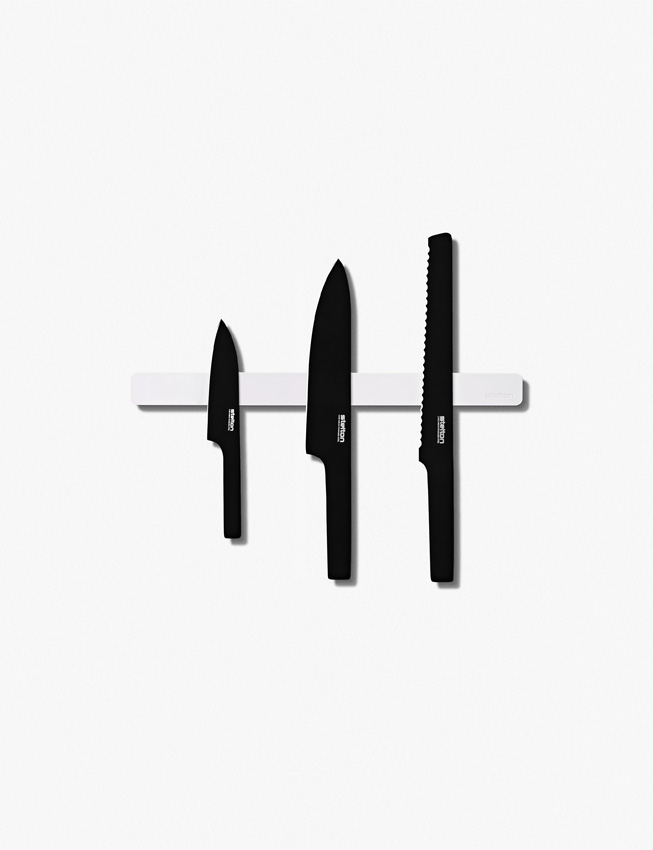
We dig products like these Stelton Knives (so much so we got a set for the LifeEdited apartment). At around $300 for a set of 3, the Danish designed and manufactured knives are not cheap, though the set, which includes a chef’s knife, a serrated multipurpose knife and a small chef’s knife (a more versatile paring knife) cover most tasks a gourmand can throw at them.

Their one piece forged stainless steel construction feels great in your hand, and their heat-treated matte-black finish gives great grip (we do have some questions about the durability of the finish).

Of course, they’re simply beautiful. Their finish and gorgeous shape begs to be displayed, which is easy with Stelton’s accompanying white magnetic holder. This is quite a contrast to the counter-hogging knife block filled with 2-3 knives you use and a whole bunch you don’t.

Products like these beg the question, what if you could be psyched about everything in your home? What if everything in your home were used? With that mission in mind, what would stay from your existing stuff? What would go?

Let us know what indispensable stuff you have in your home—things that marry form, function and high quality?

Image courtesy of Stelton.dk