It’s All About the Benjamin

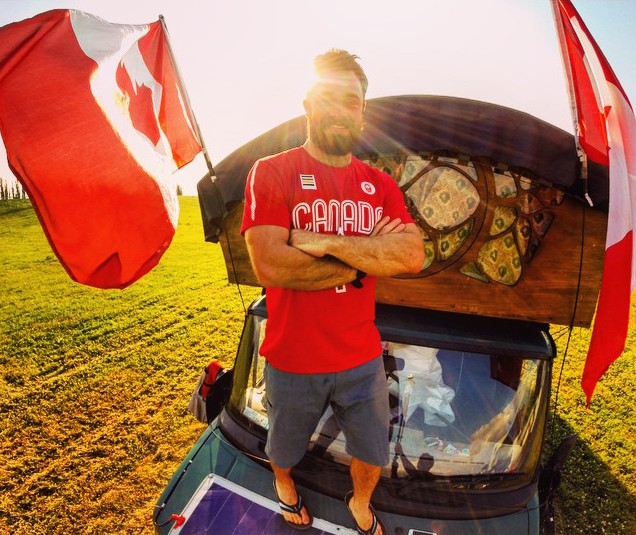
There’s a subject in many of the posts I write about that is present but not always called out by name. The subject is money. Time and again, we read stories about people editing their lives, not just because they want to create a smaller carbon footprint and have less to clean and manage. These are very valid reasons, but let’s face it, most people downsize and simplify because it’s cheaper. When life is cheaper, when the base of Maslow’s hierarchy of needs is satisfied, people are less concerned about making money, leaving them time to think about loftier pursuits than paying the bills. Canadian Ben Hayward is an awesome example of such a downsizer. For the last year, Ben has been living frugally out of his “Hobbit Mobile” traveling around Europe, training and competing to pursue his dream of being an Olympic kayaker.    

Before his current journey, Ben was already an accomplished athlete. He’s ranked Canada’s #1 solo whitewater kayaker; he’s occupied a spot on the national team for the last nine years; and he’s amassed 47 gold medals in national games. Yet he wanted to go even further and compete in the 2016 Olympics in Rio. In order to be better prepared, he realized he had to go live in Europe where the best training opportunities existed.

While the Canadian government offers a small stipend to their team members, it wasn’t enough to pay for the myriad expenses that come along with training and traveling–hotels, food, race entry, coaches, etc. Most people in his position accept that they will go into debt to pursue their dreams–something Ben told me he was willing to accept as well if it came down to it.
DSC04632

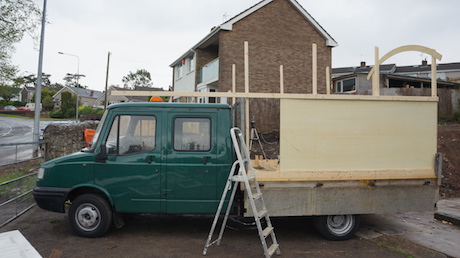
But Ben had another solution. As if his resume weren’t impressive enough for his 25 years, Ben is one year away from completing his architectural undergraduate degree. In thinking about how he could live cheaply in Europe, he conceived an idea to build his own traveling home that could also exploit his architectural chops. With the help of friend Adam, he conceived the Hobbit Mobile, a tiny house on wheels, which would allow him to live simply and frugally while he traveled and trained all across Europe.

Rather than spending his entire $5K nest egg on the van, Ben decided to crowdfund the construction of the Hobbit Mobile. In his “Van Starter” campaign, Ben managed to raise $16K, paying for the van’s entire construction (you can still contribute to his pursuits).

IMG_6030

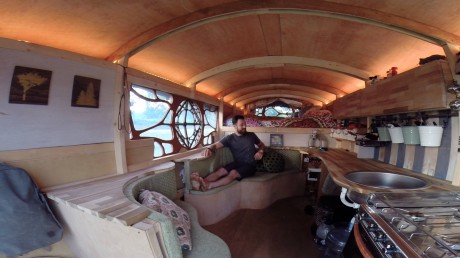
The van is built on a durable commercial vehicle frame and has what Ben called “Wallace and Gromit” (and Shire) style to it. There’s a lounge area, a lofted bed and a kitchen to prepare the 5-6K calories of food he consumes in a given day. With passenger space for six and room for 11 boats (gear is stashed inside the boats), he’s been the occasional taxi and/or hotel for his teammates. The house has solar arrays for power and there’s a copper cauldron for storing water, which also has a heating element at its base for generating hot water. Ben uses the bathrooms that are present at all of the training facilities where he camps.
ben-hayward-interior-2

All of this not only allows him to keep expenses minimal, but it simplifies his life. He said that because he knows where he’s going to eat and sleep, the van affords him a lot of mental space that his teammates who are constantly making room and board arrangements might not enjoy.

Ben told me there are numerous other benefits of living in the van. “In a normal house, it’s so easy to plug stuff into a wall and pay later,” he told me. “It’s been really cool to be self-sufficient and be connected with power useage, prioritizing what I need to use power for.” He also says that he loves spending so much time outside. “Living in a small space makes you go outdoors, which I believe is better for the human psyche. Living in a conventional house, it’s so easy to spend most of your life trapped inside.”

Because his overhead is so low, Ben can make ends meet with his stipend and a few sponsorships. He has strung together some impressive results recently, entering the finals at the World Cup in Spain last week and earning a bronze medal at the Pan-Am Games a month ago. But he’s mostly focused on training for the World Championships, an Olympic qualifying event, that goes down in about a month.

“From an external view, it seems like a poor lifestyle,” he says of the rather spartan way he lives. “But the quality of my life is very high,” he assured me. Though not everyone would choose to live as he does, he believes the downsized, minimal way of life is hardly limited to single, male, Olympic caliber kayakers. By paring down to the necessities, keeping expenses low, spending lots of time outdoors, the life that you would dream of living might not be as far out of reach as we think.

Keep up with Ben on his website and Instagram.
The Tiny House ‘Sturgis’ Coming to Colorado this Weekend

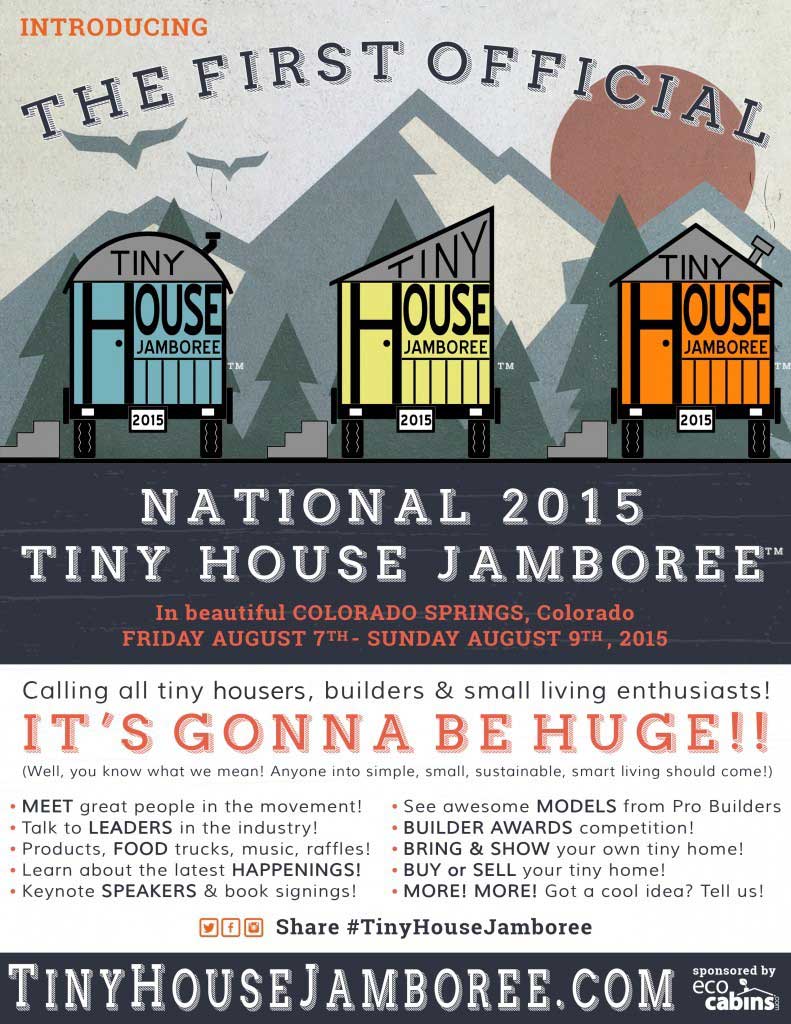
Tiny houses are, to borrow a hopefully soon-to-be-retired expression, trending. I believe this trendingness is attributable to their role as the architectural embodiment of our collective exhaustion with too much physical, financial and psychic overhead. They provide just what a single person or couple need and nary a thing more. But there are few legal places to park them outside Portland, leaving many folks who would live in a tiny house unable to do so. In order to become a real movement, tiny houses and the folks that love them need to consolidate power. There needs to be a visible groundswell of support, showing legislators that tiny homes are more than some backyard dalliance with simple living. The Tiny House Jamboree this weekend (August 7-9, 2015), in Colorado Springs might just help create that groundswell.

The Jamboree looks to be the worlds’ largest tiny house gathering to date. Jay Shafer, Deek Diedricksen and most all of the biggest names in tiny living will be in attendance. There will be a ton of builders, vendors and other tiny house related exhibitors, making it the perfect venue for folks looking to take the tiny plunge. The event’s organizers are expecting a huge turnout to the free event. I emailed Marcus Alvarado, one of the event’s head coordinators a few questions to find out more about the event.

DF: What the are the intentions and goals behind the jamboree?

MA: The 2015 National Tiny House Jamboree aims to bring together the community of tiny house builders and sustainable-living enthusiasts in celebration of the ever-growing Tiny House Movement. EcoCabins’ Marketing Director, Coles Whalen, puts it best by saying, “The movement is rooted in sort of a counter-cultural idea: smaller environmental footprint, tighter-knit communities, a debt-free lifestyle”. This movement means so much, to so many different people, from so many different backgrounds, it’s a simply a melting-pot that aims to flip the script on what a normal US dwelling should look like. We hope to bring this vision to the largest celebration this community has ever seen!

DF: How many people do you expect to attend and where are most of them coming from?

MA: As of today [August 1], we are upwards of 9,000 registrants from all 50 states and 14 countries! Most of the registrants are coming from Colorado, Texas, California, New Mexico and Kansas. Outside of the US, Canada has the most registrants with Australia and Germany tied for the second most.

DF: What do you see as the highlights of the jamboree?

MA: That’s hard to say when we have been jamming the “Jam” with all tons of special happenings! We have an all-star group of speakers that are set to present at the Jamboree including: Andrew Morrison, Jay Shafer, Derek “Deek” Diedricksen, Zack Giffen from Tiny House Nation, and a whole lot of others you wouldn’t want to miss! We will have drawings routinely handing-out giveaways from our 30+ vendors, a Mini Chapel for couples to renew their vows, a gypsy wagon stage auction, live music, along with a presentations from Sketchup and IKEA. To top it all off, We also will be screening “Small is Beautiful: A Tiny House Documentary” at a local movie theater. And did I mention we are going to have builders from all around the nation exhibiting? We’re excited!

DF: Anything else you would like to tell our readers about the event?

MA: We are aiming to make this event to be the “Sturgis” of the tiny house movement with a fun-packed jamboree that goes against the grain of conventional celebrations. We also offered “Open-Camping” to 50 lucky attendees for free! However, when everything is said and done, we have worked incredibly hard to make this event significant enough for this community to take and call their own. See ya all there!

Visit their website for more information.

Anyone Up for a Trip to Iceland?

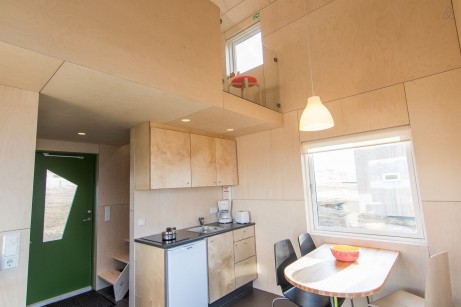
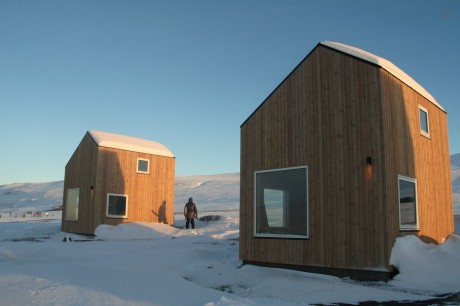
A reader sent me this Airbnb listing featuring three identical tiny cabins available to rent out. Located in the roaring metropolis of Sunnuhlíð, Iceland, these tiny houses look like the perfect place to read, use as a launching pad for sheep shearing tours, and staring out into the distance.

icelandiceland-livingiceland-loft iceland-snow

HT to Sunnuva

Get Your Life on Track

I’ve covered more than my fair share of compact, mobile homes. More often than not, the mobility is expressed on pavement, whether the home is affixed to a bicycle, a truck chassis or being towed around by an automobile. Very rarely–as in never–have I featured homes that move on old shipyard railway tracks. But that’s exactly what I’m doing today with the aptly named “Small House on Tracks” project by Polish architecture students Tomasz Zablotny and Paweł Maszota.

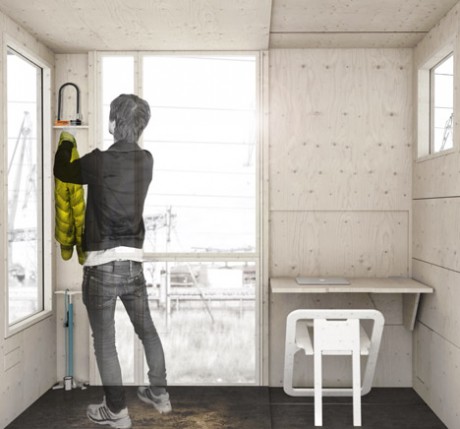
Small-House-on-Tracks_Tomasz-Zablotny-kitchen Small-House-on-Tracks_Tomasz-Zablotny-office

SMoT (my acronym, not theirs) is actually not meant as a universal housing solution, but rather a site-specific one for the Gdańsk Shipyard, a decaying industrial center that the project’s creators want to help revitalize into an artist colony.

Small-House-on-Tracks_Tomasz-Zablotny-bathroom

The “houses” are actually expandable housing units, each fulfilling a different role. The units only measures 5’ W x 6.5 L x 8’ H, all the easier for moving on a truck bed or storing when not needed. They are filled with flat packing furniture that folds into the wall.

Zablotny told Dezeen that they are not necessarily meant for full time residency, but rather to provide “comfortable space[s] for artists, interns, workers or simply those to whom the unique atmosphere of the site would appeal.”

I’m not exactly sure how SMoT would have appeal beyond temporary housing in old, disused industrial complexes–of which there are a few, particularly in Europe and the US, which are no longer manufacturing powerhouses. But I’m a sucker for housing that can be expanded and contracted according to the needs of the day.

See and read more on Dezeen

New Startup Offers Rent-a-Tiny-House

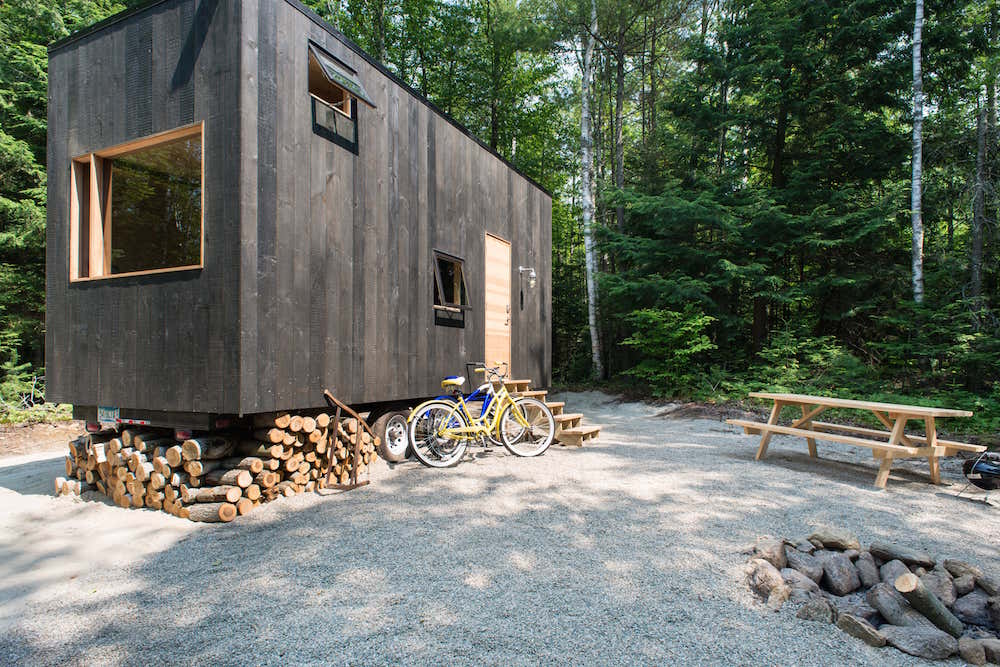
As I brought up a few weeks ago, there is a real need for more small, inexpensive vacation homes, ideally ones that are easily accessed by city-dwellers. City life can be a real grind. Without some sort of retreat, it can be unsustainable. Well the gods have heard my plea. Actually–as is more often the case–a group of Harvard grads heard my plea (but aren’t they the same thing anyway?). Headed by MBA student Jon Staff and Law School student Peter Davis, Getaway House provides an attractive, affordable, off grid tiny house for “folks looking to escape the digital grind and test-drive tiny house living.”

KATARAM_Kitchen

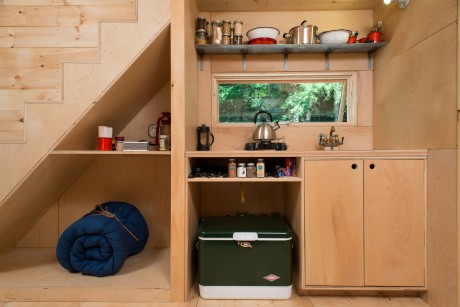
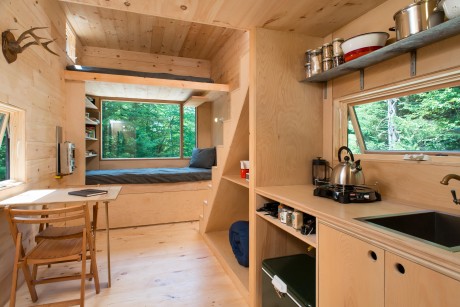
There is currently one completed Getaway House that is available to book by the night. It is dubbed “Ovida” and is located within two hour driving distance from Boston. The place was designed by a group of Harvard Design School grads. This elite-institution provenance shows through in its design. Both its modern interior and exterior are clad with attractive rough cut pine. The interior features built in furniture such as a table that doubles as a window cover and two built-in beds, giving the place capacity to sleep four. All electricity is solar, the toilet is composting and water is handled via a 110 gallon water tank that is refilled via the host house the tiny house shares its land with. Bookings also include fresh linens and available “provisions”–a sort of backwoods mini bar with things like coffee, trail mix, pasta, etc (these cost extra). Ovida is available for a reasonable $99/night for double occupancy.

KATARAM_Inside

Another Getaway House, dubbed “Lorraine” will be available mid-August and they are already taking reservations. A third house is due out in early September. Staff and Davis raised a bunch of money to build the houses with the goal of making them into a replicable model, providing both affordable, sustainable urban retreats and income generator for property host.

Getaway House is actually the first initiative of a project called Millennial Housing Lab, which, somewhat along the lines of what I wrote about yesterday, is trying to develop and realize “fresh housing ideas for a new generation,” focusing “on all sides of the housing experience: architecture, neighborhood design, financing, regulation and community-building.” As I’ve mentioned time and again, for all the hype surrounding tiny houses, micro-apartments, micro-suites and other creative forms of housing, market and regulatory forces often stand at odds with bringing these things into being. While Getaway House is ultimately a tiny vacation cabin, it is also another small step in making tiny, low impact housing a viable housing option for more people.

Dating Site for Tiny House Lovers

One of the bigger questions about downsizing and living with less concerns how it affects one’s romantic life. Many otherwise compatible people might find themselves at odds when one party wants to shack up in 200 sq ft or less. Well, if you’re in the market for romance and you love tiny living, there is a dating site that might help you find your soulmate. Tiny House Dating is the site where tiny house lovers can find love with other tiny house lovers.

The site features a database of men and women looking for likeminded romantic partners. There are the normal filters such as gender, age, sexual preference, city and state. The main difference between Tiny House Dating and more conventional dating sites is the survey question that asks “On a scale from 1 (low) to 10 (high), how serious are you about Tiny House living?” From a quick perusal, there are quite a few 10s.

The depth of field for both men and women still seems to be fairly shallow at present, with only a few pages of profiles for each sex. Profilees are located all across North America, though if the right match is found, I guess one party can hitch up his or her tiny house to a pickup and relocate.

A Case for Building More Small, Inexpensive Vacation Homes

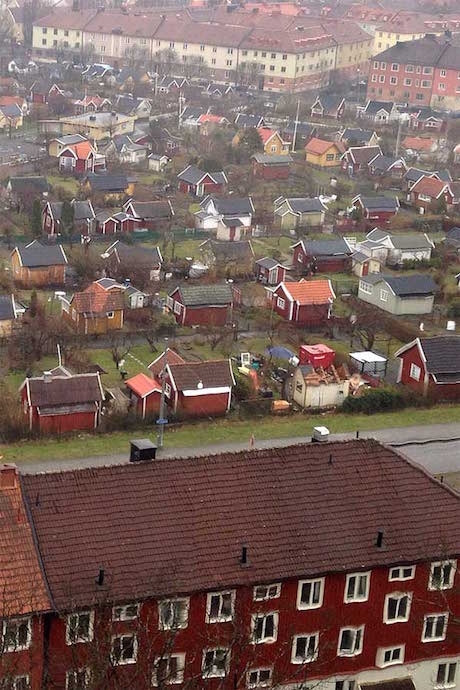
Who knew that Sweden has had tiny house colonies for that last 100 years? Apparently many Swedes knew, but this unimformed American did not. These aren’t “tiny houses” in the modern sense of the term. There are no trailers or composting toilets. But “kolonistuga” houses are indeed tiny, often measuring no more than 215 sq ft and having a porch no bigger than 64 sq ft.

Kolonistugor

Kolonistuga are located in what are called koloniområde, which is a type of vacation colony for working class Swedes that became popular in the early 20th Century. Each property contains the kolonistuga and a small garden, or koloniträdgård. The gardens are actually the reasonkoloniområde exist–following WWI, the colonies were set up for city-dwellers to grow and supplement their food stocks as well as get out of their cramped homes.

slottisburg

To this day, the kolonistuga must adhere to certain building standards, maintaining their diminutive proportions as well as traditional appearance. They are located throughout Sweden, in both the countryside and others, like Slottsskogskolonin in Gothenburg, smack dab in the middle of a city. Each house is individually owned, but the land is rented by owners. Houses are typically vacated during the winter.

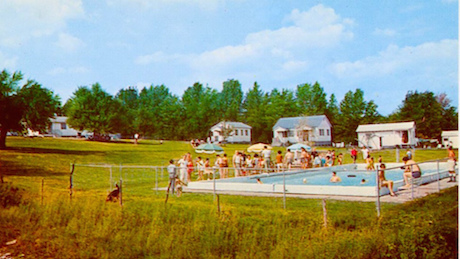
Once upon a time, Americans had something like the koloniområde. Bungalow colonies once flourished in the mid-20th century, mostly around the Catskills and Poconos as well as the shores of New York and New Jersey. Primarily used by Jewish Americans, they provided basic, affordable, community-centric vacation living, largely for city-dwellers looking to beat the heat and enjoy some sustained reprieve.

bungalow colony

Unlike the koloniområde, which are still quite active, the popularity of bungalow colonies waned in the 70s and 80s, killed by cheap airline tickets and destination travel (some still exist though their numbers are few and most are used only by Hassidic Jews).

This diminished popularity is a damn shame for several reasons. First, going to Disney World for a week doesn’t have the same potential for forging lifelong relationships as going to the same place year in, year out. And one off vacations are a little like dabbling with respite, whereas having a bungalow is a commitment to it. Lastly, visiting various locations usually requires expenses like hotels and restaurant meals, all of which can be cost-prohibitive to people living on more modest incomes.

While there is a good deal of focus placed on compact housing as primary residences, it’s worth pointing out that it makes wonderful supplemental housing such as the kolonistuga or bungalows. The time to start building small, efficient and inexpensive holiday homes once again is now.

A Very Big Idea in Tiny House Living

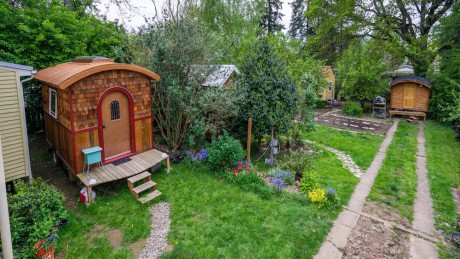
Make fun of Portland all you want, but few American cities (probably none) are showing more creativity with their zoning in order to provide affordable, transit friendly housing options. Their liberal policy about setting up tiny houses in backyards as ADUs is particularly unique. For all the hype surrounding tiny houses, actually living in one is near impossible in most cities, at least if you want to keep Johnny Law off your tiny doorstep. Without worrying about legal issues, it’s a lot easier to start thinking about how to best exploit the merits of tiny house living, which is exactly what Portland’s Simply Home Community is all about. With the help of tiny houses, seven people have figured out an ingenious way to convert a standard single family home into a highly efficient, community-centric living situation.

What’s most interesting about Simply Home is the obviousness of the idea (albeit one that’s typically sidelined by zoning issues). The idea is to park a bunch of tiny houses in the backyard of a single family home. The home will both house people and provide common spaces for the tiny house dwellers. The format provides a fair degree of privacy and autonomy (at least for the tiny house dwellers) and the big house provides shared amenities for all.

simply-home-house

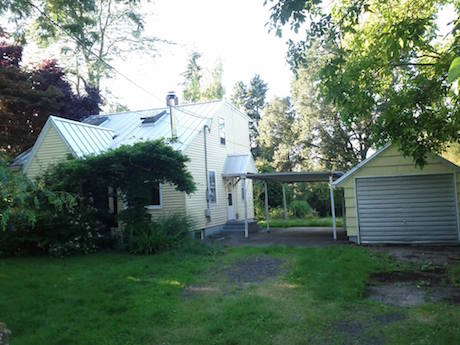
At 1450 sq ft, the big house isn’t all that big, but it still houses three people and provides a communal kitchen, living, dining and guest rooms, laundry and bathroom. In the backyard, there are four tiny houses along with a community garden and there are plans to build a hot tub.

The community is rooted in the co-housing model, where several houses band together to share resources and make a distinct community. There are weekly meetings, rules and so forth. There are also community potlucks, movie and game nights. The house and property are owned by two of the community residents, though there are plans to convert it to an LLC structure.

Simply Home seems like one possible solution for transforming the low density, inefficient living that more or less defines American housing. By creating micro-communities inside existing housing stock and infrastructure, we can add density, reduce carbon footprints, save money, meet more people, have more fun.

See and read more on Treehugger

Images via Tiny House Giant Journey

The Perfect Home for the Modern, Connected Hermit

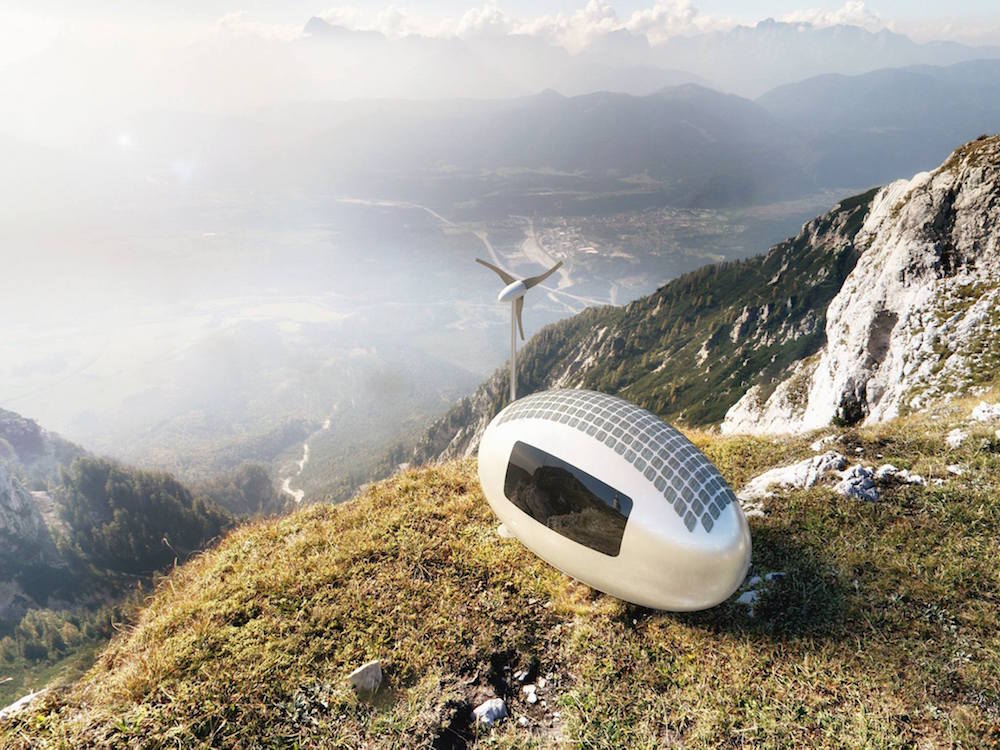
Have you ever had the desire to escape it all? Maybe hole up in the woods or on the side of a mountain. But perhaps the traditional twig hut or cave is a bit too spartan for your liking. Maybe you want electricity and running water. And maybe you’re not into rustic decors. You want something modern, maybe even futuristic. If these are your needs, you need not look any further than the Ecocapsule by Slovakia’s Nice Architecture.

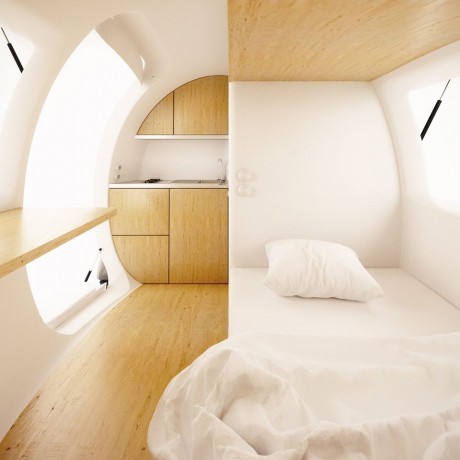
ecocapsule-interiorThe tiny structure can go completely off-grid. The top of the egg-shaped structure has 600W solar cells and there’s a built-in 750W wind turbine, both of which are hooked up to battery so you can get power on windless nights. Rain is designed to flow along the sides of the structure and get trapped and stored in a reservoir in its base.

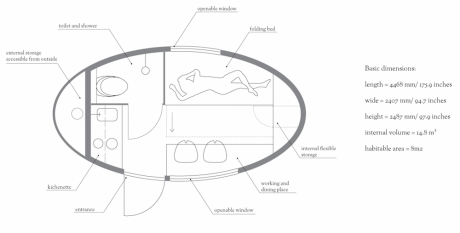
ecocapsule-diagramIt’s got everything you need: a kitchenette, bathroom with toilet and shower, a folding bed and desk. The structure is around 14’ long and 8’ at the widest part of the egg, and NA says there’s 86 sq ft of habitable floor area. In other words, it’s damn small.

ecocapsule-roof-top

In all seriousness, this is a pretty cool little structure and would make a great retreat, even if you’re not into writing manifestos in your spare time. NA also has some renderings of the Ecocapsule on city rooftops, suggesting these could be set up anywhere you want (though connecting to sewage stacks might be tricky). And at 3300 lbs, they could be shipped from overseas and towed around relatively easily to different locations. Another very cool aspect is that it exists–at least in prototype version, which will be on display at the Pioneers festival in Vienna. NA expects to start taking pre-orders later this year.

Via Treehugger

Images via Ecocapsule.sk

Tiny, Offline, Off-Grid and Ready for Creation

It’s a funny contradiction that the information age–so brimming with raw creative material–is often the assassin of creativity. It’s as if our consciousness has so much data coming in, we have lost the capacity (or time) to put it out. For those looking to do a creative juice fast, a certain (perhaps high) level of digital disconnection is required. And there are few places we can imagine being better for such disconnection as the cabins of the Bothy Project.

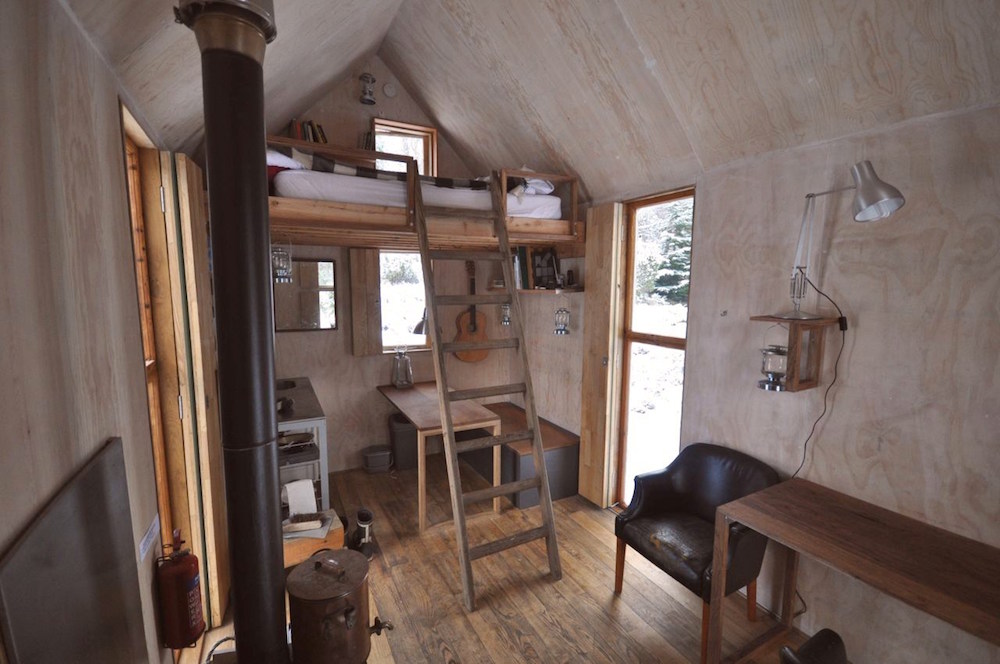
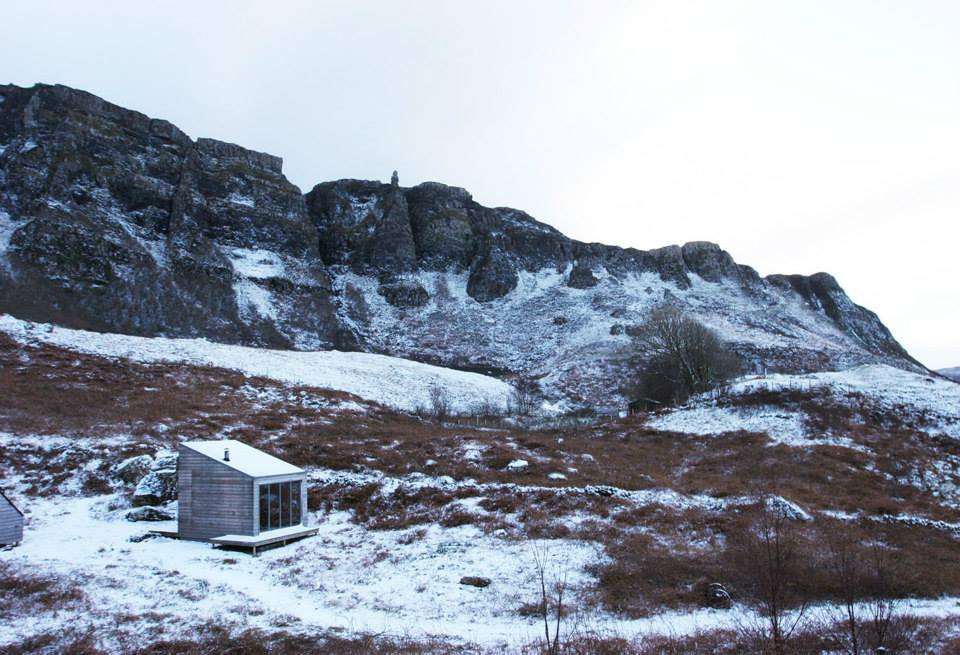
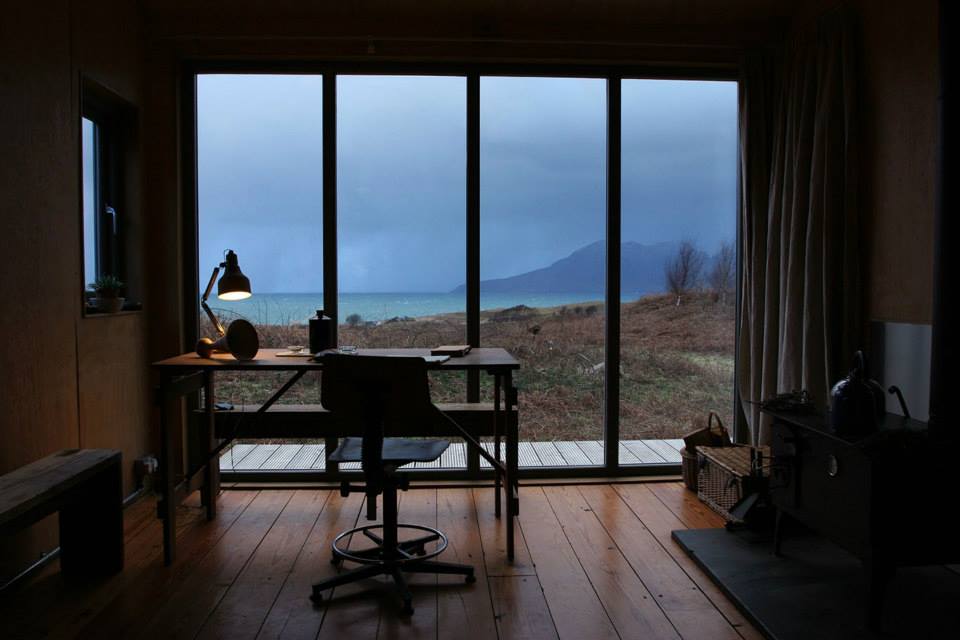
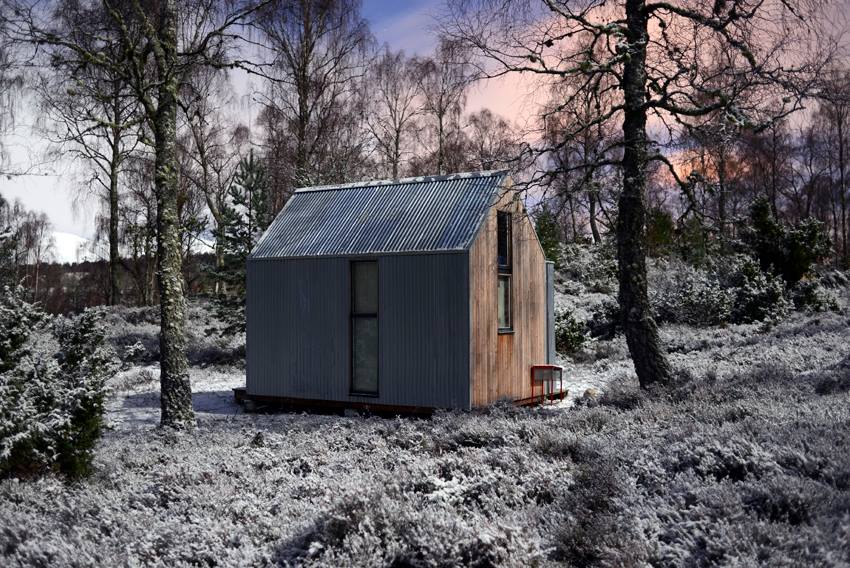
Bothy currently consists of two tiny, off-grid art residency cabins in Scotland (they have one other that’s going up next year and have plans to build more).  The spaces were not set up for just any creative endeavor. According to their website, the Bothy Project’s “objective is to create platforms for artists to journey and explore the peculiarities of  the history, mythology, landscape and people in the areas surrounding the bothies”–something we’d imagine would come naturally in such enchanting locations.

The structures themselves are beautiful, modern little cabins set in idyllic locales. Each feature the most basic furnishings and amenities–less to distract you from your craft.

As mentioned, there are two Bothies: the woodland Inshriach House in Aviemore and the coastal Sweeney’s Bothy on the Isle of Eigg. There are three ways to get a Bothy stay. For artist residencies, there are “supported programmes” and “self-directed residencies”; the former being funded by organizations who sponsor an artist’s residency (see the fruits of some of those residencies here), the latter is for self-supporting individuals who pitch their projects to TBP and pay £250/week (these are only available in August and all booked for 2015). You can also rent either cabin in a more conventional manner through booking sites (Inshriach’s is here and Sweeney’s is here).