If This Store Succeeds, It Might Put Itself Out of Business

The prevailing business model for many retail outlets is to keep customers in neverending cycle of consumption. Whether it’s through selling unrepairable products, selling products with impending obsolescence built into their DNA or through selling new, slightly-different-than-last-month’s products at breakneck speeds, the objective is the same: get people to buy again. But a new UK web shop called “BuyMeOnce” has a different approach to commerce. As the name implies, they want to sell you products that can, with proper care, last indefinitely. If you buy a product from them, say a valise, that should be the last valise you buy from them or anyone else.

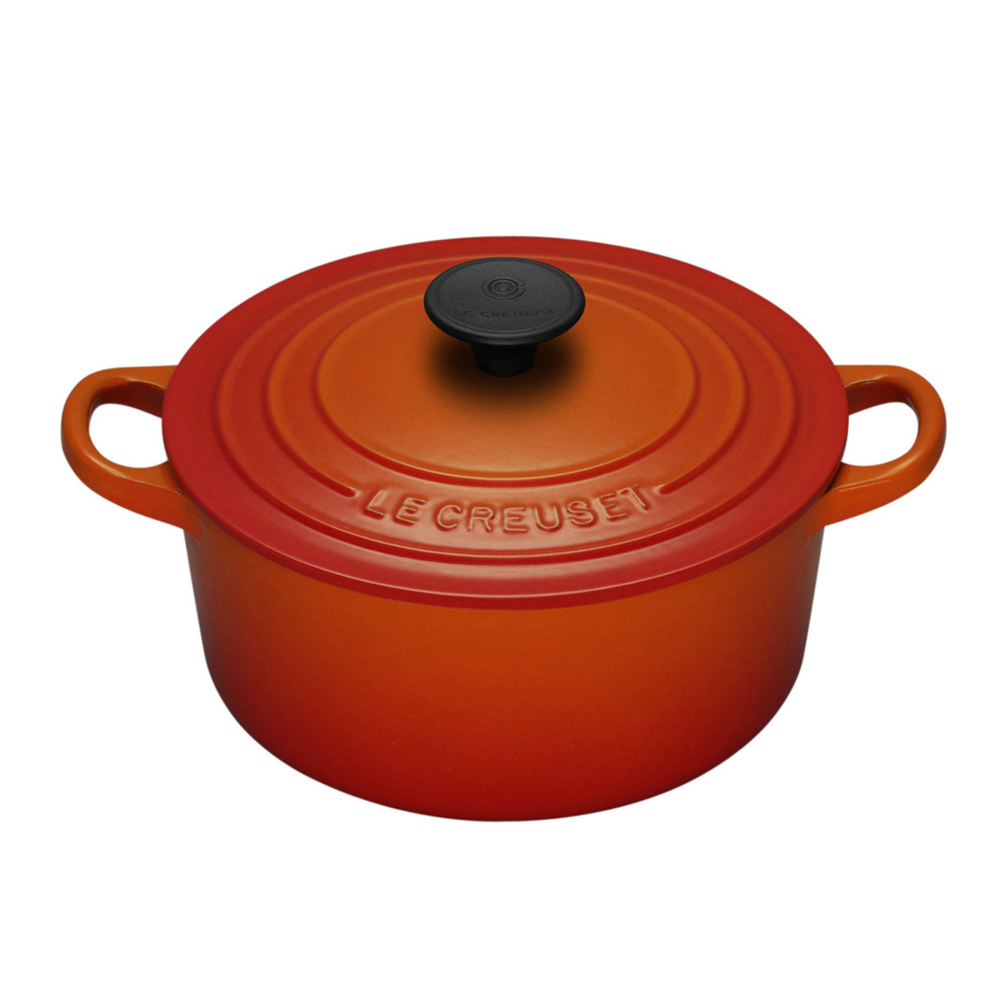
BuyMeOnce founder Tara Button told the Telegraph UK she was inspired by her Le Creuset casserole dish. She said, “‘I will have this for life–wouldn’t it be great if everything else in my kitchen was like that? You buy it once and you never have to buy it again.”

The web shop goes beyond the kitchen, featuring clothing, furniture, tools and a handful of other categories. All products are chosen for their durable construction, timeless design and repairability. On the latter point, the site also has articles and tips for making things last a lifetime or more.

Button’s concept is something we have written about many times in the past, though we call it “heirloom design.” It’s the idea of designing and consuming products capable and worthy of being handed down from one generation to the next.

The main obstacle to heirloom design becoming normal is economics: stuff cost so little money that it’s easy to rationalize buying three or four pairs of cheap shoes versus one heirloom quality pair. But this short-term thinking misses hidden expenses. Cheap stuff is cheap because manufacturers use crappy materials and construction and employ sketchy labor and environmental practices. Cheap stuff is often designed for the times, not the ages, so you are likely to want to replace it before it wears out; notice how often the simplest clothes and products are also the most expensive. Cheap stuff (and frankly, most stuff, nowadays) is not designed to be repaired. And perhaps more than anything, when we buy cheap stuff, we don’t value it; we are less likely to care for it, cherish it and even use it.

It’s heartening to see BuyMeOnce and other shops like it becoming more mainstream. People still need stuff, but with the right orientation and selection, the stuff we use can be more useful, look better and last longer.
Waffle Towels Save Space, Dry Faster, Rock Harder

In our never ending quest to save space, we’ve found it’s often the small things that make the biggest difference. Case in point are towels. Many of us assume terry cloth is the only way to go for absorbent towels–its bulky texture seems a natural fit for absorbing water. But terry cloth’s loft takes up tons of space, dries slow (often getting moldy whilst drying) and takes up disproportionate space in the washing machine and dryer.

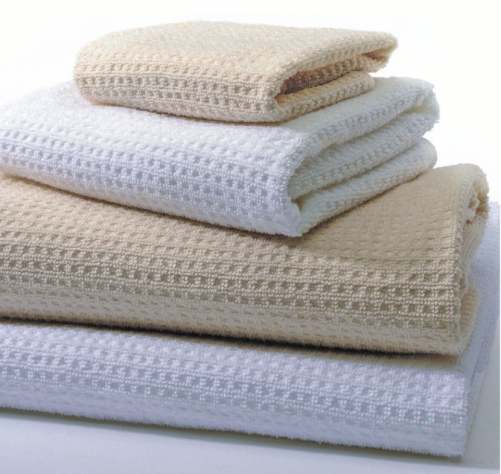
We came across a fancy sounding towel called nido d’ape in the book “Flanagan’s Smart Home“–author Barbara Flanagan’s wonderful book that lists 98 must-have housewares for the pared-down life. Nido d’ape simply means “bee’s nest” in Italian. Americans call them waffle towels. The shallow cavities in the fabric effectively increase surface area, wicking more water with minimal increase in bulk. They take up a fraction of the volume of their terry cloth brethren, dry much quicker and absorb amply.

We’ve been using waffle towels in the LifeEdited apartment and have been impressed by their performance. Author Barbara Flanagan warns the towel’s feel is “bracing,” and they lack the “security blanket-like fluffiness” of terry cloth. That has been our experience as well. The towels grip your skin. Her solution: “Grow up. Persist. There will be lighter loads of laundry filling fewer baskets straining fewer appliances.”

We’ve been using the Aquis microfiber towel, thinking that the synthetic material would dry quicker. It does, but we also noticed that if they are not dried off quick, they get a funky moldy smell.

This author uses a cotton variety from Gilden Tree. While they don’t have the squeegee feel of the Aquis, the towels do dry both your body and themselves quickly. The cotton is not nearly as odor retentive as the microfiber.

We also experimented with a smallish 19 x 39″ size, thinking the ability to wrap it around the waist would be sufficient. It wasn’t. It barely fit around the waist and was barely deep enough for men, much less women. The larger 29 x 55″ size proved much better and the bulk when stored is about that of a terry cloth hand towel.

Flanagan blames the excesses of the 80’s for the “hotel towel”–essentially a piece of terry cloth that could house a Bedouin village–becoming the household norm. The only problem is that if you lack daily maid service and a store-room, these towels make no sense. Waffle-weave towels do, saving space and energy while doing what they’re supposed to do: dry.

[Note: this post was originally published on August 9, 2012. After a couple years of use, we made a couple refreshes to the article.]

Built Rams Tough. Dieter Rams that is

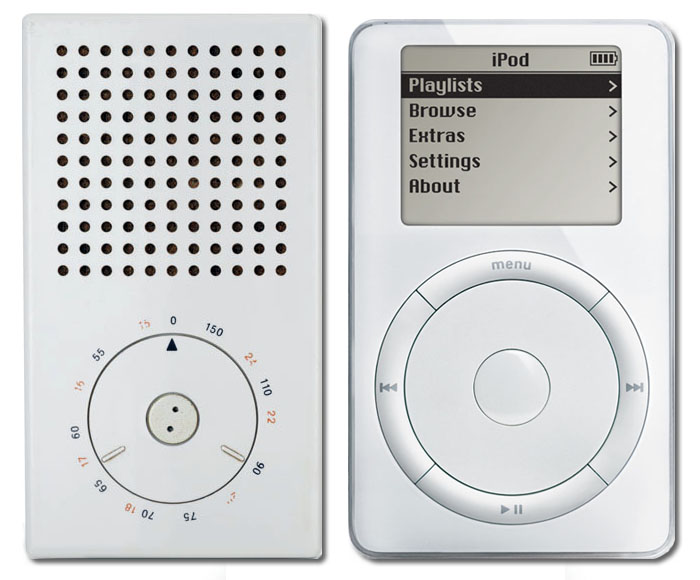
At LifeEdited, we frequently use the expression “less, but better.” To us, it means that living an edited life is more about refinement than elimination. Have what you need, but love what you have. And as clever as we think we are, we weren’t so clever as to coin “less, but better”–that distinction goes to Dieter Rams. Even if you don’t know Rams by name, you know his work. The German industrial designer has become synonymous with economical and elegant design.

Rams made his name at Braun, where over the course of 40 years he designed some of the most elegant and recognizable products ever produced.

More than mere industrial designer, Rams was a philosopher. Rams distilled the ethos behind his designs in his “Ten Principles of Good Design” (see below), a demanding set of criterion that a design must meet before going into production.

In the above video produced by Dwell, we get a glimpse into Rams’ exacting soul. In the interview, he claims that in his heyday at Braun, he could count the number of companies that took design seriously on two hands. Nowadays, he says it’s down to one finger (you might be able to guess which Cupertino-based company that is). Rams apparently wants better design everywhere. From products to cities, he thinks the world is simply “too chaotic.”

It would seem if most designs–product or otherwise–were subjected Ramsian levels of scrutiny and exactitude, most things would never be produced (not a bad thing necessarily). Somehow, we think this world might be a lot less cluttered and make a whole lot more sense. We can dream, can’t we?

Rams’ Ten Principles of “Good Design”:

  1. Good Design Is Innovative: The possibilities for innovation are not, by any means, exhausted. Technological development is always offering new opportunities for innovative design. But innovative design always develops in tandem with innovative technology, and can never be an end in itself.
  2. Good Design Makes a Product Useful: A product is bought to be used. It has to satisfy certain criteria, not only functional but also psychological and aesthetic. Good design emphasizes the usefulness of a product while disregarding anything that could possibly detract from it.
  3. Good Design Is Aesthetic: The aesthetic quality of a product is integral to its usefulness because products are used every day and have an effect on people and their well-being. Only well-executed objects can be beautiful.
  4. Good Design Makes A Product Understandable: It clarifies the product’s structure. Better still, it can make the product clearly express its function by making use of the user’s intuition. At best, it is self-explanatory.
  5. Good Design Is Unobtrusive: Products fulfilling a purpose are like tools. They are neither decorative objects nor works of art. Their design should therefore be both neutral and restrained, to leave room for the user’s self-expression.
  6. Good Design Is Honest: It does not make a product more innovative, powerful or valuable than it really is. It does not attempt to manipulate the consumer with promises that cannot be kept
  7. Good Design Is Long-lasting: It avoids being fashionable and therefore never appears antiquated. Unlike fashionable design, it lasts many years – even in today’s throwaway society.
  8. Good Design Is Thorough Down to the Last Detail: Nothing must be arbitrary or left to chance. Care and accuracy in the design process show respect towards the consumer.
  9. Good Design Is Environmentally Friendly: Design makes an important contribution to the preservation of the environment. It conserves resources and minimises physical and visual pollution throughout the lifecycle of the product.
  10. Good Design Is as Little Design as Possible: Less, but better – because it concentrates on the essential aspects, and the products are not burdened with non-essentials. Back to purity, back to simplicity.

Amina Speakers: The Best Product You’ll Never See

In the coming months, we will be highlighting products and services we use in the LifeEdited apartment. Today, we’re “looking” at the Amina Invisible Speakers. 

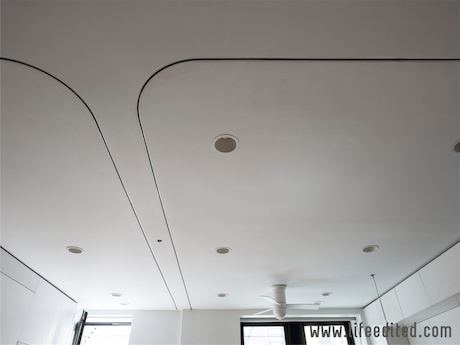
With the living room of the 420 sq ft LifeEdited Apartment doubling as entertainment area, there was a need for quality loudspeakers. The perfect solution was found in a loudspeaker that becomes part of the finished ceiling, actually completely invisible and covered with regular drywall compound and paint. Impossible you say. No, it’s not!

The latest audio trend is to hide loudspeakers rather than treating them as a “must see” piece of furniture, especially with 5.1 or 7.1 surround sound. Current invisible speaker solutions created by Amina Technologies, a leading speaker developer and manufacturer from the UK, actually affords not only very good sound reproduction, but even better, smoother coverage throughout the whole space. The sound source is hard to locate, almost ethereal, and completely undetectable by the eye. Even while listening intensely, without any visual cue as to where the speaker is installed, it is very hard to locate them, almost impossible. The speaker makes a great conversation piece to boot.

ceiling
find the speakers

In the main living space, a stereo pair of Amina Technologies’ AIW5X plaster-over loudspeakers were used. They work on the same principle as a musical instrument, combining modern electronics with acoustical engineering. Using a tuned “sound board” and an exciter, and connected to a Marantz NR1602 receiver (or any receiver/amplifier), they create sound in a most unusual way. Through having many minuscule vibrations sum, much like on a soundboard of a guitar or violin, and fill the room in all directions with full sound. For purposes of keeping bass frequencies out of the walls and ceilings, a small, hidden subwoofer provides the deep bass, as to not bother the neighbors.

For the bathroom we still wanted to maintain the stereo quality of sound while having little space, so an AIW2X speaker was used to provide an acoustically summed stereo sound. These panels reproduce both the left and right speaker channel mechanically using dual “exciters”, and although there is no “stereo spread”, there certainly is sense of openness and timbre that feels like there is definitely a stereo pair somewhere.

All in all, Amina afforded the solution that satisfied both the need for quality sound, as well as the aesthetics that we were looking for. They kept the amount of visual clutter on the finished ceiling down to just the moving wall tracks and light fixtures, and actually have enough sound power to make it sound like you have a band in the room.

Costs for Amina Invisible speakers range anywhere from $750 to about $2500 dollars for the loudest solutions (plus of course the level of wall or ceiling finish you require will be extra, but when taking the build or remodelling in consideration, the finishing is part of the big picture already). They are great for anything from the dining room to that “hidden Home Theatre”, or even to put the tunes on our micro dance floor. They are available worldwide through authorized dealers and distributors. Visit www.aminatechnologies.com.

Does Your Umbrella Withstand 82 MPH Winds?

Watch as a man subjects himself and his umbrella to 82 MPH (133 KPH), hurricane-strength winds. The umbrella, made by Dutch company senz°, achieves this strength by working with, not against, the wind. Their asymmetrical design has a minimal point of front contact, avoiding the common sail effect of round umbrellas. The umbrella spokes also pivot in such a way that should the umbrella get turned out, it yields to, rather than resists, the wind.

senz-umbrellaCheck out the senz° Youtube page to see more heroic feats of umbrella-strength, such as a parachute drop with the umbrella.

We found a variety of senz° umbrellas on Amazon starting around $40. Many of the US models are made by Totes, who is licenses the senz° design.

Senz° is a great example of rethinking common objects to make them more practical, durable and smarter. Who says umbrellas should merely last for a handful of storms? What if you could have one umbrella for life?

Do you know of other common products that achieve superior utility and durability by bucking traditional design? Let us know what they are in our comments section.

Origami Makes Editing Your Outdoor Gear a Little Easier

One of the great appeals of living a pared-down, less distracted life is that it affords the time and mental space to engage in recreational activities. But there’s a catch for the minimalist recreational enthusiast: Unless you’re a runner, you’re activity of choice probably requires a bunch of gear. LifeEdited founder Graham Hill is a kiteboarder with a board, harnesses, etc. This author is a road and mountain biker and must negotiate two bikes and a ton of gear like tools, thermal bib knickers and so on. Storing all this stuff while trying to keep a pared down life can be a real challenge.

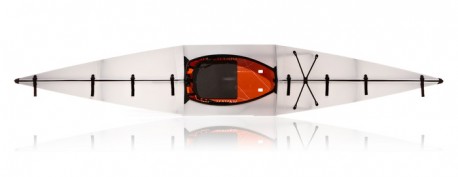
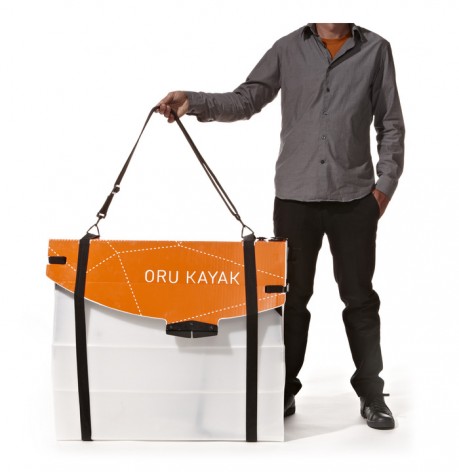
While we don’t have definitive answers for kiteboarders and cyclists (though the ThinBike technology might help slim your rides), there is good news for the edited kayaker. By incorporating origami principles, the Oru Kayak takes one of the most space-intensive outdoor sports and makes storage very manageable.

The 12 foot, 25 lb kayak folds up into a 33″ X 29″ X 10″ travel case. The kayak is rated to 260 lb load and can withstand at least 20K folds.

The Oru Kayak is available in spring 2013 for $800 through Kickstarter.

If you have any suggestions for storing your outdoor equipment, let us know.

Custom Make Your Life with CustomMade.com

One of the biggest problems with getting custom made stuff is finding a good person to make it. Most of us don’t have the bandwidth to find skilled craftspeople, much less bid the job out, particularly if it’s a small one. The hassle, combined with perceived expense, leads most of us to mass-produced items that aren’t what we want and with which we have minimal emotional connection to.

A site called CustomMade is changing all that. They claim to be the “world’s largest matchmaker for custom goods.” They connect people who want custom stuff with a network of 3500 skilled craftspeople from the US and Canada.

The site can be used in a few ways. You can bid out a job, specifying exactly what you want and how much you want to spend; you can search for craftspeople by region; and you can see and purchase already-made items. Categories include furniture, jewelry, leather goods, tableware, and carpentry.

Since their start in 2008, CustomMade had completed 2800 custom jobs. The site has 40,000 goods to peruse from, most of which you can customize; e.g. getting a wedding ring you see in your size or a table to your dimensions.

Prices for goods like furniture are higher than IKEA and other box stores to be sure. But so is quality. And though it’s hard to quantify exactly, the nature of putting a bid out to a large pool of prospective fabricators probably yields more competitive pricing.

We talk a lot about heirloom design–the ideal that the items in our lives are high quality enough to be passed down to the next generation. CustomMade makes this ideal that much easier to achieve, taking much of the hassle out of custom, hight quality fabrication.

via Core77

5 Products That Make Our Lives Better

We are always on the lookout for products that do more, last longer and take up less space than their conventional counterparts. We’re not talking about things like a good laptop or phone, which might be indispensable, but will be outdated in six months. We’re talking about the products that won’t go out of date, whose utility proves itself through the years.

We’ve put together a short roundup of products we find ourselves unable to live without (not literally of course). It’s also a nice excuse to ask you what your list includes. What are the things that make your life or home work better–things that make life simpler and more streamlined? Let us know in our comments section below.

  1. Waffle-weave towels. We’ve talked about them before, but too much cannot be said about their merits. The longer we use them, the more they prove their superiority to terry cloth. We’ve been using Aquis microfiber towels and Gilden Tree cotton waffle towels. Both take up less storage and washing machine space, dry faster and avoid mold. If we were to choose one however, it’d be the Aquis; the synthetic material seems to grab moisture from your skin. It’s also softer than cotton. If you’re not into synthetic stuff, the Gilden Tree towels still work great and are available in more sizes and colors.
  2. Outlier pants. These things rock. They look like dress pants, feel like sweat pants, wick and repel moisture like mountaineering pants and wear like iron. Starting at $188, they are not cheap, but they will literally replace three pairs of conventional pants and outlast them as well. I have had several pairs for the last few years. My favorites are the 4 Season OG’s and Climbers, both of which have four-way stretch material (not all Outlier pants are as stretchy). Their shorts rule as well. Right now, they make one women’s variety.
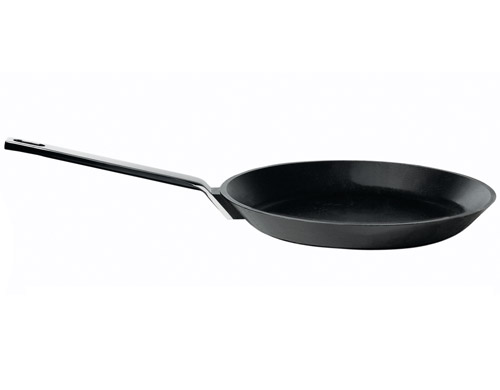
  3. A cast iron skillet. Nonstick skillets are great, but they wear horribly and have a dubious safety record. Copper and stainless steel wear great, but are temperamental, scorching and staining easily. Cast iron, on the other hand, wears like, well…iron. It distributes high and low heat great. With a little bit of use–i.e. ‘seasoning’–it can be almost as nonstick as a Teflon pan, without all the plastic bits in your food. You can clean them without water. And while enameled iron pans are nice, the bare cast iron versions are less fussy and prone to marring. I use a beautifully designed 12″ iittala Hackman Dahlström Tools for almost everything (pictured at very top. Discontinued, but available at various stores), but most any cast iron skillet work equally great. Get a size that’s big enough for the amount of cooking you do, but not so big that it takes ages to heat.
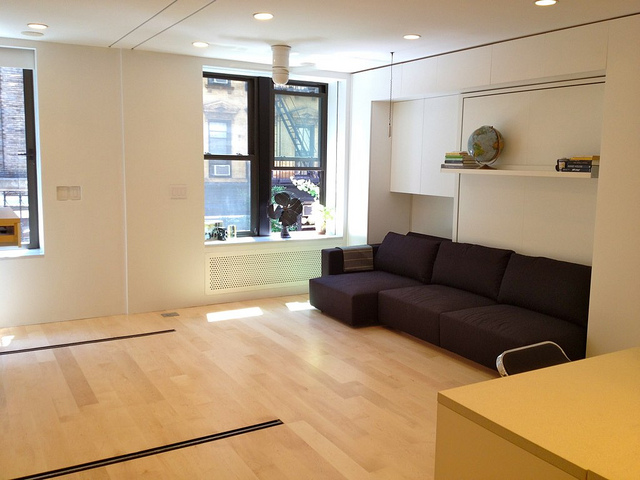
  4. A comfy couch that you can sleep on. I was at IKEA a few weeks ago and they had a 375 sq ft mock-up apartment featuring a huge, overstuffed sectional couch. I thought it a waste of space until I sat it in. Few things demarcate home like a comfy couch. In the LifeEdited apartment, the Resource Furniture Swing couch is the most used piece of furniture. A great couch can be your guest room in a pinch, and while convertible sofa-beds are great, sometimes it’s better to get a longer couch than invest in a substandard sofa-bed, which are often pretty uncomfortable.
  5. A scanner. We thought scanner technology was stable enough that it could be included on this list. Scanners are simple, can last ages, don’t require stupid, overpriced toners and, most importantly, allow you to dump tons of paper by scanning receipts and important documents. Scanners eliminate the need for a fax. You can also scan old photographs for posterity and digital display.

What would you include on this list? What items streamline your home and your life more than most? Let us know in our comments section.

4 Products that Disappear After You Buy Them

A recent article in the NY Times called “The Cult of Disappearing Design” reported on a growing movement toward invisible home furnishings. The “all-invisible aesthetic,” according to the article, “aims for a higher-minded goal: creating unified spaces that flow from room to room and place to place.”

They featured a couple items we’ve had here in the past like the Folditure “Leaf” Chair and the Bedup hiding bed. They also featured the Fisher & Paykel DishDrawer which is used in the LifeEdited apartment.

While there is an inherent challenge showing the invisible, we thought we’d add a couple items not included in the Times’ list.

1. Amina Invisible Speakers

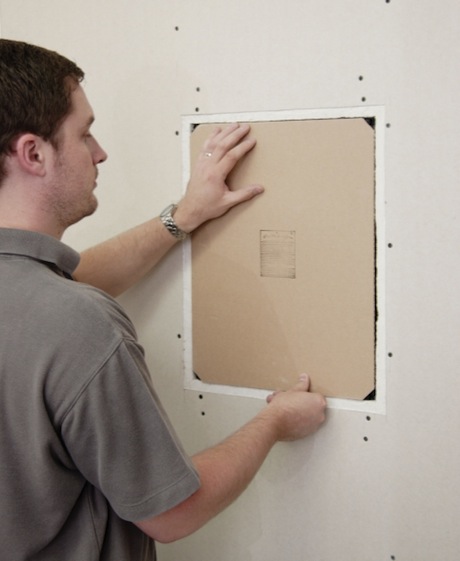
We used Amina high performance invisible speakers in the LifeEdited apartment. Their sound is easy to appreciate, though their beauty is not. The above picture has two large Amina speakers in the ceiling, but you’d never know. They are built into the drywall.

2. Induction Cooktops

In the LifeEdited apartment, we use Fagor portable induction cooktops, which are invisible in that we can put them in a drawer. Built in models are even more sleek (there’s a Fagor model pictured above). They sit virtually flush with the counter. They only conduct heat with ferrous metal, so they are cool to touch, which makes allows them to be used as additional counter space. They are also 12% more efficient than electric radiant burners.

3. Integrated Kitchen Appliances

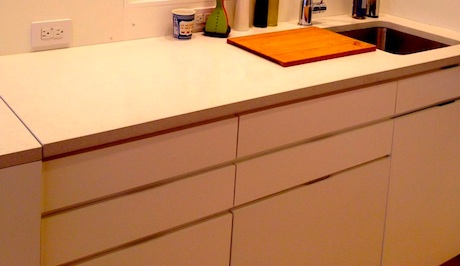
While the Times mentions Fisher & Paykel DishDrawer as a disappearing design, there are many dishwashers and refrigerators on the market today are available as “integrated”–i.e. a panel that matches the rest of the cabinetry can be affixed to the front of the appliance. Sorta pictured below is the DishDrawer in the LifeEdited apartment. IKEA makes an integrated dishwasher for about $699. Panels cost extra.

For whatever reason, integrated fridges are more expensive. We used the Sub-Zero 700 BCI stacking drawer fridge, which retails for $3500 and up.

4. Blanco Crystalline Sink

The Blanco Crystalline Sink incorporates such a simple idea: cover you sink when you don’t need it, creating a cleaner look and more counter space. The sink comes with a removable glass cover (available in white or black). Unfortunately, due to code regulations a super-cool retractable faucet is only available outside the US.


Folding Chair Stores Stealthily, Kills Aliens

We ran across this “Leaf” chair by Folditure back in May at the International Contemporary Furniture Fair. It’s made of an aluminum composite panel frame, features stainless steel hinges, aircraft grade stainless steel rivets, and other high quality materials. It can be used indoors or out. It is made with pride in Hoboken, NJ. It folds flat to an amazing 3/4″ and hangs like a jacket in a closet. It’s pretty damn comfortable to boot.

And it looks like something out of a science fiction movie.

The Leaf is an impressive piece of furniture–high quality, functional and very stowable. It just looks a little strange. Regarding the chair’s aesthetics, Folditure’s website claims that “the Leaf is equally at home in a fine parlor or dining room or on your patio. Or aboard your starship!” We couldn’t have said it better.

The Leaf is available on Folditure’s website for $680 with exposed backrest and $760 for the laminated version.

images via Folditure.com