Fashion Week, Edited

If you live in New York City or are interested in fashion, you might be aware that this week is New York Fashion Week (NYFW for the cognoscenti). It’s a weeklong celebration of the fashion trends that will make your current clothes look inexplicably outdated in the not so distant future. The practice of continually refreshing and overhauling one’s fashion is, for many, one of the leading causes of accumulating way too much stuff. As I oft-quote, one expert estimates that only 20% of most wardrobes are actively worn. The rest is just filler–likely casualties of changing fashion.

Let me hazard to say that I am not a fashion basher. As much as I continually extol the virtues of having a few well-selected garments, I am pretty fussy about what those garments looks like. I am particular about the color, fit and function of my clothes. I believe fashion is one of the most practical mediums in which one can express him or herself.

But let’s face it, fashion has a super dark side. As mentioned, many people find themselves with way too many clothes, leading to stuffed closets and emptied bank accounts–all done in the name of staying au courant. And then there are the considerable environmental and human right tolls paid in order to keep our clothes cheap and plentiful (follow this innocent looking link if you are interested in knowing more about what I’m alluding to).

As with everything, less, but better wins the day. Those of us living above or below the tropics can’t very well live without clothes, but we can create wardrobes filled with necessary clothes that are worn and cherished. In honor of NYFW and looking spiffy all year long, here are a few posts from the past fashions that will help you create your edited wardrobe.

  • Project 333. Courtney Carver is like the minimalist Anna Wintour. But instead of yay or naying particular fashions, she challenges people–women and men–to put more thought into their wardrobes by selecting 33 items to wear for three months. What’s great about her approach is that it’s pared down, but no so much that you can’t achieve variety.
  • Outlier Tailored Performance. I know, I’m a bit of a fanboy, but this company is a great example of how you can sell folks (ok, mostly men) great-looking, responsibly manufactured and sourced clothes that allow you to do more with less.
  • Shapeshifting fashion. For those who might want to spice up their minimalist wardrobes, companies like MORF create clothing that allows several looks with the one garment.
  • Rent and shared clothing. If you are simply not someone who can wear the same thing too long, consider renting or swapping your clothes. It’s way friendlier to your pocketbook, the planet and will give your closets some breathing room.
  • Fall deeper in love with your existing clothes. Just like friends and family, sometimes we take great, but familiar things for granted. Patagonia’s Well Worn campaign urges us to fall back in love with the things we have. Love them, wear them, fix them if needed. Sometimes the fashion we seek is the fashion we already have.
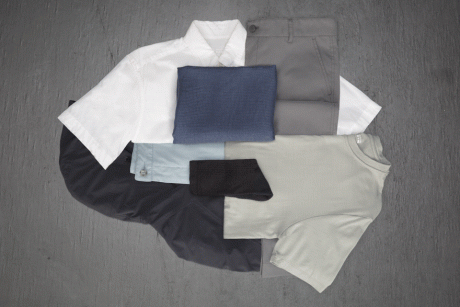
  • Wear a uniform. Yep, I’m a broken record, because uniforms are so awesome! They’re the autopay system of fashion–select one and forget about it. There’s something so liberating about not thinking about what you have to wear on any given day.

Sam Aronov / Shutterstock.com

The Business of Selling Less

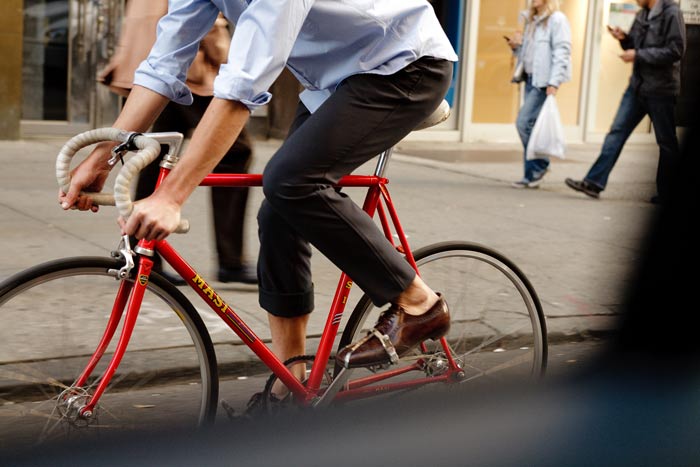
In 2009 I attended a conference where I struck up a conversation with two guys who had recently launched a men’s fashion label. Their names were (and are) Abe Burmeister and Tyler Clemens and their company was (and is) Outlier Tailored Performance. At the time, they were focused primarily on making great looking men’s clothes that would work well for cycling. The line consisted of a few pairs of pants and a couple shirts made of fabrics normally reserved for mountaineering gear. Unlike most dressy, fashionable clothing, their stuff was wicking, water-shedding and stain resistant. Most of their pants used four-way stretch materials, making it super easy to pedal or perform any other activity. As an added bonus, their stuff was made in New York City by people earning living wages.

I mentioned that I used to be really into cycling and that I had a cool bike. They asked me if my bike and I wanted to do some modeling in exchange for some clothes (clearly they were bootstrapping it at the time. Thankfully, they now employ real models). I have since become something of an Outlier devotee. In the six years, I have replaced most of my pants, shorts and, to a lesser extent, shirts, with Outlier stuff. Their styles are super simple, which also happens to be my style. Their stuff fits great. I take comfort knowing it is not made in sweatshops. And it is the most durable clothing I’ve ever owned. I’ll regularly wear a pair of shorts or pants for four days straight and they won’t look or feel dirty (it’s why a guy who wore one outfit for one year chose so many Outlier garments). In short, their stuff allows me to do more with less.

In the last six year, some things have changed at Outlier, others have not. They have grown as a business. When we first met, their warehouse was in their living room and their stuff was perpetually sold out. Now they have a couple large spaces in Williamsburg, Brooklyn and a good sized staff. They have expanded their offerings considerably and are no longer focused just on cycling–though their stuff still works great for cycling. But unlike many companies that achieve a modicum of success, they have not sent their manufacturing overseas. They are also now a registered B-Corporation, a type of business that must adhere to rigorous social and environmental performance standards. And they are still committed to selling less, but better clothes. It’s a mission that greets you when you open their website: “Quite simply Outlier is about owning less.”

I shot Abe a few questions to talk about Outlier and the business of selling less, but better clothing:

DF: Tell our readers a little bit about Outlier and what you stand for.

AB: We are trying to invent the future of clothing. Basically we believe that what we wear should be liberating not constraining, and that means making clothes that let you do more while owning less. To put it in more concrete terms we make things like pants that are both more durable and more comfortable yet still look great so you are happy wearing them every day. Or shirts that stay cleaner and resist odors so that you can wear them longer, wash them less and carry less stuff when you travel. A lot of it is built around the idea that what you put on in the morning shouldn’t restrict what you do with your day, you can go to work or summit a mountain in the same clothes.

DF: How has your company evolved since you first started?

AB: Well when we started we only made a single style of pant, and now we are a full fledged clothing company making various shirts, pants and outerwear so it’s been a big evolution. We’ve also got a lot broader in our focus, the very first couple garments were oriented around bike commuting, but we very quickly realized that focus was constraining and there was WAY more you could do with our goods.

DF: You write on your site, “Quite simply Outlier is about owning less.” I feel like your site used to a be a bit more atmospheric. What prompted this overt mission declaration?

AB: We’ve had our basic philosophy posted on our site for a long time and two of the core tenets are “the world does not need more design it needs less” and “one well considered object can take the place of many cheaply made ones”. We just got those two sentences combined into one shorter and sweeter one now.

outlier

DF: Some people see some contradiction between minimalism and commerce. They think, “How can you sell more to have less?” What would you say to that charge?

AB: This makes zero sense to me. We are trying to sell higher quality goods, which means that they are actually putting more into economic circulation then a bunch of low margin goods produced by subsistence level workers. In GDP terms five cheap items at a 1x cost adds the same amount as 1 quality item at a 5x cost. But that ignores the sort of multiplicative effects you get when people are paid properly and thus able to participate in the broader economy in a real way. The less time people spent on subsistence level events the more time for more creative and interesting endeavors. And this reflects all the way through the lifecycle of an object, from the workers having more free time and money all the way through to the final buyer needing to spend less time thinking about what to wear.

DF: Do you see minimalism as a fad or a real alteration in the way people consume?

AB: We don’t really think about this sort of stuff, we just focus on doing what we see as the best path. We’re not out to judge other people’s lifestyles and paths, we provide an example and opportunity for people to live a certain way, but it’s up to them to decide how they want to proceed.

DF: By conventional standards, your clothes are pretty pricey. What would you say to someone who might not want to spend the kind of money you charge for your clothes?

AB: There is a massive difference between what something costs and what sort of value it delivers. We don’t believe in compromising, we make the absolutely best possible goods we can and then we spend a huge amount of effort trying to make them as reasonably priced as we can. This means they cost a lot more than the disposable type clothing that some many companies pump out nowadays, but if you extrapolate our prices over the lifecycle of a garment you’ll find that our stuff is actually a much higher value than most of the alternatives.

DF: What’s next for Outlier?

AB: We just try to keep learning and subtly improving the world around us.

Visit Outlier’s site to see their full line.

Image by Emiliano Granado

Want to Simplify Your Life? Try a Uniform

My high school hallways were like a fashion show catwalk. With my classmates carefully scrutinizing my outfits, I made sure my clothes were up to date, that I had the right sneakers, the right cuffs on my stonewashed jeans, the right collar shape on my Gap button-downs and so forth. I carefully rotated my wardrobe to make sure there were no repeated outfits in a given week. I didn’t want anyone to think I didn’t care.

While no one ever accused me of not caring, no one cared that much either. All the anxiety, time spent assembling the right styles, laundry–all of it was for naught. I hovered through high school enjoying low-to-medium popularity, no portion of which was attributable to my clothing.

Most people just don’t care that much about what we’re wearing. In my experience, people will notice if our clothes aren’t clean, if they’re falling apart or if they are majorly out-of-date. They’ll notice if what we’re wearing is well made or fits us well. But people won’t care if the nice, clean, stylish thing we wore on Monday is the same nice, clean, stylish thing we wore on Friday.

The world is filled with a profound number of choices, but studies show that having fewer–not more–choices may be the path to greater happiness. Few places provide a greater opportunity for strategically eliminating choice than our clothing.

Rather than boring and imposed fashion, a uniform can be a great way to simplify your life and even express your style–there’s a reason Steve Jobs, one of the foremost design gurus of the last 100 years, wore the same outfit day in, day out.

With a uniform, dressing and life become much simpler and speedier, and with the right uniform, no one will accuse you of not caring.

If you are interested in creating your own uniform, here are a few tips to get you started:

  • If you don’t have a uniform, or don’t know what it would be, start with your favorite clothes as the basis of your uniform. This should be stuff that that fits you well and you feel comfortable wearing. The idea is to have a wardrobe of only your favorite clothes. If you don’t have favorite clothes or don’t don’t care about fashion, ask someone you trust to help select your uniform.
  • Try to find versatile clothing that will work for several different settings. For example my Outlier pants, a staple in my uniform, work for casual and dress occasions.
  • If you can’t make one thing work for several occasions, create separate uniforms, e.g. a work uniform and a casual uniform.
  • When you find something you like, buy multiples. Get a few colors of the same item if you’re worried about looking the same all the time (but remember no one cares).
  • Even if you don’t wear the exact same thing every day, choose high quality clothing staples like a particular skirt, pant or shirt. Choose classic cuts in muted and complementary colors that you’ll be less likely to tire of and that work well together. Ideally, every item in your wardrobe should look good together.
  • Add variety and style to your uniform by wearing accents like colorful undershirts, shoes or jewelry.

Do you have a uniform? Let us know your suggestions in our comments section below.

[This post originally appeared on this site on April 12, 2013]

The 10 Item Wardrobe Challenge

In the past, we’ve looked at Courtney Carver’s Project 333, a minimalist challenge that asks participants to wear only 33 items of clothing for 3 months. Well Canadian Matt Souveny’s 1 Year, 1 Outfit project makes Project 333 look like something out of Keeping Up with the Kardashians (we suspect the K’s have big wardrobes). The Royal Air Force pilot and men’s fashion blogger (interesting combo, eh?) has pared his wardrobe down to 10 items (not including socks, underwear and outerwear). The 10 items include one pair of pants, one pair of shorts, two T-shirts, one button-down, one sweatshirt, one pair of sneakers, one pair of boots, a blazer and a belt. That’s it. Every choice was derived from Reddit’s male fashion advice forum, a place where only the geekiest of dandies dare tread.

The specific items Souveny chose were an Outlier merino v-neck t-shirt, an Outlier merino crew neck t-shirt, an Outlier merino/Co Pivot dress shirt, Strike Gold Loopwheeled sweatshirt, Apolis Chore Jacket, Hollows Leather ‘The Rail’ belt, Outlier 60/30 Chinos, Outlier New Way shorts, Strike Mvmt Interval Runners and a pair of Viberg Service Boots. In case you’re curious, he wore Outlier Megafine merino socks and pullWool Merino Boxer Briefs (see full list with links here). Save for a couple items, Souveny sought to use North American made products.

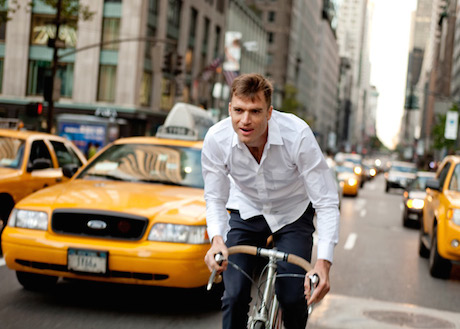
If it seems like Souveny has a disproportionate amount Outlier clothing on his short list, it’s not because he’s a spokesperson (so far as we know). Outlier, a small, Brooklyn-based clothier, makes clothes that use the latest in technical fabrics, all cut in fashion forward styles. Their stuff is as appropriate on multi-day backpacking trips as it is in boardrooms. For this reason, the brand has become a Reddit darling–it’s also a personal favorite of this author, who owns a number of items on Souveny’s list (Full disclosure: in more youthful times, I was one of their first models. That’s me below in a super sketchy photoshoot sprinting through traffic on 5th Avenue without a helmet).

outlier-heavy-traffic

I don’t have any personal experience with the other brands, though I’m a fan of merino wool in general for its wicking abilities and BO funk-resistance. Of the other brands, I’m confident their merits have been scrutinized and overanalyzed by Souveny and many others on Reddit.

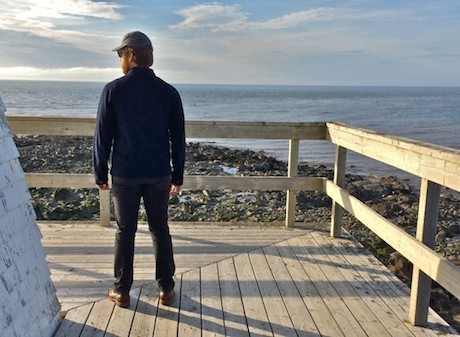
thisstylishlife

Some note of Souveny’s circumstances should be made. He is on a nine months leave from work, living in a 600 sq ft cabin in the woods (for the record, his main place is 2500 sq ft and he claims no “minimalist” cred). And when he does go back to work, he wears a flight suit, which I suspect he won’t count as an additional item. While he might not have to contend with work attire, he will have to contend with Canadian winters–and summers for that matter–making the brevity of items all the more impressive. Ten items living in the tropics ain’t that big of a deal.

Laundry-620x412

Souveny is chronicling his experiment on his blog This Stylish Life. Here’s some of what he wrote about his first month:

What I have found is that choosing what I wear each day is dictated only by what is clean and the weather outside. If it’s hot it is a shorts day and if it’s not then pants it is. It is that simple, I don’t think about colours, social encounters, or situations that may warrant using a cheaper spare. I put on my American Trench raincoat if it is raining and my Apolis wool jacket if it is cold. It all works together because I designed it with that purpose, I coordinated my outfit once and that is all I have to do for the year.

I have stopped chasing sales online or thinking about how to fill this or that imaginary gap in my wardrobe. It has given me more free time away from the internet and I’ve actually started reading books again, which I haven’t had the time to do for years. I guess I was too busy shopping.

This sounds a lot like the post we wrote a while back about wearing a uniform. Eliminating choice in many situations is a liberating, not restrictive, act. And it does not mean eliminating style or comfort. In fact, when you have fewer things, there’s a greater imperative to make those few things the right things, the ones you love and look great. While we might not all be able–or want–to pare down to ten items, Souveny’s experiment that shows us how, with a little consideration, we can simplify our lives and do more with less stuff.

Image credits: This Stylish Life and Emiliano Granado for Outlier

Via CNN

5 Products That Make Our Lives Better

We are always on the lookout for products that do more, last longer and take up less space than their conventional counterparts. We’re not talking about things like a good laptop or phone, which might be indispensable, but will be outdated in six months. We’re talking about the products that won’t go out of date, whose utility proves itself through the years.

We’ve put together a short roundup of products we find ourselves unable to live without (not literally of course). It’s also a nice excuse to ask you what your list includes. What are the things that make your life or home work better–things that make life simpler and more streamlined? Let us know in our comments section below.

  1. Waffle-weave towels. We’ve talked about them before, but too much cannot be said about their merits. The longer we use them, the more they prove their superiority to terry cloth. We’ve been using Aquis microfiber towels and Gilden Tree cotton waffle towels. Both take up less storage and washing machine space, dry faster and avoid mold. If we were to choose one however, it’d be the Aquis; the synthetic material seems to grab moisture from your skin. It’s also softer than cotton. If you’re not into synthetic stuff, the Gilden Tree towels still work great and are available in more sizes and colors.
  2. Outlier pants. These things rock. They look like dress pants, feel like sweat pants, wick and repel moisture like mountaineering pants and wear like iron. Starting at $188, they are not cheap, but they will literally replace three pairs of conventional pants and outlast them as well. I have had several pairs for the last few years. My favorites are the 4 Season OG’s and Climbers, both of which have four-way stretch material (not all Outlier pants are as stretchy). Their shorts rule as well. Right now, they make one women’s variety.
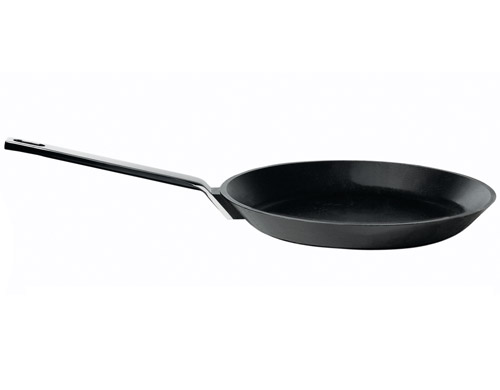
  3. A cast iron skillet. Nonstick skillets are great, but they wear horribly and have a dubious safety record. Copper and stainless steel wear great, but are temperamental, scorching and staining easily. Cast iron, on the other hand, wears like, well…iron. It distributes high and low heat great. With a little bit of use–i.e. ‘seasoning’–it can be almost as nonstick as a Teflon pan, without all the plastic bits in your food. You can clean them without water. And while enameled iron pans are nice, the bare cast iron versions are less fussy and prone to marring. I use a beautifully designed 12″ iittala Hackman Dahlström Tools for almost everything (pictured at very top. Discontinued, but available at various stores), but most any cast iron skillet work equally great. Get a size that’s big enough for the amount of cooking you do, but not so big that it takes ages to heat.
  4. A comfy couch that you can sleep on. I was at IKEA a few weeks ago and they had a 375 sq ft mock-up apartment featuring a huge, overstuffed sectional couch. I thought it a waste of space until I sat it in. Few things demarcate home like a comfy couch. In the LifeEdited apartment, the Resource Furniture Swing couch is the most used piece of furniture. A great couch can be your guest room in a pinch, and while convertible sofa-beds are great, sometimes it’s better to get a longer couch than invest in a substandard sofa-bed, which are often pretty uncomfortable.
  5. A scanner. We thought scanner technology was stable enough that it could be included on this list. Scanners are simple, can last ages, don’t require stupid, overpriced toners and, most importantly, allow you to dump tons of paper by scanning receipts and important documents. Scanners eliminate the need for a fax. You can also scan old photographs for posterity and digital display.

What would you include on this list? What items streamline your home and your life more than most? Let us know in our comments section.

Do-It-All Clothing Cuts Clutter

Is your closet teeming with single-purpose clothing? You got wool slacks for fancy, jeans for chilling and sweatpants for, um, sweating. Before you know it, you have a ton of barely-used clothes maxing out both closet and credit card.

What if there were clothes that looked and fit great and were ready for whatever you were up to? These pants from Outlier Tailored Performance are a great example of such a beast (available for boys and girls). Their tailored cut makes them suitable for formal affairs, while their technical fabric make them great for riding your bike, climbing and other activities that shouldn’t be done in pants this styling. They also feature a self-cleaning NanoSphere treatment, which makes them impervious to spilt coffee and slightly-too-long intervals between washings.

We’ve been wearing them for a couple years and they look like new despite their many travels through boardrooms and countless miles logged on our bikes. They show that a few sophisticated, well-made, multi-functional items can save money and replace piles of single-purpose, closet fodder.