SHTF Ready Housing Collective Pretty Sweet

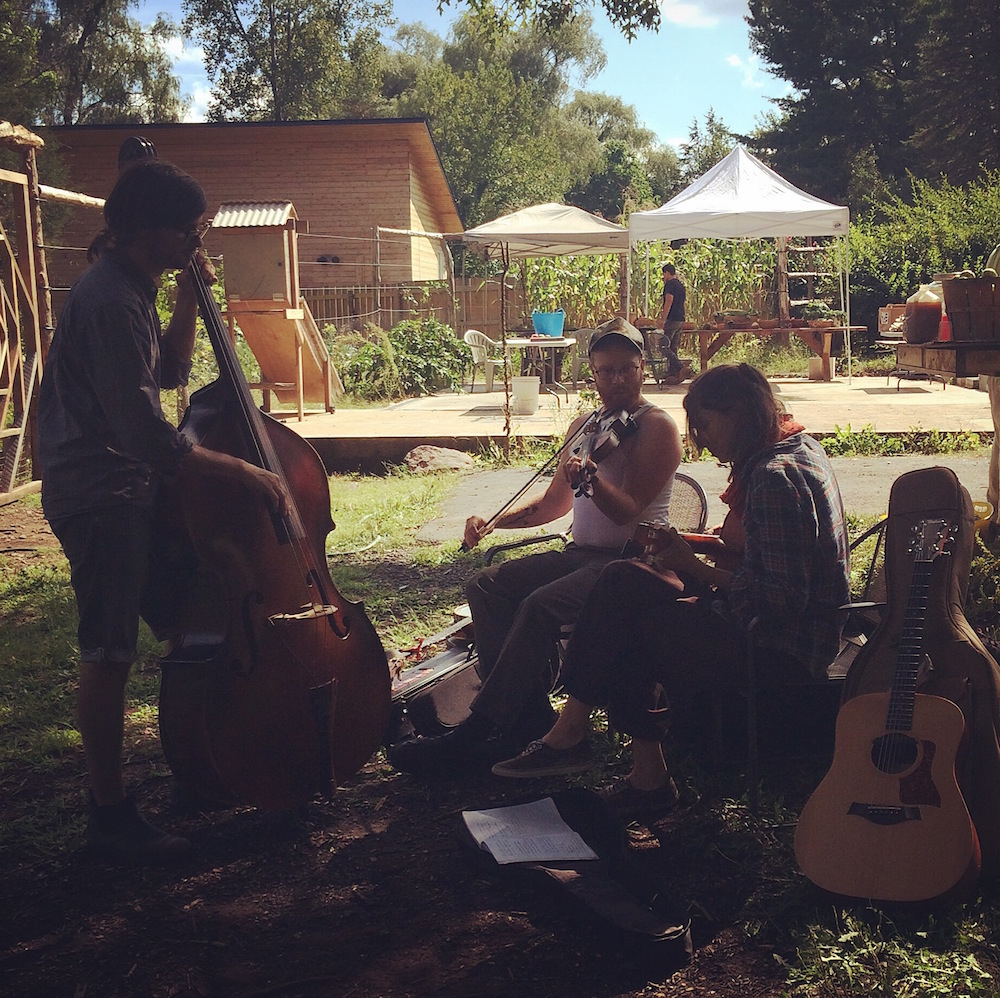
Techno-urban utopianists predict a future where people will live in plant-covered high rises that spring up like natural organisms. All transportation will be on demand. Everything will be powered by completely clean fusion power. Goods will be shared and instantaneously accessed through sophisticated technology. All of these systems will cut down our workload, leading to a happier, healthier civilization. This is definitely a direction our planet could be heading in. Then there’s the other direction. In this future our infrastructures, financial systems and climatic balances will collapse, leading to massive energy and food shortages, mass migrations and so on. Should this latter scenario come to pass, we imagine there will be a long line to join The Long Spoon Collective. Located in Saugerties, NY, LSC is a small collective that grows its own food, constructs tiny houses for free for people who want them and is trying to start an economy based on giving instead of money.

The collective’s membership stands at six at the moment. The Saugerties Times explains how the sextet came together:

The collective got its start when founder and native Saugertiesian Chase Randell, a Skidmore graduate with a master’s degree in humanistic multicultural education, became involved with the Sustainable Saugerties Transition Town group last summer. He, along with Karuna Foudriat, a former Waldorf school teacher and current divinity school Ph.D. candidate, and a group of supporters, began to grow food on a local farm….Randell and Foudriat were joined by Frank O’Leary, who knew Randell from Skidmore, and recent émigrés from New York City Jared Williams and Lala Montoya, permaculture experts who recently returned from a year in Kenya. Collective members are committed to growing their own food and living as much as possible without using money.

More than mere backup plan for the collapse of the status quo, LSC has a larger goal of addressing “issues of poverty and environmental degradation by meeting the basic need for food and shelter directly.” As such, the food they grow–much of which is grown on once-derelict farms and private gardens–is given away.

LSChouse

Their off grid tiny houses, which some members live in, are made of salvaged materials. They even offer to tear down unused structures on properties in exchange for use of the scrapped materials.

The members do have money coming in from the conventional economy, but their participation is a bit like Peak Oil, i.e. taking the resources of the old way while they’re still available in order to lay the groundwork for the new way. Money is directed toward things like hosting free workshops, fueling trucks to support their projects and so forth. Their ultimate goal is to transition themselves from the normal economy to the giving economy.

Saugerties is a two hour drive from NYC, which the collective sees as a big plus. The proximity gives them access to tons of people who might join the movement. Speaking of, they’re looking for more members. Head on over to their website for more info.

The Untethered Life

Dan Timmerman is an American. He makes his living professionally racing cyclocross. If the combination of those two statements doesn’t impress you, you probably don’t know much about cyclocross. The sport is like steeplechase on a bike, and though popular in Europe, it is still pretty niche this side of the pond. The reason Timmerman can make his living like this is not because of the millions he makes clearing hurdles on his Ridley cross rig. He does it because he and his wife have reduced their living expenses to such an extent that they can do what they damn well please.

Five years ago, the couple bought a cabin on a 10-acre property in rural New York. The cabin is owned outright, so housing costs are negligible. It’s off-grid, relying on solar power, which is stored in batteries when the sun’s not out. Heat and cooking fuel come from chopped wood. Water comes from a well. Poop is composted. They raise chickens, grow veggies and Dan does some hunting, though he says most of their food comes from the grocery store. They have cellphones, which double as their internet connection for their laptops. Paying for the cell phone bill is their only real “bill.”

Beside the profoundly low overhead, their setup allows them to be immersed in nature–one of the main motivations for moving there. “”We have direct access to nature—it’s right there…We’re connected to it every day, not just sitting there observing it,” Timmerman said (full interview on video above).

There are some downsides to their setup, namely that they are pretty remote, which forces them to drive quite a bit. His wife Sam drives 18 miles to Ithaca to work and the nearest town is eight miles away. But Dan says they have a community in the woods, and even though they talk about moving further in, the advantages of having freedom to do what they want and being so close to nature outweigh the disadvantages.

H/T Tim F!

Via Business Insider and DirtWireTV

Low Impact, High Times in the Woods

Individual tiny cabins out in the woods are nifty and all, but the architectural form’s real potential lies in community formation. Magic happens when you throw a bunch of tiny structures and people in a cluster to share resources, meals, skills and lives. This kind of magic has been happening at a 55-acre woodland preserve in upstate New York named Beaver Brook for the last five years. The property was purchased by tech entrepreneur Zach Klein for $280K as a place to commune with nature and friends. The Beaver Brook land came equipped with an amazing off grid cabin, designed by its previous owner, Scott Newkirk. Klein had more than a passing interest in small cabins, having started the appropriately named Cabin Porn blog, the web’s leading repository for gorgeous little cabins set in equally gorgeous natural settings (also a book).

beaverbrook-newkirk

In the ensuing years, Beaver Brook has become an ongoing community and retreat (Klein, incidentally, has since moved to San Francisco). There are now additional cabins on the property, including a space-aged looking one by fellow Brookers Grace Kapin and Brian Jacobs and a bunkhouse built around the frame of a 19th Century barn. There are 20 regular “residents,” including five kids, who either pay a monthly fee for the bunkhouse or camping on the land, $150 and $75, respectively; these folks also help out with regular maintenance of the land doing things like path maintenance, according to the NY Times. Beaver Brook has guest stays, hosts weeklong building workshops and artist residencies as well.

beaverbrook-sauna beaverbrook-bunkhouse

Similar to my post about the need for more small, inexpensive vacation homes, Beaver Brook presents an earthy, low impact, low cost way people can supplement their oft-harried urban lives with an immersion in slow, natural living. 

Images via Beaver Brook

Video: Man Goes Beyond Off Grid, Going Under It

Happy Friday! Sit back, relax, grab a bowl of cereal and watch this Fair Companies video of Dan Price and his Hobbit hole home. Be prepared to feel like your life is a wasteful, complicated mess. It’s fairly tough to get much lower impact than Dan. He lives in a tiny subterranean Shire-like structure that is almost wholly constructed of reclaimed materials. He pays $200 a year for the land his house sits on (or, rather, under) and his annual expenses total $5K. He gets most of his water from a spring. His feces are composted in a toilet he made 25 years ago. He uses the tiniest bit of electricity. His diet consists mostly of raw fruits and veggies and cereal. He has very few possessions. Almost everything in his life has been edited–a word Price, once a professional photographer, uses liberally–down to the most essential. Despite his radical level of editing, Price sees himself as a pretty normal guy, albeit one who has and consumes very little stuff.

The video is really worth the full 34 minute viewing time. It’s the chronicle of a man who has consistently chosen to live according to his own rules (His lifestyle is no flash in the pan. Before the Hobbit hole, he lived in a tent, teepee and tiny house). And while he considers himself a normal guy, he alludes to how his lifestyle is partly the function of being a bit of a hermit–that more human contact would put him under more scrutiny, making it more difficult to do his own thing, which he seems to enjoy quite a bit.

Even if you don’t want to live like Price, to know this level of minimalism is not only possible, but being carried out, might help inspire whatever bit of modest editing you might be having difficulty incorporating into your life.

The Perfect Home for the Modern, Connected Hermit

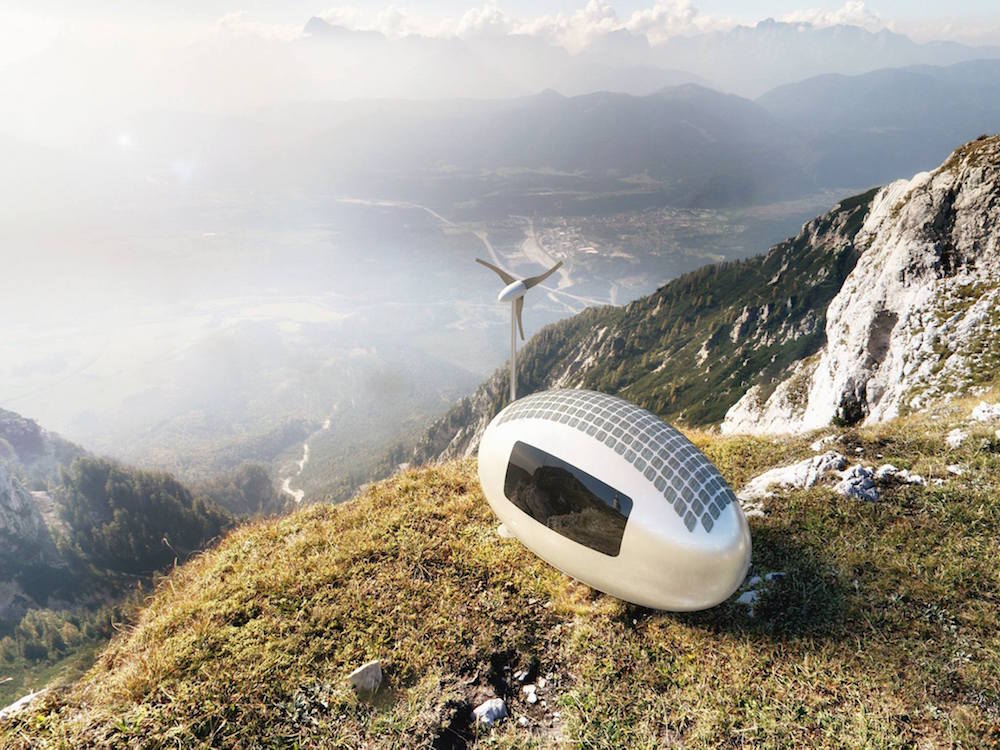
Have you ever had the desire to escape it all? Maybe hole up in the woods or on the side of a mountain. But perhaps the traditional twig hut or cave is a bit too spartan for your liking. Maybe you want electricity and running water. And maybe you’re not into rustic decors. You want something modern, maybe even futuristic. If these are your needs, you need not look any further than the Ecocapsule by Slovakia’s Nice Architecture.

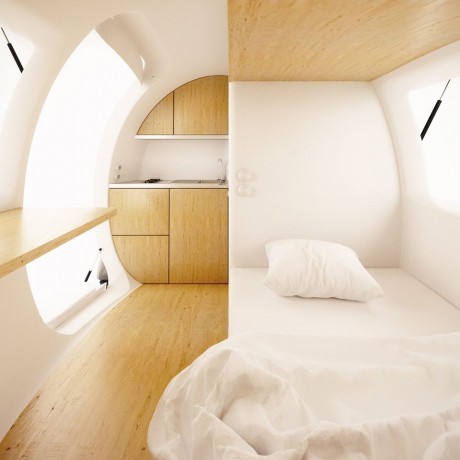
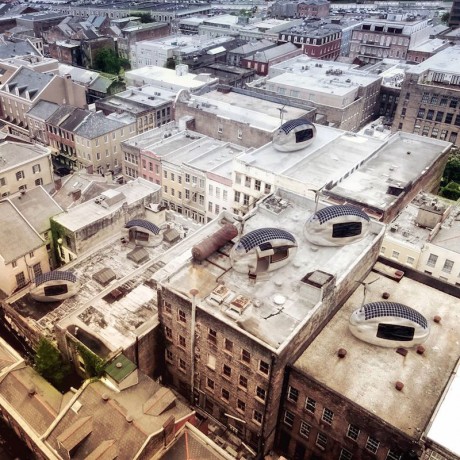
ecocapsule-interiorThe tiny structure can go completely off-grid. The top of the egg-shaped structure has 600W solar cells and there’s a built-in 750W wind turbine, both of which are hooked up to battery so you can get power on windless nights. Rain is designed to flow along the sides of the structure and get trapped and stored in a reservoir in its base.

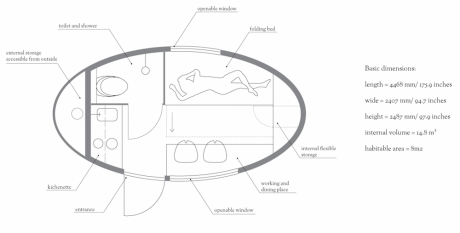
ecocapsule-diagramIt’s got everything you need: a kitchenette, bathroom with toilet and shower, a folding bed and desk. The structure is around 14’ long and 8’ at the widest part of the egg, and NA says there’s 86 sq ft of habitable floor area. In other words, it’s damn small.
ecocapsule-roof-top

In all seriousness, this is a pretty cool little structure and would make a great retreat, even if you’re not into writing manifestos in your spare time. NA also has some renderings of the Ecocapsule on city rooftops, suggesting these could be set up anywhere you want (though connecting to sewage stacks might be tricky). And at 3300 lbs, they could be shipped from overseas and towed around relatively easily to different locations. Another very cool aspect is that it exists–at least in prototype version, which will be on display at the Pioneers festival in Vienna. NA expects to start taking pre-orders later this year.

Via Treehugger

Images via Ecocapsule.sk

Snowboarder Living the Off-Grid Dream

A couple decades ago, snowboarder Mike Basich did what few are able to: he went pro, actually making a good living doing what he loved most. Pulling in around $170K year, he did what any protagonist in an American success story would do. He bought a big house (4K sq ft) and a fancy car. But as success mounted, as the purity of his sport became tainted by speciously-sourced money, Basich found that success wasn’t all it was cracked up to be. He quit the sport, became a photographer and started living his truth. The architectural manifestation of that latter pursuit is a 228 sq ft off-grid cabin in Soda Springs, CA.

The cabin, dubbed Area 241, took Basich five years to construct. He laid the 175 tons of stone for its walls himself and hand mixed cement with water ported from a nearby stream. All the timber is Douglas Fir he harvested from his 40 acre property.

Water comes from snowmelt and streams. Power is solar and cooking and heating are handled by a small wood-burning stove. Lest the place seem too spartan, Basich built a hot-tub and a private chairlift on the property.

The house is pentagon shaped and its proportions are based on the golden ratio, which he says is supposed to better make the space fit the body.

This author tends to be a little leery of off-grid spaces. Oftentimes, they can only be accessed and supported via long journeys in internal combustion vehicles (it looks like Basich gets to his via snowmobile in the winter and we’d guess an offroad vehicle in warmer days). A trip to the grocery store might be a three hour round trip. And how useful are places like this in the context of housing the world’s 7B people?

Those prejudices aside, this place is so badass and I want one like it so bad. It looks like an amazing place and an amazing way of life, rising and resting with the sun, living as one with nature. I’m totally jealous.