Grandma and Grandpa Lighten Up and Hit the Road

A few weeks ago, we took a look at full time, van-dwelling nomad Foster Huntington. While his life looked pretty awesome, it did have a certain youthful character to it. There simply aren’t a ton of people above the age of 35 who want to hole up in a pickup pop top camper for any appreciable length of time. For the chronologically gifted, the stereotypical nomad home is the RV, but for many their ginormous size, often high cost to purchase and voracious thirst for fuel are understandably big turnoffs. A recent NY Times article entitled, “Increasingly, Retirees Dump Their Possessions and Hit the Road,” talks about, well, how many retirees are dumping their possessions and hitting the road.

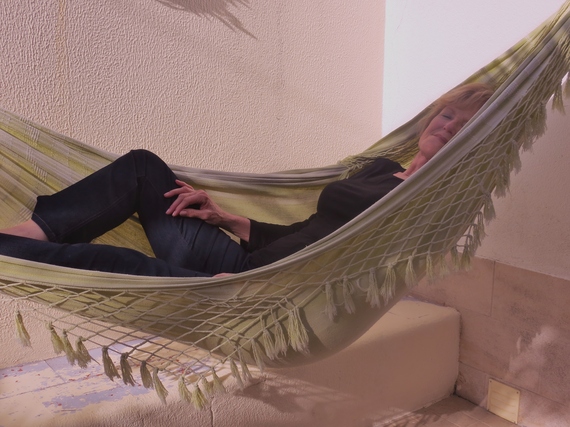
Some of the people profiled in the article, are doing the RV thing (and nothing wrong with that), but others, like Lynne and Tim Martin, 73 and 68 respectively, have become professional, homeless vacationers (that’s Lynne in the hammock above). A few years ago, they sold their three bedroom house, ditched nearly all of their possessions and are now hopping from country-to-country, embedding themselves in homes they usually find on Homeaway.com. She even wrote a book about their life called, “Home Sweet Anywhere: How We Sold Our House, Created a New Life, and Saw the World.” Ms Martin told the Times, “We simply traded the money we were spending for overhead on a house and garden in California for a life in much smaller but comfortable HomeAway rentals in more interesting places.”

stacy-monday

Others, like Stacy Monday (above collage taken from her site), have managed to induce retirement through extreme frugality. At only 50 years old, Monday travels the world, relying on Couchsurfing.com and volunteering on organic farms and nonprofits, all of which has enabled her to reduce her living expenses to virtually nothing. She told the Times she typically spends $150/month, an income that she can make through odd jobs and random donations on her blog Barefoot Lovely.

Danila Mansfield, 58, and her husband, Chris Gill, 64, are another RV-less couple who sold their home and possessions to travel and volunteer around the world.

The combination of old age and nomadic living, particularly in regions without the best healthcare, can present issues people who live near regular medical care don’t have–something that happened to Ms Mansfield, who had to deal with an acute respiratory issue whilst on the road. Needless to say, the very frequent flying lifestyle has its limits (though we suspect the way of life has numerous health benefits one doesn’t get from hanging around the same house year-in-year-out, thus extending the range of mobile years).

According to the article, there were 360,000 Americans receiving Social Security benefits at foreign addresses in 2013, which is 48 percent more than 10 years earlier. But more than having a foreign address, the article suggests that people of all ages are increasingly questioning the value of the large and over-stuffed American dream home. If this article has any relation to larger trends, and we suspect it does, in the coming years there will be a growing movement toward trading our ostensibly stable, large homes with their convenient-rich, but cumbersome possessions for itinerant, varied housing, lightweight and experience-rich living.

What It’s Like to Live in a Micro-Apartment

As a New Yorker, burdened as I am with our stereotypical New York-centricity, it kinda pains me to admit that Seattle is America’s micro-apartment capital. Seattle’s micro-apartment’s might lack the flash of NYC’s adAPT pilot program or the innovation behind Panoramic Interests‘ San Francisco develops. But what Seattle lacks in bling, it makes up for in volume. Whereas you could count the number of proper micro-apartment buildings in NYC and SF on your hands and toes, Seattle boasts at least 50 micro-apartment buildings and a couple more in the pipeline. Seattle has created a type of micro-apartments that is low-frills, furnished, affordable and almost always located close to transit hubs. Though perhaps not much more than glorified boarding houses, we see them as promoting simple, thrifty, car-free living.

But for all the publicity Seattle micros have received, there have been few reports as to what it’s like to actually live in one of these micro-apartments.  A couple months ago, Nicole Hennig reached out to us with exactly that. She lives in one Seattle’s many micro-apartments (more specifically a building by Footprint Properties) and she gives us a pretty great account to what it’s like to live in one.

Hennig is not necessarily the stereotypical micro-apartment dweller, who she says are mostly people in their 20s in the building where she lives. After leaving her job of 14 years at MIT at the beginning of 2013, Hennig, a self-described Baby Boomer, started her own business helping librarians and educators find and use the best mobile technologies for education. Because all of her work is done online, she decided to spend a few years exploring living in different locations. Much of last year was spent in Oaxaca, Mexico and she has spent this year bouncing between different Airbnb properties along the West Coast.

She came to Seattle in part to live in a micro-apartment. “I had been following the ‘tiny house’ movement for quite a while,” she wrote to us. “But I prefer urban areas to rural, and it seems most tiny houses need to be located in small towns or rural areas. So that fact that micro-apartments exist, usually in walkable neighborhoods of big cites–that sounded perfect to me! (and it is).”

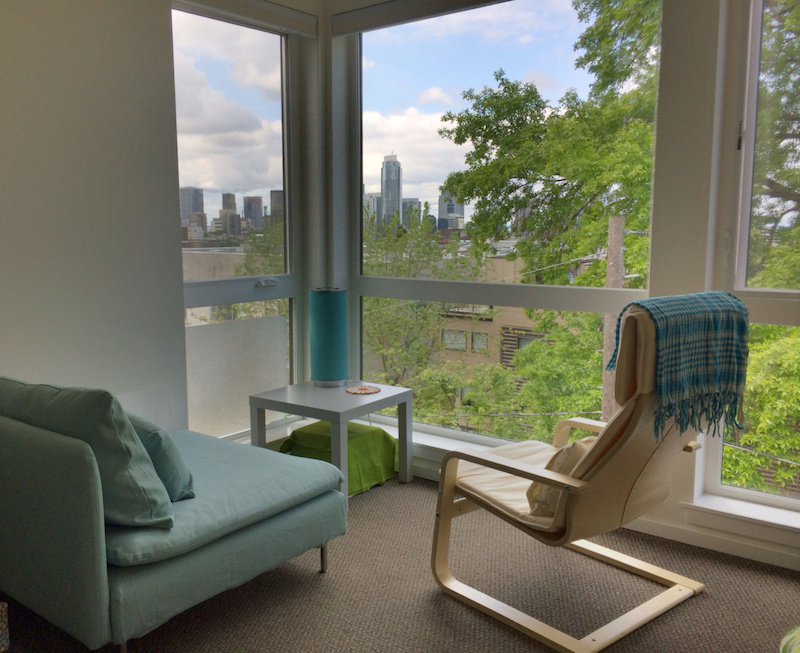
She looked around at various micro-apartments in Seattle–many of which she found too tiny and depressing–before finding her current place in the Capitol Hill neighborhood. The apartment is roughly 300 sq ft with floor-to-ceiling windows that have a view of Seattle’s skyline. “The great view makes my tiny space feel big,” she told us.

The apartment costs $1000/month, which includes basic furniture, Internet, and all utilities. That includes a $50/month premium to have a six month lease. While not dirt cheap relative to other places in the neighborhood, she sees many perks. She wrote, “I could have found a much larger, full studio apartment in the same neighborhood for $1,200, but I would have had to pay extra for utilities and Internet, buy more furniture, and commit to a year-long lease.”

“The best part of living in this micro-apartment,” she writes, “Is that it makes living in what is normally an expensive neighborhood affordable, by cutting back on space. Space is the thing I care least about since I have very few possessions.”

Hennig is a poster child for lightweight living. She writes, “I prefer experiences to things and I like working for myself. I’d rather rent than own practically everything in my life. I’ve owned thousands of books over the years and now I’m happy to only have e-books. I don’t own any more music or movies, preferring Pandora and Netflix. If I need a car, I use Zipcar, Car2Go, or I get a ride from Sidecar, Uber, or Lyft. When I was in Portland I rented a bike from a local person for the whole six weeks I was there, using Spinlister (for a much cheaper price than a bike shop rental).”

hennig-kitchen

Of the building itself, she doesn’t report much in the way of community spirit, saying that, like most city-dwellers, most residents keep to themselves. And though there are communal kitchens in her building, she rarely sees anyone in them. She prepares her food in her apartment, mostly using a little rice-cooker/veggie steamer, and a small travel blender, as well as occasionally ordering out from the bevy of great, cheap takeout places nearby.

hennig-micro-roofdeck

“People do use the roof deck one level above me,” she writes. “There are chairs and grills for cooking out. I met a few people from the building on the 4th of July when I got home from a party–everyone went up to view the fireworks from the roof.”

While this sort of minimal living might seem to discourage feeling grounded and tending longterm relationships, she says the opposite is true. “I consider my home to be wherever I am. It’s very easy to keep in touch with my closest friends and family in Boston, Vermont, and San Francisco, and eventually I’ll probably build one more community of friends somewhere. Then I will float between them at different times of year. I collaborate online with others on some of my work projects, so I never feel isolated in my work life. In each location I’ve met friends of friends to hang out with and I always end up getting invited to holiday celebrations, bike rides, tours of the city by locals who like to show off their city, and so on. I also become a regular at the various coffee shops where I work and chat with the employees there.”

“Overall, I would say that a micro-apartment is perfect for my nomadic life, making it affordable and convenient to live in a great urban neighborhood for the nice-weather part of the year,” Hennig writes. “I love my view, and my neighborhood and I love having few possessions. When it’s time to move, I’ll probably hire a Task Rabbit to come get the few furniture and household items I purchased to use while I’m here and sell them on Craigslist for me. I’ll probably pack of a box of a few items and mail it to myself for use in my next six-month rental–or I’ll just have him sell all of it for me and go back to staying in furnished Airbnb rentals for a while, I’m not sure. I might use this ‘closet in the cloud’ service [MakeSpace Air] I heard about recently to store a few things until I find the next apartment.”

In many ways, Hennig embodies a sea-change in terms of how people can live. She forgoes space for location, she uses technology to both reduce her possessions and professional location dependence. It’s a lighter, less encumbered, simpler lifestyle–one that we think will be far more common in the near future. Read more about Hennig’s life on her blog Location Flexible Life.

Bicycle-Powered Nomadic Housing

Maybe it’s the cooling temperatures, or the fact this author has been hanging out at home too much as of late, but there’s been a ton of talk about nomadic living on this site as of late. Last week, we looked at Foster Huntington, a full-time-camper-pickup-living-nomad and bon vivant. While I definitely dig his lightweight setup, one question has always troubled me about his and all petrol-fueled mobile living arrangements: what do you do in the event of a complete societal meltdown? Really, when SHTF, it’s going to be tough to move your ICE-powered home to more favorable environs if gas costs $20/gallon or is simply unavailable. (C’mon, I can’t be the only one thinking these things).

Resilient nomad housing would have to have minimal grid-dependence, which is why we dig the Taku Tanku concept by Japanese design firm Stereotank so much. It’s a trailer that’s minimal enough to be towed by foot or bicycle. If we were ever to face a Mad Max dystopian reality, we’d want this as our home way more than some 454 V8-powered behemoth.

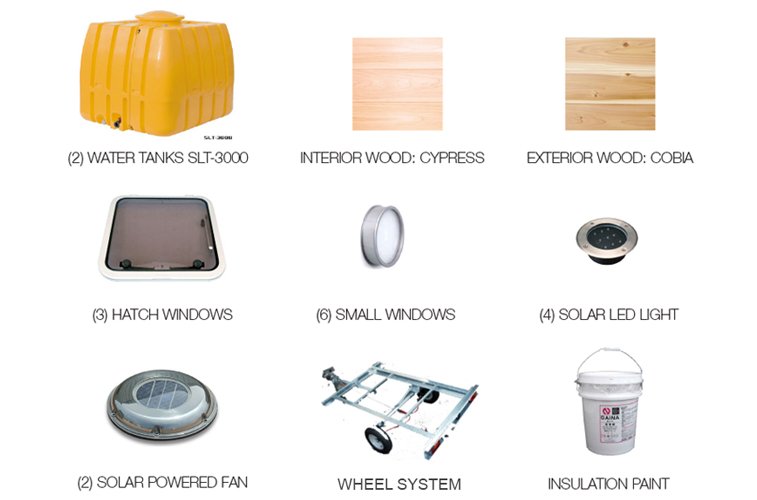
The Taku Tanku is designed to sleep 2-3 people and carry a bit of luggage. It can be made of lightweight, off-the-shelf materials; its main structure being two 3K liter water tanks. There’s really not that much more to it.

tricycle_house

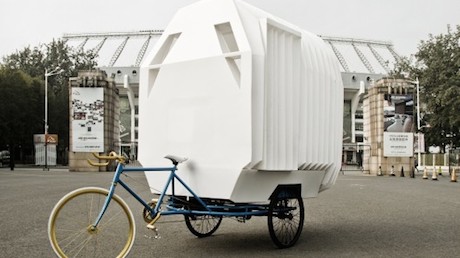
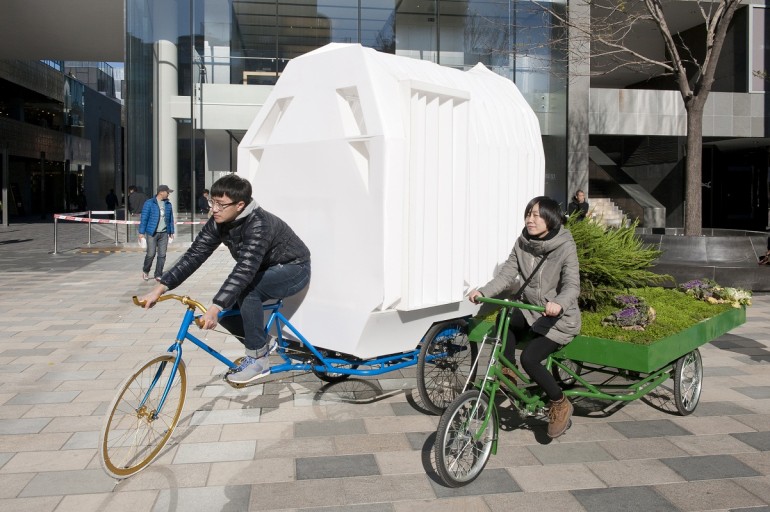
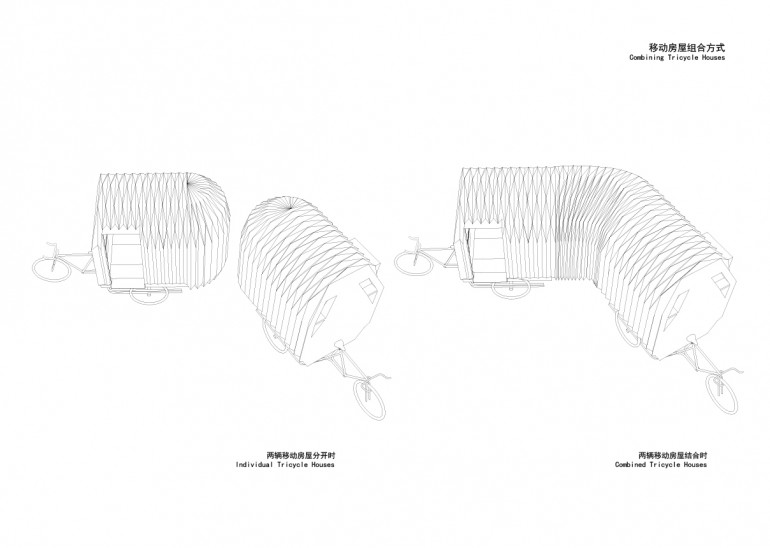
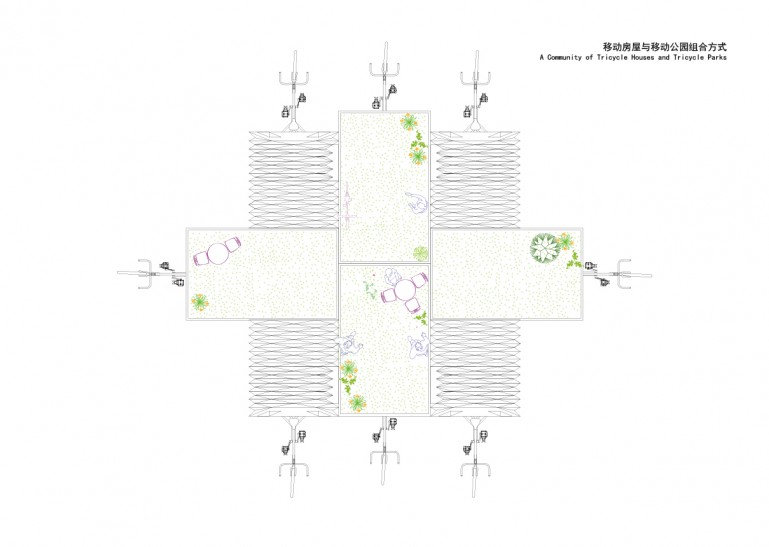
This is not the first time we’ve seen human-powered nomadic housing. The Tricycle House, was, as the name implies, a house affixed to a tricycle. Unlike Taku Tanku, a Tricycle House was built. Each house has its merits. We suspect the Tricycle House’s flexible folding, accordion structure, while lightweight, might not be as durable at Taku Tanku’s. The Tricycle House is smart because it’s designed to be used in tandem with a trike-powered garden, making sure you can tow your food source in case things get nasty. If S really did HTF, it’d be good to work through these important considerations ahead of time…just saying.

Via Gizmag


Modern Nomad Asks the Question, “Are We Meant to Live in One Place?”

For most of the 2.5 million or so years humans have been around, we have been nomads. Humans were tethered to the meanderings and vicissitudes of herds, flocks, the availability of foraged edibles and climatic shifts. People traveled, ate and lived light. Then around 10K years ago, there was an agricultural revolution. People started making land produce food that exceeded subsistence levels. People stopped moving so much. They built houses close to their crops. They created surpluses of food and some people started making stuff other than food. Those non-food producers needed a place to live, so they made villages. Those villages became cities. The cities became so crowded humans made suburbs. Surpluses became so great we made Costco…and so on.

Given that we humans spent 2,490,000 of our evolution wandering about and a mere 10K staying put, it’s not a huge mental leap to think some of our biological default settings are set to nomad. This ostensible (though far from verified) biological disposition would explain quite a bit about people like Foster Huntington.

In 2011, Huntington was working as a designer for Ralph Lauren in New York City. He decided to leave his job. He bought a camper van and has been traveling ever since. He has supported himself by writing a couple books, “Home is Where You Park It,” and “The Burning House: What Would You Take?“–both espousing the benefits of lightweight, nomadic living (the latter sharing a theme I wrote about on this site). According to Business Insider, he and some of his cadres have even created a business converting vans and buses into living spaces.

Huntington is a prolific Instagrammer, and his feed shows a life of intense and idyllic leisure, replete with beaches, gorgeous vistas, impromptu camping, snowboarding and surf trips. There are many pics of his and his cronies’ van, car and bus-based “homes.” He appears to be currently stationed with in some paradisiacal treehouse with a bunch of his buddies.

Just to save you some energy, we will preempt your critique that Huntington is young and single, and this type of living is not feasible for families. As we’ve seen on this site, families can and do live nomadically, though admittedly it’s probably more challenging. And yes, most careers wouldn’t accommodate this way of life. And sure, the 100K miles Huntington has driven leaves a carbon footprint, but we suspect it’s much smaller than heating, cooling and operating most homes, not to mention most people drive almost that much in their day-to-day lives.

If you put aside the critiques, I think Huntington shows that the good life need not be a heavily loaded one. He shows that by paring things down to the barest of essentials (a requirement for living in such a dinky space), you don’t need a lot to get by. And all that time spent maintaining our lives’ structures (the homes, the stuff, the careers) might be spent enjoying things far less serious and far more fun. And he shows that we can choose how we want to live, even when it seems like that choice might have already been made for us.

See more of Huntington on Restless Transplant and Van Life

[Thanks for the tip Robert]

Via Business Insider


Tricycle House Makes Tiny Houses Look Decadent

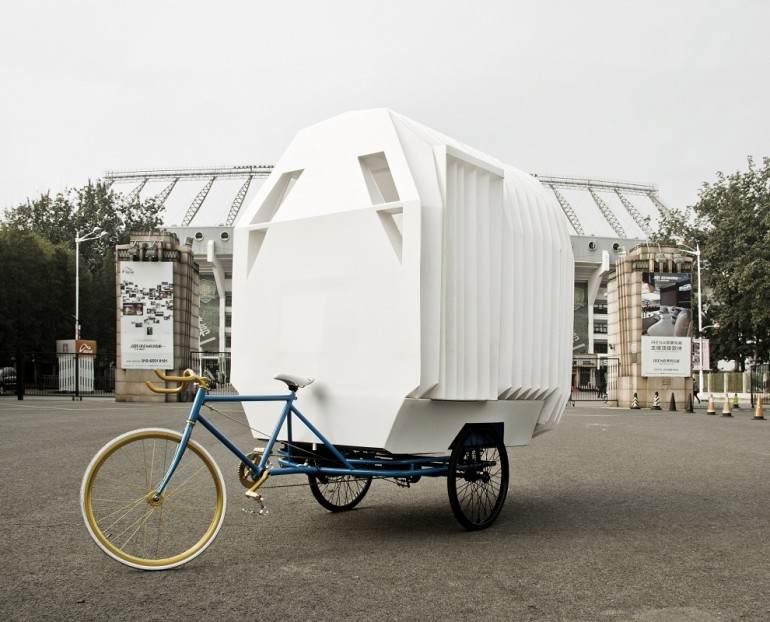
Sure, tiny houses are tiny, but they seem downright palatial compared to the Tricycle House. The project, part of the Get it Louder Exhibition in Beijing, is collaboration between People’s Architecture Office (PAO) and the People’s Industrial Design Office (PIDO). Like Tiny Houses, the house is as much a political statement as it is an architectural one, providing a response to the soaring price of Chinese real estate and government “land grabs” that have displaced many Chinese citizens. The tricycle provides the opportunity for home ownership, albeit on very small scale.

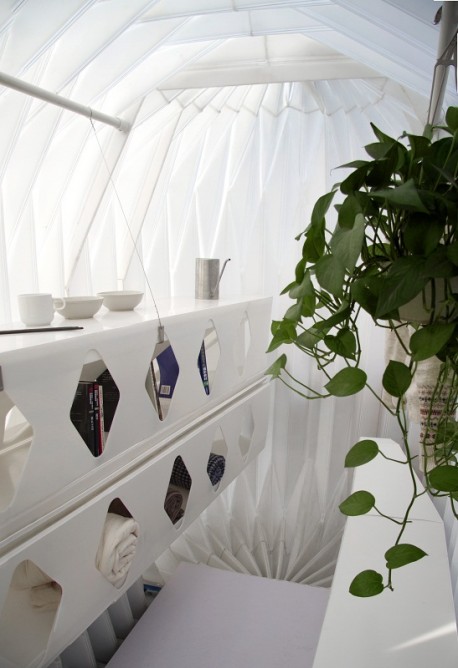
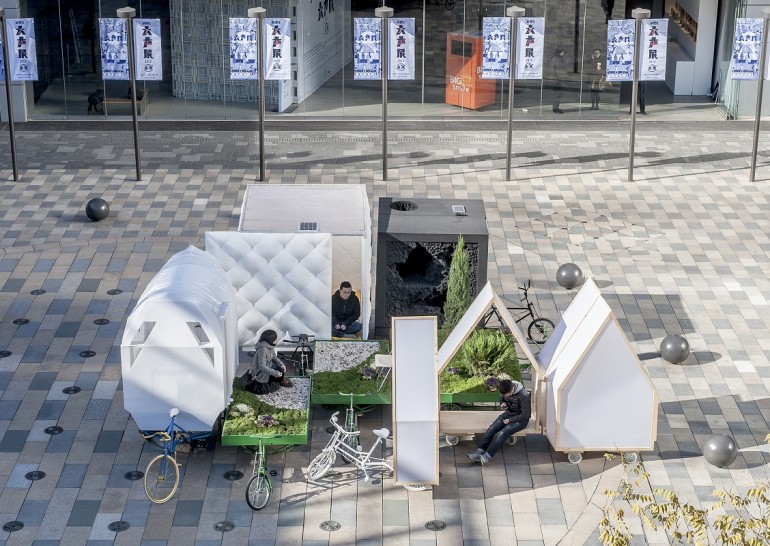
The polypropylene-constructed house is roughly 30-35 square feet and can be used as a dining room, kitchen, bedroom, workspace and bathroom. It boasts some impressive features such as a bathtub and clever folding sink and drawers. Similar to the Napoleon Complex, the house seems best used when coupled with other tricycle houses and tricycle gardens.

We’re not sure if there are any plans to develop the idea beyond concept, but a similar lightweight, off-grid housing structure would make a great edited recreational vehicle.

Via Gizmag and Treehugger

Thanks Susan