Hipster-ific, Human-Powered Automobile Alternative

We are forever on the lookout for great ‘edited’ transportation options. Bikes, walking and public transport are the ostensible ideal modes of transit, but for many they lack the protection, carrying capacity and range to make them feasible daily transport. Conversely, car-shares, trikes and other minimal ways of getting around using internal-combustion engines and 1K lb + masses of metal are overkill for many. A company called The Future People is striking a nice middle ground. Their Future Cycles are lightweight, human powered vehicles that, for some, could be real replacements for the personal car.

TFP is a design collective, principally made up of husband and wife Cameron and Rachael Van Dyke. According to their website, they are out to “test alternative value systems related to housing, transportation, and community.” They unveiled two Future Cycle models at the recent Detroit Auto Show (TFP’s hometown), wanting to “propose an alternative set of values in relation to transportation,” according to a press release.

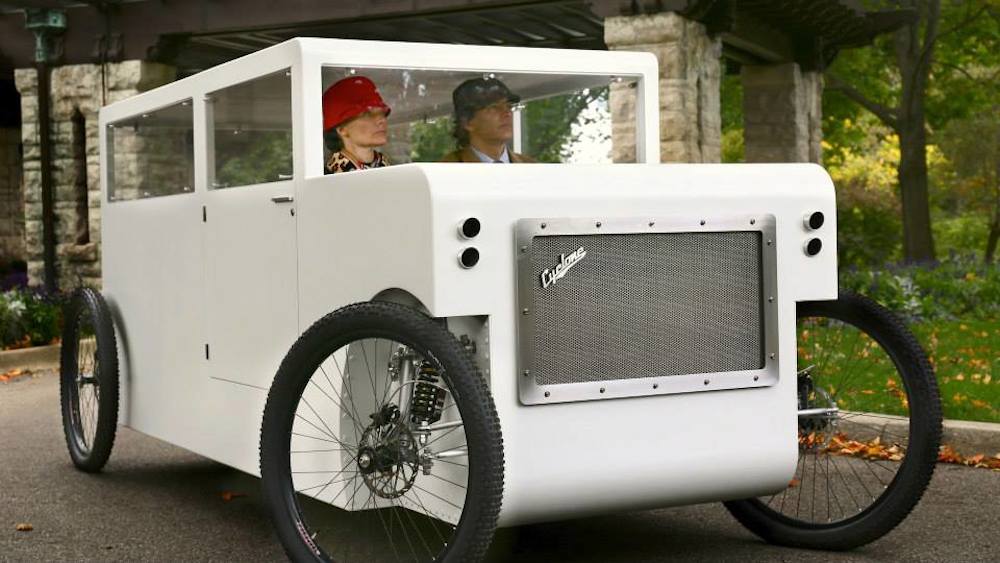
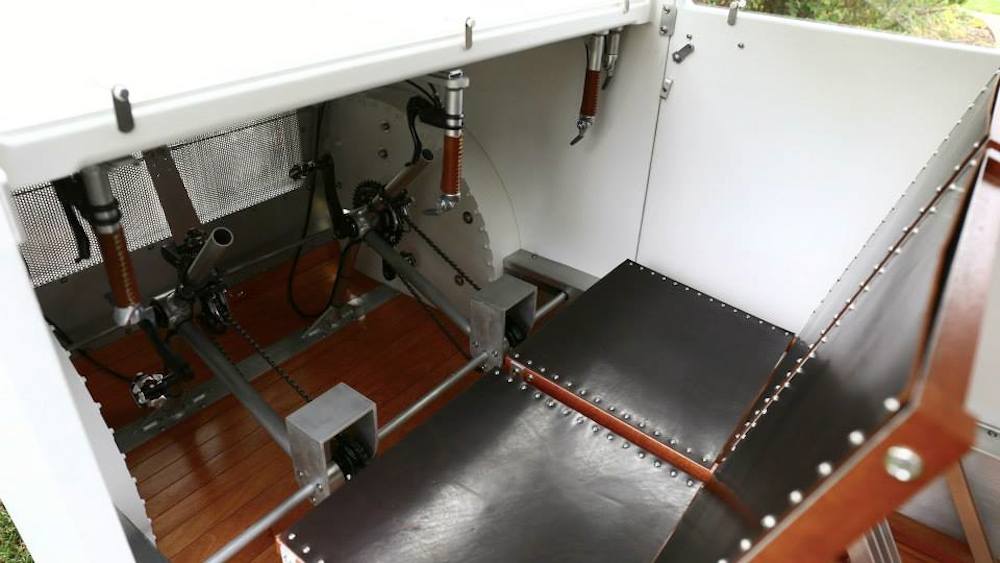
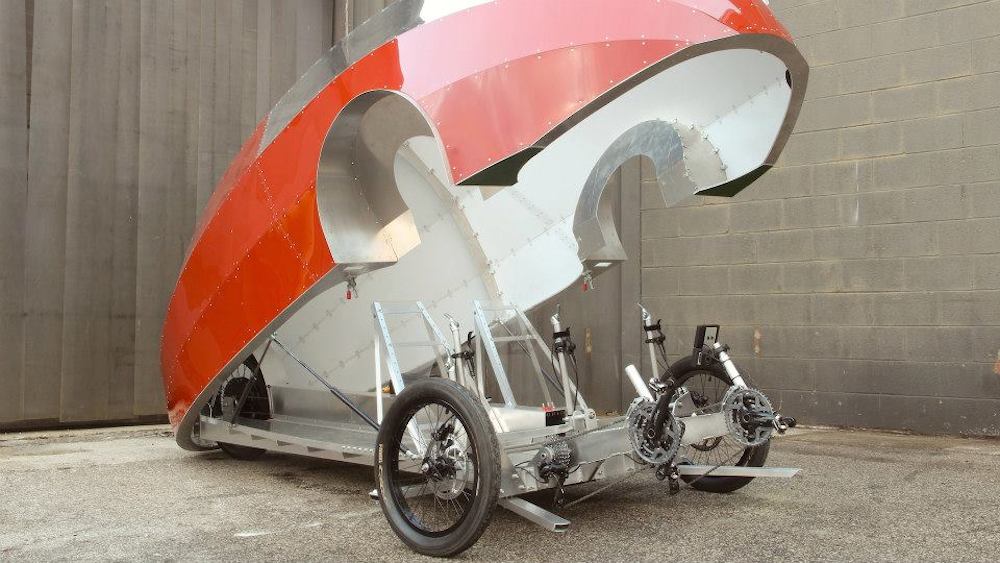
One model is named the Cyclone. It’s powered by two peddlers up front and seats four. According to TFP, it takes design cues from the Model T and the iPod. With its mahogany floors and leather seats, it is painfully stylish, however I suspect it’s boxy shape is like doing a bellyflop with the wind (not cool when efficiency is the name of the game) and I might trade those amazing-looking mahogany floors for something lighter (though, to be fair, it is a concept).

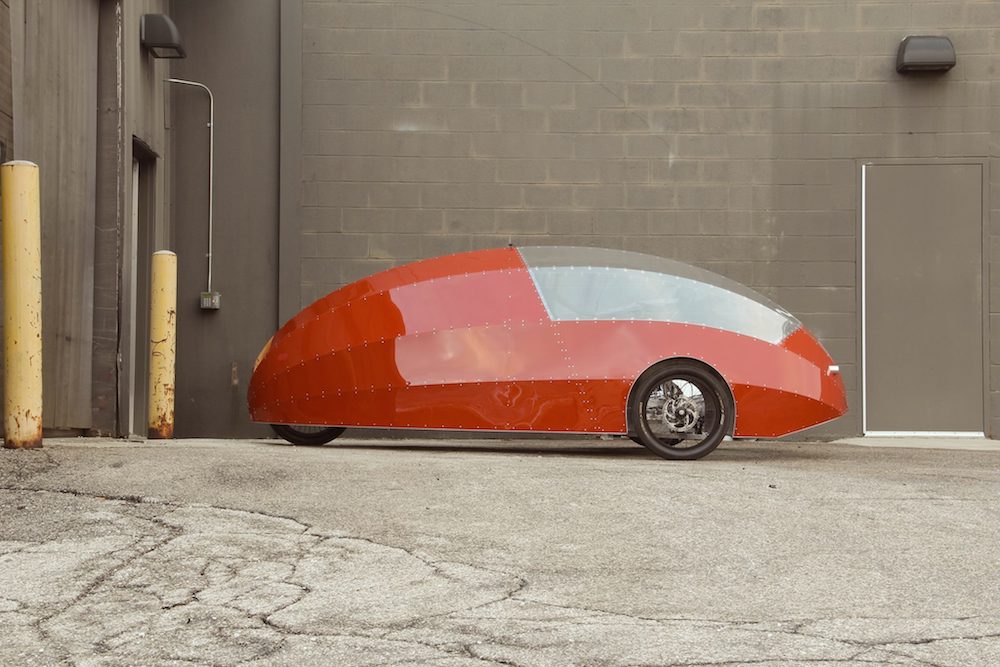
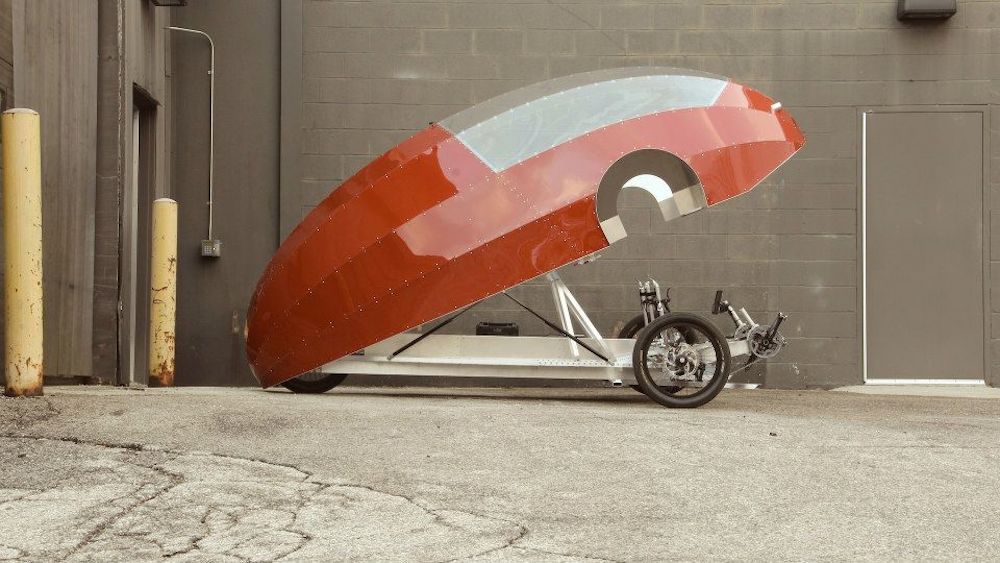
Far more interesting is the Zeppelin, a slug-shaped two-seater with pedals and a 750w electric rear motor with a 20 mile range. It only weighs 270 lbs, has a big boot for lugging stuff and can cruise at 25 mph on flat ground. The shape, unlike it’s boxy brother, looks like it would slice through the wind. It meets the federal bicycle classification and therefore requires no license, registration or insurance.

“The goal with the Zeppelin was to find an ideal point at which a bicycle and car could coexist within the same object,” according to Cameron Van Dyke, “creating a truly hybrid design.”

If you want one of these vehicles, you are probably going to have to wait. Unfortunately, unlike the Organic Transport ELF that we looked at last year, the The Future Cycles don’t appear to be for sale. We hope that changes.

Via PSFK

Truly Edited Transport

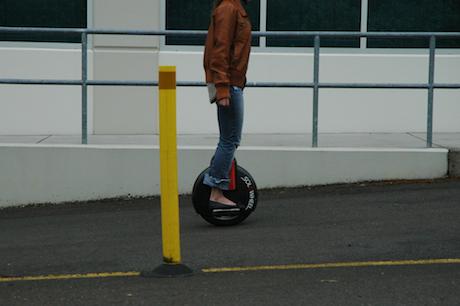
If you can make the leap from four-wheeled car to two-wheeled bike, why not halve the wheel count again? That’s the idea behind Focus Designs‘ SBU V3 electric unicycle. The 27 lb unit does 0-10 mph in three seconds, has a 12.5 mph top speed, goes 10 miles between charges and handles up to 325 lbs of rider weight. Pretty impressive for one-wheeled transport.

The SBU works much the way a Segway scooter does, with fore-aft self-balancing mechanisms (SBU stands for self-balancing unicycle). Left-right balance, on the other hand, is your responsibility. Turning involves leaning your body weight to the desired side. There’s a reverse, that’s activated by leaning forward.

The company says using the SBU is much easier to learn than a normal unicycle (that’s a relief), saying it typically takes between five minutes and two hours to get the hang of it. There is an optional Noob training wheel to assist your learning curve.

sbu-dimensions

The whole unit stores quite compact: the base is 22″ x 18″ x 7.5″. The basic unit is $1795, plus a $225 charger. Not cheap, but theoretically, if you were to use the SBU on regular basis for short commutes, its expense could be justified (think of it as a faster, electric-assisted, Razor scooter with one wheel and no handlebar…not a good comparison really).

solowheel

If the SBU is neither harrowing nor small enough for your liking, the SBU guys also designed the Solowheel a while back, which does away with the silly seat. Smaller is not cheaper however. You can pick one up for $1995 on Amazon.

Having never tested either the SBU or Solowheel, we’ll suspend any judgments about their usability. And even though they strike us as a bit expensive, we do see the merits of a mode of transport between walking and biking–something quicker than the former and more portable than the latter.

(thanks for the tip Jonny!)

Living in a Bicyclists Paradise

We don’t hide our ardor for bicycles. They are the most efficient form of transportation known to humans. They don’t take up a lot of room. They are relatively affordable and make us fit and happy. But we admit, they simply aren’t practical in a lot of places. Amsterdam is not one of those places. As this short movie called “Bicycle Anecdotes from Amsterdam” attests, bike culture is simply culture to Amsterdamers.

One thing we learned watching the movie is the city’s history with the car. In the 50s and 60s, regulation and urban planning were supportive of cars. But a subsequent increase in congestion and automotive fatalities–coupled with the 1973 oil embargo–led to the car’s decline and the bicycle’s ascent.

There are many reasons bicycle culture flourishes in Amsterdam. The pancake flat city has vast networks of bike lanes, bike parking and bike-friendly laws. The scenes from the movie make cars look anomalous. Dutch bikes are very utilitarian, lacking the fanfare they do in the States; they are heavy, somewhat anonymous and have an upright position that prohibits high speed. Amsterdamer children begin riding young and by adulthood are very competent riders.

There’s the suggestion in the movie that the Dutch’s adoption and subsequent rejection of the car might influence Americans, who are still pretty tethered to their cars. We think this parallel holds up to a certain extent. Amsterdam is a historic city, whose core was conceived long before cars or even bicycles. For older American cities like New York, Boston and San Francisco, which were planned prior to the advent of the car, a widespread adoption of the bicycle as primary transport seems feasible. But for other cities like Houston and Los Angeles, who came about in the age of the automobile, this adoption might prove more challenging. Like most things, necessity will be the key factor–when gas becomes prohibitively expensive, many people will discover a love of the bicycle as deep as the Dutch.

Via Treehugger

Electrify Your Bike with these Revolutionary Wheels

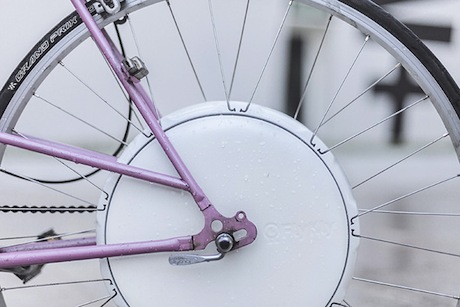
If your commute is too far for a bike ride, but too short for a drive, you may have considered an electric bike. E-bikes promise less carbon, effort, hassle and expense than a car. But buying another bike, particularly one of the ungainly e-bikes that seem to be popular, might not be so appealing. A couple new products are offering the perfect solution: by slipping in a special wheel, they turn your existing bike into an e-bike.

copenhagen-wheel

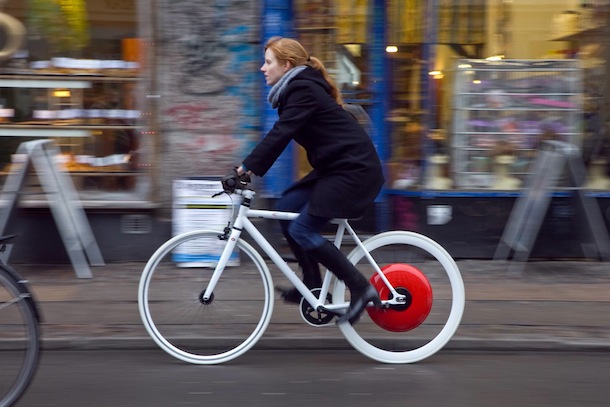
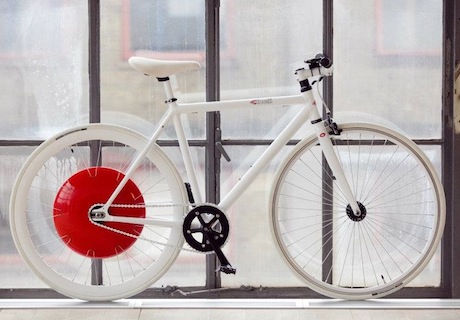
The Copenhagen Wheel by Superpedestrian actually measures your power output and automatically determines when you need an extra jolt. Power is derived in the same way hybrid cars get theirs. The wheel “captures the energy dissipated when you brake or go downhill, storing it in a lightweight and high-capacity lithium battery,” according to SP’s website. The company reports that the battery has a 15 mile range when fully charged (it’s not clear why it can’t be continuously charging).

The wheel also feature a Software Development Kit (SDK), which enables app developers to hack the wheel to make it do things like pollution monitoring and navigating.

The wheel was invented at MIT’s SENSEable City Laboratory and unveiled at the 2009 Copenhagen Climate Talks. The team behind the wheel decided to form a company late last year. The NY Times reported the other day that the company just received $2.1M in funding. The wheel is set to be released in late November. Pricing unavailable at this point.

The other wheel is called the FlyKly. The wheel’s development is being funded through a Kickstarter campaign (it has long since passed its $100K goal). It is packed with bells and whistles (figuratively speaking). It is available in 26″ and 29″ varieties and weighs 9 lbs. You can plug in the FlyKly for additional power and achieve a 30 mile range. You can lock the wheel remotely. They have their own SDK for hackability. It also has an available light that is charged via a dynamo, which also has a USB port where you can plug and charge your phone. FlyKly is projected to ship in April or May of next year, and you can buy one with a $590 pledge.

flykly

These wheels look and perform remarkably similar to one another, and one (we won’t say which) might be derivative of the other. That’s okay with us. Just as there are Toyota Prius’ and Honda Insights, the world can probably stand to have more than one ultra-efficient, bicycle-based mode of transportation.

Via Fast Company

A Case for Buying the Bike You Want

We don’t do–or at least haven’t done–car reviews on this site. One reason is that car companies aren’t exactly eager to have us dole out opinions about their new turbo-charged super-sleds to a bunch of design-oriented minimalists who err on the thrifty side. But another reason is that we don’t like cars very much. Sure, they get us around. Some of us even have them (this author shares a well-used Honda Element with his wife). But our relationship with them is one of tolerance and necessity, not adoration. Cars are expensive, dirty, promote sprawl and have many moving pieces that tend to complicate life. We appreciate that many of our lives cannot function without owning a car, but if workable with your lifestyle, we recommend selling your car and picking up a car-sharing membership instead.

Bikes, on the other hand, are a different matter. Maybe it’s because they are the world’s most efficient form of transportation, or because they condition our bodies as they get us to our destination, or because we need somewhere to place the fetishism we had for cars in our youths–whatever the reason, we love bikes.

When we test drove the Schindelhauer ThinBike last week, we received a few comments about its $1500 price tag. We notice people tend to balk when a bike’s price goes north of $1000–a figure that seems orders of magnitude greater than the $60 Murray of our youths. While we won’t deign to say how much you should or should not spend on a bike, we will make this recommendation: Don’t be afraid to buy the bike you like and will ride…even if it cost more than $1000.

There are some technical reasons why you should consider an upgraded bike. Cheap bikes tend to be cheaply made; they often have crappy bearings and seals, stamped (not forged) metal parts that bend, steel rims that rust, brakes that barely stop, frames that weigh a ton. And before you say you can’t tell one bike from another, test ride an expensive bike against a cheap one. See if it doesn’t ride better and is not easier to pedal, shift and brake.

There are also intangible reasons why you should consider an upgraded bike. In an edited life, one where most everything you have is necessary, it’s important that the stuff you have is the stuff you love and will use. Every item you have needs to be a starter, not a second-string player.

This longwinded preamble was really just an excuse for this author to show off his new bike.

Before I put it together, I had two bikes: A well-worn road bike with a slightly buckled headtube and a mountain bike I was always planning on (but never) riding. I decided to trade both in and get the one bike I wanted and would match my riding needs. BikeEdited, if you will.

The bike is built around a very basic chomoly-tubed frame by a company called Murphy Himself (I think it’s one guy actually). I chose it because it has multiple eyelets where I could install fenders and a bike rack for a baby seat or touring. I like it’s clean, decal-less look. It’s not particularly light, but I’m not riding competitively so why should I care?

(As an aside, if you are overly concerned about bike weight, specialized equipment or having the latest and greatest equipment, you must read Grand Petersen’s “Just Ride.” Petersen is the founder of Rivendell Bicycle Works and debunks many commonly held myths amongst ‘serious’ cyclists, such as the necessity for clipless pedals, padded shorts and carbon frames.)

Like I mentioned, a big priority was having full fenders. Even light rain on a fenderless bike can create a huge stripe up your back. I wanted to make sure I was fully protected. Clip-on fenders tend to rattle off and provide incomplete protection, so I purchased a set of Velo Orange hammered-alloy full fenders that fit and look great and provide ample coverage.
alfine-rear-hub

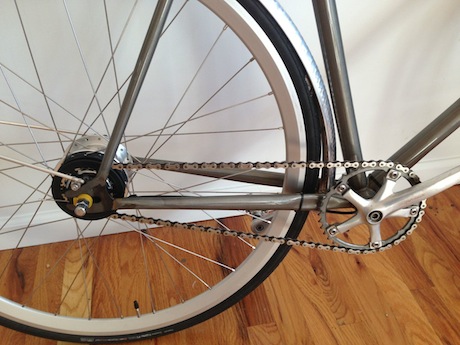
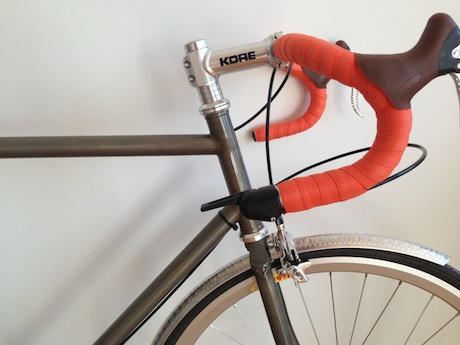
Next, I wanted a bike that was almost maintenance free, so I decided to use a Shimano Alfine internal 8 speed rear hub instead of a derailleur-based drivetrain. It’s a bit heavy, but it shifts flawlessly and 8 speeds is enough (don’t ask Petersen what he thinks of 33 speed drivetrains). Because I wanted to use drop bars, I purchased a bar-end shifter from a company called JTek Engineering.
jtek-shifter

The rest of the bike is a smattering of new and old parts stripped from my previous bike: A Dura-Ace crank, Mavic front hub, Velocity Deep V rims, Panaracer tires, Ritchey seatpost, Selle San Marco saddle, Cinelli bar, Kore stem, Tektro brakes. When all was said and done, the bike cost around $1400 (I saved a little money using old parts).

I love the way the bike rides, fits and–I’ll admit it–looks. I make up excuses to ride it. And therein lies my point: When we get the stuff we want–whether it’s a bike or a frying pan–we use it, cherish it and take good care of it. A bike just happens to be an important piece of stuff in our estimation. And while this cherished stuff might be a little more expensive (or not), as we like to say around here, “If something costs twice a much, but lasts four times as long [or is used four times as much] it’s effectively half price.”

None of this is an excuse to spend money needlessly. Nor is an excuse for a superfluous upgrade. And many may find a cheap bike they can safely lock outside serves their needs better. Likewise, there are many great bikes under $1000; if you know a thing or two about bikes, buying used can be a sound idea. We’d also be remiss not to mention bike sharing. For many city-dwelling bike commuters, systems like NYC’s Citi Bike effectively eliminate the need to own a bike at all.

For the rest of us who don’t live near a bike sharing system or have long distance commutes where a personalized bike makes a difference or just like riding our own bikes, we think making an investment on a bike you love and will ride is a good one.

[Full disclosure: In my previous life, I worked at five bike shops, crossed the US and a few other countries by bike and have generally been an advocate of bicycles.]

The Bicycle is the Official Vehicle of the Edited Life

We know there are many parts of the world where driving is extremely impractical, and we are not here to begrudge the multitudes for whom that is a reality. But make no mistake about it, no mode of transportation gets you around more effectively, efficiently and with minimal overhead than bicyling.

Consider the passenger mile per gallon of various modes of transport as a function of caloric energy expended over distance:

Nothing beside subways comes even close to a bicycle’s efficiency. But not everyone has a subway system in their area. And, as recent events are showing, even those who have great subway systems can be left at the mercy of repairs.

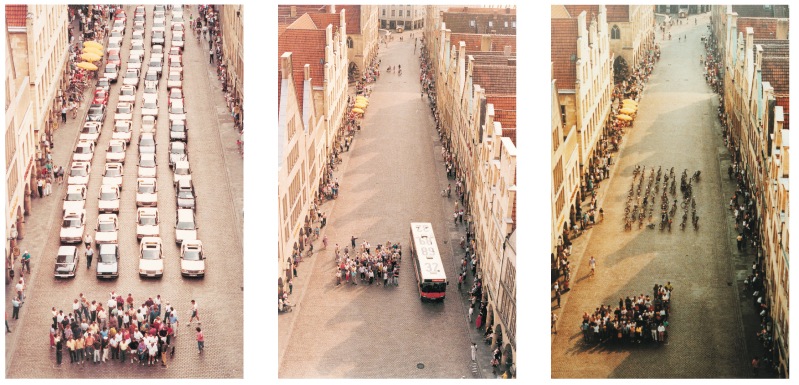
Then consider the sheer area consumed by bikes versus other modes of transport. The picture at top shows 50 people and 50 cars at left, 50 people and a bus in the center and 50 people standing by 50 bicycles at right. It’s a great illustration how cars make cities more crowded and cast suburbs further afield.

Biking may even reduce your personal area as a 150 lb bicycle commuters riding at 12-14 mph for 30 minutes burns 297 calories during his or her commute.

And even though walking takes the minimal volume prize, the 250% increase of efficiency compared to a slight increase in volume make bicycling a no-brainer for commutes longer than a mile.

Other benefits of ditching your car for a bike include avoiding costly car registration, repairs, insurance and fuel. An added bonus is that traffic becomes a thing of the past. Ridding yourself of managing these annoying details makes life simpler and happier.

So maybe you are considering commuting to work or doing more errands on your bike, but something is stopping you. Here are a few suggestions to help you get started:

  1. Get a bike you will ride. Some people think the Salvation Army is a bike shop. It’s not. Consider how much you will save by driving less, go to an actual bike shop, find something that fits your body and riding style and invest accordingly.
  2. Get some bike friendly clothes. We talk about Outlier a lot here, but there are many other commuter-friendly clothes out there such as Betabrand and even Levi’s that work too. It’s best to have clothes that are both durable and permit movement necessary to pedal.
  3. Get full fenders. Unless you live in the desert, you will deal with rain at some point. Few things are as gross as dealing with road grime all over your clothes after a light shower. Nothing helps avoid that like a set of wraparound fenders. Clip-on versions will work in some cases, but often leave you unprotected. When buying a new bike, make sure the frame is compatible with fenders.
  4. Learn how to take care of your bike. Get regular tuneups. Have a good floor pump. Get some decent chain lube (i.e. not WD40). Learn how to fix a flat (it’s not that hard). Many people avoid riding because they are afraid something will go wrong–it might! Learn how to deal with the situation rather than avoid it.
  5. Be flexible. Riding three out of five days is better than not riding at all. If there’s a blizzard, it’s okay to take public transport or drive. Going from two cars to one makes a big difference too. The key is just start riding!

Graph statistics by James Strickland, 2009