Simple is as Simple Lives

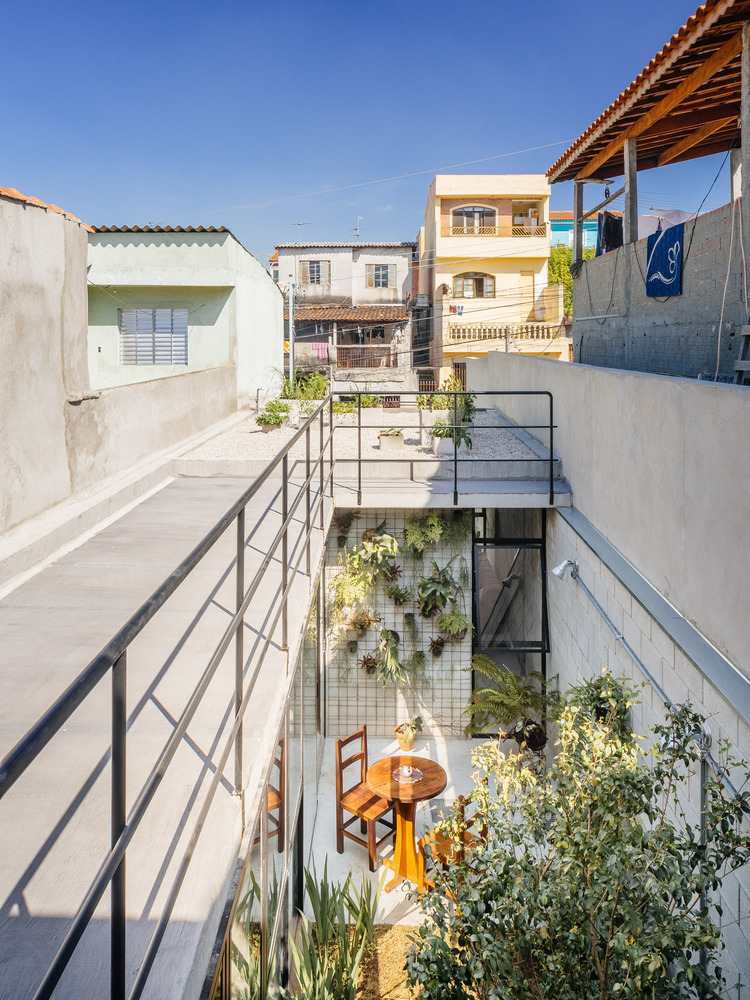
Sure, high tech micro apartments are pretty nifty, but never underestimate the power of good design even with the most meager means. Case in point is Vila Matilde by São Paulo’s Terra e Tuma Arquitetos. Ms Dalva, the owner of the home, has lived in the same location for decades.  When her previous structure started crumblilng down around her, she was faced with two options: buy an apartment that would exhaust all of her savings and put her further from her family, or build a new structure. Ms Dalva’s son reached out to Terra e Tuma to help design the structure we see here.

The house took only 10 months to construct, four of which were spent tearing down the previous structure. Time was of the essence because the longer the build out took, the more money Ms Dalva had to shell out.

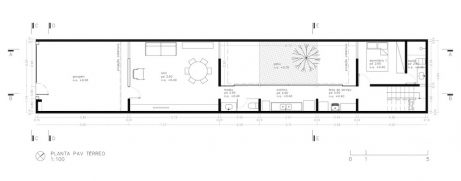
(\\tt03\Volume_1\Clientes\INATIVOS\162\Publica347365es\162_desenhos_publica347343o_R01.dwg)

Much of the house is actually retaining walls of the 16’ x 82’ lot. The walls create the house’s form while acting as supports for the neighbor’s buildings. The ground floor has two main sections separated by an inner courtyard. The front section contains the living room and the back the bedroom. There is a narrow corridor lining the courtyard containing the bathroom, kitchen and laundry. The top floor has a guest room and vegetable garden.

While no mention is made of exact costs, the place is made primarily of unfinished cinder block and poured concrete, which we imagine helped keep costs very low.

Despite its modest design and resources expending—or probably because of them—the house won ArchDaily’s Building of the Year.

HT Tim D.

Photos ©Pedro Kok

The New Starter Home

Somewhere between now and 1950 (or thereabouts) something went wrong with American housing. Back then, car-fueled sprawl hadn’t yet driven people so far from city centers. At 983 sq ft, the average home was just about right sized for the average household size of 3.54 people (277 sq ft/person). Architect Jonathan Tate told Fast CO.Design said this is what went wrong:

Houses morphed from a consumer good into an investment commodity, which in turn led to developers building cookie-cutter starter homes based on what they deemed to be the most likely to appreciate in value. Houses became more expensive to purchase and maintain, their sizes ballooned, and they were increasingly located in areas far removed from established neighborhoods since it was less expensive to buy greenfield land.

This morph made homes prohibitively expensive to large swaths of the population, evidenced by a 48 year low in homeownership rates in 2015. Tate and developer Charles Rutledge recently launched the Starter Home* project as a response to the commodification of homes, designing and developing housing around how people live.

starter-home-back

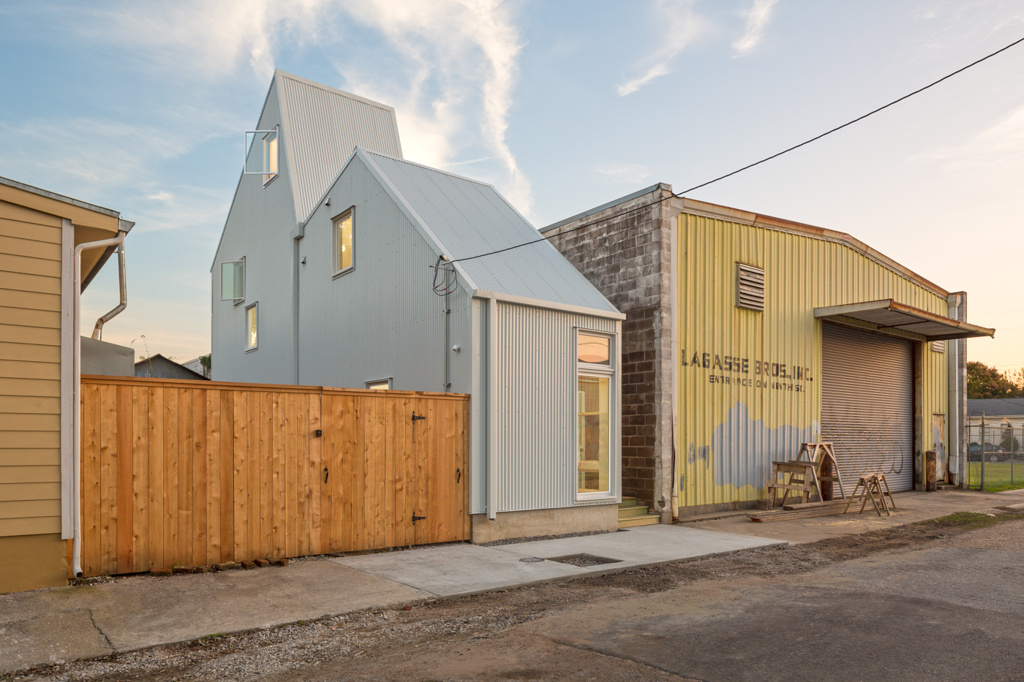
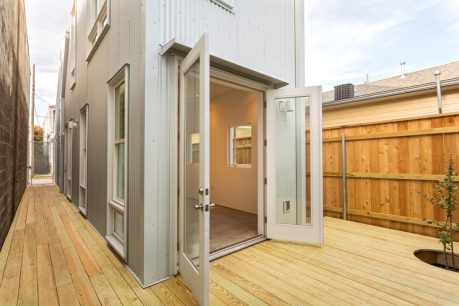
The first Starter Home* recently went up in New Orleans. It’s 975 sq ft, but its actual footprint is only 473 sq ft. Even with setbacks and some outdoor space, it can fit onto a very small 16.5’ x 55’ lot. The compact proportions make the house ideal for urban infill development, using lots that might not support conventional homes. This has the benefit of allowing the developer to purchase centrally located land at a discount, which in turn creates a lower purchase price. The first starter home cost $339K, which is about $35K more than the average New Orleans listing. Tate believeshe can drive that price down with scale. Tate has 15-20 projects in the pipeline and is planning on making Oakland, CA the next stop for the Starter Home*.  

The basic tenets of the Starter Home* are great: reduce the size and price of single family homes; bring more housing into our city centers; bring sanity back to American housing. With the average new single family home size hovering around 2700 sq ft, we need this now more than ever. 

For more information and images head over to CO.Design

Absurd Rents Lead Man to Think Outside Box, Live in One

We always feel a little bittersweet when we run across people living affordably and microscopically in extremely expensive cities. On the one hand, it’s a testament to human ingenuity and we love gawking at their cleverness. On the other hand, it’s a bummer that people can’t simply afford a decent little place in a major city without selling multiple vital organs. As one of–and perhaps the most expensive American city to live in–few places are as bittersweet as San Francisco. And few people are as bittersweet as 25 year old freelance illustrator Peter Berkowitz, who lives in a plywood box set up in a friend’s living room.

perterberk-interior

The box measures 8’ L x 3.5’ W and 4.5’ tall. It has a bed, storage and even a desk that folds out from the, um, wall. Though probably not up to code, it does have a skylight, window and door. As far as plywood box bedrooms go, it’s a nice one. But it’s most important feature is its price: $400/month (+$1300 construction costs). In a city where the average rent is north of $3700, this is a true deal.

Of course we believe people should have the right to live how and where they want to–that is, within certain parameters of safety and livability. Berkowitz is no victim here. He writes in his blog:

Yes, living in a pod is silly. But the silliness is endemic to San Francisco’s absurdly high housing prices – the pod is just a solution that works for me. Many people have apartments with the space/ capacity to house another person but choose not to because there isn’t an attractive way to do so. Temporary partitions offer poor privacy, especially in terms of sound.  They also tend to ruin whatever room they’re in – you’re less likely to use your living room if it doubles as a bedroom.

There you have it. 

The State of Small in New York City

As has been said of the largest city in the United States, if you can make it there…well, you know. And regarding micro housing, they did make it here. Once. The soon to open “My Micro” (we’re loathe to call it by its new suburban subdivision sounding name “Carmel Place”) is a comely building with smartly designed units ranging in size from 265-323 sq ft. The building is the product of former Mayor Mike Bloomberg’s adAPT NYC pilot program that gave a one-time pass on the minimum size a developer could build an apartment. But it could be that My Micro is as far as New York micro housing will go for the foreseeable future.

A pillar of current Mayor Bill de Blasio’s election campaign was bringing more affordable housing to the city. In keeping with that commitment, his administration introduced its “Housing New York” plan with a sweeping set of zoning changes that included reducing the minimum allowable square footage of an apartment from 400 to 275 sq ft. Parking lots were also part of the plan; according to Capital New York, a proposal would “eliminate the requirement for parking lots in any new senior or affordable housing developments within a half-mile of public transit and replacing existing senior housing lots—which they say are virtually empty—with more housing.”

The other day, an affordable housing advocacy group called Real Affordability for All threatened de Blasio with imminent protest if he didn’t capitulate on a number of issues including the housing size and parking lots. At present, details are still being hammered as to what the final plan will look like, but aforementioned issues are still very much up in the air. 

Unfortunately, this is not a topic that lends itself to oversimplification. 55% of New Yorkers are rent burdened, spending 30% or more of their income on housing, and 30% of those people are spending 50% or more. Those opposing the changes fear that developers will hit de Blasio’s affordability targets by making housing that is both smaller and less accessible.

It should also be noted that those opposing the changes are not young professionals or well heeled empty nesters looking to simplify their lives by getting some tricked out micro apartment in Manhattan. They are working class folks, most of whom live in Queens and the Bronx, places where transit options are far fewer than they are for someone who lives a couple blocks from Union Square. The struggles that face these New Yorkers, and concerns that developers will exploit the new zoning to build substandard housing, are legitimate. If a financially strapped family of four can save 20% on a 300 sq ft apartment versus a 600 sq ft one, they might just do that.

But we hope de Blasio and all parties involved don’t conflate the micro housing conversation with providing affordable housing for New Yorkers who need it most. The topics might be related, but they are not the same. 

The big issue is creating more housing that matches how people live. Across the boroughs, 33% of New Yorkers live alone and it’s 50% in Manhattan. There is a dire need for more housing, ideally market based, designed specifically for these populations. Building small and smart is a logical way of doing that. It has been opined that this could even free up unnecessarily large housing, now occupied by singles, for larger households.

And maybe we’re a bit too immersed in the micro mentality, but 400 sq ft, at least for singles and some couples, is huge! Many major cities like Washington DC, San Francisco and Seattle have much lower minimum building requirements (225 sq ft for the latter two). Seattle’s micro apartments, as we’ve long reported, have been wildly successful for providing affordable, market rate, transit friendly housing for (mostly) singles–albeit success met with a hefty dollop of protest.

The possible amendments in the plan might be an issue of advocacy as much as anything. Few people outside our friends at CHPC are advocating for micro housing with the passion of the affordable housing folks. While there are many charges that micro housing will benefit developers, the dearth of lobbying efforts calls this assumption into question. The New York real estate development community is a financial behemoth, yet they don’t seem to be offering a countervailing voice pushing for micro housing.

The fact is building micro housing is often more expensive than conventional development, as there are more walls, kitchens and bathrooms per square foot. And in a city where you can fetch a per square foot premium for large apartments, many developers might be a bit indifferent to the micro housing topic. If there were more advocacy, there might have been more conversation about a compromise–protecting the welfare of strapped New Yorkers and loosening restrictions on building small.  

Of course, whether the zoning laws pass or not, small living will continue in NYC, either illegally or in the form of micro-suites, which work within the constraints of existing code while achieving high housing density. But we fervently hope the measures pass. While New York has many faults, it still holds great sway in affecting national and global trends. Legalizing micro in New York would likely help advance the movement of small footprint, urban living everywhere.

GuilhermeMesquita / Shutterstock.com