Lighten Up and Get Out of Town with this $150 DIY Bike Camper

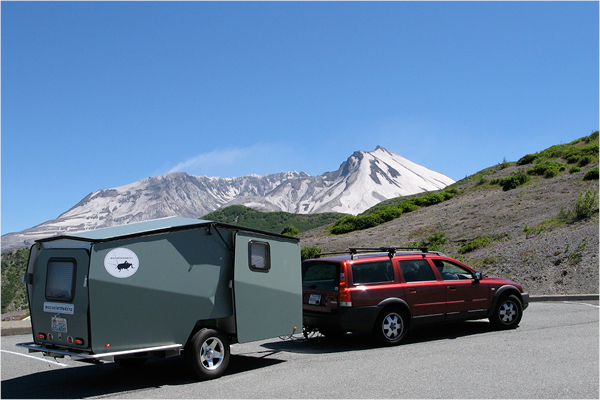
We’ve explored bicycle towed trailers in the past. In particular, the Wide Path Camper seemed like a nice execution of the idea. But as a number of readers noted, it had a couple big liabilities. First, was its weight of 100 lbs. While this is a reasonable weight for a camper, it’s a lot for a human to drag any considerable distance. The next was its high profile, which would catch the wind like nobody’s business. This Micro Airstream bike camper by maker extraordinaire Paul Elkins solves many of these problems, being lighter, sleeker and a lot cheaper than the WPC (or anything else we’ve come across for that matter).

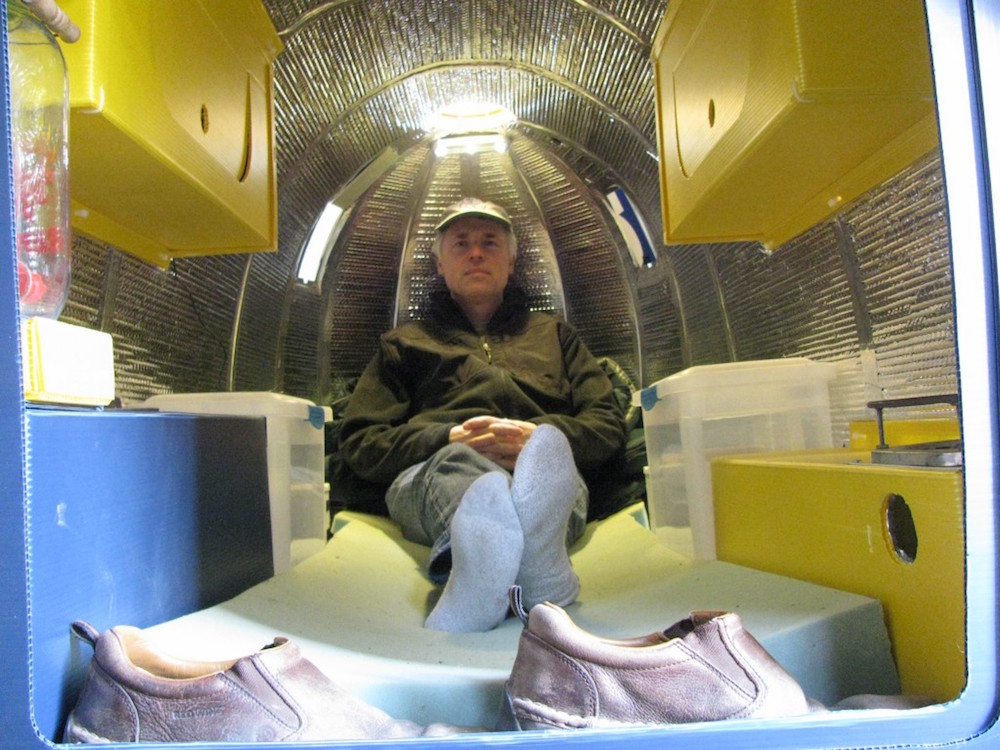
paul-elkins-trailer paulelkins-interior

It has most everything a single tourers/nomad needs. At 45  lbs, it’s a bit heavier than a trailer, but has an insulated sleeping structure that adds a ton of functionality and removes the need for a tent. It has a low, curved profile, which will probably still catch the wind, but not so much as to prove unworkable. Best of all, Elkins offers plans to make the trailer for $150 out of materials such as zip ties and recycled campaign posters (a commodity that will abound in the coming months). Check out the above video by Fair Companies and be sure to visit Elkins other amazing DIY projects.
The Rise of the Minimalist Millionaire

Aside from its inherent space and energy efficiency, compact living–or rather the high density living that often accompanies it–has been credited as being a catalyst for innovation. In his book Triumph of the City, Harvard economist Ed Glaeser found that when a city doubles in size, productivity and innovation per resident increases by 15%. His thesis was that because people are constantly in collision with one another, sharing and expanding ideas, cities make fertile environments for innovation. More specifically, he said the ideal condition for innovation was 100 people per acre. One person who took Glaeser’s idea quite seriously was Zappos.com founder Tony Hsieh. He took it so seriously that a few years ago he helped spur the Downtown Project. With the help of various Glaeser-inspired urban interventions, he sought to transform Las Vegas’ haggard old downtown area into one of the world’s leading innovation centers.

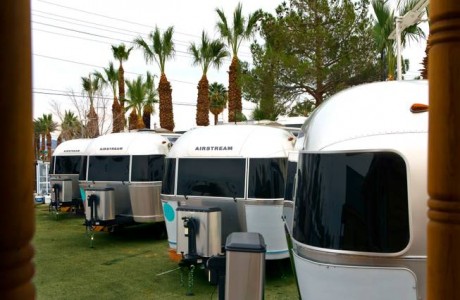
Airstream

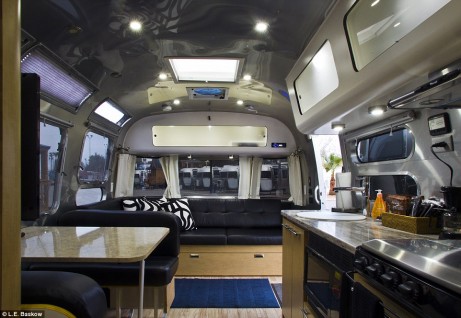
One way the Downtown Project went about achieving their 100 person per acre ideal was to convert a vacant lot into an Airstream trailer park, mostly using them as “crash pads” for visiting coders.

No one can accuse Hsieh of lacking conviction in his beliefs. Not only has he put $350M of his own money into the revitalization project, but he is living in one of the thirty trailers–sharing the 200 sq ft space with his pet Alpaca. Like the MacMannis’ Airstream we looked at the other week, Hsieh isn’t exactly slumming it. The trailers are all recently renovated and nicely appointed. Nonetheless, for a man with a net worth of $840M, this is a very modest home. While some could charge him and other people of means as tourists in the realm of small space, minimalist living, I think they are showing something else. The merits of small, simple living are something anyone, rich or poor, can benefit from. Consequently, we are seeing more people who can have all they want choosing to live with what they need.

Photo: L.E. Baskow

Your Own Terrestrial Spacecraft

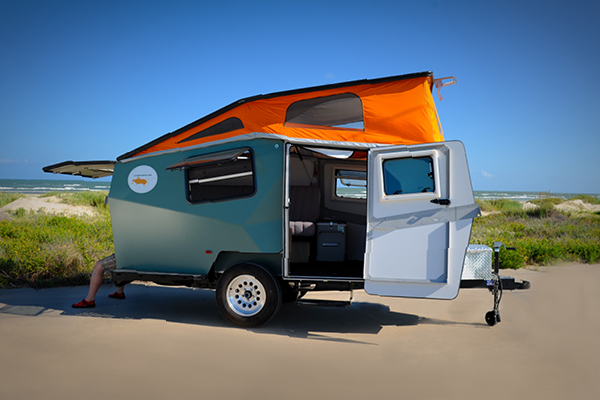
Shipbuilders might know a thing or two about optimizing tiny spaces, but their skills pale in comparison to those of spacecraft engineers. There isn’t any other type of mobile home where space is so important (pun intended). When your odometer registers in tens-of-thousands of miles, carrying even a square millimeter of extraneous volume makes a big difference in efficiency. It’s with that sense of lean design that Garrett Finney designed the Cricket Trailer.

Before designing the Cricket, Finney worked as an architect and designer for NASA, working on their habitation modules–the place where astronauts live, bathe, sleep and eat. In other words, he was a “space” architect. The Cricket’s stripped down interior, replete with lots of machined aluminum, shows vestiges of Finney’s aerospace roots.

The $17K Cricket has all the basic features of a traditional small trailer including a indoor/outdoor shower, toilet, queen size bed that doubles as banquette seating and a cooking area (custom options are available). The Cricket does not, however, include a HAL computer.

Where Finney’s aerospace background really shines through is the Cricket’s weight. At a mere 1300 lbs, it doesn’t require a special vehicle to tow it the way many trailers do.

Finney explains on his site that he was an avid backpacker, but having children made that endeavor much more difficult. The Cricket Trailer was his solution for creating family-friendly adventure without the logistical issues. And while having a trailer might seem like a big piece of stuff, consider it could effectively be a family’s vacation home. The fact that it uses a normal car and could be shared with another family could make it one worthwhile piece of stuff.

More Mobile Living: Video of Couple’s DIY 3 Story School Bus

This video from Fair Companies takes an extensive tour of Richard and Rachel’s school bus home. Unlike René Agredano and Jim Nelson’s mobile living we looked at yesterday, this project is decidedly DIY; most evidenced by the decapitated VW Vanagon that makes up the top 2 stories. Just like the latter couple, Richard and Rachel tout the advantages of living mortgage-free as one of their principle motivations for living this way.

They also liken the project, which has taken them about 6 years so far, to the cardboard forts kids make. They fabricated most of their furniture and even included things like a projection “room” on the second floor. They claim there’s a level of connection and imagination that comes from a hand-built home not usually found when you buy something already built.

There seem to be some concessions to this hacker home, e.g. no plumbing; they use grey water to shower and wash their dishes every few days. They also don’t have RV status, which I suspect is why they didn’t specify their last names or location (though the bay they look upon looks suspiciously like San Francisco Bay).

The upsides they report are many. The have a minimal carbon footprint, using a composting toilet, solar power and even a solar-powered fridge. The bus only cost $12K to build, including a $1200 fridge. They live debt free with only $100/month living expenses. And they enjoy freedom that comes from not living to pay for their lifestyle. This is a common theme from yesterday’s couple and the Tiny House Family we looked at last week.

Do you think you could live on the road like either one of these couples? Have you? What was your experience? Is this something that can be done for longer than 6 years or is this more of a phase? Could a family live like this? Is a mortgage inherently a bad thing? We’d love to hear what you think in our comments section.

Instead of a Cruise, Go on a ‘Stay’ at El Cosmico Trailer Park Resort

The world moves too damn fast, right? Everyday, we are assaulted by a thousand forms of stimulation, each whittling down our precious time and attention to nano levels. Ever feel like turning off the phone, closing that tab, setting up the auto-responder, canceling those appointments and skipping out for a bit?

Few places seem as well-suited to meet this objective as El Cosmico, an 18 acre resort (or sorts) at the outskirts of Marfa, TX. El Cosmico offers lodging and “community space that fosters and agitates artistic and intellectual exchange.” Its mission is described in its “Mañanifesto.” Here’s an excerpt:

Mañana doesn’t care about email or normal hours of operation. Mañana recognizes that we can’t all have everything we want at any given moment, like peaches in January or cell phone reception in West Texas. Mañana is the anticipation that it might happen today, and it might just as likely not, and really either way it’s not that big of a deal. The key to Mañana lies somewhere in the unspecified future. It holds the great promise of hope…El Cosmico is at the center of this exodus from a world of urgency, and flies its Mañana flag proudly.

Sounds perfect.

El Cosmico offers several, full-amenity trailers ranging from $110-150/night. Other accomodations include yurts, teepees, army tents and camping.

It also offers an elm grove of hammocks, dutch hot tubs, a community lounge and mercantile and an outdoor kitchen and dining space.

Should you be craving more activity than swinging on a hammock (we’re not sure why), there are numerous “happenings“, things like concerts, potlucks, drinks and playing dice. They also offer workshops; currently, there are ones for songwriting and “Camp Design Build Adventure,” both of which sound pretty cool.

For most of us, there is so much to do, and to be done now, if not sooner. Places like El Cosmico allow you step back and realize there is always the option of mañana.

images via El Cosmico