What You Should Know Before Living in a Tiny Home

In a recent article, Dwell runs down ten things people should consider before making the jump to small living. Our man, Graham Hill, gets a feature sitting at #1 noting that consciously decluttering your stuff is paramount to living small but also to “buy less, but better”.

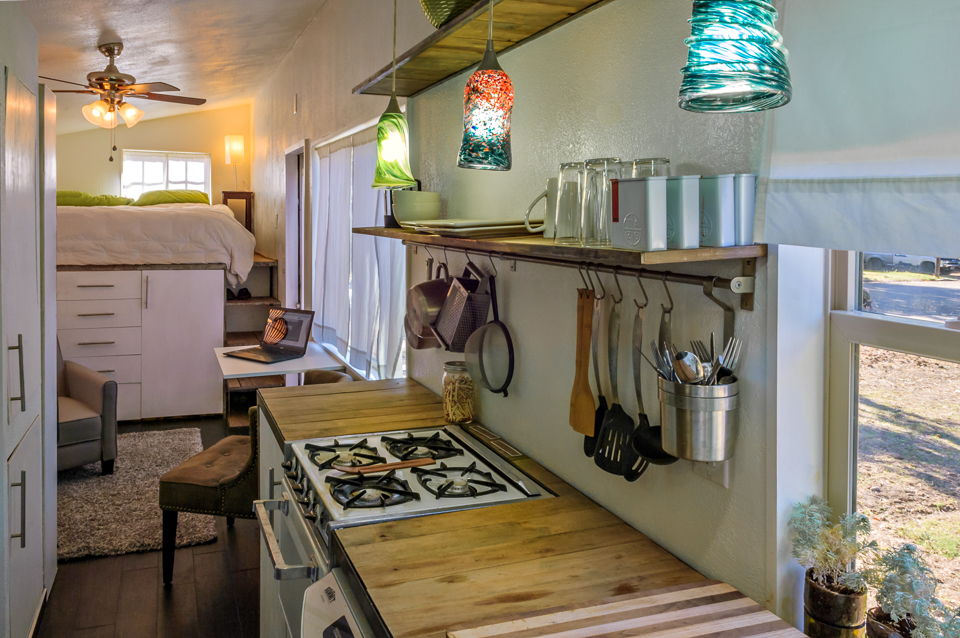
Another great tip mentioned in the article comes from tiny apartment designers, Nina Tolstrup and Jack Mama (pictured above) of Studiomama. If tiny living seems like a big jump, they recommend to “rent a small place on Airbnb to try out small-space living first”. It’s a great way to temporarily live the tiny house dream without the commitment. There’s also a side perk of getting a vacation out of it as well. Places like Getaway House, Caravan Tiny House Hotel and Tiny House Siesta are already capitalizing on the tiny rental market.

For the full rundown of Dwell’s 10 tips, click here

Photography is by Rei Moon of Moon Ray Studio


Seeking Higher Ground with an Elevator Bed

Beds in tiny homes can be a hard to thing to deal with because they take so much space, and you’re not even using them during waking hours. Instead of a lofted option, Ana White of Spruc’d came up with an affordable solution to create more space without sacrificing comfortability. Enter the elevator bed. She constructed a mechanical sleeping system with the use of garage pulleys and sliding door hardware on a budget of $500. The full bed lifts when not in use and also makes enough room for a guest bed underneath.

The building plans for the bed as well as the entire tiny home are available here.

The Unbearable Lightness of Tiny Living

Each week we are profiling real people who are editing their lives for more freedom and happiness. This week we hear from Jan, who lives in 98 sq ft tiny house. He shares his experience about the freedom of tiny, lightweight living as well as the difficulties of meshing different attitudes about stuff and space in relationships.

Tell us about yourself

My name is Jan. I am 45 and work as a photographer and videographer. I am separated with a 3-year-old boy.

My parents, both children in Germany during the WWII, instilled a non-consumptive, credit free life-style. They modeled buying quality over quantity and only paying cash for what you can afford.

Later, I backpacked for several years, and all through my twenties and early thirties never paid more than $100 rent per month. I learned to build and built my own shelter, or did work-trade for rent. For years I kept my possessions down to what would fit in the back of a small pick-up truck.

In my late thirties I fell in love with a beautiful woman who lived an unedited life. Stuff gave her a sense of security. Clutter was her art form. For six years and through the birth of our son, we tried to blend our lives, but could not. Accepting neither of us would change, I built a 6×9 foot shack in the backyard and moved out. We get on much better now.

What makes your life an ‘edited’ one?

I’ve always been self-employed, so I’m very aware how much effort it takes to earn each dollar. Not believing in credit, each purchase I make is a conscious decision. How much of my life does it take to afford this thing? I’m also aware how much effort is required to own stuff. Where to store it? How to store it? How to care for it? Unnecessary stuff and clutter simply makes my anxious. But that’s not to say I’m non-materialistic. I would argue that I’m hyper-materialistic. I love the look, feel and function of something well made that fits my life perfectly. A pair of shoes I wear every day. Two sharp kitchen knives. A bicycle. A camera. All these things, carefully chosen gives me great pleasure to buy and use daily.

How long have you been living this way, and do see yourself continuing to live this way?

I have always had a minimalist bent, but lately have been refining it with far more awareness. It merges many divergent interests, from macro and micro-economics, environmentalism, self-sufficiency, spirituality, design, art, parenting, and how we will make it as a species in a shrinking world. Presently, how I live is a personal choice. In the future that choice may be forced upon us.

What are the biggest advantages of living this way?

A profound sense of lightness in the world. Every time I discover a way to live more essentially, I feel a surge of freedom. When I refine an elegant solution to a vexing problem, I gain great pleasure each time I engage with that solution. Something as basic as placing a hook into a wall so I can hang my bag and not trip over it on the floor. Or building a composting toilet for a few dollars and taking personal responsibility for my own waste. Or lying in bed at night in a loft that fits me just so. Watching the moon rise and stars turn because I deliberately placed the windows in these precise locations. Or each month doing my bookkeeping and seeing my savings increase to a point where I could live comfortably without working for a few years. And not because I earn a lot of money, but because I have learned how to spend wisely.

What are the biggest challenges?

Trying to meld a minimalist lifestyle with someone who does not share the same interest. It is an exercise in futility and frustration. I had to learn to accept that I can neither change someone else’s life nor repress my own nature.

For families, how has this lifestyle affected the other members of your family?

Thankfully I have a young son who stops me from getting too anal. He helped build the shack and feels it is his as much as mine. He comes and goes as he pleases with his toys, muddy shoes and dirty fingers. I let him climb up ladders, on counters, light stoves, play with tools and knives, and in doing he learns respect, consequence and body awareness. He teaches me to let go and lighten up. If he breaks something we fix it together. If he gets something dirty, we clean together. After all, it’s just stuff. What’s essential is the respect between us.

In terms of partnerships, I think a minimalist lifestyle only works both partners already live this way. I also strongly believe in a shack of ones own. My home only cost me $5000 and three months of work. I’d rather help build a partner their own home than try to blend two incompatible lifestyles together.

What is the number one suggestion you’d give to someone looking edit their lives?

Read the book “Your Money or Your Life” by Vicki Robins.

What item(s) have made your lifestyle easier?

A good bicycle, good tools, a few comfortable clothes that fit well and can be worn in different settings.

Do you have any design or architectural suggestions derived from your lifestyle?

Consider curved rafters. That simple architectural detail made all the difference in turning my loft from a cramped triangle into a spacious cocoon.

This post was originally published November 28, 2012. 

Turn On, Tune In, Get Tiny

To live in a tiny house is as much political statement as it is architectural one. Take the NOMAD tiny house–its whole raison d’etre seemed to be stopping its owner from living the highly-leveraged, consumerist lifestyle. We can now add Macy Miller to the pantheon of tiny house political heroes. Over the course of 18 months, the architect-to-be documented the construction–and constructed–her own 196 sq ft, trailer-mounted home for $11K ($2K of which was for the composting toilet). The home forced her to make revolutionary changes to her relationship with space and stuff (i.e. using a lot less of it). And her monthly operating expenses of $250 allow her to do whatever she wants with her life without the economic pressures most homeowners suffer.

The place is a refreshingly modern take on the tiny house, many of which resemble little houses that, had they been around 130 years ago, would have been located on prairies.

Miller received a lot of press in the last year. Many of the stories cited foreclosure and divorce as the motivation behind building the place. But a little digging around her blog revealed a more intentional shift. Her divorce and foreclosure happened several years before she began her tiny house. She could have paid the mortgage, but because of mismanagement by the bank, she was forced to foreclose (she subsequently won a lawsuit against them). In other words, she wasn’t forced to downsize–she wanted to.

Her blog tracks her story in great detail. The latest chapter is her baby, which is due in a few month. She blogs extensively about the many, supposedly-mandatory baby items she is doing without, both by choice and spatial necessity. Before you ask, the father (who is not the ex) will not be living in the tiny house with Miller, child and her great dane Denver (who she assures is not suffering because of the small digs); he will be involved with the child’s upbringing in case you were worried.

Like many tiny house advocates, Miller freely admits 196 sq ft will not work everyone, but seems quite adamant that it works for her–a stance that makes a lot of sense to us. See more Minimotives.com

Renzo Piano Makes Micro Modern

More often than not, tiny houses like the ones made famous by Tumbleweed Tiny House Company have a decidedly rustic vibe. If you want to live in one of these basic homes and you’re not into the shack-in-the-woods aesthetic, you might be out of luck. All that might be changing soon. Renzo Piano, one of the world’s leading architects, recently introduced a design that is the modern minimalist’s dream home.

The Diogene house, set up on the Vitra campus in Basel, Switzerland, is named after ancient Greek philosopher Diogenes, who, according to Designboom, “lived in a barrel to exalt simplicity through action, the home is a voluntary refuge that relishes a life outside of an existing infrastructure.” The home measures a mere 215 sq ft (20 sqm). In keeping with its namesake, the Diogene home is meant to provide the most essential elements of life–a sofa bed, small kitchen, shower and toilet. The rest of life takes place outside the home in “civic places” as Piano refers to them.

The aluminum-clad prototype home is intended to be completely off grid with solar water heaters, solar panels, rainwater collectors, a composting toilet, natural ventilation and triple glazed windows for great insulation. Ultimately, Piano sees Diogene being mass produced. Though it’s not trailer-based like US tiny houses, it’s compact dimension and off grid setup would lend itself to regulation-free living in much the same way tiny houses do.

We dig the philosophy of many tiny houses, but at times they can seem a bit monotonous in terms of design. Beyond its inovative features, Diogene proves that small can look any way you choose.

All images © designboom

What Happens When Beer and Transforming Apartments Mix

A couple weeks ago, we had Derek “Deek” Diedricksen and Paul Farr from Tumbleweed Tiny House Company stay at the LifeEdited apartment. The pair were in New York City leading a tiny house workshop showing people how to make their own tiny houses. We wanted to know what they thought of the place. They videoed this self-guided tour that gives their thoughts on the apartment (their enthusiasm might have been helped out by a beer or two).

Check out Deek’s blog Relaxshacks.com and Youtube channel for cool pics, videos and news about tiny house construction and living.

Thanks guys!

Europe’s Narrowest House Saves Space, Fights Obesity

Many tiny houses we look at on this site show uncommon ingenuity and creative use of space. Others, like this house for Israeli author Etgar Keret, err on the side of ridiculous. At 5′ at its widest point and 3′ at its narrowest, it is thought to be the narrowest house in Poland and perhaps all of Europe.

To be fair, the home’s design was not purely driven by livability. Keret built the Warsaw home at the site of a former Jewish ghetto as a memorial to his parent’s family died in the Holocaust.

Keret says that he plans to live in it when he’s in Poland however, and the space is fully functioning, with a kitchen, bathroom and bedroom.

image credit: Yasuhiro Yamashita

The home’s sun-drenched interior reminds us of the Kyosho Jutaku homes like the one above, which use optical illusions to create space. Its ridiculously narrow dimensions remind us of NYC’s Spite House.

What are your thoughts on this house? Interesting architectural exercise? Practical living space?

High School Student Builds Own Tiny Home

Few things will make you feel less industrious and patient than watching this video of high schooler Austin Hay and his hand-built tiny house. The Fair Companies video shows two segments: The first when he was a high school junior with his partially complete Tumbleweed Tiny House-designed home; the second segment shows Hay, now a high school senior, giving a tour of the completed home.

Hay matter-of-factly describes how he built the house out of mostly salvaged materials (he shows off the three trash cans of waste generated during the build), how he scrimped and saved to put the place together (he says it cost him $12K), how he did it all without the aid of a shop class, how he built his own day bed, shelving and many other built in features. The place features a composting toilet, on-demand hot water and propane appliances.

One of the more poignent moments is an interview with Hay’s grandfather, who had given Hay a propane stove as a Christmas gift. The grandfather’s tears of pride show that building your own home not only cultivates a deeper connection with your own home, but for all those involved in making it. Kinda makes you want to build stuff.

via Fair Companies

Test Drive A Tiny House Today with Airbnb

Perhaps you’re considering ditching most of your possessions, going part time and remote at your job and swapping your clunky traditional home/apartment for a tiny house. But you’re not sure it’s the right move. You have your doubts about what it’s like to inhabit such a small space.

Airbnb can help you with your tiny hesitation. The site offers a number of tiny houses you can call home for a night or two, providing a taste-test for your would-be tiny life.

By far the most interesting that we found is  David Guilbault’s 68 sq ft Teeny Tiny Guesthouse in Seattle, WA (video above). The DIY paradise features a very clever “garage door Murphy bed” and in-floor, full-sized tub. David charges $75/night with a two night minimum.

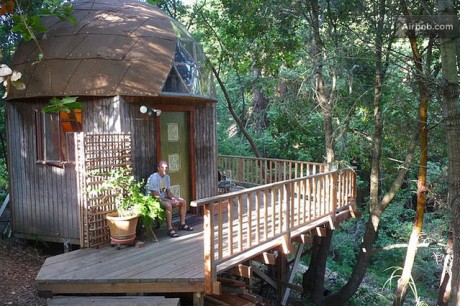
A little outside of Santa Cruz in Aptos, CA is the Mushroom Dome Cabin. The owners claim it’s the “number 1 listing on Airbnb”; with its cool design and beautiful setting, we can imagine why.

The tiny house sleeps 3, features a wraparound porch and a 22″ LCD TV. The $100/night charge includes breakfast.

If you live on the east coast, you can rent a more traditional tiny house right on beautiful Lake Champlain in Plattsburgh, NY (below).

This model is a more traditional, Tumbleweed-style, trailer-based tiny house. Nelson, who owns the place, includes access to kayaks, canoes and paddle boats. The place is $100/night with a 2 night minimum.

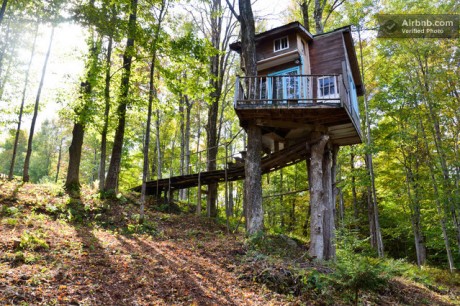
Also on the east coast is this awesome treehouse in Lincoln, VT. The structure rests 30 ft above a fern covered forest by the Green Mountain National Forest.

Lincoln is three hours from Montreal and four from Boston, so it’s a bit out of the way–for better or worse. Ellie and Harrison, who rent the place, charge $125/night.

While these stays might not perfectly replicate living full-time in a tiny house, they might give you a sense of what it’s like. Barring that, they look like great, relatively affordable places to spend your vacation.

via Tiny House Listings

Site Provides Real Estate Guide for Tiny Home Movement

In the market for a 300 sq ft geodesic dome in Seward, Alaska? Perhaps a 264 sq ft log cabin in Idaho? Or most any size yurt? If you answered yes, an appropriately-named website called Tiny House Listings has you covered.

If you’re not familiar with the tiny (or small) house movement, it is a movement by and for people who build and/or inhabit tiny (or small) homes–usually well below 500 sq ft. Many are so small as to be considered illegal for living; builders get around regulations by putting the structures on trailer carriages, thereby avoiding normal building code.

This is not merely an aesthetic or financial choice, but a philosophical one. Small house folk–because their homes afford no room for extraneous stuff–test the boundaries of what people really do and do not need to live happily. Freedom from mortgages, a contradictory stance to the McMansion status quo and the grey legality of the movement all make it all the more subversive.

Tumbleweed Houses out of California and Sarah Susanka, author of “The Not So Big House”  are the movement’s main exponents, though there are many others cropping up around the country.

If you’re considering joining the movement, the listing site has a good stock of tiny houses–some with land, some without, some on wheels, some out east, some west, some square in the middle. Few exceed $50K and many are well under that figure; prices seem to be more related to the land than the structure.

The site also links to small house plans (most, if not all, direct to Tumbleweed), builders (we found a company out of Maine that will make your own Hobit Hole), workshops and other resources.

While we tend to promote urban solutions to high density, small-space living, the small house movement shows how you can achieve simple, small footprint living further afield. If you’re considering a tiny house–either as a primary residence or part time one–The Tiny House Listing site is a good resource.

Any small house people out there? We’d love to hear your experience.