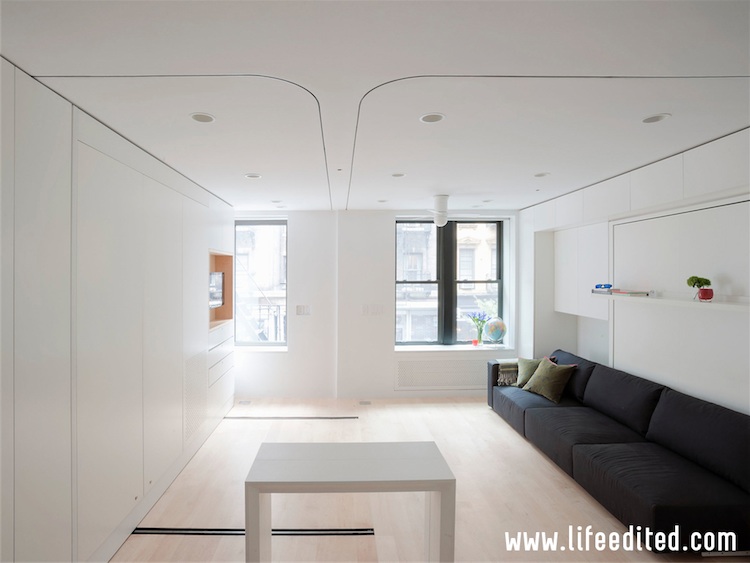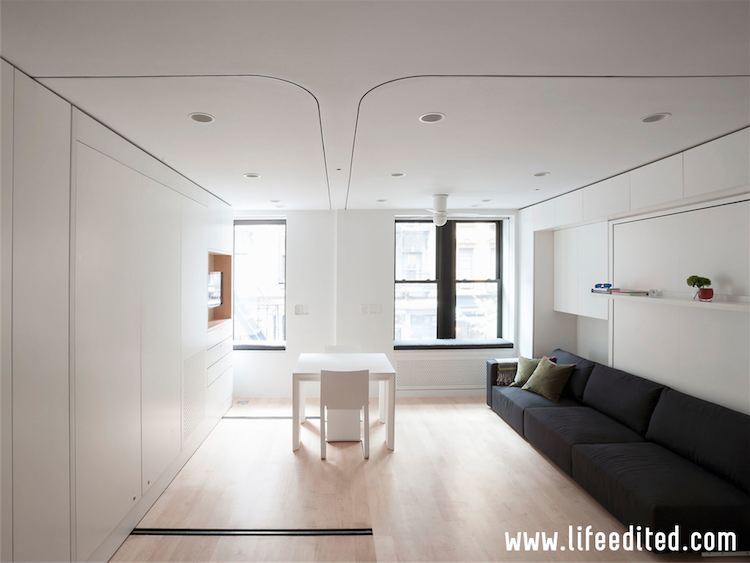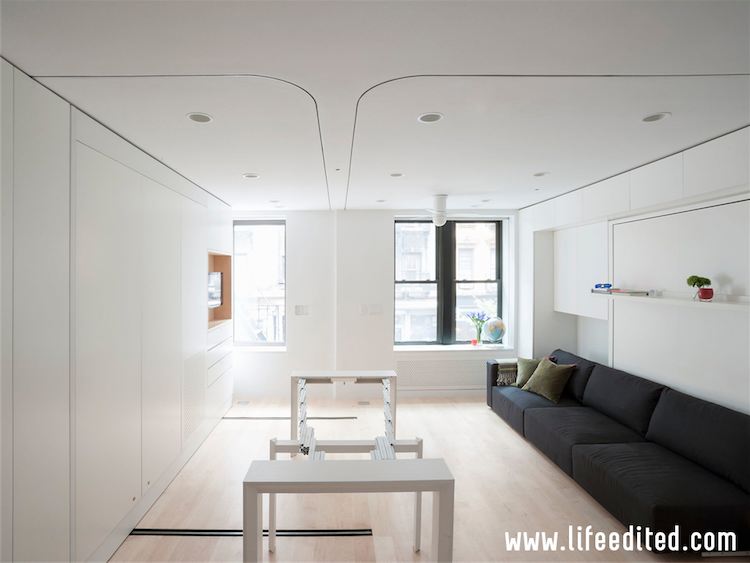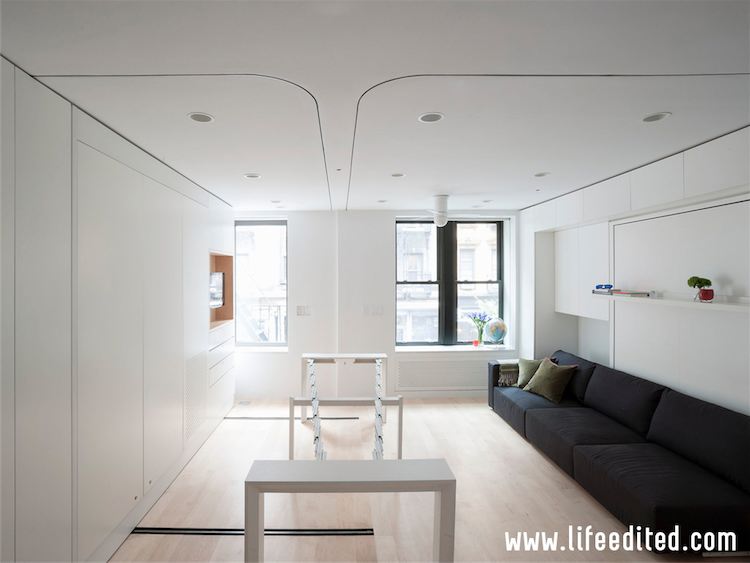
The Home of the Future is Transforming

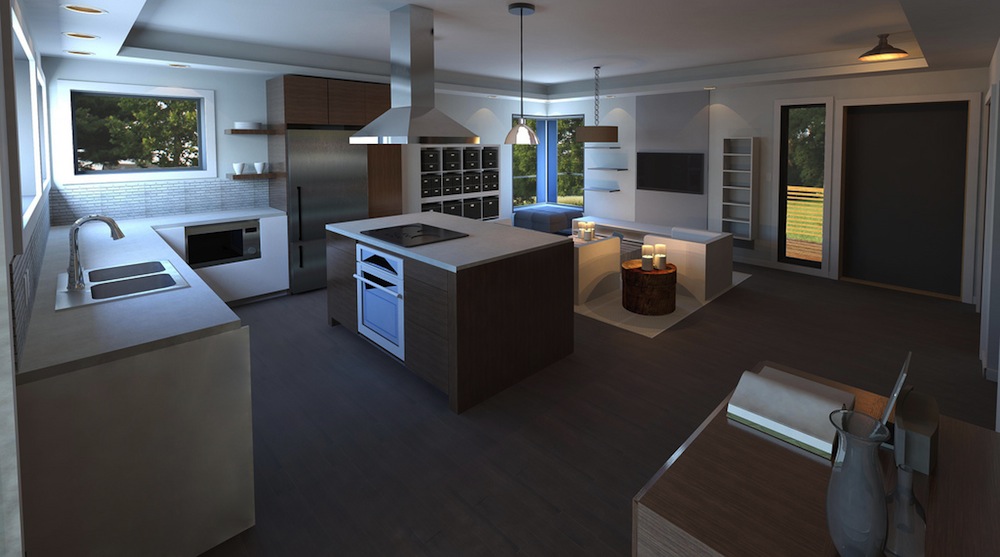
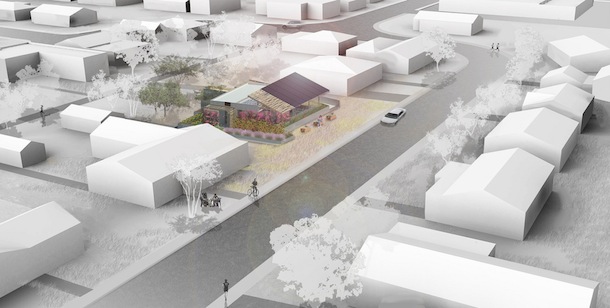
On October 3rd, 20 teams of college students from around the world will descend upon Irvine, California for the Solar Decathlon. On display will be some of the most innovative designs in energy efficient home building. The US Department of Energy sponsored event is looking for “the team that best blends affordability, consumer appeal, and design excellence with optimal energy production and maximum efficiency.” Fixtures of the SD designs include PV panels, rainwater catchment and grey water systems–things that help the overall structures be as energy positive as possible. This year, a third of the teams are sporting another, less obvious, but equally important energy saver: transforming furniture.

More specifically, Resource Furniture is sponsoring six of the 20 teams entered into the competition. RF President Ron Barth remarked, “After several teams approached us about the value we could provide to their projects, we sought out other teams that would benefit from our multi-functional solutions.” The company is sponsoring Arizona State University and The University of New Mexico; University of Louisville, Ball State University and University of Kentucky; Norwich University; Southern California Institute of Architecture and California Institute of Technology; Queen’s University, Carleton University, and Algonquin College; and the University of Southern California. See a full list of all the teams and links to their sites here and view more images at SD’s Flickr page.

Barth told us that when he approached some of the teams, not all had furniture selected. To us, this seems like a curious omission for a competition whose mission is to promote efficiency. SD’s guidelines dictate that the interiors of each structure be no smaller than 600 sq ft and no larger than 1000. The choice of furniture can make that 600 sq ft suitable for a family of four or, conversely, make the 1000 sq ft cramped for two.

It was also interesting to peruse many of the entries. Most were quite beautiful to look at and had ingenious strategies for energy production and retention. But many appeared to use the full 1000 sq ft interior limit as well as much of the 4680 sq ft lot space. Many of the team’s renderings showed their home designs sitting in far off fields or in the middle of the desert, leading us to wonder how rigorously setting was considered? As Lloyd Alter stated in Treehugger recently, “When it comes to green building, where you are is as important as what you build.” How do these homes fit into an increasingly urbanized, interdependent world population? A world with depleted natural resources? Is the Solar Decathlon looking for the home of the future or the suburban home of the future?

One of the cooler designs is called DALE, designed by the Southern California Institute of Architecture and California Institute of Technology team. It uses housing modules that can be expanded with shifting occupancy needs–e.g. couple to family to extended family. Check out the video above for an illustration (you can cut to the 1:00 mark for the juicy parts).

Our high-density-biased gripes notwithstanding, there are some very cool designs on display at the Solar Decathlon. And we hope the inclusion of more transforming furniture indicates a level of holistic design that includes interior functionality and setting as much as it does a home’s raw energy consumption.
This Little Italian Kitchen Has Spine

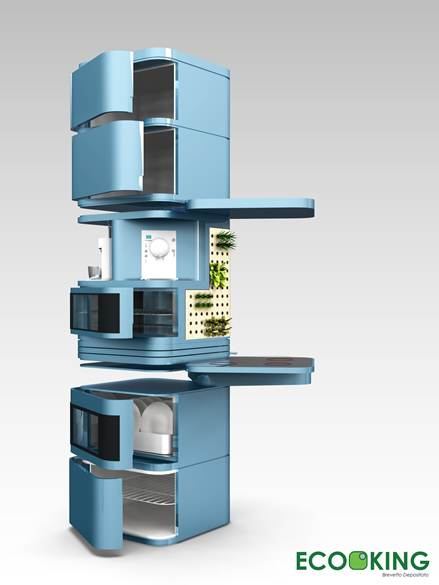
We were turned onto this innovative column-kitchen (not sure if that’s a proper term) that was released at the recent Milan Furniture Fair. It’s called ECooking, designed by Massimo Facchineti and, unlike many concept designs, will be manufactured by Clei, the same folks who make the Swing sofa/bed in the LifeEdited Apartment.

The little unit is packed with features:

  • Kitchen basics: Oven, fridge, induction cooktops, sink, dishwasher and espresso maker (an Italian basic)
  • Multi-stage water filtration
  • Herb garden that uses filtered grey water
  • Built in ventilation and UVA light for your herb garden
  • Counter surfaces that creates seating for six
  • Storage
  • Rendering shows a solar paneled back to power entire house (unconfirmed).

Ecooking-Clei-back

Again, the cool thing about this is the fact that: A. it was made and B. is going to be released. Resource Furniture says it should be available early to mid-2014 (no price or additional details available just yet). We suspect some of the features, like the solar panels, might not carry over from concept, but even the basics are pretty cool.

While ECooking might not be ideal for someone who regularly hosts large dinner parties, it seems like a perfect compliment for a micro apartment where it would significantly reduce the kitchen footprint while providing more than enough function for the small-scale gastronome.

Desk. Edited.

From pen and paper to standard typewriter to electric typewriter to large computers to tube monitors to LCD monitors–the loads our desks bear has changed a great deal in the last 100 years. But today many of us have done away with almost all paper and we can get by with a tablet or laptop for a good portion of our work duties. If that’s the case, why use a desk designed to carry reams of paper and a big CPU and monitor? We found a few desks that better accommodate this new lightweight office.

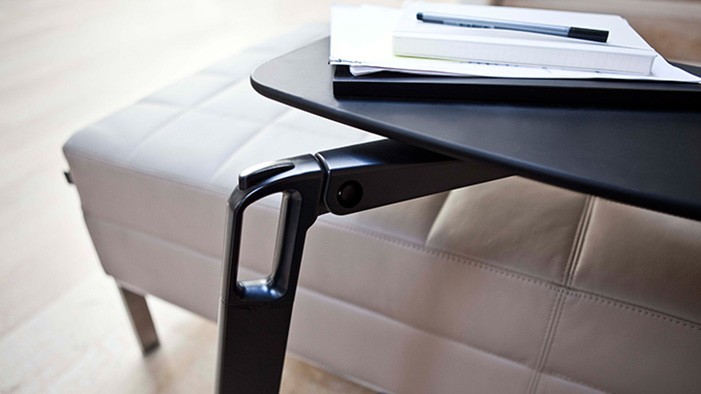
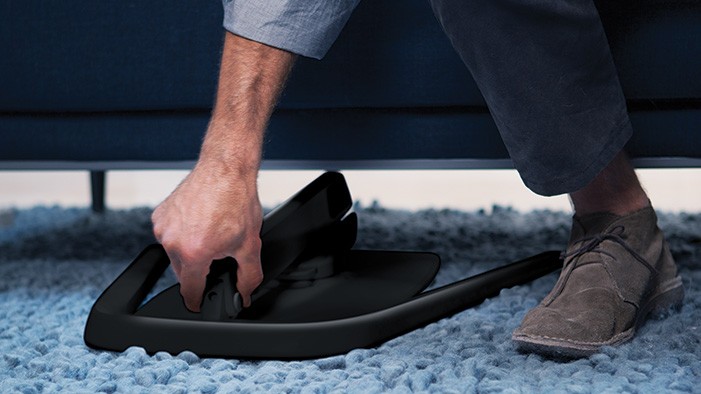
The Free Stand by Stephan Copeland is the ultimate expression of the lightweight desk. It’s a stand that is just big enough for a tablet or laptop. Its height is adjustable from 19.5-27″ and can be positioned to fit over a normal chair, sofa or lounge chair. It can be folded and stowed away when not in use. The unit is scheduled to be available later this spring through Coalesse; no pricing info available yet.

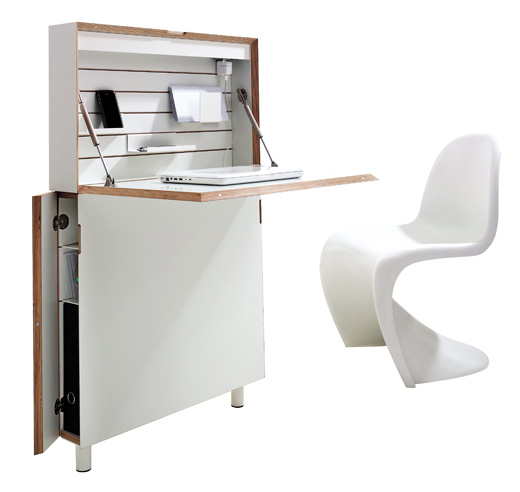
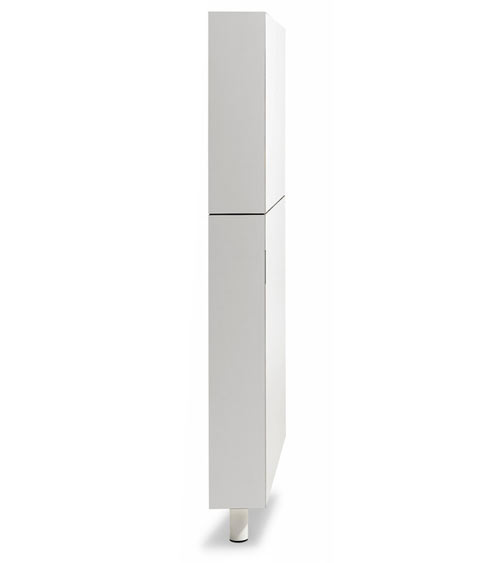
The Flatmate by Michael Hilgers is a bit more of a comprehensive unit–i.e. it has room for your elbows, some minimal storage and plugs for your devices. When closed, it’s a mere 5″ deep. The unit is attached to the wall to maintain stability. The Flatmate is available for $1850 from Resource Furniture.

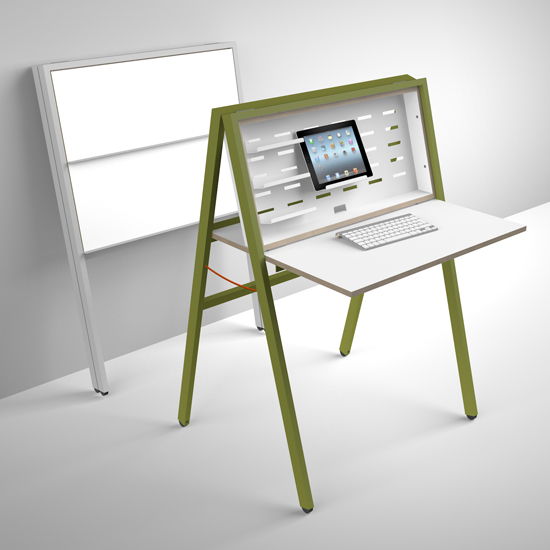
Michael Hilgers actually has several varieties of lightweight desk designs such as the HIDEsk, which is an easel-like desk, and the  balKonzept, a desk designed to fit over your balcony railing.

Of course, if you really want to stay lightweight, you can just use your dining room or kitchen table like this author does ;-).

image via coalesse and Michael Hilgers

Is it a Sleepy Living Room or Lively Bedroom?

In the coming months, we will be highlighting products and services we use in the LifeEdited apartment. Today, we’re looking at the Swing Sofa/Bed from Resource Furniture. 

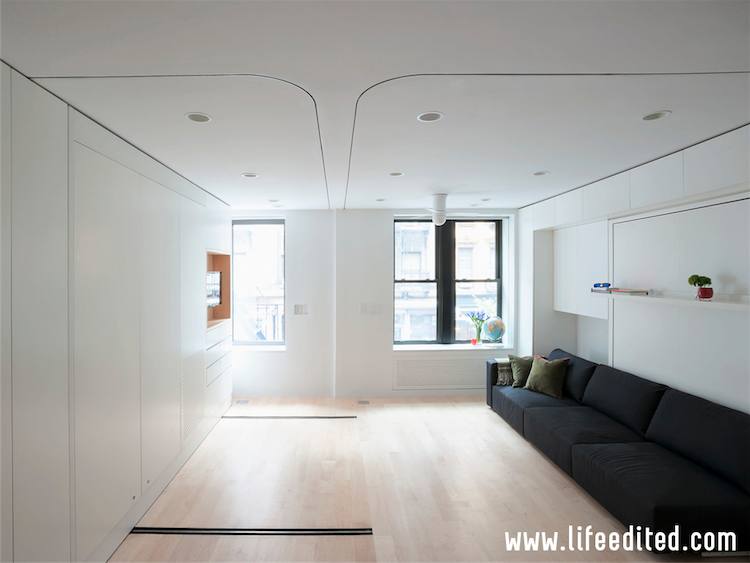
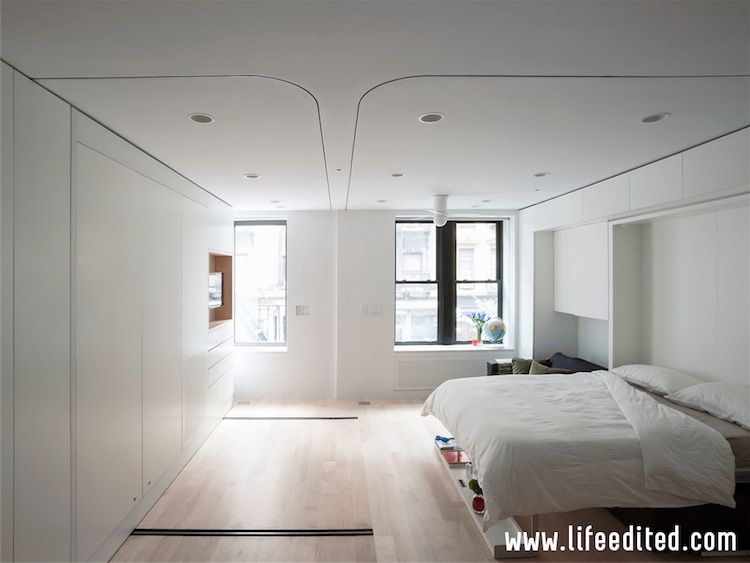
The Swing sofa/bed from Resource Furniture is probably the most important piece of furniture in the LifeEdited Apartment as the master bed and couch are arguably the two most important pieces of furniture in any home. It serves the vital function of easily converting our comfortable living room into a comfortable bedroom.

Standard Murphy beds require their front-sides to be clear before lowering their beds. The Swing utilizes this valuable frontal real estate because its bed, when lowered, is higher than the full-sized couch that sits flush with the frontside of the unit. This exploitation of all available space is crucial for small homes, where every unfilled gap cuts into valuable square footage.

The Swing is designed and manufactured by Clei in Italy. Here are some of its key features:

    • Easy, one-handed lowering of the bed.
    • An available chaise lounge, which can be attached to either side of the sofa. With the chaise, the sofa is 9′ 2″ wide.
    • The chaise version has an upper shelf that provides and additional 6′ of storage (note: The LifeEdited version does not include this feature).
    • An aluminum bedframe with steam-bent beech wood slat supports.
    • A bookshelf that holds up to 25 lbs and stays level when the bed is pulled down.
    • Storage under the sofa seat for bedding or other items.
    • A self-standing/self-supporting structure that requires no attachment to the walls or floor. It is a ‘wall-bed’ that makes its own wall and can be used as a room divider.
    • Available in more than 40 finishes, melamine, lacquer and wood veneers. Available in 30 CARB 2 compliant (California Air Resources Board) finishes.
    • Available headboard cushions that provide cushioning and eliminate the gap between mattress and backboard, ideal for reading or watching TV in bed.
    • Available in 100 different fabrics options.
    • Available LED interior lighting.

Amazingly, the entire depth of the system when open for sleeping is only 6.5” longer than a standard mattress.

Prices for the non-chaise version start at $9100 and $12,850 with chaise. Bank on an extra $800 or so for a mattress. No this is not cheap, but this is a quality piece of furniture you will have for years. Furthermore, consider the Swing could eliminate the need for a dedicated bedroom. How much does an extra bedroom cost? In a city like New York City, real estate can easily fetch between $500-$1000/sq ft. Let’s say a very small bedroom is 70 sq ft–in other words, 35K-70K!

The difference between a studio rental and a one bedroom, or between a one bedroom and two bedroom can easily be $1K/month difference. The Swing could pay for itself in a year and you’d have a great piece of furniture to take with you to your next place.

Looked at in either of these lights, the math becomes quite different.

For more information, visit www.resourcefurniture.com or stop by their New York City showroom.

8 Tips for Making Your Own Micro Apartment

With all the hoopla around the adAPT NYC competition and other micro-apartments around the country, it’s clear there’s a demand for smart, small apartments. In fact, people write us daily asking if we have apartments available to rent or buy.

While LifeEdited is working with development teams to get you your micro-apartments with the greatest haste (be sure to sign up for our list), many of the developments are years away. This leaves the question: What do I do now if I want a micro-apartment?

If you’re interested in living in a micro-apartment–either converting your existing place or starting fresh–here are some suggestions we think are critical to living a big life in a small apartment.

  1. Pick a good address. We think small spaces work best when you use your city or town as your living room. With amenities like restaurants, entertainment and parks at arm’s length, a good address will provide a living room you actually want to hang out in. Central locations are more walkable and have better public transport, allowing you to live car-free or get by with a car-share. Check out Walkscore.com to see how a neighborhood stacks up in terms of walkability and amenities. Yes, a good location will cost more, but you can save money by being car free and choosing a smaller apartment.
  2. Size matters. While there is no magic number for square footage, the micro-apartment designation is about 250-400 sq ft for singles; 300-600 for couples; 500 + for families (separate rooms are generally a good idea for a peaceable family). In most cities and towns, there are plenty of apartments these sizes.
  3. Get in good shape. In general, square and rectangular spaces are ideal. They feel bigger than odd-shaped spaces and are easier for fitting modular furniture.
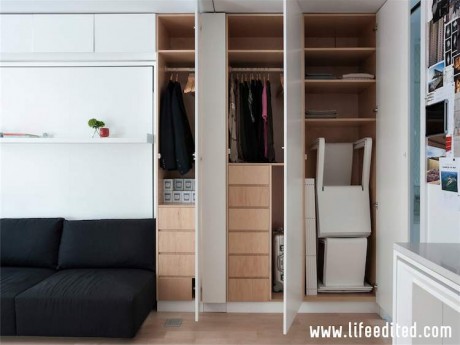
  4. Get a Murphy Bed. It’s the single easiest way of creating space without sacrificing function. A queen size bed is about 35 sq ft.–i.e. 10% of a 350 sq ft space; a 10% used exclusively while unconscious. We use the Swing sofa/bed by Resource Furniture; the sofa on the frontside provides even more space-saving as most Murphy beds have unused front sides. Starting at over $10K, the Swing is not for everyone. Resource Furniture has many less expensive models and there are a number of decent Murphy beds that can be purchased for around $3K. We were recently turned onto Murphy Bed Center, who has models starting at $1699. If you’re a DIY type, build your own for $275.
  5. Get high…with storage. Almost all of the adAPT NYC submissions included floor-to-ceiling storage. Having high storage utilizes unused vertical space and frees up floor space, making an apartment seem larger. On the high end, Resource Furniture offers modular storage units to fit with their furniture. On the low-end, the IKEA Pax system can be had for less than $1K and is almost 8′ high.
  6. One table is enough. A while back we looked at tables that serve as both coffee and dining tables. While these table are a little on the pricey side, only needing one table frees up quite a bit of floor space and provides two important surfaces.
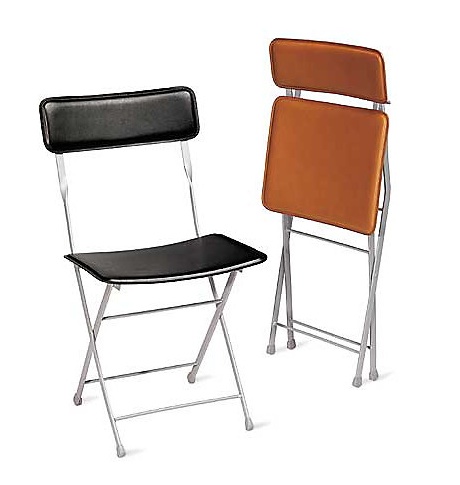
  7. Sit and stow. Having chairs available for guests is important, but when we’re home alone or with our partners, we only need one or two chairs out at a time. The rest of the time, extra chairs just take up space, which is not a luxury the micro-apartment dweller can afford. If you don’t know what chair to get, here are 10 folding chairs to fit almost any budget.
  8. Get a comfy couch. A micro-apartment requires that every object be highly useable. While that stiff, low profile couch might take up little space and look super cool, if it’s not comfy, you’re not going to want to sit in it. Get a comfortable couch you’ll want to sit in day-in-day-out. If it’s big enough to sleep guests, all the better.

Anything we missed? Let us know in our comments section.

Comfortably Seat Ten in Your Micro Apartment

In the coming months, we will be highlighting products and services we use in the LifeEdited apartment. Today, we’re looking at the Resource Furniture Goliath Table.  

Of all the pieces of furniture in the LifeEdited apartment, none get more oohs and ahs than the Goliath Table. The table, made in Italy by Ozzio and distributed in the US by Resource Furniture, transforms from a 17″ deep console without leafs to 115″ dining room table with.

Depending on how many of the five leafs you add, you can make the table appropriate for seating two, four, etc. In the cozy 420 LifeEdited space, it’s a critical piece of furniture, allowing us to easily host dinner parties for ten plus people.

When not in use, we store the table under a breakfast bar made especially for the Goliath.

The table is available in a number of durable finishes. Visit Resource Furniture’s website for full details. While the starting price of $3950 might strike many as a lot of money, consider that this table can effectively turn any room into a real dining room. Think about the cost of eliminating 50-100 sq ft from your home. How much would that save?

Perhaps you’d use it to turn your dining room into something you might use more like a home office. Likewise, the table’s high quality construction make it something you can keep for many years. Looked at this way, we think the Goliath a great investment (it’s sure to impress your dinner guests too).

5 Products That Make Our Lives Better

We are always on the lookout for products that do more, last longer and take up less space than their conventional counterparts. We’re not talking about things like a good laptop or phone, which might be indispensable, but will be outdated in six months. We’re talking about the products that won’t go out of date, whose utility proves itself through the years.

We’ve put together a short roundup of products we find ourselves unable to live without (not literally of course). It’s also a nice excuse to ask you what your list includes. What are the things that make your life or home work better–things that make life simpler and more streamlined? Let us know in our comments section below.

  1. Waffle-weave towels. We’ve talked about them before, but too much cannot be said about their merits. The longer we use them, the more they prove their superiority to terry cloth. We’ve been using Aquis microfiber towels and Gilden Tree cotton waffle towels. Both take up less storage and washing machine space, dry faster and avoid mold. If we were to choose one however, it’d be the Aquis; the synthetic material seems to grab moisture from your skin. It’s also softer than cotton. If you’re not into synthetic stuff, the Gilden Tree towels still work great and are available in more sizes and colors.
  2. Outlier pants. These things rock. They look like dress pants, feel like sweat pants, wick and repel moisture like mountaineering pants and wear like iron. Starting at $188, they are not cheap, but they will literally replace three pairs of conventional pants and outlast them as well. I have had several pairs for the last few years. My favorites are the 4 Season OG’s and Climbers, both of which have four-way stretch material (not all Outlier pants are as stretchy). Their shorts rule as well. Right now, they make one women’s variety.
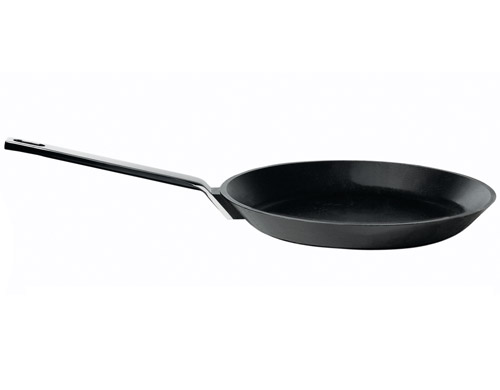
  3. A cast iron skillet. Nonstick skillets are great, but they wear horribly and have a dubious safety record. Copper and stainless steel wear great, but are temperamental, scorching and staining easily. Cast iron, on the other hand, wears like, well…iron. It distributes high and low heat great. With a little bit of use–i.e. ‘seasoning’–it can be almost as nonstick as a Teflon pan, without all the plastic bits in your food. You can clean them without water. And while enameled iron pans are nice, the bare cast iron versions are less fussy and prone to marring. I use a beautifully designed 12″ iittala Hackman Dahlström Tools for almost everything (pictured at very top. Discontinued, but available at various stores), but most any cast iron skillet work equally great. Get a size that’s big enough for the amount of cooking you do, but not so big that it takes ages to heat.
  4. A comfy couch that you can sleep on. I was at IKEA a few weeks ago and they had a 375 sq ft mock-up apartment featuring a huge, overstuffed sectional couch. I thought it a waste of space until I sat it in. Few things demarcate home like a comfy couch. In the LifeEdited apartment, the Resource Furniture Swing couch is the most used piece of furniture. A great couch can be your guest room in a pinch, and while convertible sofa-beds are great, sometimes it’s better to get a longer couch than invest in a substandard sofa-bed, which are often pretty uncomfortable.
  5. A scanner. We thought scanner technology was stable enough that it could be included on this list. Scanners are simple, can last ages, don’t require stupid, overpriced toners and, most importantly, allow you to dump tons of paper by scanning receipts and important documents. Scanners eliminate the need for a fax. You can also scan old photographs for posterity and digital display.

What would you include on this list? What items streamline your home and your life more than most? Let us know in our comments section.

10 Folding Chairs to Look at and Sit On

Many people have reached out to us looking for solutions for making their own home an edited home. Often requested is a guide to folding chairs–chairs being a staple piece of furniture for most any home. With a little help from our friends over at Apartment Therapy, we’ve put together this list of 10 folding chairs, ranging from the super inexpensive to the super not-inexpensive.

Let us know what we might have missed in our comments section.

1. Terje Folding Chair from IKEA, $16.99

We’d be remiss to not include the big I. This is one of their several folding chair options. They’re not super sturdy, but boy are they inexpensive. We’ll leave it at that.

2. Mika Natural Wood Chair from World Market, $75 for 2

This chair has a nice look and works inside and out.

3. Cyclone Indoor/Outdoor Chair from Target, $123.89 for 2

If your aesthetic leans toward pop-art, this chair from Target might be your style. It works inside and out.

4. Muji Beech Folding Chair, $70

We really dig this chair. Simple, real-wood, good price.

5. Clarity Acrylic Folding Chair, $150 for 2

Like the Target chair, this one will appeal to a particular aesthetic. The translucency opens up visual space, but acrylic tends to scratch over time.

6. Lina Leather Folding Chair by Design Within Reach, $150

We quite like the look of these. They have a very light design, but the leather gives them a touch of luxury. Their legs don’t look super beefy, so might be best for the lither buyer.

7. Flux Chair, $199

We’ve been using a Flux chair for a while and they’re surprisingly comfortable. They work as a lounge or dining chair, but are too slack for an office chair. When unfolded, they lie completely flat. They’re available in several colors.

8. Resource Furniture Pocket Chair, $225-480

These high-quality, Italian-made folding chairs are 3/4″ deep when folded. Unlike a lot of folding chairs, they have a nice, substantial feel. Prices vary depending on finish.

9. Leaf by Folditure, $680-760

We’ll dispense of the alien jokes. In terms of raw functionality and portability, it’s tough to beat the Leaf. They hang in your closet and are built solid enough to withstand your heaviest friend. [Note: the Folditure site has stopped publishing these prices, so check with them to see current pricing.]

10. The April folding chair by Gae Aulenti, $1350

If your tastes lean toward mid-century modern, and your budget leans toward hedge fund manager after a bonus, this chair is probably for you. Solid construction, classic looks, big price tag.

Via Apartment Therapy

300 Sq Ft Mock-Up for adAPT NYC Dines 8, Sleeps 3

We admit it, we’re pretty thrilled about adAPT NYC, Mike Bloomberg’s initiative to bring smart, small-space living to America’s biggest city. Regardless of what the winning design looks like, the competition serves as an important milestone in bringing this type of dwelling to the forefront of American consciousness.

While there haven’t been any official entries–the competition deadline is in September–our friends over at Resource Furniture have installed a mock-up in their NYC showroom to demonstrate what can be done using their furniture in a 300 sq ft space.

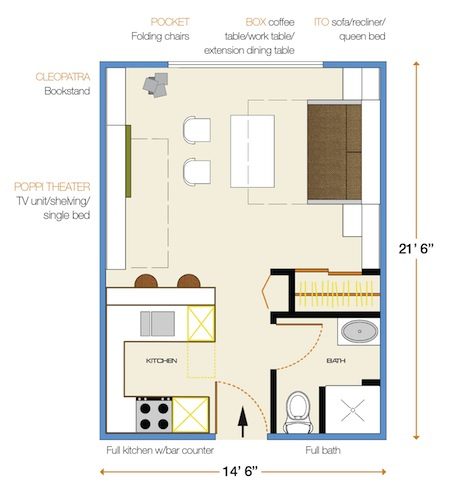
While Resource Furniture doesn’t have a lock on transforming furniture, they have the most comprehensive US collection we’ve found. While Murphy Beds are the most common space-savers, Resource offers other important space saving pieces like the Box Table used in the adAPT mock-up; the table converts from a coffee table to 8 person dining table. The Pocket chairs used are only 2″ deep when folded.

In terms of the beds, many Murphy Beds only get the bed out of the way, whereas most RF’s beds use the frontside, like the Ito Bed, which doubles as a recliner/sofa, and the Poppi, which is a bed and entertainment center.

Many people have asked us if we can help them design their own LifeEdited apartment. As every space is different, it’s nearly impossible to create a design without a fair amount of work. Besides showing a compelling model for the adAPT competition, RF’s mock-up shows how much you increase the utility of a compact space without any customization. If you’re in New York City, visit their showroom at 969 3rd Ave.

3 Hiding Beds Not Named Murphy

We love transformable beds. The LifeEdited apartment would not be possible if not for our Resource Furniture ‘Swing’ sofa/bed and ‘Lollipop’ bunk beds. The former allows one room to be living room and master bedroom and the latter enables a couple feet of depth to be a disappearing guestroom.

The ‘Swing’ is ultimately a Murphy bed–albeit one that uses aircraft quality mechanisms and, unlike most Murphy bed’s, has a couch in front of the unit when not in use.

The Murphy bed is the invention of a man named (you guessed it) William L Murphy. He was a San Franciscan who, so the story goes, wanted to woo his wife-to-be but couldn’t bring her up to his bachelor pad, which was effectively a bedroom. A couple hinges and springs later, he was wooing away in his “parlor” and giving himself a prominent place in bedroom-furniture history.

The Murphy bed makes sense. It has one hinge, it can use fairly normal mattresses and stows away nicely. But it’s not the only type of hiding bed out there. Here are a few models that are trying to unseat old Murphy as the king of hiding beds.

1. Zoom Room

One of the bigger gripes with Murphy beds is that they require manual labor–i.e. you have to raise and lower the bed with you arms. This might sound like a petty complaint, but the truth is some of us can’t do this for whatever reason and more of us don’t want to. We want to go to sleep and wake up without lifting a finger.

Zoom Room eliminates this issue by being fully automated and remote controlled. And because the mattress slides out from the bottom, the front-side of unit remains vertical so you can use it for storage, an entertainment center, etc. Prices begin at $4,450.

Zoom Room also makes traditional Murphy beds.

2. Bedup by Decadrages

The self-explanatory Bedup is a French product that uses ceiling space to hide your bed.

Bedup allows you to use very little wall space–a good option for particularly small rooms. Unfortunately, it does not appear to be readily available in US.

3. Resource Furniture LGM

Okay, so it’s kinda a Murphy bed as the bed pivots from the base, but the LGM‘s rotating frame allows the front-side to remain vertical so it can be used for additional shelving or a table/shelving combo (called the LGM Tavolo).

[divider]As many of the above units are highly customizable, it’s tough to give pricing. We can say they are not cheap. Most start well north of $5K. Keep in mind though that if these types of beds allow you to avoid purchasing a home without a spare bedroom–or any bedroom–that cost is quickly offset. In NYC, for example, real estate is easily $800-1K/sq ft. Let’s say a small bedroom is 10′ x 10′–that’s $80-100K! Purchasing a $15K bed unit is the far more economical route.

Do you know of other innovative space-saving beds? Let us know.