adAPT NYC Finalist Takes it to the MAX

The other day, we checked out “My Micro NY“, the winning design of the adAPT NYC competition. We found a little more information about it, such as the fact that it’ll lay claim to being the first major prefab building erected in Manhattan. Its housing modules will all be made in the nearby Brooklyn Navy Yards and will take a mere two week to put in place after the foundation is laid.

click on thumbnails to see larger images

Today, we are looking at another entry using prefab construction entitled MAX, which is a collaboration between Blesso Properties, Bronx Pro, Hollwich Kushner (HWKN) and James McCullar Architecture.

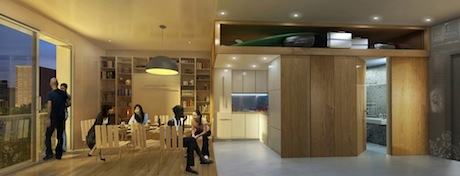
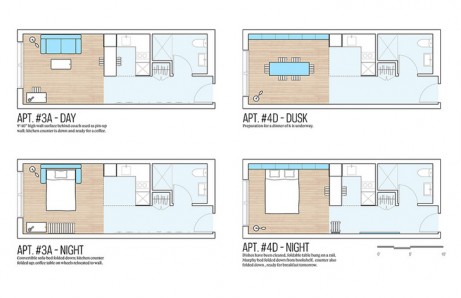
The building’s 56 units are 250 sq ft each, making them the smallest of the finalists. HWKN says this about the overall design and the building’s unique top:

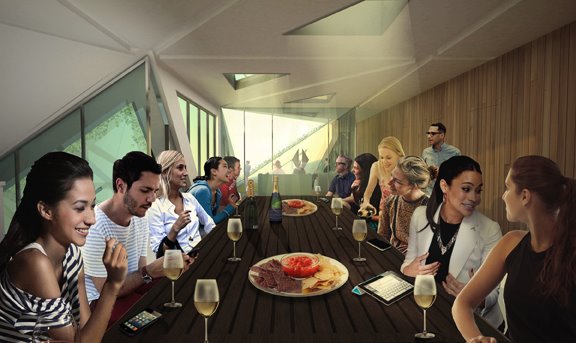
These efficient machines for living are arranged around a vertical public core, topped by a “hat” of communal rooftop amenity space, giving Max its unique disposition. Max wants you to make friends, have a drink, socialize, and expand beyond your four walls.

The “hat” features green spaces and, critical to any small space apartment complex, hottubs. The vertical core mentioned, from what we can deduce from the pictures, has multi-level communal areas, a game room and a common dining area.

HWKN described the building as a “community incubator” and there is something distinctly adult-dorm about the layout. This is a good thing. People often reminisce about dorm room days as the happiest days of their lives. With tight quarters, you were pushed into the hallways, cafeterias and other common areas, making meeting and connecting with friends a natural part of living. Designs like MAX ask why college students should have all the fun?

What do you think of MAX? Would you live there? If so, why. If not, why not?

Images credit: HWKN

“My Micro NY” Named Winner of adAPT NYC Competition

New York City Mayor Michael Bloomberg announced the winner of the adAPT NYC micro-apartment design competition this morning and the winning team is a partnership of Monadnock Development LLCActors Fund HDC and nARCHITECTS.

We don’t know a ton of info about the design, entitled “My Micro NY,” but based on the pictures, the team’s 55-unit building will be made from individual prefab modules with adjustable and modular interior layouts that can be adapted with times-of-day and use.

adapt-nyc-winner-5

With over 33 teams from around the world competing for the prize, competition was stiff. We at LifeEdited think the design looks amazing and want to wish Monadnock, Actors Fund HDC and nARCHITECTS a big congratulations.

adapt-nyc-winner-1

adapt-nyc-winner-3

adapt-nyc-winner-4

images via flickr/nycmayorsoffice

Event: Museum Exhibit Dedicated to Small Space Living

Small space apartment aficionados mark your calendars: Next week, beginning January 23rd, The Museum of the City of New York opens its “Making Room: New Models for Housing New Yorkers” exhibit. The exhibit is co-presented by the museum and Citizens Housing & Planning Council (CHPC) and will show off models, drawings and a mock-up 325 sq ft transforming apartment demonstrating possible futures for smart, compact apartment design. Winning designs of the adAPT NYC competition–the Bloomberg’s pilot program for designing and constructing a multi-unit micro-apartment building–will be on display as well.

New York City expects almost 1M new residents by 2030. A growing portion of these people will be singles, seniors and other populations for whom small, efficient apartments make a lot of sense. Spearheaded by CHPC, the adAPT NYC competition and the Making Room exhibit are rallying the best ideas for how the city and its real estate developers will accommodate them. We suspect this is just the beginning.

If you’re not a New Yorker, fear not, the exhibit runs through September 15th, so you have some time to get there. Barring that, check in with us for news and updates.

Ever Want Your Own Restaurant? Here’s Your Chance

We’re loathe to call things the “Airbnb of…” dog-biscuits, chessboards, whatever. We are sure peer-to-peer marketplaces have a prelapsarian past, but few enterprises have made purchasing services from your friends and neighbors as easy as Airbnb. So unfortunately, we have to designate a great new venture called Feastly the, ahem, Airbnb of restaurants.

Feastly allows chefs and gourmands to transform their homes into their own restaurants without all that overhead and investment of a traditional restaurant. Conversely, it allows diners an alternative to the traditional restaurant.

It’s pretty simple: As a chef, you register on Feastly’s site. You determine the menu, the price, the date, how many feasters you can handle, etc. Feastly fills the seats, handles money and takes a modest administrative 12% cut.

As a diner, you browse and sign up for dinners in your area (right now, their main markets are Washington DC, NYC and San Francisco). More than just a restaurant, the Feastly experience awards diners with home-cooked meals and a unique social experience, or as Feastly cofounder Noah Karesh put it, “The dining table is the optimal social network.”

We’ve been using Feastly chefs to cater the LifeEdited dinner parties and are very impressed with the quality of food and service.

We asked Mr Karesh some other questions about how Feastly started and how it works.

Why did you start Feastly?

Feastly came from my travels to Lake Atitlan,Guatemala. I was struck by my inability to find authentic, local food there and convinced a local to invite me over for dinner. Sitting around his family’s table, I had my “a-ha” moment realizing that it shouldn’t be so hard to eat local food and meet people when traveling. Feastly was born over Start-Up Weekend DC in November 2012 and a year later, we’ve hosted hundreds of meals for thousands of Feasters. One of my many goals with the platform is to bring Feastly to Lake Atitlan.

Do you know ahead of time what will be served? Can you make requests?

Yes, our chefs post menus online ahead of time so that Feasters can search for their favorite dishes or chefs. For those with food restrictions, our chefs do their best to cater to any food issues. Thanks to our feedback forms, chefs can receive immediate feedback on their meals and get ideas from Feasters for future meals and how to improve the overall user experience.

How much do dinners typically cost?

Our meals range from ice cream tastings to brunch to seven course dinners and may range from $5-200 with the average meal costing $38.50 [booze is sometimes, but not always, included in price.]

Do you think your approach could replace going out to a standard restaurant?

Yes, but even more than just replacing people’s reliance on restaurants to “eat out,” we are increasingly serving as a social network for our Feasters. Our users come for the food, but increasingly stay due to the positive relationships they are building around the dinner table. We’ve helped to introduce couples, business partners, friends and activity partners over meals.

What about markets you don’t serve yet? How can people get involved?

We’ve been excited to see so much positive feedback in NY and DC and soon SF, and we get emails daily from people around the world encouraging us to open in their cities. Like our peers at Airbnb, we are eager and working to expand globally, so that we can bring the best of Feastly everywhere. We are also eager to bring on more chefs, and like to work with local partners eager to bring Feastly to their communities. We’re always open to new ideas and partnerships and it’s best to reach out at info@eatfeastly.com.


Survey Shows Real Costs of City Life

In our quest to find the best place to live an edited life in the US, we came across this chart from The Atlantic. It shows what percentage of income is spent on housing and transportation by the middle class for every major metropolitan in the United States.

While this chart does not provide a definitive answer to our question (and of course there is no “one” answer), it does provide some useful data.

First, it looks at the middle for income; defined as people making 50-100% of median income for that city. And rather than looking at raw housing costs, it looks at housing costs as percentage of that income. So even though the average rent in the city of San Francisco is $3226, most San Franciscans use 33% of their income for housing; combine that figure with one of the lowest transportation costs in the country and San Francisco looks quite competitive in terms of affordability. Same story with New York City: High incomes in proportion to high housing costs combined with low transportation costs equal reasonable overall expenses.

Washington DC ranked the most affordable in this survey. The nation’s capital has relatively high housing costs, but also high relative incomes and very low transport costs.

On the other end of the spectrum are cities in Florida and California (San Fran excepted). Their low incomes relative to housing and high transport costs made them not-so-affordable places to live.

Unfortunately for all of the cities surveyed, the overall costs of housing and transport relative to income has gone up, as indicated in the graph at top.

via The Atlantic

Transforming Apartments and the Custom Conundrum

We’ve looked at pictures of Robert and Rosa Garneau’s NYC transforming apartment in the past, but thanks to this video from Fair Companies, we get to see the apartment come to life. Of particular interest is seeing the movement of the 500 lb sliding wall, the pre-programmed, automated hydraulic table and the amazing amount of storage the apartment contains.

All of the furnishings were custom built for the apartment. Most of it contains storage; many pieces disappear and/or are modular (the video takes you through the whole space).

Customization like this raises an interesting question about these types of transforming spaces: Because all the pieces work in concert with one another, how do people who might want a home like this adapt their existing inventory of furniture to that space? Is that even possible?

Or is it better to start from scratch as the Garneau’s did? If the Garneau’s were able to squeeze approximately 40% more utility from their space because of their furnishings, might the extra investment be worth it?

Let’s take a look. Robert Garneau said he spent about $234K in renovations. NYC real estate costs around $800-$1000/square, so a 40% larger space (i.e. 910 sq ft), would be $208K-$260K more than the Garneau’s place (we know…it’s crazy). At that price it’s about a wash between the additional space and renovation costs. To make a truly fair comparison, we should add additional furnishings for the larger space, renovations and higher upkeep and maintenance costs. Also, consider you could probably go half as elaborate as the Garneau’s and have similar utility. Suddenly the math gets a lot more competitive.

What do you think? Would you be willing to start from scratch to have a small, transforming space that does everything you need? Do you think spaces like these with lots of custom, built-in furnishings could go mainstream? Or do you think they will remain curiosities–homes for eccentrics and architects, but no one else? Let us know in our comments section.

Opinion: Where is the Best Place to Live an Edited Life in the US?

We are great advocates of cities: They’re walkable, bikeable and have public transport for easy mobility; the average city dweller uses approximately 14% less carbon than his non-urban counterpart according to the Brooking’s Institute study; their density facilitates easy interchange of resources and vibrant cultural lives.

But to use “city” as an abstract term might not be helpful if you are looking to move somewhere where you can best live an edited life–i.e. living a life with more money, health and happiness with less space, stuff and energy. The question becomes, which city supports that life best?

We talk a lot about New York City and San Francisco, as they both are very dense, have extensive public transport systems and have vibrant cultural lives. But consider the average rent in the New York metropolitan area is $2687. San Francisco is even more at $3226.

Perhaps you want to take economist Jed Kolko’s advice and buy a home, which he claims will save around 30% in living expenses. Well consider that the median home price in Manhattan is $1.14M. Want to slum it up in a borough like Brooklyn? Median price is $582K (the borough was recently deemed the second most expensive place to live in the US behind Manhattan). San Francisco is no slouch at $705K. That’s a lot money to fork over to save money! And buying small doesn’t necessarily save you a ton. Studio rents in both cities frequently exceed $2K. If you’re a family, expect to pay $3500+ rent or $800K for even a modest apartment.

Of course, with these prices come increased economic opportunities, but there’s a paradox: There are more jobs where you can make more money, but, in most cases, you work more, with less time to enjoy the benefits of the city.

There are middle-ground cities like Chicago, Boston, Philly, Seattle and Denver that enjoy more manageable living expenses along with decent economic situations, but they also tend to be less walkable and have less developed public transport.

Then there is Main Street USA. Many claim that small business and technology will allow people to work remotely will make them the “cities” of the future. But for the most part, this is still speculative. Most jobs are still in denser areas and these areas are usually quite car-dependent.

We realize this is not a simple question. The “right” answer might depend on living situations (single, couple, family), career situations, family connections, etc.

Imperfect as the answers may be, we’d love your opinion. Do you live–or have you lived–in a place you think facilitates the edited life–a place you think allows you to do the most with the least?

Please leave us your thoughts in our comment section below. Thanks!

What Happens When Beer and Transforming Apartments Mix

A couple weeks ago, we had Derek “Deek” Diedricksen and Paul Farr from Tumbleweed Tiny House Company stay at the LifeEdited apartment. The pair were in New York City leading a tiny house workshop showing people how to make their own tiny houses. We wanted to know what they thought of the place. They videoed this self-guided tour that gives their thoughts on the apartment (their enthusiasm might have been helped out by a beer or two).

Check out Deek’s blog Relaxshacks.com and Youtube channel for cool pics, videos and news about tiny house construction and living.

Thanks guys!

LifeEdited: Hurricane Sandy Edition

Somehow doing a post on transforming design or architecture seems a bit beside the point in light of hurricane Sandy, whose impact has been staring us in the face for the last few days. Heck, the LifeEdited apartment was right in the storm’s path and is currently without power!

A few weeks ago, we talked about how to get happy spending money–on other people. We thought it a good opportunity to remind our readers that there are plenty of chances to be happy with the recent devastation on the east coast.

Millions of people have been affected by the hurricane, many of whom are in grave need of your support. If you don’t have a specific charitable organization in mind, consider checking out organizations like Charity Navigator and Charity Watch that evaluate charities to see how much of their money goes into relief efforts. The latter site listed the below organizations as highly rated charities serving hurricane victims; their respective ratings are in parentheses:

There are also numerous hands-on volunteer opportunities. Check out NY Observer’s list if you’re in the NYC area. Otherwise, Google your area and find who is accepting volunteers.

Lastly, if you want to dovetail your giving with life editing, many charities, particularly shelters, are asking for clothes and other goods. It’s a perfect time to unload your unused stuff to those in need. Don’t worry, we won’t tell anyone about your mixed motivation.

image by Spencer Platt / Getty Images

Salvaged Materials Make Up Super Slick NYC Studio

Check out this short video of Bill Di Paola’s 500 sq ft studio on Manhattan’s Lower East Side–aka “The Tron Apartment.” Though the polish and shine of the place make it look like everything was bought new, the space is mostly a collage of recycled and salvaged materials. For example, the kitchen shelves were purchased from Pan Am Airlines when they went out of business. Interesting touches like mirror-polished metal panels on the ceiling, illuminated plexiglass walls and a clear glass sink are designed to give the impression that the space is larger than it is.

Di Paola said he wanted to something super clean to contrast with what he does during the day, which is running a great bike advocacy group in NYC called Times Up. In other words, after a long day of bike grease, he wanted a bastion of cleanliness. He seems to understand that the aesthetic isn’t for everyone, but feels it perfect for himself.

The apartment demonstrates that with a bit of resourcefulness and creativity, you can do a lot with a small space.

Via SpacesTV