Japanese Family of Six Thinks Inside the Box

A few weeks ago, we saw how one man conveniently stashed his kid in a cubby in his tiny Warsaw apartment. Several thousand miles away, a husband and wife went a bit further, stowing their four children in little cubbies in their 770 sq ft Tokyo apartment.

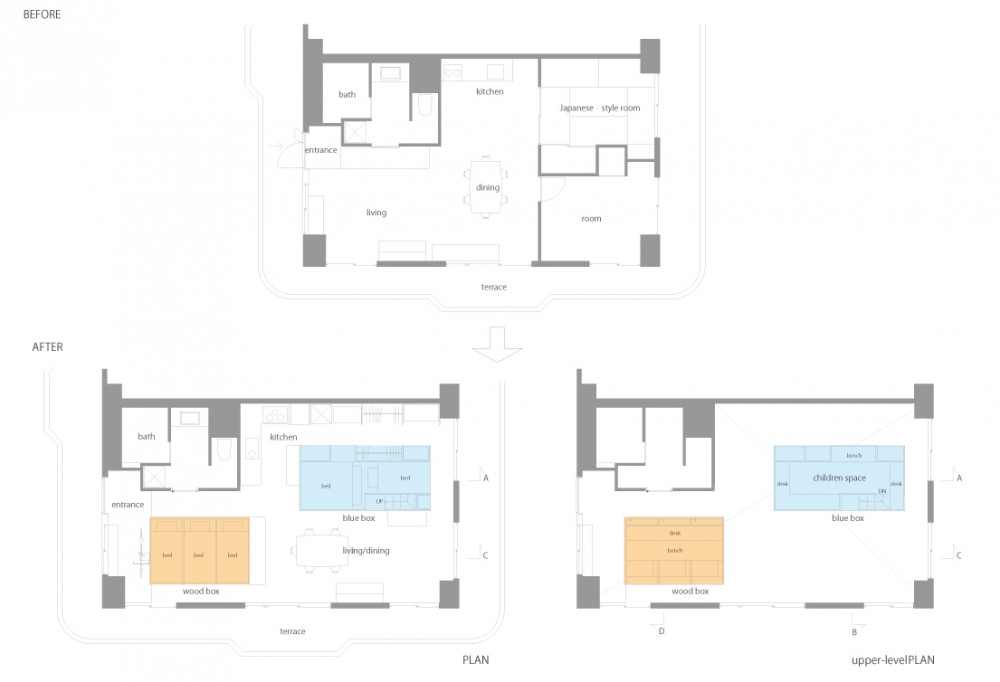
To do this, Miha Design, the firm responsible for the renovation, converted the original apartment, which included one bedroom and a traditional Japanese room, into an open floor plan.
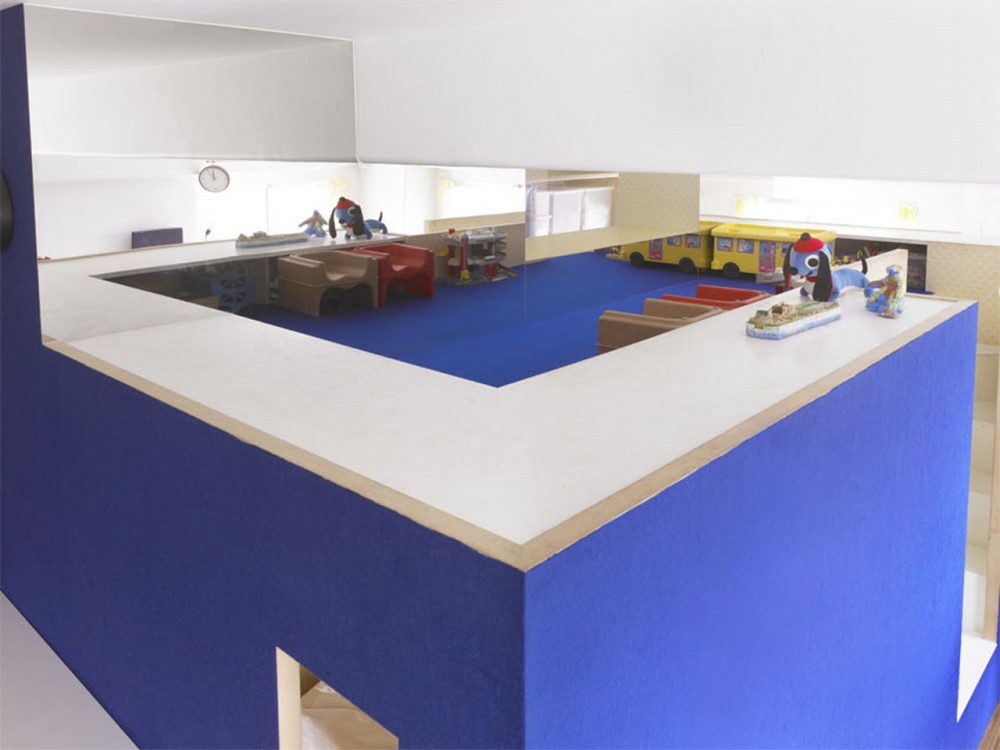
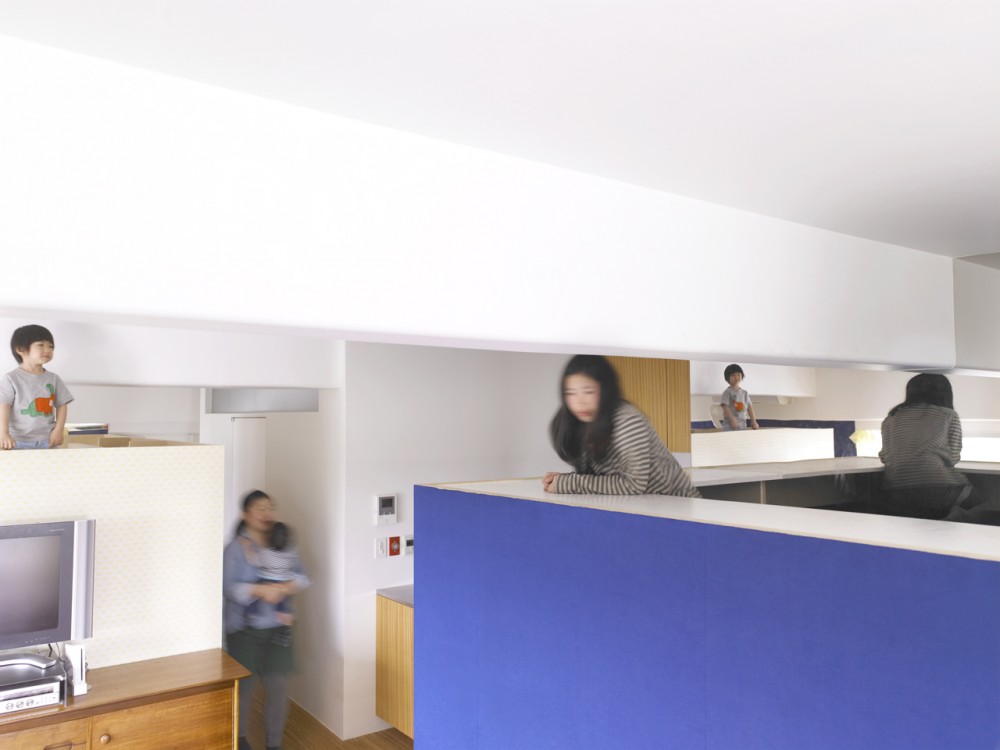
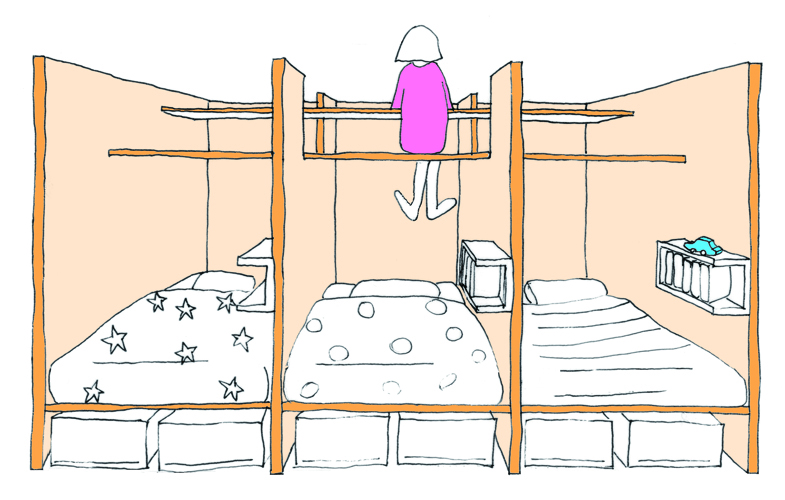
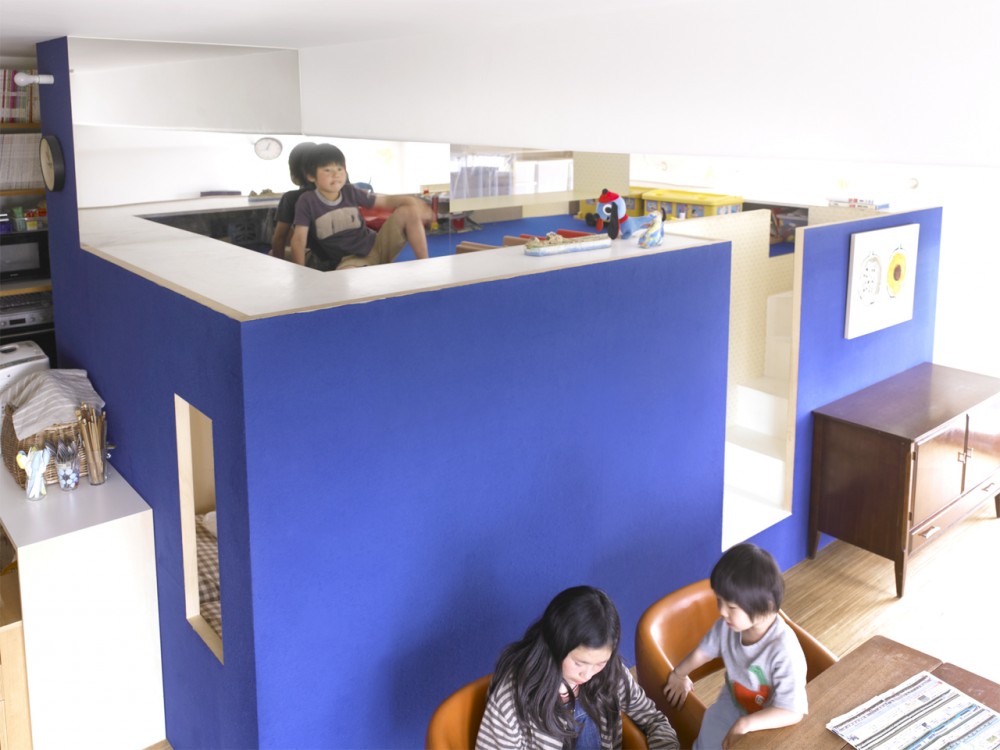
They created space separation by erecting two large boxes that house several discreet spaces. One box–covered with blue felt–contains three sleeping cubbies for the younger children; on its top is a 1.1m high play area–suitable for young children to scoot around. There are desks and benches on top as well; slots for legs allow the kids to sit upright. Under the beds are storage bins for the kids’ stuff.

The second box has a wood finish and beds for the parents and eldest child. The top has a similar desk and bench setup as the other box, albeit less blue.

The rest of the space is comprised of a dining/communal area, a galley kitchen, an entrance way and a storage area.

People are always asking us how to fit families in compact spaces. Miha Design’s space is one possible version, demonstrating a creative way to fit a large family in a small space in an expensive city–while still maintaining some semblance of separation for each family member. We do wonder what will happen when the kids grow up and cease to fit in their cubbies or start knocking their heads on the ceiling. We also suspect the dangling leg design might not fly with every parent.

All photos by © Sadao Hotta

Via Arch Daily
Live in a Sliver Japanese Style

Japanese architecture proves that necessity is the mother of invention. In order to fit their ample population on the space-squeezed island, homes are designed to fill up every sliver of space, however puny. This ABC Nightline tour of Japanese “micro-apartments” gives a nice look at some of these super-slivers.

Not to be pedantic, but these are not micro-apartments, but a class of home called Kyosho Jutaku that use remnant real estate in fantastic ways.

In the video, ABC interviews Japanese architecture expert Azby Brown, who shows off modern interpretations of traditional Japanese architecture like underfoot storage and stowable beds.

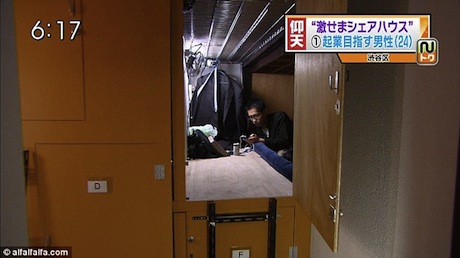
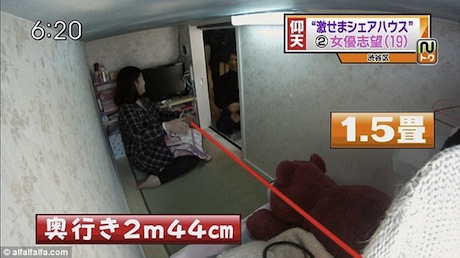
These tiny homes seem downright palatial compared to geki-sema homes, tiny-shared spaces that have been recently called  “coffin-apartments.”

coffin-home-2 coffin-home

These teeny-tiny living boxes are designed for young Tokyo professionals who just need a place to sleep.

What do you think? Are either of these types of dwellings viable living spaces or more or less human storage lockers?

See the Future in Ancient Japanese Architecture

While there’s a time and place for innovative space-saving solutions, sometimes the way forward requires a little looking back. A perfect example of this is the traditional Japanese home, a space-saving layout that works as well today as it did 400 years ago.

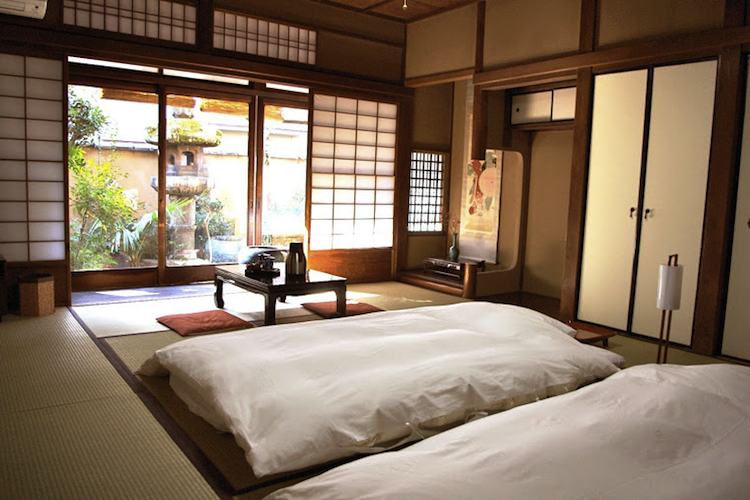
Unlike western homes, which typically have designated rooms for specific purposes (e.g. living, dining and family rooms), traditional Japanese homes center around a large living space called a washitsu that serves as any and all rooms (excepting the kitchen, toilet and genkan). Many modern Japanese homes still include a washitsu, though they are now accompanied by several western-style rooms as well.

Subdivision of the main room is achieved with shōji, translucent paper walls, or fusuma, thicker, impermeable walls, both of which move along wood rails on the floor and ceiling. Opening and closing these walls can dramatically alter the size and utility of the room.

This versatility of the room is made possible by lightweight portable furniture such as futon beds, zabuton seating cushions or tatami chairs for seating and low tables. All furniture can be stowed in a large closet area called an oshiire.

One of the most brilliant aspects of the traditional Japanese architecture is its standardization. Layouts are based on the tatami, an 18 sq ft mat, traditionally made of rice straw. The fusuma are the same size as the tatami. Imagine a home that required no custom pieces? Where everything was standardized and easily replaced?

There are definitely some downsides to the traditional Japanese home. Privacy probably being the first one. Fusuma and shōji are really glorified paper walls and provide little in the way of audio isolation. Historically, rooms were shared by the whole family, which might not suit everyone. Western knees and backs are not necessarily conditioned to sitting cross-legged or getting up and down from a 6″ high bed either.

All that said, it wouldn’t be hard to imagine adapting many of the traditional Japanese architectural elements to western preferences: More robust sliding walls, a platform for your futon, folding chairs rather than zabutons and so on.

Have you lived in a traditional Japanese home? What were the advantages/disadvantages? We’d love to hear your experiences in our comments section below.

Design Lessons From Japanese Schoolchildren

At the beginning of a Japanese child’s elementary education, he or she is typically given a backpack called a Randoseru. The backpack has firm sides and measures 30 cm high,  23 cm wide and 18 cm deep. It is made of leather or high quality synthetic material. The bag is not emblazoned with the latest cartoon characters. Girls’ are usually red, boys’ black.

The bags are given with the expectation that they last throughout the child’s six year elementary education. This is a good thing, because the bags start around $100 and can exceed $350. The bags actually last beyond the child’s schooling.

In America, few children are given $350 backpacks. Our design philosophy says that children will abuse their stuff and should be given something that can be cheaply replaced. For example, by the time this author was out of elementary school, I had blown through countless $20 nylon backpacks. Preservation was not a priority.

The question is does a child’s backpack abuse stem from her inability to take care of the bag or the lack of value she has for it?

The example of the Randoseru seems to point to the latter point. Japanese children take care of their bags and make them last, not because they are less active, but because they place a high value on them. What if we took a cue from Japanese schoolchildren and gave more value to the objects in our lives, rather than perpetuate a disposable culture?

Spending more up front might make sense economically as well. What if we were willing to spend $120 for one backpack that could be handed over to another child versus $120 for six that will end up in landfills?

And what if we applied this philosophy to everything in our lives? What if our lives were filled with high quality stuff we loved? Where most of our items were worthy of being handed down to the next generation?

What is the Randoseru in your life? Let us know in our comments section.

image credit taopic.com

Innovative 19th Century Tiny Apartment Designed Out of Spite

The Japanese are notorious for using odd-shaped land parcels to make amazing tiny homes. In fact, they have a proper name for them: Kyosho Jutaku. The “Lucky Drops” home below is a perfect example. Because of its skinny lot, the home’s frontage was kept at a mere 10′, while it has a very long 96′ depth.

But as innovative as the Kyosho Jutaku homes are, it turns out that an angry American was the forefather of this style of skinny architecture.

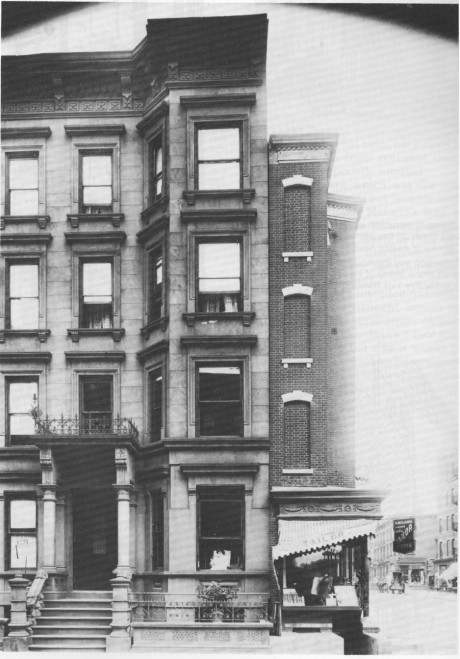
In 1882, Patrick McQuade wanted to build some homes at the corner of 82nd and Lexington in New York City. Trouble was, he needed an adjoining parcel owned by Joseph Richardson; that parcel was only 5′ wide, hence McQuade offered what he thought was a reasonable $1K for the land so he could complete his project.

Richardson refused the offer, asking for $5K instead. McQuade, told him to get lost and started building, thinking that the 5′ parcel would simply go unused.

He was mistaken. Richardson later built what would be known at “The Spite House.” The house at its narrowest was 3’4″ wide. Because of a zoning law that allowed bay windows to extend 2’3″ beyond the lot, he was able to eek out a maximum width of 7’3″. The building was 102′ long, 4 stories had 8 suites (2 per floor), one of which Richardson occupied, and, surely pleasing to the man, blocked most of the light to McQuade’s building.

The place wasn’t for everyone according to the indelicate Richardson: “Everybody is not fat and there will be room enough for people who are not circus or museum folk.”

A 1929 article said this of the interior and furnishings:

Only the very smallest furniture could be fitted into the rooms. The stairways were so narrow that only one person could use a stair at a time. If a tenant wished to descend or ascend, from one floor to another, he would, of necessity, have to ascertain that no one else was using the stair. The halls throughout the house were so narrow that one person could pass another only by dodging into of the rooms until the other had passed by. The largest dining table in any of the suites was 18 inches in width. The chairs were proportionately small. The kitchen stoves were the very smallest that are made.

Unfortunately, the home was demolished in 1915 by the venerable Bing and Bing company, so pics of the interiors are nonexistent. But this narrow home, conceived in venom and anger, might have presaged the next generation of smart small homes. Or not.

But as innovative as the Kyosho Jutaku homes are, it turns out that an angry American was the forefather of this style of skinny architecture.

via The Universe of Discourse and nyc-architecture.com

Lucky Drops image credit: Yasuhiro Yamashita

Coolest Small-Space Cans Come from Japan Yo

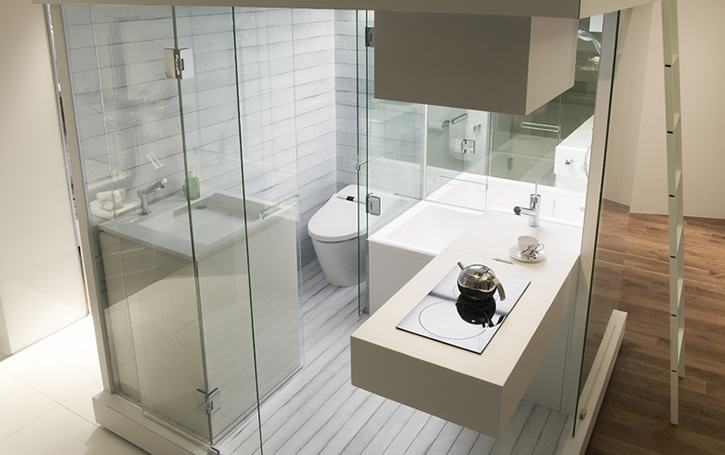
The Japanese have a knack for lending high-end design and materials to spaces Americans typically associate with dorm-rooms and halfway houses. Case in point is the Subaco Sanitary Unit from the Spiritual Mode corporation (we’re confident “spiritual mode” and particularly “sanitary unit” sound more elegant in Japanese). Subaco is an all-in-one bathtub, toilet, wash basin, kitchen, laundry and loft–all of which occupy a whopping 6 x 6 ft (2 x 2m) footprint.

It looks like they have at least a couple varieties: the peekaboo model with glass walls for the WC (don’t throw stones–or anything else–whilst using it) and a model with solid walls. We can see all the bathroom fixtures and induction cooktop, which because of its flat surface and cool-to-touch surface, doubles as a countertop. There even appears to be a fan for the cooktops. We’re curious to see what kind of laundry machine is used.

Presumably, these modular units can be plugged into any space; they look like they’re destined for the wan rūmu manshons we covered a while back.

Most small American apartments employ the Afterthought School of bathroom and kitchen design–knees often knock into tubs and doors while on the can; fridge doors refuse to open in the kitchen; prep space is a joke.

We wonder if Americans were given such sleek and elegant designs in their small-space living options, whether they might be more inclined to scale back on their living spaces?

Image credit: Spiritual Mode

Via Treehugger

Kyoto Hotel Offers Travelers Posh Pods

Japan always seems to be one step ahead of the rest of the world in space-saving living. Case in point is a capsule hotel in Kyoto called 9 Hours. The name is based on the idea of 1 hr to shower, 7 hrs to sleep and 1 hr to rest.

While capsule hotels have been around for a while in Japan, they have been more focused on function than form. 9 Hours’ super sleek interior and ample amenities give a luxury feel to what is essentially sleeping in a cubby.

The developers express that they are not interested in replacing full-size hotels–merely providing an alternative for people who may literally need a place to sleep and nothing more.

The video asks if the US and Europe are ready for this style of hotel. We suspect it’ll come down to cost. If a space is 20% the size and 20-30% the cost of a standard hotel room, it will create a compelling argument for booking a pod. Ultra-sleek environs like 9 Hours will make the decision to go with a capsule easier as well.

What do you think? Have you stayed in a capsule hotel? What was your experience. Would you? If not, why not?

via Monocle