If You Let Them Build It, They Are Much More Likely to Come

The world is abuzz about tiny houses. They are the architectural antidote to all that ails the modern American home: they are small, affordable energy misers whose tiny confines prohibit the accumulation of extra stuff. But tiny houses have a fatal flaw: they are illegal for permanent habitation in most cities. The few cities where tiny houses number more than a half dozen (Portland, Olympia and, um…did we say Portland?) are cities that have relaxed their zoning, usually designating them as Accessory Dwelling Units (ADU, aka “Granny Flat”), which are basically houses set up behind other, larger houses. But the Colorado city of Walsenburg (don’t worry, this author–a longtime Coloradan–has never heard of it either) is creating a plan that might someday soon serve as a precedent on how tiny houses can turn from architectural plaything to viable housing solution.

The plan, helmed by Sprout Tiny Homes, is to create a subdivision made entirely of tiny houses. Rod Stambaugh, founder of Sprout, convinced the Walsenburg city council to remove their restriction of building smaller than 600 sq ft. Rather than riding on trailer beds, these houses will have foundations and be connected to the grid–a good thing for people who might not be keen on composting toilets. But the houses themselves will be pretty damn small: the 32 units will range from 262 to 672 sq ft. There will also be a community center and outdoor movie theater. Stambaugh told Outside Magazine that he expects them to sell for $60,000 to $130,000.

Walsenburg is a former coal mining town of 3K that has seen better days. The tiny house subdivision is meant as a way of providing affordable housing and revitalizing the economy. As Lloyd Alter notes in Treehugger, that revitalization will be greatly abetted by what could by the US’s largest cannabis growing facility, which is going up on the outskirts of town. In fact, it wouldn’t be surprising if the main intent for the tiny house subdivision is to provide housing for workers at the the facility.

While company housing for pot growers might not do wonders for changing stereotypes about the type of people who gravitate toward tiny houses, the end result could be the same: showing that tiny houses can be a viable, safe, affordable housing solution. Stambaugh has plans to do another development in nearby Salida, Colorado and would eventually like to bring tiny houses to more prosperous mountain towns, such as Vail, where there’s a major shortage of affordable housing.

What’s Right With This Picture?

From above, this picture shows a fairly normal suburban neighborhood. There are large, single family homes, each with their own driveways, front and back yards. But if you look closely, right between N St and Lessley Pl, there’s a group of homes with irregular yards. Trees from one property cascade over onto the next. There’s some weird walkway system that flows unimpeded from one property to another. It’s tough to tell where one property ends and the others begins. These are the homes that make up the N Street Cohousing community of Davis, CA.

N Street began in 1986 when Kevin Wolf and his wife Linda Cloud purchased and brought together two adjoining houses. Eventually additional houses were purchased by other parties and brought into the community.

247328_178590218864666_4080711_n

In 1999, the Davis city council recognized N Street as a planned development (PD). According to the N Street website this had a number of community-building implications: “Sideyard setback easements were slightly more relaxed while the backyard setback was extended from ten feet to 30 feet. Construction of larger second unit apartments were allowed.” This permitted the melding of backyards as well as the subdividing of existing houses. Today N Street contains 19 houses with over 60 adults and 5-10 children depending on the year.

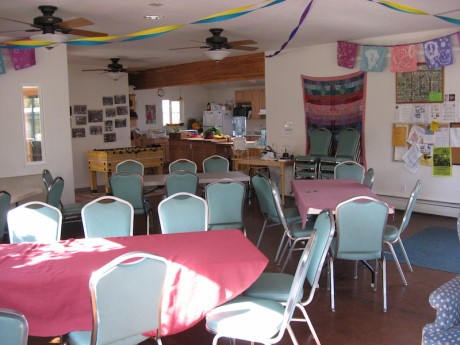
The initial house purchased by Wolf was made into a communal house, which has “a four bedroom-two bathroom apartment upstairs and the downstairs includes the community’s dining room (sitting 50 for dinner and 70-80 for concerts), a large kitchen, a TV/meeting room, a bathroom and a shared laundry room.”

IMG_0062

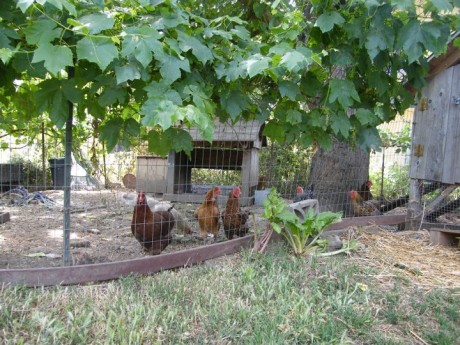
Though it might seem like a commune, all houses are individually owned and occupied, though some owners rent their houses out. And while there are no backyard fences, each house has its own yard that it maintains. Many, if not all, of the yards are landscaped and farmed. There are gardens, chickens coops and more.

Chickens

The main thing driving N Street is its culture of shared living and mutual support, of which the community says:

N Street Cohousing has all the attributes of a classic cohousing community. We live together as an intentional community, sharing much of the joys and pains of our lives with each other. We support each other in difficulty and celebrate in success. We sometimes vacation together. We have even been known to fall in love and marry each other. However, we live in our own homes and have our own yards (though without any fences). Each of us can be private when we want to be and each household sets its own culture for visiting, borrowing, and participating.

In cohousing parlance, N Street is deemed “retrofit cohousing”–which is to say the architecture and layout were never designed to be community oriented as they are in developments like Pocket Communities and other purpose built cohousing developments.

This retrofit solution is one of the reasons why N Street is so interesting. In the coming decades, suburban living might present large economic, environmental and social challenges. Without cheap fuel, people might not be able to access their suburban homes in an economically viable manner (this, to a large extent, is already happening across the country where many suburbs are becoming slums). Even with cheap fuel, the carbon production of suburban living–stemming from both large homes and related mobility–will become ever harder to reconcile with the dire need to curb carbon production. And as the population ages, having large, individualized homes that are tough to pay for and access (i.e. drive to and from), will present major issues for a growing older adult community. Despite these challenges, there’s a huge suburban infrastructure that’s not going anywhere anytime soon.

N Street presents one possible way of meeting many of these challenges. Because it has a built-in community, it might reduce the need to drive to see friends and access services. Because it has some agricultural capacity, it might provide a model for self-contained, sustainable living. And because community members look out for one another, and because the houses have the flexibility to be further divided into individuated apartments, allowing for more affordable housing as well as possibly creating ad hoc retirement communities, communities like N Street might provide a supportive housing model for aging populations. All of these things working within the existing suburban infrastructure. One can hope!

The Power of Free Real Estate

Throughout the month of June, a group of people in San Francisco are conducting an experiment in improvisational community creation. [freespace] is a 14K sq ft blank canvas for anyone looking to present his or her talents, ideas, classes, swaps or anything else to the greater community. It is, as one of its members declares, “a big empty building filled with people who care.”

The project came to be after the founders were given a $1, one month lease for the vacant SOMA neighborhood warehouse (if you’re unfamiliar with SF real estate, this is a good deal). While we apologize profusely for the delayed announcement, there is still a lot going on for the remaining 12 days of June–yoga classes, a TEDx event, hackathons, live music, salons and much more.

One of the most endearing aspects of [freespace] is its sense of urgency. With a 30 day lifespan, there’s no dilly-dallying. They have started several projects meant to endure beyond June, including a 30 day garden, a mobile learning center for the homeless, a matchmaker-service for muralists and walls and its own bikeshare program.

To us, [freespace] exemplifies the increasingly paradoxical nature of many of the world’s leading cities. On the one hand, the cities often hold the highest concentrations of creative energy that make living there so great. On the other hand, the rising cost of these cities–both for commercial and residential real estate–make the conditions inhospitable for that creativity to flourish. People with jobs of indeterminate value (see artists) and real estate that doesn’t generate a lot of money are usually excised or marginalized by the city.

In fact, a project like [freespace] only exists due to the largesse of its donors (the city, its real estate broker and property owner)–and it’s only for a month. The [freespace]ers have launched a fundraising campaign to cover July’s $24K rent, but have only raised $3700 to date.

We wish [freespace] the best of luck and hope that similar projects arise in other cities–ones that might endure for more than a month. By providing large, low or no cost communal spaces for people to meet and create in, we imagine the creativity that makes our cities so valuable will flourish once again.

Love Thy Neighborday

The average American moves 11.7 times in a lifetime. One out of six Americans move once a year. This high mobility may have turned the institution of neighborly relationships from marriage to long-term dating or even brief fling. This situation was verified by a Pew Study that found fewer than half of Americans know most or all of their neighbors.

Neighbors are good (at least the ones that don’t blast music at 2am). They feed our cats, lend us ladders and cups of sugar and provide easy companionship. A strong tie with a neighbor is worth 1000 Facebook friends on the black market. But it’s tough to love our neighbors when we don’t even know them.

The good folks over at Good Magazine have a remedy for this neighbor deficit disorder: It’s called Neighborday. On April 27th, they challenge all of us to get to know the people closest to us (geographically at least). They explain the motivation:

…While the internet age, has brought unprecedented access to information, networks, and commerce, it’s unclear if it has brought us closer or has in fact further isolated us…Neighborday is about creating a new story. It’s about transcending the old story of self to create a new story of us. It’s about expanding our definition of self to include those who live above us, below us, and next to us. It’s a call to action of the most important kind: to let our neighbors in, and to build more self-reliant streets, blocks, and neighborhoods, together.

We know you’re busy. We know you already have lots of friends that you have trouble keeping in touch with. Worst of all, we know it’s awkward introducing ourselves to the people closest to us–especially if we’ve lived someplace for a while. It might take a little courage (remember, they haven’t introduced themselves to you either, so the shyness is probably mutual).

But really? If we don’t know our neighbors, if we can’t knock on their doors when we need a favor, consider there might be a gap in our social lives.

Visit Good’s Neighboring homepage to take their pledge. They also provide ideas for celebrating Neighborday, like turning your home into a parttime restaurant. If we don’t know our neighbor’s name, we’re probably best off starting small, like introducing ourselves in our hallways, driveways or sidewalks instead of giving our usual “what’s up” or “how’re you doing.”

Are you tight with your neighbors? Beside basic friendliness (always the easiest tactic), how have you cultivated relationships with your neighbors? What advice would you give those of us who are strangers to our neighbors?