The Chicago Bungalow

In the early part of the 20th Century, the United States experienced a surge of housing demand from upwardly mobile first and second generation immigrants. Fueled by incomes that exceeded their previous subsistence levels, these people were after something more comfortable than their previous cramped urban quarters. At this point in history, cars hadn’t quite hit saturation levels (in 1930 there were 2 : 10 cars/people versus 8 : 10 today). As such, these new, comfortable homes had to be densely laid out so people could get to work via bus and streetcars. One supply solution to this demand came in the form of the Chicago Bungalow–a modest, solidly-built, densely laid out single family house that spread throughout the midwestern city’s borders.

bungalow-interior

Between 1910-1940, 80K bungalows were constructed in Chicago. According to the Historic Chicago Bungalow Society, these homes had several distinguishing features such as having:

  • One and one half stories
  • Brick faces with stone trim
  • Low-pitched roof with overhang
  • Rectangular shape: narrow at the front and rear ends, longer on the sides
  • Generous windows
  • Full basement
  • Offset front entrance, or side entrance

Measuring roughly 1200 sq ft, the family-focused Chicago Bungalows were fairly uniform in dimension, yet they had aesthetic variations such as differing brick color and unique decorative windows that gave each unit its own personal character.

gladstone

Because they sat on long, narrow 125’ x 25’ lots, which included small yards, aforementioned populations were able to stay relatively close to city and industrial centers. Incidentally, my mother, whose father worked in the railyards, grew up in a southside bungalow along with my uncle and grandmother (before they were known as such).
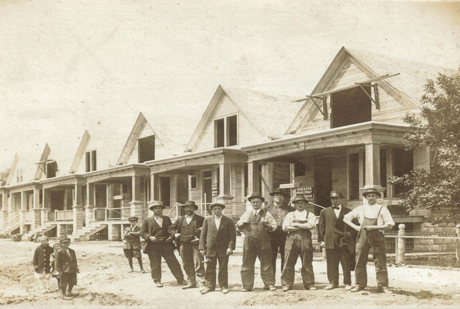
bungalow-historic

In contrast to today’s single family home, whose girth has grown beyond 2600 sq ft for the average new single family home, the Chicago Bungalow was (and still is) an exercise in modesty, practicality, quality craftsmanship and solid urban planning. As I’ve said many times before, the past often holds the key to the future.

Images via Historic Chicago Bungalow Society

Sprawl, Huh! What is it Good For?

Last week we gave a micro view of the embiggened American home. Today, thanks to Google and the US Geological Survey’s Landsat images, we see the macro view. The GIF’s below, made by Texas architect Samuel Aston Williams, show the Houston, Dallas/Fort Worth, Chicago, NYC, San Francisco and Los Angeles metro areas as they grow from 1984-2012. The ever-sprawling burbs look like spilled milk over once-green hinterlands.

Of course the images don’t tell the full picture, e.g. how the increase in sprawl relates to overall US population or how these spread out cities might be the product of an increasingly urban country (in other words, the increased size of one area might translate to a major decrease in another, more remote locale). Nonetheless, these images, coupled with consistent data showing the ballooning American home size, paint a picture of a country that might need a serious edit.

click on image to enlarge

via The Atlantic Cities

Windy City Goes Micro with FLATS Chicago

Chicago adds its name to the growing list of cities that are building large-scale micro-unit developments with FLATS Chicago. The project is quite an undertaking. The development company, Cedar Street Co, has acquired seven buildings, representing 1200 apartments that will be converted into luxury apartments in the city’s rough-and-tumble Uptown and Edgewater neighborhoods.

Unit size will average around 350 square feet and be as small as 275. Amenities will include things like free wifi, washer/dryers in each unit, bike-shares, common spaces, rooftop pools and sports clubs. Projected rents range from $800 a month for a studio to at least $1,400 a month for a two-bedroom.

Rendering of Interior of FLATS Chicago

Jay Michael, one of Cedar Street’s partners, told Time Out Chicago that he wants to “sell singles on what he calls ‘FLATS life’: Common spaces are ‘an extension of your space’ where you can meet neighbors or entertain friends,” and that they are “targeting recent college grads who are ready to live alone,” who “for the same rent they’d pay for their half of a two-bedroom condo…can live solo at FLATS.”

Sounds good to us.

But there’s a catch: the buildings in question are dilapidated SRO’s, many of which, until recently, were occupied by impoverished residents. Though the developers want to make their units financially “approachable” to the existing tenants, the rents will likely be out of reach for most, and construction will inevitably displace them, even if that displacement is only for the length of the renovation.

While not obliged to do so, Cedar Street is working with transition coordinator Sherri Kranz to find housing for old tenants, many of whom have been in the apartments for more than 10 years. In one building alone, Wilson Tower, she’s working to find 60 people new homes–a challenge for people accustomed to paying as little as $475/month rent. She’s turning to city housing and nonprofits, though it sounds like sometimes the best she can do is get people on waiting lists. [Note: the SRO’s in question are not the “supportive housing” we talked about the other day, but rather privately held buildings.]

It’s the perennial gentrification conundrum. On one side are the under-served populations the buildings house. However, these building are, in Kranz’s words, “slums”–ones that in short time will be closed due to disrepair, making them a not-so-sustainable housing solution.

On the other side, the FLATS apartments will presumably serve large populations of city-dwellers, young and old alike, who are priced out of traditional apartments in more expensive neighborhoods.

Granted, there’s a big difference between having to get a roommate and being homeless, but it doesn’t negate the need for this type of clean, smart and affordable apartment.

Do you have any thoughts on these competing interests? Have you seen them successfully reconciled? Let us know in our comments section.

via Time Out Chicago