BigAss Haiku Fan for a Clean Life

The SenseME Haiku ceiling fan by Big Ass Solutions is silent, aerodynamic, and beautiful. Made with automative-quality paint and hand-weighted blades, the white composite I Series fan is an omnipresent and dynamic factor in our LifeEdited 2 apartment.

161018_lifeedited_0408

Using a third of the amount of energy a typical fan-motor would, the Haiku’s SenseME technology allows for cost-effective, comfortable, and high quality air by enabling “seven discrete speeds,” which can be chosen from an app on your smart-phone and even paired with your thermostat to maximize efficiency. With built in sensors, the beautifully and simply designed Haiku works silently and in tandem with its environment.

If you use air conditioning in your space, a ceiling fan like the Haiku will allow you to raise the thermostat setting about 4°F with no reduction in comfort. For extra info on the benefits of ceiling fans follow this link!

PS: If your ceiling fan doesn’t have a motion censor like the Haiku be sure to turn it off when you leave a room; fans cool people, not rooms, by creating a wind chill effect.

The Wisdom of Terence Conran

The best designers tend to be the ones who question the necessity of most of our stuff–who realize most of it is superfluous and the stuff that isn’t should be given great care and attention in terms of its design. England’s Terence–ahem Sir Terence–Conran is one of those designers. Growing up in the wake of WWII, he is a champion of thrift and democratized modern design.

quote-hanging-onto-a-bad-buy-will-not-redeem-the-purchase-terence-conran-74-7-0760

He has brought surprisingly great design to such proletariat outlets as UK’s Habitat (which he founded), Marks & Spencer and JC Penny in the US. He is also an author of 50 books and is infinitely quotable. Here are a few soundbites reflecting Conran’s attitudes and principles: 

  • Hanging onto a bad buy will not redeem the purchase.
  • Any room full of unnecessary clutter is not pleasant to sit in. So clear it of everything. When you fill it again, be ruthlessly selective about what goes back in. Your quality of life will be much improved.
  • Arguably the only goods people need these days are food and happiness.
  • Good design is probably 98% common sense. Above all, an object must function well and efficiently-and getting that part right requires a good deal of time and attention.
  • In the 70s, when I was doing Habitat and it was the time of the three-day week, we started a range called Basics. We went through the standard house creating necessary things that were good value and simple. We kept it going for a few years and franchised it out to a Japanese store called Seibu. They eventually opened stores called Basics, and later these became Muji. So, you see, some of the best things come out of hard times. We’re probably entering a time of simpler things now. Pink walls and chandeliers don’t feel right. I think we’ve had enough of frivolity for a while.
  • It is extraordinary that so many people today buy well-designed cars, audio-visual, domestic and electronic equipment, yet houses and furniture are all too often ‘el crappo’ when they could easily be inspiring.
  • My belief is simply that if reasonable and intelligent people are offered something that is well-made, well-designed, of a decent quality, and at a price they can afford, then they will like it and buy it.

Check out this profile of Conran to learn more about him.

Lighten Up and Get Out of Town with this $150 DIY Bike Camper

We’ve explored bicycle towed trailers in the past. In particular, the Wide Path Camper seemed like a nice execution of the idea. But as a number of readers noted, it had a couple big liabilities. First, was its weight of 100 lbs. While this is a reasonable weight for a camper, it’s a lot for a human to drag any considerable distance. The next was its high profile, which would catch the wind like nobody’s business. This Micro Airstream bike camper by maker extraordinaire Paul Elkins solves many of these problems, being lighter, sleeker and a lot cheaper than the WPC (or anything else we’ve come across for that matter).

paul-elkins-trailer paulelkins-interior

It has most everything a single tourers/nomad needs. At 45  lbs, it’s a bit heavier than a trailer, but has an insulated sleeping structure that adds a ton of functionality and removes the need for a tent. It has a low, curved profile, which will probably still catch the wind, but not so much as to prove unworkable. Best of all, Elkins offers plans to make the trailer for $150 out of materials such as zip ties and recycled campaign posters (a commodity that will abound in the coming months). Check out the above video by Fair Companies and be sure to visit Elkins other amazing DIY projects.

Find Joy with Less, Win a Book

We’ve long been fans of Francine Jay, the writer behind Miss Minimalist and the “One Less Gift Certificate.” Jay just released a new book entitled “The Joy of Less: A Minimalist Guide to Declutter, Organize, and Simplify” and we wanted to spread the good word. While applicable to all levels of minimalists, we found the book especially useful for those just getting started or perhaps looking to reach the next level of less-ness. In particular, she introduces reader to her “STREAMLINE” method of paring down. Streamline is an acronym:

  • S  Start over
  • T  Trash, Treasure, or Transfer
  • R  Reason for each item
  • E  Everything in its place
  • A  All surfaces clear
  • M Modules
  • L  Limits
  • I  If one comes in, one goes out N Narrow it down
  • E Everyday maintenance

In her clear prose, she expands on each of these topics and gives practical instructions on tackling big messes.

Many who start the process of decluttering are greeted by a pall of doom. Too often, their focus is on the hardship of getting rid of stuff: the emotional challenges of letting go of stuff we have strong emotional bonds with, the toil of purging. Jay does a good job of stressing the liberation one gets on the other side: the peace, ease and freedom of having fewer things to deal with. She even says that removing can get a bit addictive. She writes:

What I expected to be a tedious and rather onerous task turned out to be exhilarating. I was instantly addicted. I decluttered in the morning; I decluttered in the evening; I decluttered on the weekends; I decluttered in my dreams (really!). When I wasn’t actually decluttering, I was planning what I could declutter next. It’s as if I could feel the physical weight being lifted from my shoulders. After I’d been particularly productive, I’d twirl around in my newly empty space with a huge grin on my face.”

If you’d like to experience the joy of less firsthand, we are giving away a hardcopy of The Joy of Less. Leave a comment below if you’d like to be entered (you can also leave a comment without being entered by saying “do not enter”). We will draw a name at random (our commenting system takes your email address, so please do not leave your name or email). Drawing will close end of day Saturday April 30 2016.

Simple Bed Belies Complex History

We ran across the Stapelliege stacking day beds by Müller Möbelwerkstätten on Remodelista. They’re pretty great. They are made of plywood and available in a number of wood finishes, colors and several sizes. All of the corners are rounded to make them especially kid friendly. While two seems like a pretty ideal number to stack, they can go higher.

mueller-moebelwerkstaetten-stapelliege-01_zoom

As this is not a complicated piece of furniture, to expand on its functionality would be doing it a disservice. However, expanding on the design’s origins would be really interesting! Here’s what Smow, a German store that sells the bed, has to say about it.

The origins of Rolf Heide’s Stapelliege can be traced back to the mid-60s. A turbulent time in Germany and worldwide, in addition to the trouble spots of the Cold War and its counter movement of Flowerpower and the peace movements, the great destruction of World War II presented the European population with problems of housing shortage and a need for new solutions; consequently, the 1960s were marked by especially strong changes in cultural and social life. In terms of housing, one popular solution was large estates on the outskirts of cities; conurbations which more or less appeared out of thin air and had to meet especially one criterion: as many apartments as possible on as little space as possible – space for decorative flourishes or elaborate designs was simply not provided. In the broadest sense, the design and the concept of Rolf Heide’s Stapelliege therefore fits perfectly into this period, even if the bed is not reminiscent of the concrete blocks of the 60s.

Who knew this simple bed had such a complex history?

1966_cmyk_300_720x600

The bed is available for sale from a number of vendors, but mostly in Europe it appears. Individual beds range from €381 for kids models up to €1,130 for a large 160x200cm (full sized) bed. A bunch of snazzy, Heide designed storage units are also available.

Via Remodelista

A Guide to Buying a Refrigerator for Small Apartments

For the most part, American appliances, including refrigerators, fall into two categories: Big and nice or small and cheap. In other words, it’s tough to get small and nice if that’s what you’re after. But doing nice and small can be done, even in America. After a few years of research, we thought we’d create a general guide that might help you select the right fridge for your small space.

The Basics

Stating the obvious, what makes small space appliances suitable for small spaces are their size. We’re going to limit our discussion to 18” and 24” wide refrigerators, which are the two most common widths available. 24″ is far more common than 18″. 27” and 30” models, while suitable for some small spaces, are not your most compact option.

There are far more variations in height. Broadly speaking, there are counter height and standard height fridges. The former tend to run around 32-34” so they can fit under a standard 36” countertop. The latter usually range from around 60” to 80”.

Most fridges are counter depth, meaning their overall depth is around 24”, give or take, so they don’t protrude too much beyond the counter,.

Fridges can be Energy Star rated, which means they are 9-10% percent more energy efficient than models that meet the federal minimum energy efficiency standard. Most middle to high end fridges will have this certification, but low ends will not necessarily.

integrated

Perhaps the most important consideration is how the fridge will fit the layout and aesthetic of your kitchen. Most people buy a new fridge because theirs died or they are doing a larger renovation. If you’re in the former category, you might consider finding a model that roughly fits the dimensions of your previous model. If you’re redoing your kitchen, you’ll want to think about how the fridge fits in with your cabinetry (more on sizing in a minute). Especially important is what, if anything, you’re doing above the fridge (keeping it open, more cabinets, etc).

If you have the money, we’d suggest a panel ready fridge, which means it’ll accept custom panels matching the rest of your kitchen’s cabinetry. This is generally only found on premium fridges and the panels aren’t necessarily cheap either. But it creates very streamlined looking kitchen.

Down from panel ready are stainless steel clad appliances, which tend to look and clean up better than painted models, which are how the least expensive fridges are clad. 

Counter Height Fridges

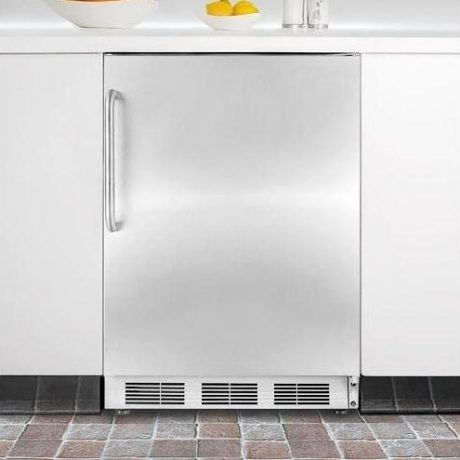
Counter height fridges are great if you want to save space. They take up minimal volume and permit more counter space as the surface isn’t interrupted by a fridge. But they have some notable drawbacks. The first is storage volume. A normal counter height fridge has around 5-6 cubic feet of storage. A fairly standard 60” high model will have two times that. This amount of volume might be fine for a single person who doesn’t cook often or shops every couple days, but for many people this amount of space quickly becomes limiting. 18″ models are available as well, but are mostly suitable for keeping last night’s leftovers cool.
summit-undercounter

The next issue is that most counter height fridges have manual defrost (all fridge models are available if you don’t need a freezer). This means every month or two you must let your freezer compartment thaw out. And up until that point, the compartment get smaller and smaller as layers of ice form around the interior of the compartment. It’s a pain. The Avanti RA3136SST is one counter height fridge with auto-defrost, but because of its size (3 cubic ft), it’s mostly suitable for people with Smurf-like appetites. The U-Line 1000 series will also do the trick…for $2K.

summit-interior

If you’re looking for other non-manual defrost fridge/freezer combo options, you can choose a drawer style fridge. We used the 27” wide Sub Zero 700 BCI in the first LifeEdited Apartment (pictured at top, since discontinued). It looked really nice as it accommodated custom panels. But its limited storage volume and height (you couldn’t stand a bottle of wine upright) limited its functionality. At around $2500, it was also very expensive. In fact, most drawer fridges are more expensive than their standard size equivalents, starting around $1500.

Our overall recommendation is to only go for a counter height if space is really limited and/or you are not a serious cook or you only like dealing with very fresh food. In terms of manufacturers, Summit probably makes the most number of models, though most manufacturers have counter height options.

Standard Height Fridges

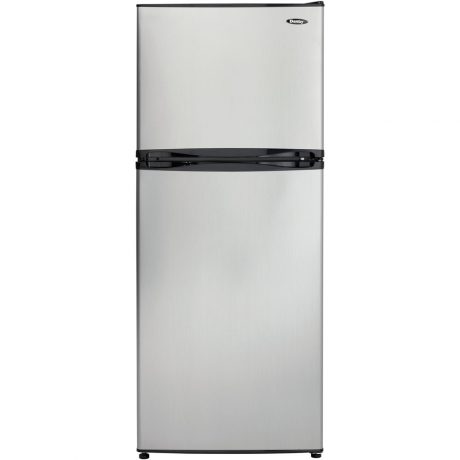
If you have a bit more room to play with and you like keeping things on hand that you don’t cycle through very fast (condiments, wine, etc), we recommend going with a standard height fridge. With 10+ cubic feet of storage, they are far more practical for most people. And unlike counter height fridges, almost all have automatic defrost. Finding a model that works for you is mostly a matter of budget and aesthetics.
danby

If you’re looking for an affordable 24” compact fridge, there are a number of options. You could pick up the Danby DFF100C1BSLDB for around $500. At 24” x 60”. These and others like it are the kind of fridges most landlords buy. They’re not sexy, but this level of fridge tends to have a reasonable 10 cubic ft of storage and it’ll keep your stuff cold. What more do you need?

Up from there you could get into some nicer stainless steel fridges like the LG LBN10551PS. It’s 24” x 68” and has 10 cubic feet of storage volume. At around $800-900, it’s a little more expensive, but it looks nicer than the Danby-level fridges.

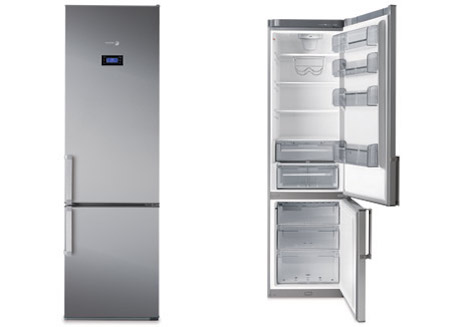
Up from the LG are the more premium European style 24” models. These tend to be between 70-80” high and have more storage. They can be purchased panel-ready, allowing you to seamlessly integrate them into your kitchen.
fagor

For one of our projects, we used a Fagor model and it’s worked out great. It measures 24” x 80” and has about 13 cubic feet of storage. Like most other tall skinny fridges, the freezer has pull out drawer which take a little getting used. For example, you can’t toss a big turkey in there and putting ice trays in there is can be trickier than one models with one open volume.

In this tier, there are a variety of nice options, though most will run quite a bit of money. On the bottom end is Blomberg BRFB1042WHN for around $800 (also available as panel ready for $1500) and on the high end is Liebherr BF1061, which is built in to custom cabinetry and will set you back $5700. For our next project, we chose the panel ready Smeg CB300U which retails for about $1900.


Don’t Call Me Murphy

The problem with most beds is that they do one thing: support your unconscious body for 6-13 hours a night depending on your employment situation. For the other 18-11 hours, mono-purpose beds just laze around the house, occupying a ton of space that could otherwise be used to good effect. And though we are unabashed fans of murphy beds, which can quickly transform a bed area into a something else area, they are not the only type of multipurpose bed. We ran across a couple different European bed manufacturers that pack a ton of utility in the same footprint that would otherwise be used for a bed alone.

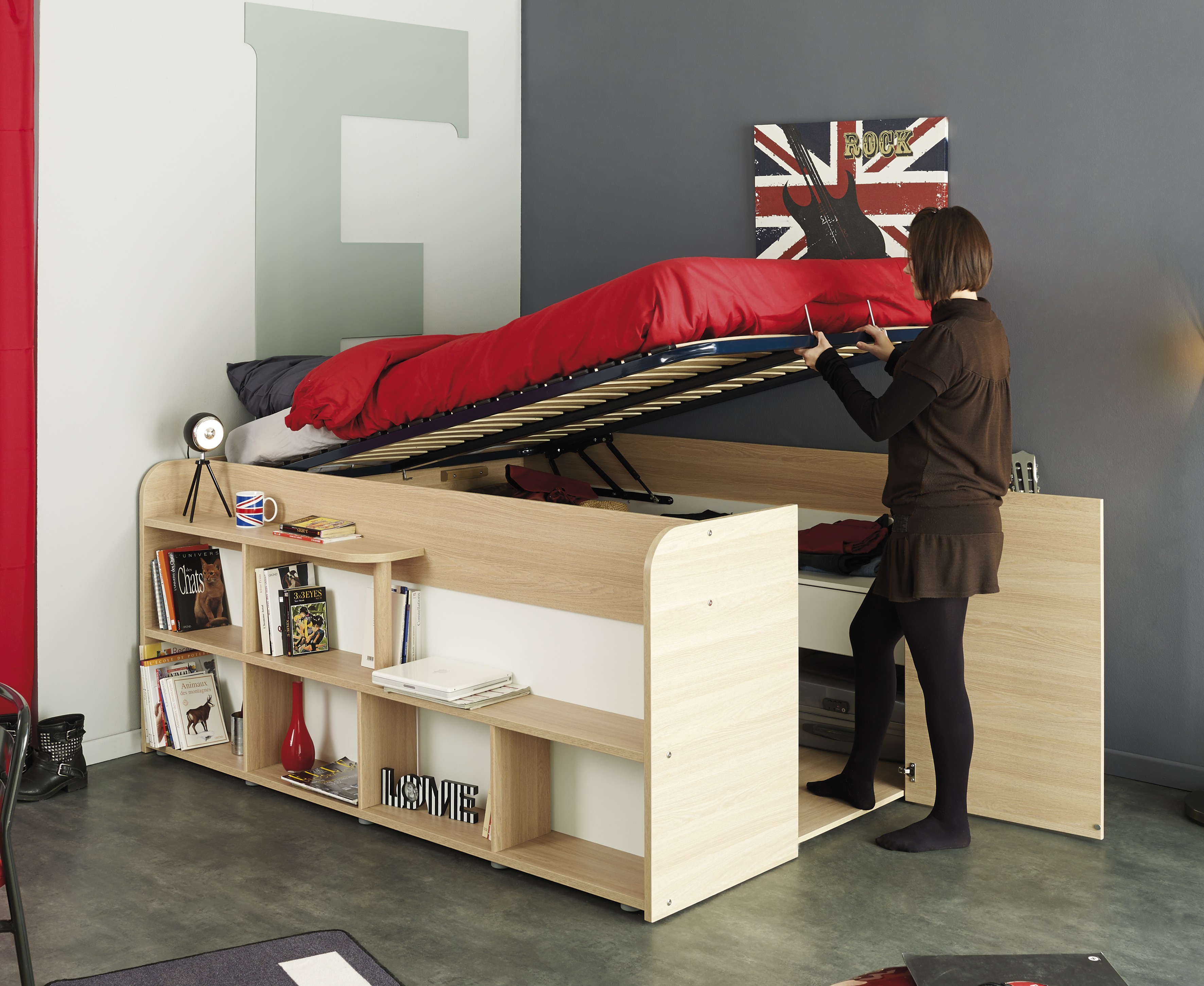
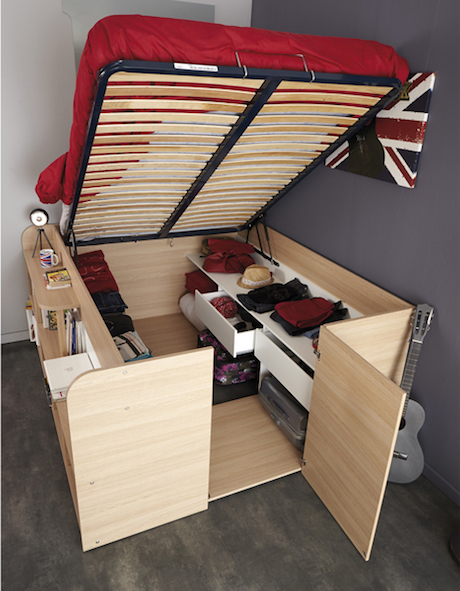
space-upThe Space Up bed (above) by France’s Parisot is a bed system with a closet’s worth of storage under its double-sized mattress. To access the storage, the mattress and its frame cantilever up, made possible by hydraulic pistons. The sides of the bed also features bookshelves, adding to its utility. With a low price point and no frills materials the Space Up seems mostly geared toward younger audiences.

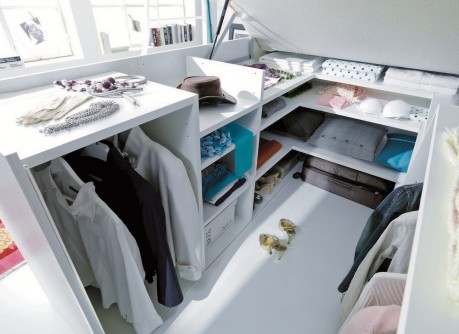
1347_z_Dielle Modus 0101350_z_Dielle Modus 012If you want something more high end, check out Italy’s Dielle Modus who takes the Space Up idea to 11. While they make a variety of bed and storage systems, the ones that caught our eye are their room systems featuring storage either under or above the bed. The storage volumes for both are considerably larger than Space Up. The below-bed systems work much like Space Up with a hydraulic lift for the mattress. The under-bed volume is big enough for a hanging rack storage; it’s also big enough to warrant stairs to access the bed. Those stairs double as drawers of course.

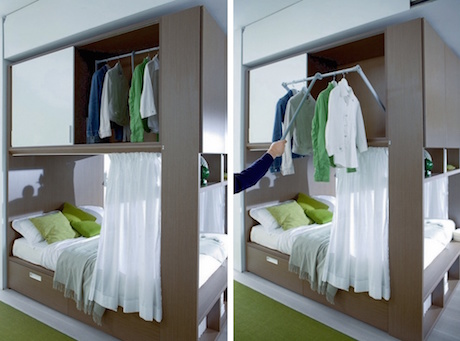
1252_z_Dielle Modus 002bdielleThe models featuring overhead storage are more practical than they might initially seem. The overhead cabinets have hanging racks that easily pivot down. There is captain bed type drawers underneath and tall cabinets at the head. The sleeping nook can also be closed off with curtains to fend off light and, we suppose, insects.

Improving a Classic

While the world can’t seem to get enough gadgets–smartwatches, fitness trackers, posture regulators–there’s a lot to be said for basic stuff done right. And few items are as basic as cast iron skillets. They distribute heat perfectly. A well seasoned one gives near stick free performance without you daily dose of vitamin T (Teflon). But cast iron skillets are heavy and some have rough cooking surfaces that make them less stick resistant and harder to clean. A Kickstarter project called the Field Skillet setting about addressing some of these issues in pursuit of crafting the ultimate cast iron skillet.  

The Field Skillet is a svelte (for cast iron) 4.5 lbs–lighter than a 13” Macbook Pro. The makers say it’s the minimum weight they could make it while retaining the heat distribution properties that make cast iron so loved as a cooking tool. Part of the weight savings is attributable to the fact that it’s been polished and machined to have a smooth surface, which improves cooking performance and makes cleaning a breeze. They say the pans will come pre-seasoned and pass the fried egg test.

The 10.5” outer diameter and 9” cook surface is designed to be big enough for most purposes, but not so big as to crowd out other burners. The skillet is made in the US out of 75-90% recycled iron and carries a lifetime warranty (not sure what could go wrong with a cast iron skillet, but can’t hurt we suppose).

We could go on about its features, but at its heart, the Field Skillet is a simple tool designed and made as well as it possibly can be. It’s a formula that seems to work very well on Kickstarter. Field Company, they firm behind the project, set out with a $30K goal to start up production. As of this writing, they’ve raised $1.4M. You can still order one of their skillets for a $90 pledge. Delivery is projected for next January. Visit their campaign page for more info.

Introducing LifeEdited: Maui

It’s been years since we revealed the first LifeEdited Apartment (LE1) in New York City. It was both design laboratory and CEO Graham Hill’s personal apartment. But as some might know, Graham splits his year between NYC and Maui, initially due to a kite surf addiction. A few years ago he bought a 2.2 acre piece of land in Maui with the intention of one day designing and building a home that incorporated many of the same ideas that informed LE1. That one day is today. LifeEdited is building a mini compound, calling it, appropriately enough, LifeEdited: Maui (LEM). The home will showcase the best design and technological ideas for high quality, low impact living. 

Thus far, LifeEdited has mostly been an urban tale. Doing more with less is a necessity in the city. In Maui, we have a 1000 square foot max of what we are allowed to build…so the beauty is that we are making a four bedroom, 2.5 bath with that space where all the bedrooms transform to other uses during the day. We created a program (subject to some change) that reflects how the project can achieve this aim. We want to maximize use and experience while minimizing impact. Here’s what we came up with:   

  • Making the main house under 1000 square feet. We don’t want to encroach on the land any more than we have to.
  • Employ transforming design and exploit outdoor space as much as possible. We want to make the space we have do as much as possible.
  • Make it off-grid and net zero or even net positive. We will use solar power, water catchment systems, composting toilets, etc.
  • Employ smart home tech to improve user experience and reduce energy consumption.
  • Employ electric vehicles such as bikes, trikes, cars that will be charged with power generated by on site solar.
  • Employ agriscaping, taking advantage of the fertile soil to grow food on the property.
  • A water catchment reservoir.
  • Use carbon offsets to mitigate one of the project’s biggest energy sinks: airline travel.

An hour long TV show about the project will air on the DIY Network later this year (and likely on HGTV). And we will be giving regular updates on this site and social media. We will be reaching out to press and various influencers on our mission to spread the less is more gospel!

Awesome Furniture Company Makes Awesome Furniture

As we saw with the Yatno line, lightweight, compact and affordable furniture–the kind ideal for small space living–need not be disposable, poorly designed junk. We can now add furniture maker Greycork to this list. The startup is making a line of furniture that features elegant designs, super simple assembly, lightweight structures and affordable prices. And unlike Yatno, Greycork is US-based and taking orders.

greycork

On their website, Greycork is offering a sofa, chaise, bookshelf, coffee table and side table. All of items can be assembled without tools and are made of high quality materials such ash wood and powder coated steel. And despite their good looks, the prices are genuinely reasonable. You can buy all five pieces individually, with prices ranging from $125 for the side table to $700 for the sofa. Or you can get all five for $1500. The furniture is made in the US and flatpacked shipped to your door.

While we appreciate what stores like IKEA do provide for small space dwellers, it’s been said that the cost of throwing their furniture away and re-buying it is often cheaper than the cost of moving it. What companies like Yatno and now Greycork are doing is creating adaptable, lightweight and attractive furniture that’s worth holding onto.

Via Ippinka blog