Transforming Apartments and the Custom Conundrum

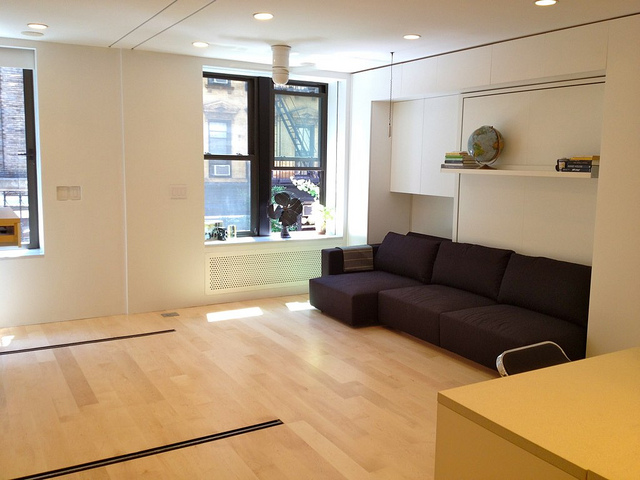
We’ve looked at pictures of Robert and Rosa Garneau’s NYC transforming apartment in the past, but thanks to this video from Fair Companies, we get to see the apartment come to life. Of particular interest is seeing the movement of the 500 lb sliding wall, the pre-programmed, automated hydraulic table and the amazing amount of storage the apartment contains.

All of the furnishings were custom built for the apartment. Most of it contains storage; many pieces disappear and/or are modular (the video takes you through the whole space).

Customization like this raises an interesting question about these types of transforming spaces: Because all the pieces work in concert with one another, how do people who might want a home like this adapt their existing inventory of furniture to that space? Is that even possible?

Or is it better to start from scratch as the Garneau’s did? If the Garneau’s were able to squeeze approximately 40% more utility from their space because of their furnishings, might the extra investment be worth it?

Let’s take a look. Robert Garneau said he spent about $234K in renovations. NYC real estate costs around $800-$1000/square, so a 40% larger space (i.e. 910 sq ft), would be $208K-$260K more than the Garneau’s place (we know…it’s crazy). At that price it’s about a wash between the additional space and renovation costs. To make a truly fair comparison, we should add additional furnishings for the larger space, renovations and higher upkeep and maintenance costs. Also, consider you could probably go half as elaborate as the Garneau’s and have similar utility. Suddenly the math gets a lot more competitive.

What do you think? Would you be willing to start from scratch to have a small, transforming space that does everything you need? Do you think spaces like these with lots of custom, built-in furnishings could go mainstream? Or do you think they will remain curiosities–homes for eccentrics and architects, but no one else? Let us know in our comments section.

Custom Make Your Life with CustomMade.com

One of the biggest problems with getting custom made stuff is finding a good person to make it. Most of us don’t have the bandwidth to find skilled craftspeople, much less bid the job out, particularly if it’s a small one. The hassle, combined with perceived expense, leads most of us to mass-produced items that aren’t what we want and with which we have minimal emotional connection to.

A site called CustomMade is changing all that. They claim to be the “world’s largest matchmaker for custom goods.” They connect people who want custom stuff with a network of 3500 skilled craftspeople from the US and Canada.

The site can be used in a few ways. You can bid out a job, specifying exactly what you want and how much you want to spend; you can search for craftspeople by region; and you can see and purchase already-made items. Categories include furniture, jewelry, leather goods, tableware, and carpentry.

Since their start in 2008, CustomMade had completed 2800 custom jobs. The site has 40,000 goods to peruse from, most of which you can customize; e.g. getting a wedding ring you see in your size or a table to your dimensions.

Prices for goods like furniture are higher than IKEA and other box stores to be sure. But so is quality. And though it’s hard to quantify exactly, the nature of putting a bid out to a large pool of prospective fabricators probably yields more competitive pricing.

We talk a lot about heirloom design–the ideal that the items in our lives are high quality enough to be passed down to the next generation. CustomMade makes this ideal that much easier to achieve, taking much of the hassle out of custom, hight quality fabrication.

via Core77

A Chair That Will Follow You From Cradle Till Long Time

Few things derail your editing schemes like children. Clothes often need to be changed multiple times a day. They grow out of those same clothes every few months. Most of their toys have a six month half-life. Then there are innumerable accessories from cribs to strollers to baby bathtubs that thwart the most earnest minimalist aspirations.

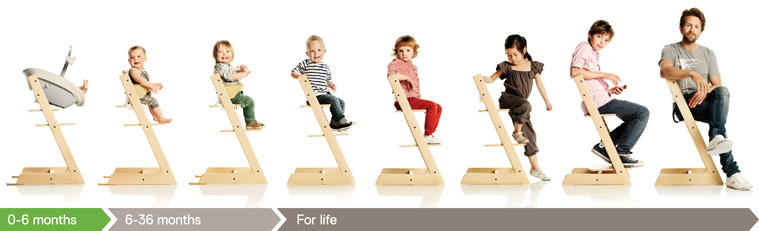
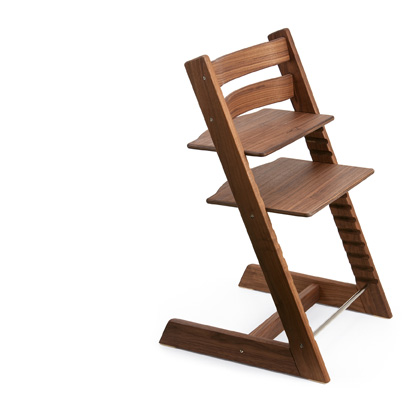
Given all of this, if you’re a parent and there are products that reduce the amount of stuff your child requires, you should probably get them. The Stokke Tripp Trapp high chair is such an item. Its simple, classic design allows it to be useful from infancy to adulthood.

The inverted seven shaped base has slots that accommodate either a seat or footrests. As your child grows, you lower the seat and footrests in the slots to the appropriate height. You can even remove the footrest and use it as an adult height chair, making this a great piece of furniture for people like grandparents who frequently have children visitors, but for whom a dedicated high chair takes up too much space.

The seats start around $200 and go up depending on the material. Oak and walnut version are available that are quite a bit more expensive; these options are worth considering as this could easily be an item kept for many years.

Do you have other tips for minimizing kid clutter? Let us know in our comments section.
5 Products That Make Our Lives Better

We are always on the lookout for products that do more, last longer and take up less space than their conventional counterparts. We’re not talking about things like a good laptop or phone, which might be indispensable, but will be outdated in six months. We’re talking about the products that won’t go out of date, whose utility proves itself through the years.

We’ve put together a short roundup of products we find ourselves unable to live without (not literally of course). It’s also a nice excuse to ask you what your list includes. What are the things that make your life or home work better–things that make life simpler and more streamlined? Let us know in our comments section below.

  1. Waffle-weave towels. We’ve talked about them before, but too much cannot be said about their merits. The longer we use them, the more they prove their superiority to terry cloth. We’ve been using Aquis microfiber towels and Gilden Tree cotton waffle towels. Both take up less storage and washing machine space, dry faster and avoid mold. If we were to choose one however, it’d be the Aquis; the synthetic material seems to grab moisture from your skin. It’s also softer than cotton. If you’re not into synthetic stuff, the Gilden Tree towels still work great and are available in more sizes and colors.
  2. Outlier pants. These things rock. They look like dress pants, feel like sweat pants, wick and repel moisture like mountaineering pants and wear like iron. Starting at $188, they are not cheap, but they will literally replace three pairs of conventional pants and outlast them as well. I have had several pairs for the last few years. My favorites are the 4 Season OG’s and Climbers, both of which have four-way stretch material (not all Outlier pants are as stretchy). Their shorts rule as well. Right now, they make one women’s variety.
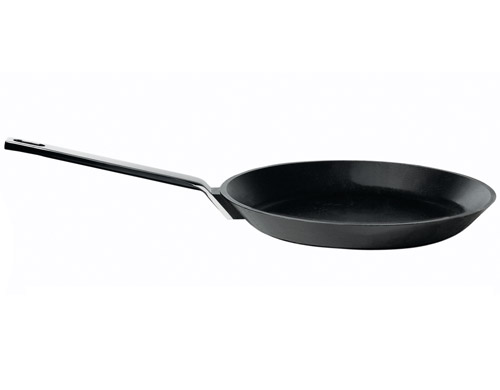
  3. A cast iron skillet. Nonstick skillets are great, but they wear horribly and have a dubious safety record. Copper and stainless steel wear great, but are temperamental, scorching and staining easily. Cast iron, on the other hand, wears like, well…iron. It distributes high and low heat great. With a little bit of use–i.e. ‘seasoning’–it can be almost as nonstick as a Teflon pan, without all the plastic bits in your food. You can clean them without water. And while enameled iron pans are nice, the bare cast iron versions are less fussy and prone to marring. I use a beautifully designed 12″ iittala Hackman Dahlström Tools for almost everything (pictured at very top. Discontinued, but available at various stores), but most any cast iron skillet work equally great. Get a size that’s big enough for the amount of cooking you do, but not so big that it takes ages to heat.
  4. A comfy couch that you can sleep on. I was at IKEA a few weeks ago and they had a 375 sq ft mock-up apartment featuring a huge, overstuffed sectional couch. I thought it a waste of space until I sat it in. Few things demarcate home like a comfy couch. In the LifeEdited apartment, the Resource Furniture Swing couch is the most used piece of furniture. A great couch can be your guest room in a pinch, and while convertible sofa-beds are great, sometimes it’s better to get a longer couch than invest in a substandard sofa-bed, which are often pretty uncomfortable.
  5. A scanner. We thought scanner technology was stable enough that it could be included on this list. Scanners are simple, can last ages, don’t require stupid, overpriced toners and, most importantly, allow you to dump tons of paper by scanning receipts and important documents. Scanners eliminate the need for a fax. You can also scan old photographs for posterity and digital display.

What would you include on this list? What items streamline your home and your life more than most? Let us know in our comments section.
Transforming Tables Handle Coffee and Dinner with Ease

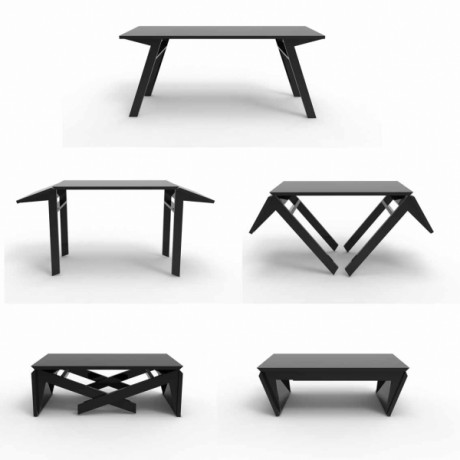
If you live in a small space–or just don’t want to clutter up your big one–you might find yourself choosing between a coffee or dining table. Having both just takes up too much room. In an effort to sidestep this either/or situation, Resource Furniture and Duffy London offer tables that are as competent at hosting dinner parties as they are having afternoon tea service–or, the US equivalent, eating in front of the TV.

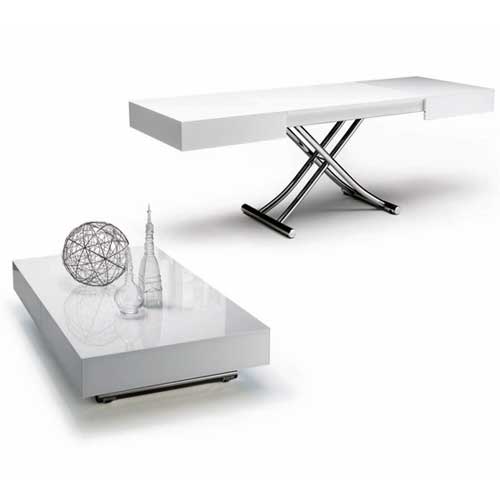
Duffy London’s Transforming Coffee Table MK1 (pictured below) has legs that fold underneath its base for  a very simple conversion. When the legs are in the elevated position, built-in leafs, which double as legs when in coffee table mode, add additional length to the dining room table surface.

The table is offered in a variety of finishes and three sizes–Mini, Large and X-Large. All three are 13″ high in coffee table mode and 30″ in dining. The two smaller versions are 29″ wide in coffee mode and 50″ and 57″ when extended; the X-large goes from 39″ to 67″ wide. Duffy’s website lists the prices at £395/$638, £445/$718 and £595/$961 respectively. Unlike a lot of cool Euro furniture we’ve found, they offer US shipping at £175/$282.

Resource Furniture has a full line of tables that have both coffee and dining table functionality. Here are a couple.

The Passo goes from a 10.5″ high coffee table to 30.75″ dining table. It’s 30″ deep and width goes from 48″ closed to 78″ when its built-in leafs are folded out from under the tabletop.

Resource Furniture Passo Table

The Box table (pictured at top of post) is similar to the Passo, though the leafs project from the ends of the table versus folding out from underneath. Fully extended, the Box is 87″ wide–sufficiently large for dinner parties for 8-10 people. Like the Passo, you can extend one, both or neither leaf, giving a ton of flexibility for its usage. For example, you could have a long coffee table or short dining table.

We’ve had a chance to use both of Resource’s tables and they work great. They are high quality, easy to raise, transform and moving around the house. Both are available in a variety of finishes and start around $3500.

These tables are great investments for many, combing great design, materials and saving space functionality.  That said, we understand they are out of many people’s price brackets. If you know of high quality, lower price alternatives, let us know.

Via Dwell and Mimi

Two Pieces of Wood, One Timeless Design

As Da Vinci famously put it: “Simplicity is the ultimate sophistication.” If he’s right, then this DIY Plank Chair by Jesse Hensel from Instructables is the pinnacle of sophistication. To elaborate much on its design would detract from its beauty. It’s two pieces of wood: one with a slot, the other beveled to be inserted in slot.

Before you ask, Hensel claims that it’s quite comfortable, but also says that you can adjust the angle to suit your preferred reclining angle. We imagine you could increase the width to make a Plank love-seat (though there might be considerations about stressing the wood). You could make the back higher, add cushions or add any number of other custom flourishes. In Instructables comments section, there are a number of similar versions with custom engraving, though we prefer simple aesthetic of Hensel’s version.

Making the Plank Chair requires a high school shop-class level of power tool mastery–something most of us could stand to have even if we didn’t want to make furniture. We imagine with a little cajoling and $30, your local lumber yard would make the cuts too.

Needless to say, the chair would store quite well.

The interesting thing to us is that this chair–which could be made from scrap wood–looks more timeless and durable than many offerings from large furniture retailers.

Go to Instructables to see detailed instructions on how to construct the chair.

Got any simple projects like this? Let us know.

Photo by Jesse Hensel

The Home of the Future or Weird Curiosity?

The England-based Yo! Company is a branding and investment firm that brings Japanese-tinged enterprises to Western territories. Among its holdings are Yo! Sushi, a conveyor belt Kaiten sushi bar in London and Yotel, a Japanese-style hotel with compact-rooms that has locations in London, Amsterdam and New York City.

Now Yo! Co founder Simon Woodroffe is bringing his Japanglo magic to the home market with the Yo! Home. The 800 sq ft London concept home aims to take us out the “agricultural, primitive age” he believes we live in now and into the future–a time when people will ask “do you remember when they had one space and it couldn’t change around?”

The Yo! Home changes around alright. There is a bed that descends from the ceiling and covers up a huge lounge area. There is a dining area that pops up from the floor; the same floor that hides a wine wine cellar. The kitchen hides completely. The guest room has a large sliding door that opens up to increase the area of the main room.

The space relies on a fair amount of automation, some of which broke down during his tour with Channel 4 News (above). To be fair, this is a prototype and breakdowns are to be expected. We do wonder about the long-term implications of an automated home. What happens if you’re really tired and can’t get you bed down?

Woodroffe spent £200K on the Yo! Home (~$325K US), which actually doesn’t seem like a lot seeing as how elaborate the space is. He thinks it’ll initially be for moneyed clients, but believes the technology and designs will eventually trickle down to the greater public.

Our hats are off to Woodroffe and his bold enterprise. Architectural thinking often gets fossilized because structures are imbued with a sense of permanency–so architects and designers avoid risky designs like these; ones that might look weird a few years from now. Concepts like Yo! Home loosen the noose of conventional thinking. They are invaluable idea-generators even if some of its features don’t make the final draft of the home of the future.

What do you think? Is this home the future or a curiosity–something that’ll look weird and overwrought 5 years from now? Let us know what you’re thinking.

Photography is by Ashley Bingham

Via Dezeen

3 Big Stores Get Into Small Spaces

There was a time, not so long ago, when furniture stores assumed their customers wanted items that would fit well in an over-sized dream home. Furniture was marketed with easy mortgages and cheap credit in mind. Well, those days are over.

With more people living in square-footage-starved cities, and more people renting, a growing population is reevaluating the dimensions of their dream home. A few furniture retailers are taking heed of this trend, marketing specifically to consumers living in small spaces.

Restoration Hardware released its “Small Spaces” collection earlier this year. It is, they claim, “A collection of epic proportions.” It’s sufficiently important to the company that it’s on their site’s main navigation bar. The collection is shown in 15 “small” spaces from around the world like the “Chelsea Penthouse” or “London Townhouse.”

These spaces don’t seem that small to us, and there are no dimensions to contradict our impression. The furniture looks suspiciously similar to other pieces in the catalog: the big space love-seat becomes the small space couch; the end-table becomes the coffee table. Perhaps it’s relative. Maybe RH is catering to people who are transitioning from 4K to 2K sq ft of living space.

IKEA has been in the small space fray for a while now. The video below shows a number of ways you can use their products to squeeze tons of utility from a small space. They claim small space living is “not about giving up your dreams. It’s about shrinking them, just a little bit”–whatever that means. The video is pretty creative and compelling.

Many of their stores feature 375 sq ft mock-up apartments. The author visited one the other day and found the layout pretty nice.

The furniture in the apartment, like RH, seemed like their normal furniture plugged into a small space. Unlike RH, IKEA seemed to understand the necessity for storage in a small space; there were shelves everywhere and two of the walls had large storage systems.

They made what seemed like a strange choice, decking the living room with a big couch. It was strange until you sat in it and realized that a comfy couch is pretty important to demonstrating a space’s livability.

West Elm also features a small space collection. A couple of their pieces actually seemed to be designed for small spaces–not just a normal piece with a small space sticker slapped on it. In particular, the Storage Bed Frame and Rustic Storage Coffee Table (below) would be useful additions to a small space. The latter model’s tabletop lifts to provide a desk space if you find yourself working on the couch.

What do you think of these collections? Are they marketing gimmicks or indicators of they way people will live in the future? Or both? Have you bought any of these products? What was you experience? Let us know.

4 Products that Disappear After You Buy Them

A recent article in the NY Times called “The Cult of Disappearing Design” reported on a growing movement toward invisible home furnishings. The “all-invisible aesthetic,” according to the article, “aims for a higher-minded goal: creating unified spaces that flow from room to room and place to place.”

They featured a couple items we’ve had here in the past like the Folditure “Leaf” Chair and the Bedup hiding bed. They also featured the Fisher & Paykel DishDrawer which is used in the LifeEdited apartment.

While there is an inherent challenge showing the invisible, we thought we’d add a couple items not included in the Times’ list.

1. Amina Invisible Speakers

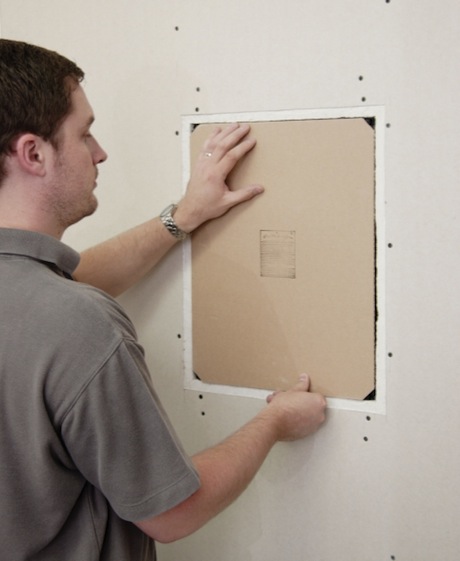
We used Amina high performance invisible speakers in the LifeEdited apartment. Their sound is easy to appreciate, though their beauty is not. The above picture has two large Amina speakers in the ceiling, but you’d never know. They are built into the drywall.

2. Induction Cooktops

In the LifeEdited apartment, we use Fagor portable induction cooktops, which are invisible in that we can put them in a drawer. Built in models are even more sleek (there’s a Fagor model pictured above). They sit virtually flush with the counter. They only conduct heat with ferrous metal, so they are cool to touch, which makes allows them to be used as additional counter space. They are also 12% more efficient than electric radiant burners.

3. Integrated Kitchen Appliances

While the Times mentions Fisher & Paykel DishDrawer as a disappearing design, there are many dishwashers and refrigerators on the market today are available as “integrated”–i.e. a panel that matches the rest of the cabinetry can be affixed to the front of the appliance. Sorta pictured below is the DishDrawer in the LifeEdited apartment. IKEA makes an integrated dishwasher for about $699. Panels cost extra.

For whatever reason, integrated fridges are more expensive. We used the Sub-Zero 700 BCI stacking drawer fridge, which retails for $3500 and up.

4. Blanco Crystalline Sink

The Blanco Crystalline Sink incorporates such a simple idea: cover you sink when you don’t need it, creating a cleaner look and more counter space. The sink comes with a removable glass cover (available in white or black). Unfortunately, due to code regulations a super-cool retractable faucet is only available outside the US.


Awesome Space-Saving Furniture Made of Planks and Broom Handles

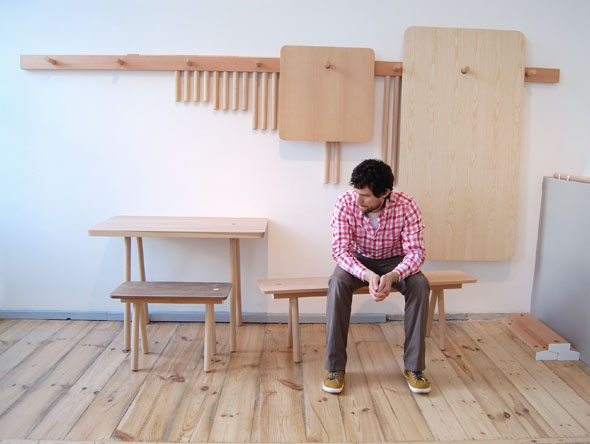
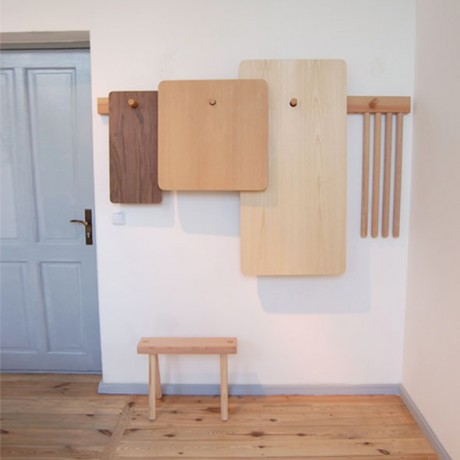
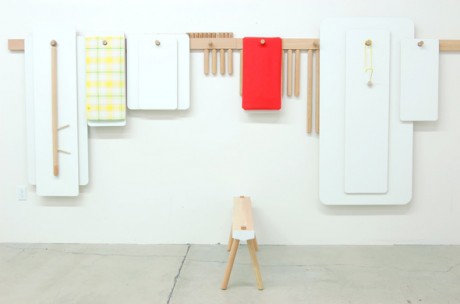
Oregon-based Studio Gorm made this simple, elegant design for transforming, adaptable furniture. There’s not much to the studio’s Peg line: some planks of hardwood with threaded recesses; several threaded legs that can be configured as benches, tables, stools, etc., depending on their lengths; and a hanging rack for storage that makes the assembly look like an objet d’art.

The studio’s site indicates that the collection is available in several types of woods and finishes, leading us to believe that it might be for sale (we are trying to confirm that now).

We have some question about how stable the units are, especially with the longer-legs, but suspect that the wider diameter legs can handle a decent load.

What’s lovely about the design is its mechanical and aesthetic simplicity. There are few moving parts, no hardware, everything is repairable or replaceable and infinitely configurable depending on your needs. It demonstrates that transforming furniture need not have a complicated hardware or a particular aesthetic.

all images by Studio Gorm

via Core 77