Minimalist Home Office Set Up

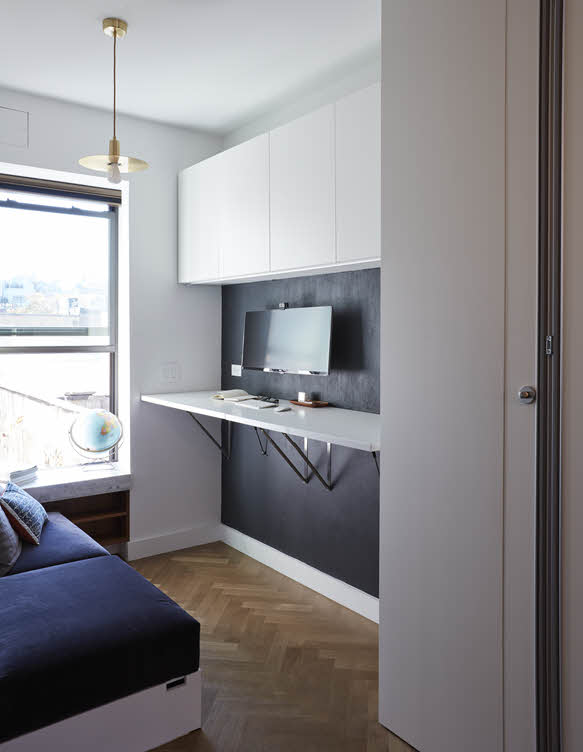
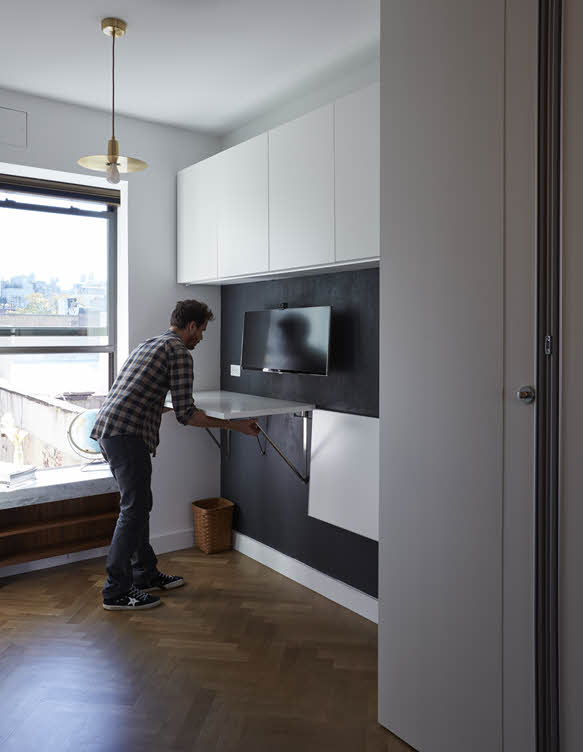
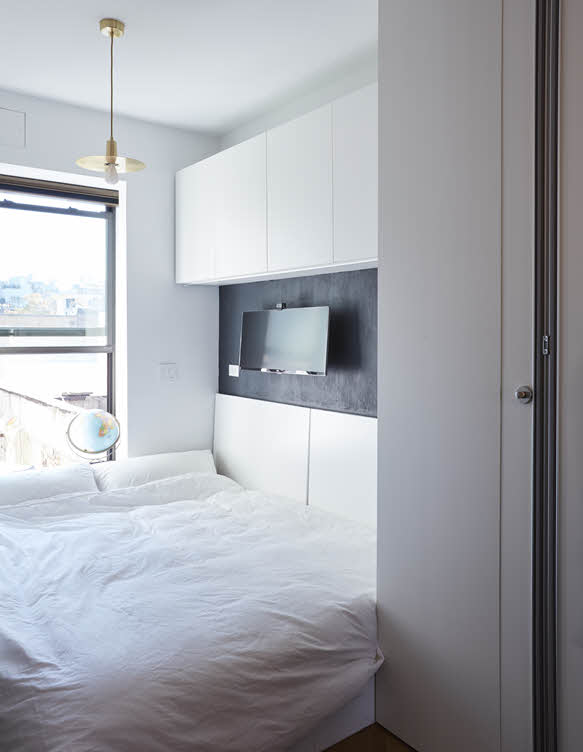
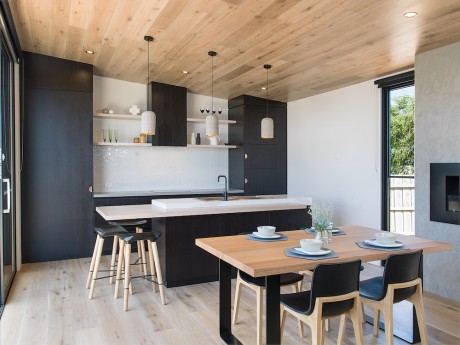
The LifeEdited 2 home office / guest bedroom is a classic in space efficiency. Apartment dwellers can work at a large stand-up desk with a 34-inch screen and two guests can sleep comfortably, all in one room that is just a bit bigger than a queen-sized bed.

What we used:

  • LG 34UM95 34” wall-mounted monitor
  • Wireless keyboard and mouse
  • MacBook & printer in the closet, connected via hidden cables running through the wall
  • LifeEdited-designed moveable sofa segments that assemble into a guest bed
  • New Concept Table from Resource Furniture (two of these, they fold down)

What we like:

  • It’s a potent home office
  • It has a minimalist feel to it — the messy bits are in the closet
  • Transformation to guest mode is pretty quick

Alternatives:

  • That 34” screen is *really* nice, but a 24” could also work well
  • You could wall-mount an all-in-one computer e.g. an iMac or curved HP Envy

This post is one in a series that describes our LifeEdited 2 showcase apartment. LifeEdited 2 embodies our green, space efficient, and minimalist principles. We view LifeEdited 2 as a lab for experiencing things that are consistent with these principles. The fold-down table described in this post was given to us, which we appreciate, but we would not have accepted if we didn’t believe in it.

Minimalist Music & Movie System

We all want to listen to music and watch movies, but we don’t want the technology to get in our way. Thus for LifeEdited 2, we deployed a very capable but very simple system.

Our needs:

  • Play music from Spotify
  • Play movies from Netflix & iTunes
  • Allow guests to use the system without reading a manual
  • Energy efficiency in all of the above e.g. music can play without the TV being on

What we used:

screen-shot-2016-12-01-at-8-19-05-pm

What we like:

  • Music sounds great!
  • Total cost is less than $1,000
  • No need for a big A/V receiver or subwoofer
  • To control it, all you need is the tiny Apple TV remote and a phone
  • Guests have successfully used it

Alternatives:

  • Rather than an Apple-centric system use a Google Cast system, or an Amazon-centric system, or a Sonos system, or a Roku system
  • Projectors can also be great for small apartments — less wall space taken up.

This post is one in a series that describes our LifeEdited 2 showcase apartment. LifeEdited 2 embodies our green, space efficient, and minimalist principles. We view LifeEdited 2 as a lab for experiencing things that are consistent with these principles. None of the products above were given to us.

We Review “Minimalism: A Documentary About the Important Things”

If you’re looking for an unbiased review of “Minimalism: A Documentary About the Important Things,” go to Rotten Tomatoes. This author was featured in the movie along with his wife and employer. The protagonists of the film–Joshua Fields Millburn and Ryan Nicodemus, aka The Minimalists–are people I choose to call friends; same goes for director Matt D’Avella. On the topic of Minimalism, you might say I fall somewhere between evangelist and zealot. So what do I think about the movie? It eff’ing rocks.

The movie follows Joshua and Ryan as they crossed the country a couple years ago promoting their book “All That Remains.” Interwoven are interviews with the two men about how they went from stressed out, consumer-crazed corporate strivers to blissed out paragons of pared down living and dispensers of hugs.

But a good deal of the film cuts away to talk about applied minimalism and the global impact of consumer culture. There are interviews with the leading figures in the movement and various experts: Zen Habit’s Leo Babauta, Becoming Minimalist’s Joshua Becker, Rowdy Kitten’s Tammy Strobel, neuroscientist/author Sam Harris, Colin Beavan, aka “No Impact Man,” our own Graham Hill and many, many more. Each lends their experience of living a life as a minimalist, but also delve into topics related to “compulsory consumption” and the environmental, social and psychological wake that follows this behavior. Topics include architecture, tiny house living, fashion, meditation and neuroscience. If you weren’t inclined toward a more minimal existence going into the movie, you probably will be at the end.

In 2006, Al Gore released “An Inconvenient Truth”–a film that compelling and concisely outlined the extent and the threat of global warming. In my opinion, nothing trumps this as our number one threat to life as we know it. But the thing that AIT didn’t cover–and this is not a criticism–is the emotional impact our consumer behavior and environmental destruction. We are ravaging our planet, but for what? The Minimalism doc does wonderful job of looking at the human impact of our rapacious treatment of the planet and how it just doesn’t work on virtually any front. And perhaps more importantly, it shows an attractive alternative–a life of less stuff and space, a life filled with more meaning, happiness and hugs. Go see the movie.

The guys are presently doing a cross country tour to promote the film through June (they are offering 10 tickets at door at each showing). But after May 24, the documentary will be showing at over 400 locations across the country. Go here to find a screening near you. The movie will also be available online August 2.  

The Unbearable Lightness of Tiny Living

Each week we are profiling real people who are editing their lives for more freedom and happiness. This week we hear from Jan, who lives in 98 sq ft tiny house. He shares his experience about the freedom of tiny, lightweight living as well as the difficulties of meshing different attitudes about stuff and space in relationships.

Tell us about yourself

My name is Jan. I am 45 and work as a photographer and videographer. I am separated with a 3-year-old boy.

My parents, both children in Germany during the WWII, instilled a non-consumptive, credit free life-style. They modeled buying quality over quantity and only paying cash for what you can afford.

Later, I backpacked for several years, and all through my twenties and early thirties never paid more than $100 rent per month. I learned to build and built my own shelter, or did work-trade for rent. For years I kept my possessions down to what would fit in the back of a small pick-up truck.

In my late thirties I fell in love with a beautiful woman who lived an unedited life. Stuff gave her a sense of security. Clutter was her art form. For six years and through the birth of our son, we tried to blend our lives, but could not. Accepting neither of us would change, I built a 6×9 foot shack in the backyard and moved out. We get on much better now.

What makes your life an ‘edited’ one?

I’ve always been self-employed, so I’m very aware how much effort it takes to earn each dollar. Not believing in credit, each purchase I make is a conscious decision. How much of my life does it take to afford this thing? I’m also aware how much effort is required to own stuff. Where to store it? How to store it? How to care for it? Unnecessary stuff and clutter simply makes my anxious. But that’s not to say I’m non-materialistic. I would argue that I’m hyper-materialistic. I love the look, feel and function of something well made that fits my life perfectly. A pair of shoes I wear every day. Two sharp kitchen knives. A bicycle. A camera. All these things, carefully chosen gives me great pleasure to buy and use daily.

How long have you been living this way, and do see yourself continuing to live this way?

I have always had a minimalist bent, but lately have been refining it with far more awareness. It merges many divergent interests, from macro and micro-economics, environmentalism, self-sufficiency, spirituality, design, art, parenting, and how we will make it as a species in a shrinking world. Presently, how I live is a personal choice. In the future that choice may be forced upon us.

What are the biggest advantages of living this way?

A profound sense of lightness in the world. Every time I discover a way to live more essentially, I feel a surge of freedom. When I refine an elegant solution to a vexing problem, I gain great pleasure each time I engage with that solution. Something as basic as placing a hook into a wall so I can hang my bag and not trip over it on the floor. Or building a composting toilet for a few dollars and taking personal responsibility for my own waste. Or lying in bed at night in a loft that fits me just so. Watching the moon rise and stars turn because I deliberately placed the windows in these precise locations. Or each month doing my bookkeeping and seeing my savings increase to a point where I could live comfortably without working for a few years. And not because I earn a lot of money, but because I have learned how to spend wisely.

What are the biggest challenges?

Trying to meld a minimalist lifestyle with someone who does not share the same interest. It is an exercise in futility and frustration. I had to learn to accept that I can neither change someone else’s life nor repress my own nature.

For families, how has this lifestyle affected the other members of your family?

Thankfully I have a young son who stops me from getting too anal. He helped build the shack and feels it is his as much as mine. He comes and goes as he pleases with his toys, muddy shoes and dirty fingers. I let him climb up ladders, on counters, light stoves, play with tools and knives, and in doing he learns respect, consequence and body awareness. He teaches me to let go and lighten up. If he breaks something we fix it together. If he gets something dirty, we clean together. After all, it’s just stuff. What’s essential is the respect between us.

In terms of partnerships, I think a minimalist lifestyle only works both partners already live this way. I also strongly believe in a shack of ones own. My home only cost me $5000 and three months of work. I’d rather help build a partner their own home than try to blend two incompatible lifestyles together.

What is the number one suggestion you’d give to someone looking edit their lives?

Read the book “Your Money or Your Life” by Vicki Robins.

What item(s) have made your lifestyle easier?

A good bicycle, good tools, a few comfortable clothes that fit well and can be worn in different settings.

Do you have any design or architectural suggestions derived from your lifestyle?

Consider curved rafters. That simple architectural detail made all the difference in turning my loft from a cramped triangle into a spacious cocoon.

This post was originally published November 28, 2012. 

Your Stuff or Your Life?

There are millions of reasons to stop over-consuming. It’s simpler, it’s greener, there’s less to dust. But as former Uruguayan president José Mujica–aka “the world’s poorest president”–reminds us, stuff costs money. For those of us not independently wealthy, our money has a pretty direct correlation with our labors. And unless your name is Tim Ferriss, our labors have a direct correlation with time. So each time we spend money, we are spending time. And once our time is spent, it’s gone. No refunds, no exchanges.

This doesn’t mean we shouldn’t buy stuff. We might decide that the things that are used, loved and add value to our lives are worth our time. This doesn’t mean that time spent working is bad either. If you love your work, knock yourself out. But ideally, we’d choose to do the work we love, not be bound to do it to pay for stuff. The reality is that if we became aware of the time-expense of our stuff, we’d probably do away with all the unnecessarily upgraded smartphones, the novelties, the status symbols. As Ben Franklin put it, “Dost thou love life? Then do not squander time, for that is the stuff life is made of.”

Find Joy with Less, Win a Book

We’ve long been fans of Francine Jay, the writer behind Miss Minimalist and the “One Less Gift Certificate.” Jay just released a new book entitled “The Joy of Less: A Minimalist Guide to Declutter, Organize, and Simplify” and we wanted to spread the good word. While applicable to all levels of minimalists, we found the book especially useful for those just getting started or perhaps looking to reach the next level of less-ness. In particular, she introduces reader to her “STREAMLINE” method of paring down. Streamline is an acronym:

  • S  Start over
  • T  Trash, Treasure, or Transfer
  • R  Reason for each item
  • E  Everything in its place
  • A  All surfaces clear
  • M Modules
  • L  Limits
  • I  If one comes in, one goes out N Narrow it down
  • E Everyday maintenance

In her clear prose, she expands on each of these topics and gives practical instructions on tackling big messes.

Many who start the process of decluttering are greeted by a pall of doom. Too often, their focus is on the hardship of getting rid of stuff: the emotional challenges of letting go of stuff we have strong emotional bonds with, the toil of purging. Jay does a good job of stressing the liberation one gets on the other side: the peace, ease and freedom of having fewer things to deal with. She even says that removing can get a bit addictive. She writes:

What I expected to be a tedious and rather onerous task turned out to be exhilarating. I was instantly addicted. I decluttered in the morning; I decluttered in the evening; I decluttered on the weekends; I decluttered in my dreams (really!). When I wasn’t actually decluttering, I was planning what I could declutter next. It’s as if I could feel the physical weight being lifted from my shoulders. After I’d been particularly productive, I’d twirl around in my newly empty space with a huge grin on my face.”

If you’d like to experience the joy of less firsthand, we are giving away a hardcopy of The Joy of Less. Leave a comment below if you’d like to be entered (you can also leave a comment without being entered by saying “do not enter”). We will draw a name at random (our commenting system takes your email address, so please do not leave your name or email). Drawing will close end of day Saturday April 30 2016.

This is What It’s All About

A reader recently sent us this letter and we think it pretty special:

Thanks LifeEdited! You are helping fuel our resolve to continue on our journey simplicity.

Our story began the summer of 2014.  My husband and I found ourselves empty nesters, in a huge house, with a huge yard, and a huge to-do list of chores and have-to’s. Our bank account non-existent, our paychecks going out the window faster than we could deposit the paychecks.  All the stuff in the world hadn’t made us happy, only miserably in-debt.

So we decided to break out of the box we’d climbed into and regain financial freedom and our joy. We spent five months purging and preparing our home to put on the market to sell.  We must have done a great job because we put our house on the market on December 31st, 2014 and on January 20th, of 2015 we were sitting at the closing table!  Our heads spinning, three-Fourths lighter in possessions, we helped a wealthy friend care take his 14,500 square foot, multi-building, 65 acre estate in Cincinnati, Ohio for eight months, which helped us eliminate almost completely all of our credit card and vehicle debt!  Ashamed to admit it, but when we sold the house we were $37,280.00 deep in debt!

We now rent a very cool 1000 square foot apartment in Historic Covington, KY. While 1000 square feet, probably sounds huge to you over at LifeEdited…for us it’s 1/4th of the space we used to have. Gone are all the dusty collections, over 35,000 books, and 500 pieces of white pottery. Gone are the days of spending nights and weekends tending to the maintenance, repair and upkeep of a huge home. Gone are all the things I felt compelled to hold onto for ridiculously sentimental reasons, just because I felt guilty about letting them go. (Trust me when I say this, Aunt Millie…who’s been dead for three decades, really doesn’t give a shit if I still have her casserole dish!). Gone are the endless headaches attached to caring for all that stuff!  Gone are the dozens of bills flooding the mailbox each day. In exchange, we’re finding freedom, peace of mind, tranquility, time for random timelessness with friends and loved ones.

Our example is helping our sons relearn and reset priorities. It feels great. We’re still working on streamlining our current possessions, because let’s face it, the world keeps screaming “you need this!” all the time, and people around us still haven’t figured out that what we want is to just share our lives with them, not get stuff from them….so we’re working on what to do with those gifts from loved ones, that you just don’t need or love.

The biggest shift for us has been becoming “appreciators” instead of “consumers.” Appreciators see beautiful things and think, “Oh, how beautiful that is and take time to delight in it.”  While Consumers are people who see beautiful things and think….”I must possess that!”

I just wanted to stop and take the time to say thank you for helping inspire me today to stay the course and not take two steps back into that old life that I so do not want to ever repeat!

Less, truly is the key to opening the door to a life filled with more abundance.

LTS & GGS

The Untethered Life

Dan Timmerman is an American. He makes his living professionally racing cyclocross. If the combination of those two statements doesn’t impress you, you probably don’t know much about cyclocross. The sport is like steeplechase on a bike, and though popular in Europe, it is still pretty niche this side of the pond. The reason Timmerman can make his living like this is not because of the millions he makes clearing hurdles on his Ridley cross rig. He does it because he and his wife have reduced their living expenses to such an extent that they can do what they damn well please.

Five years ago, the couple bought a cabin on a 10-acre property in rural New York. The cabin is owned outright, so housing costs are negligible. It’s off-grid, relying on solar power, which is stored in batteries when the sun’s not out. Heat and cooking fuel come from chopped wood. Water comes from a well. Poop is composted. They raise chickens, grow veggies and Dan does some hunting, though he says most of their food comes from the grocery store. They have cellphones, which double as their internet connection for their laptops. Paying for the cell phone bill is their only real “bill.”

Beside the profoundly low overhead, their setup allows them to be immersed in nature–one of the main motivations for moving there. “”We have direct access to nature—it’s right there…We’re connected to it every day, not just sitting there observing it,” Timmerman said (full interview on video above).

There are some downsides to their setup, namely that they are pretty remote, which forces them to drive quite a bit. His wife Sam drives 18 miles to Ithaca to work and the nearest town is eight miles away. But Dan says they have a community in the woods, and even though they talk about moving further in, the advantages of having freedom to do what they want and being so close to nature outweigh the disadvantages.

H/T Tim F!

Via Business Insider and DirtWireTV

Thoreau’s Walden, Made Readable

One of the–if not the–seminal texts of simple living is Henry David Thoreau’s Walden. It’s the tale of a man who moves alone to the woods, lives in a small cabin to find his truth. It’s also a treatise on simple living, connecting with the earth and oneself, of removing oneself from modern society’s misbegotten systems and ideals…or so we’ve heard. If you’re like us, you’re familiar with the many Thoreauvian axioms (“Most men live lives of quiet desperation [not the actual quote],” “My greatest skill in life has been to want but little” and so on), but, when pressed, must confess that you haven’t actually read the book. Take this passage from the first line of second paragraph of the book:

I should not obtrude my affairs so much on the notice of my readers if very particular inquiries had not been made by my townsmen concerning my mode of life, which some would call impertinent, though they do not appear to me at all impertinent, but, considering the circumstances, very natural and pertinent.

It goes on like this for 400 or so pages. It’s not a critique of Thoreau’s writing ability. The book was written almost 170 years ago. This was how people wrote and spoke back then. But its arcane prose–not to mention its sometimes offensive references–is damn near indecipherable to the modern reader. Good for soundbites, but not necessarily for sustained reading.

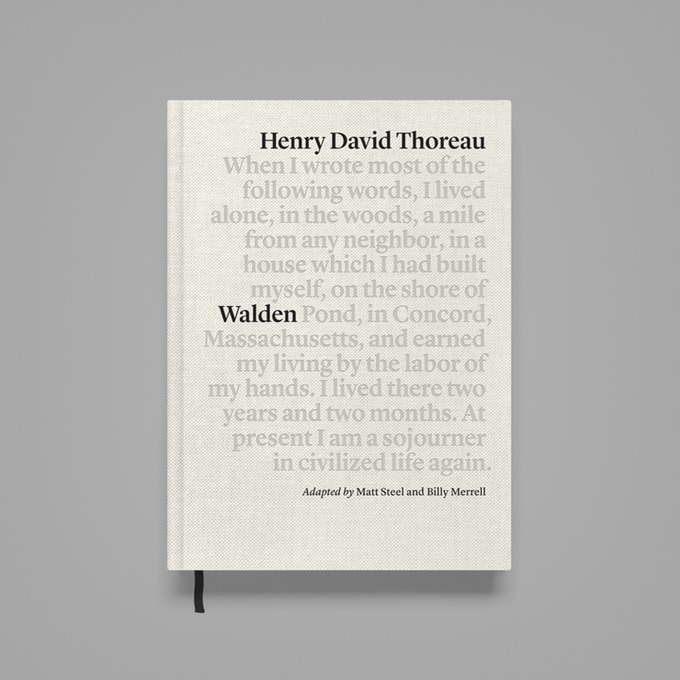
A new Kickstarter project seeks to translate Walden for the modern reader. Launched by designer Matt Steel along with writer and editor Billy Merrell and illustrator Brooks Salzwedel, The New Walden is a new take on Thoreau’s timeless wisdom.

In an essay on the site Medium, Steel explains his initial motivation:

The first time I tried to read Walden, I flunked out about halfway through the first chapter. Initially attracted by the concept of Thoreau’s experiment, I found myself quickly entangled in a dense thicket of language. I had expected to hear about the cabin he built in the first chapter; instead, I encountered an essay on economics and societal vice, with many twists and turns.

Eventually, he made it through the book and it rocked his world. He explains:

In Walden’s first chapter, Thoreau delivered the most eloquent and scathing criticism of consumerism that I’ve ever read. He saw that many of his fellow men and women were spending their best moments straining after far more than they needed; chasing after possessions and comforts that would never satisfy their deepest longings. He discovered that when we reject greed, simplify our lives, and pursue living in the present, a quiet revolution takes place inside the spirit and ripples outward into the lives of others.

The book’s impact inspired him to create a modern version, one that had updated language and was beautifully designed and illustrated.

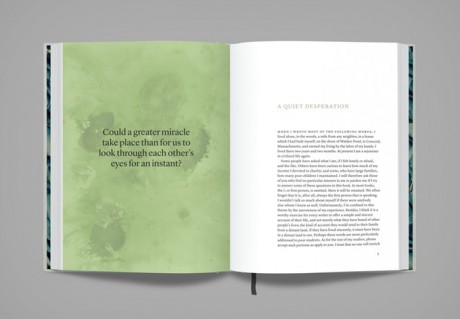
walden-text

Steel is quick to point out that he is not changing the content of Walden, just the form. “This version will be neither abridged nor dumbed down,” he writes. “It will still read and feel like Thoreau; still set in the 1840s. I am not replacing telegraphs with emails, nor wagons with SUVs…Walden is dense, layered, and complex….So when I talk about removing literary obstacles from Walden, I’m only referring to structures, syntax, and words that have fallen out of use since 1854.”

The beautiful hardbound book will not only rework the text, but will be carefully assembled, designed and illustrated, in an attempt to make it appealing to readers of today and 100 years from now. 

The campaign started today. A $15 pledge will get you a PDF version and $38 will get you a signed and numbered early bird copy. Visit the campaign page for more information. 

If You’re Going to Covet, Covet This

The term “keeping up with the Joneses” is rarely framed in a positive manner. It refers to a nasty form of one upmanship, where someone is always trying to have the bigger car, bigger house, newer clothes, etc, than someone else (i.e. the Joneses). But as we saw last year, the Australian ‘edutainment’ project “The New Joneses” flips this formula on its head. Their logic is that if you’re going to compare yourself to people, you should compare it to the right people–those who are living in forward-thinking, intelligent, responsible ways. Starting today and through the month, TNJ is doing just that with an exhibition set up in downtown Melbourne, Australia.

The centerpiece of TNJ exhibition is a 720 sq ft home by Ecoliv Buildings, a company that specializes in producing high efficiency, prefabricated, modular homes. The house is fully off-grid capable, with a solar array by Q Cells and solar microinverter battery storage by Enphase, providing power when the sun’s not shining. There are a host of other green features to the home inlcuding a solar hot water, rainwater tanks, LED downlights, electricity use metering, a greywater recycling system, ceiling fans, double glazed windows and low VOC materials.

ecoliovf

Since living sustainably means more than having a tricked out house, TNJ exhibition covers various aspects of daily living, both hi and low tech: from an electric BMW i3 and smart home tech to free roaming chickens and composting bins.

Throughout February, various people will be staying at the home as a proof of concept and way to spread the word. There will also be parties, movies and workshops as well (visit their website for more information).

Several years ago, Harvard released a study on obesity that was conducted on 12k people over the span of 32 years. They found that people were 57% more likely to become obese when a friend became obese. Was obesity “passed on” like a cold? Not exactly. It got passed along culturally. The study’s lead Dr. Christakis told the NY Times, how it highlights “the importance of a spreading process, a kind of social contagion, that spreads through the [social] network.” In other words, our environmental influences–the people we interact with, the messages we receive–have a huge impact on our behavior for better or worse. If our friends exercise regularly or buy a McMansion, the odds increase that we will do these things as well. TNJ seems to get this, showing that if we are to create new paradigms for living, ones that ‘live it up, with less’ as they say, we need to saturate our environment with good examples of how to do it. Check it out yourself online or if you’re in Melbourne in person