The New Starter Home

Somewhere between now and 1950 (or thereabouts) something went wrong with American housing. Back then, car-fueled sprawl hadn’t yet driven people so far from city centers. At 983 sq ft, the average home was just about right sized for the average household size of 3.54 people (277 sq ft/person). Architect Jonathan Tate told Fast CO.Design said this is what went wrong:

Houses morphed from a consumer good into an investment commodity, which in turn led to developers building cookie-cutter starter homes based on what they deemed to be the most likely to appreciate in value. Houses became more expensive to purchase and maintain, their sizes ballooned, and they were increasingly located in areas far removed from established neighborhoods since it was less expensive to buy greenfield land.

This morph made homes prohibitively expensive to large swaths of the population, evidenced by a 48 year low in homeownership rates in 2015. Tate and developer Charles Rutledge recently launched the Starter Home* project as a response to the commodification of homes, designing and developing housing around how people live.

starter-home-back

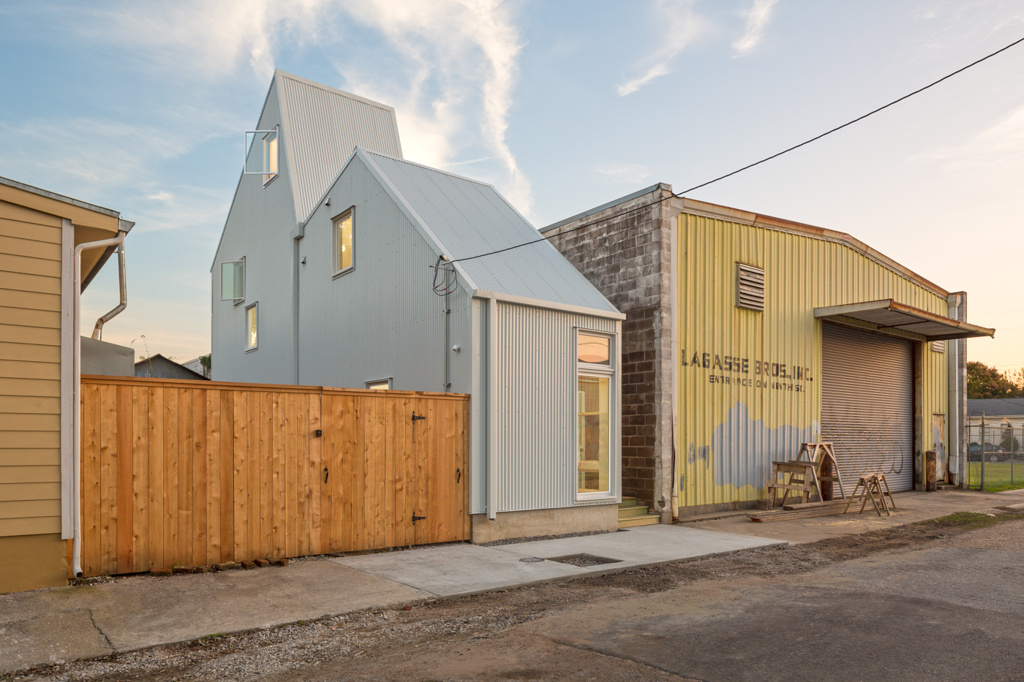
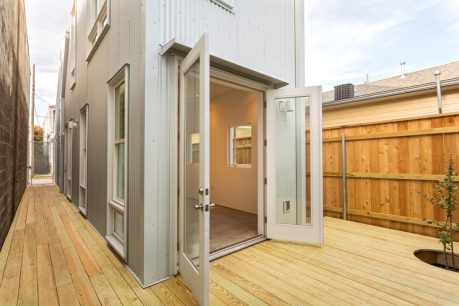
The first Starter Home* recently went up in New Orleans. It’s 975 sq ft, but its actual footprint is only 473 sq ft. Even with setbacks and some outdoor space, it can fit onto a very small 16.5’ x 55’ lot. The compact proportions make the house ideal for urban infill development, using lots that might not support conventional homes. This has the benefit of allowing the developer to purchase centrally located land at a discount, which in turn creates a lower purchase price. The first starter home cost $339K, which is about $35K more than the average New Orleans listing. Tate believeshe can drive that price down with scale. Tate has 15-20 projects in the pipeline and is planning on making Oakland, CA the next stop for the Starter Home*.  

The basic tenets of the Starter Home* are great: reduce the size and price of single family homes; bring more housing into our city centers; bring sanity back to American housing. With the average new single family home size hovering around 2700 sq ft, we need this now more than ever. 

For more information and images head over to CO.Design

Your Stuff or Your Life?

There are millions of reasons to stop over-consuming. It’s simpler, it’s greener, there’s less to dust. But as former Uruguayan president José Mujica–aka “the world’s poorest president”–reminds us, stuff costs money. For those of us not independently wealthy, our money has a pretty direct correlation with our labors. And unless your name is Tim Ferriss, our labors have a direct correlation with time. So each time we spend money, we are spending time. And once our time is spent, it’s gone. No refunds, no exchanges.

This doesn’t mean we shouldn’t buy stuff. We might decide that the things that are used, loved and add value to our lives are worth our time. This doesn’t mean that time spent working is bad either. If you love your work, knock yourself out. But ideally, we’d choose to do the work we love, not be bound to do it to pay for stuff. The reality is that if we became aware of the time-expense of our stuff, we’d probably do away with all the unnecessarily upgraded smartphones, the novelties, the status symbols. As Ben Franklin put it, “Dost thou love life? Then do not squander time, for that is the stuff life is made of.”

Find Joy with Less, Win a Book

We’ve long been fans of Francine Jay, the writer behind Miss Minimalist and the “One Less Gift Certificate.” Jay just released a new book entitled “The Joy of Less: A Minimalist Guide to Declutter, Organize, and Simplify” and we wanted to spread the good word. While applicable to all levels of minimalists, we found the book especially useful for those just getting started or perhaps looking to reach the next level of less-ness. In particular, she introduces reader to her “STREAMLINE” method of paring down. Streamline is an acronym:

  • S  Start over
  • T  Trash, Treasure, or Transfer
  • R  Reason for each item
  • E  Everything in its place
  • A  All surfaces clear
  • M Modules
  • L  Limits
  • I  If one comes in, one goes out N Narrow it down
  • E Everyday maintenance

In her clear prose, she expands on each of these topics and gives practical instructions on tackling big messes.

Many who start the process of decluttering are greeted by a pall of doom. Too often, their focus is on the hardship of getting rid of stuff: the emotional challenges of letting go of stuff we have strong emotional bonds with, the toil of purging. Jay does a good job of stressing the liberation one gets on the other side: the peace, ease and freedom of having fewer things to deal with. She even says that removing can get a bit addictive. She writes:

What I expected to be a tedious and rather onerous task turned out to be exhilarating. I was instantly addicted. I decluttered in the morning; I decluttered in the evening; I decluttered on the weekends; I decluttered in my dreams (really!). When I wasn’t actually decluttering, I was planning what I could declutter next. It’s as if I could feel the physical weight being lifted from my shoulders. After I’d been particularly productive, I’d twirl around in my newly empty space with a huge grin on my face.”

If you’d like to experience the joy of less firsthand, we are giving away a hardcopy of The Joy of Less. Leave a comment below if you’d like to be entered (you can also leave a comment without being entered by saying “do not enter”). We will draw a name at random (our commenting system takes your email address, so please do not leave your name or email). Drawing will close end of day Saturday April 30 2016.

Test Drive Tiny Living at this Tiny House Hotel

For all the hype around tiny houses, far more people talk and read about them than live in them. We suspect if people were given the opportunity to live in one for a while, they might take the tiny plunge…or put a down payment on a McMansion. WeeCasa is a hotel that gives you that opportunity, offering up one of 10 tiny house “hotel rooms” that let you experience tiny house living firsthand.

Weecasa is located in Lyons, Colorado, a small town an hour north of Denver in the foothills of the Front Range. Unlike Caravan Tiny House Hotel in downtown Portland, which has been around for a few years, Weecasa has a more pastoral vibe. The tiny houses are nestled into the trees and sit next to the St Vrain River. Lyons has a ton of things to do such as festivals, outdoor activities and is a quick, albeit uphill, drive to Rocky Mountain National Park.

weecasa-interior

The houses are built by a number of different tiny house manufacturers, and only one exceeds 200 sq ft. They are quite handsome and outfitted like tiny houses you could live in, replete with kitchenettes and bathrooms. In fact, WeeCasa is as much showroom as hotel. If you like the one you stay in–or perhaps a neighbor’s model–WeeCasa will help you buy one, or one just like it. 

Rooms run start at $139/night. Visit their website for more information. 

Via 5280 Magazine

We Wish All Suburban Developments Looked Like This

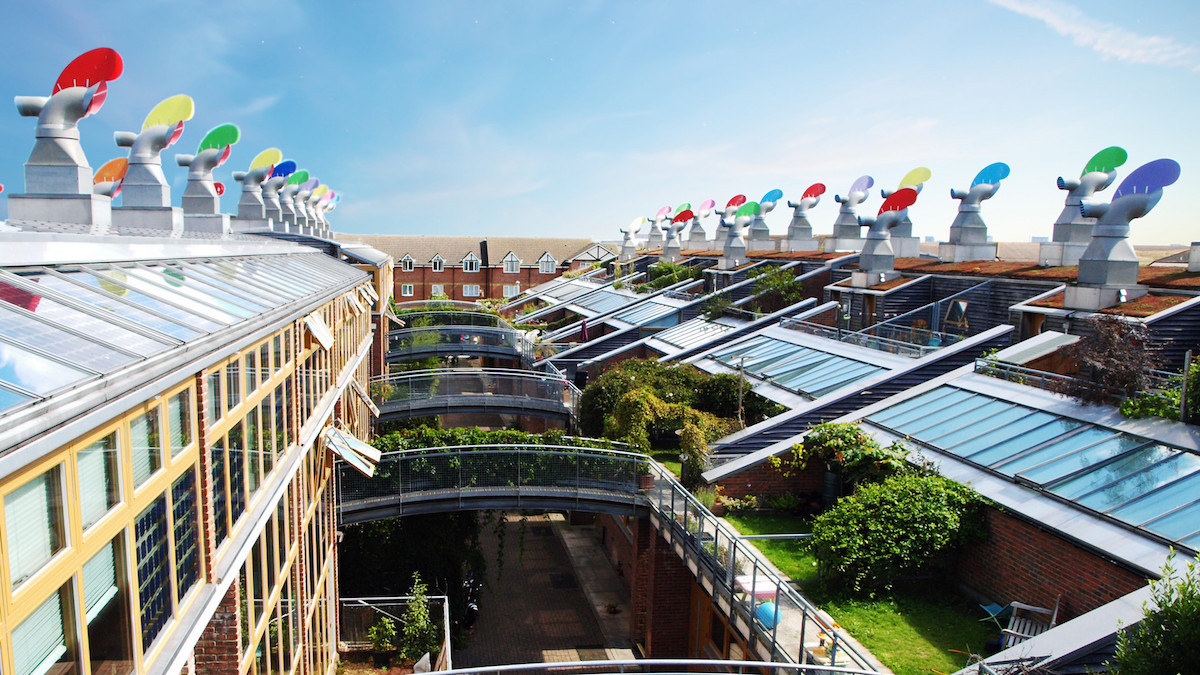
We’ve long extolled the virtues of high density, urban living. By keeping things close, you can walk or bike most places, which is better for both physical and planetary health. Density leads to more social interaction, easier distribution of goods and foods. And so on. But we also understand why people are drawn to the suburbs. It’s nice to have a little more personal space and maybe even a yard. In 2002, architectural and development firm ZED Factory completed their BedZED, a unique housing development that fuses the best of urban living with suburban comfort.

The word zed, for those unfamiliar with anglo-numerical nomenclature, means zero. In this case, BedZED, located in Wallington, a commuter suburb located 10 miles outside central London, is the “UK’s largest mixed use, carbon-neutral development.” It achieves this zero-ness through solar power and a “biomass combined heat and power plant, an onsite sewage treatment and rainwater recycling system,” according to ZED Factory’s website. Many of the building materials were reclaimed or sourced within 50 miles of the site to keep embodied energy low.

One of the more remarkable aspects of the development is its diversity housing types and uses. According to ZED’s website, “BedZED comprises 82 affordable dwellings in a mixture of flats, maisonettes and townhouses, and approximately 2500 m2 of workspace/office, and is built on a brownfield site [repurposed industrial site].” In addition to housing diversity, there is demographic diversity, with one third “social rent [subsidized low income], one third shared ownership [coop] and one third private for sale”–a structure that promotes a variety of people at different stages in their lives. Residents share the complex with ground floor businesses, whose spaces can be easily configured to accommodate large or small businesses.

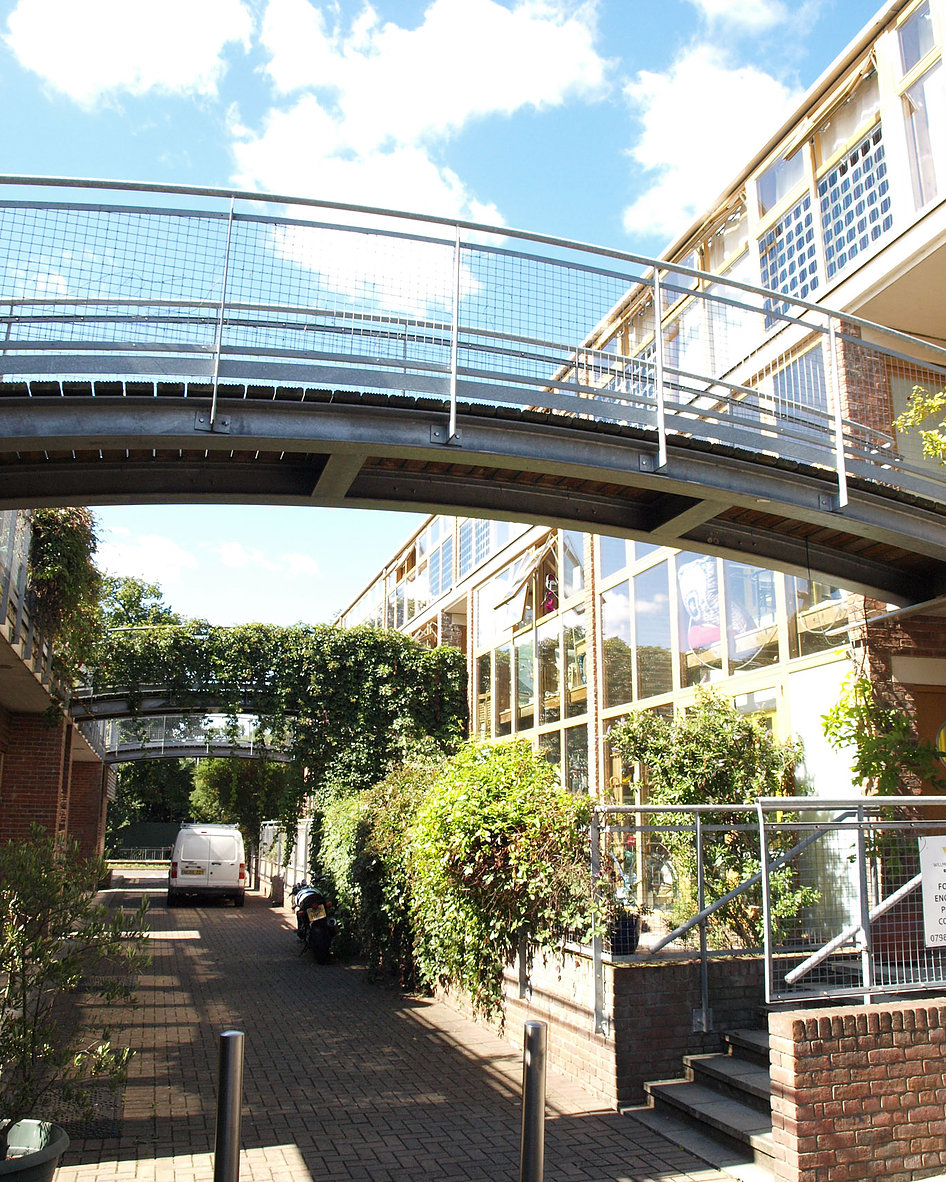
Putting aside its considerable eco and urban planning cred, the place looks great. Units are bathed in light (as much as they can be in the UK) and the interiors enjoy an industrial chic look carried over from the building’s previous life. Small, verdant walkways and wend their way through the complex and almost every unit having its own terrace or garden. If this is the suburbs, we want in! 

Image via ZED Factory

This is What It’s All About

A reader recently sent us this letter and we think it pretty special:

Thanks LifeEdited! You are helping fuel our resolve to continue on our journey simplicity.

Our story began the summer of 2014.  My husband and I found ourselves empty nesters, in a huge house, with a huge yard, and a huge to-do list of chores and have-to’s. Our bank account non-existent, our paychecks going out the window faster than we could deposit the paychecks.  All the stuff in the world hadn’t made us happy, only miserably in-debt.

So we decided to break out of the box we’d climbed into and regain financial freedom and our joy. We spent five months purging and preparing our home to put on the market to sell.  We must have done a great job because we put our house on the market on December 31st, 2014 and on January 20th, of 2015 we were sitting at the closing table!  Our heads spinning, three-Fourths lighter in possessions, we helped a wealthy friend care take his 14,500 square foot, multi-building, 65 acre estate in Cincinnati, Ohio for eight months, which helped us eliminate almost completely all of our credit card and vehicle debt!  Ashamed to admit it, but when we sold the house we were $37,280.00 deep in debt!

We now rent a very cool 1000 square foot apartment in Historic Covington, KY. While 1000 square feet, probably sounds huge to you over at LifeEdited…for us it’s 1/4th of the space we used to have. Gone are all the dusty collections, over 35,000 books, and 500 pieces of white pottery. Gone are the days of spending nights and weekends tending to the maintenance, repair and upkeep of a huge home. Gone are all the things I felt compelled to hold onto for ridiculously sentimental reasons, just because I felt guilty about letting them go. (Trust me when I say this, Aunt Millie…who’s been dead for three decades, really doesn’t give a shit if I still have her casserole dish!). Gone are the endless headaches attached to caring for all that stuff!  Gone are the dozens of bills flooding the mailbox each day. In exchange, we’re finding freedom, peace of mind, tranquility, time for random timelessness with friends and loved ones.

Our example is helping our sons relearn and reset priorities. It feels great. We’re still working on streamlining our current possessions, because let’s face it, the world keeps screaming “you need this!” all the time, and people around us still haven’t figured out that what we want is to just share our lives with them, not get stuff from them….so we’re working on what to do with those gifts from loved ones, that you just don’t need or love.

The biggest shift for us has been becoming “appreciators” instead of “consumers.” Appreciators see beautiful things and think, “Oh, how beautiful that is and take time to delight in it.”  While Consumers are people who see beautiful things and think….”I must possess that!”

I just wanted to stop and take the time to say thank you for helping inspire me today to stay the course and not take two steps back into that old life that I so do not want to ever repeat!

Less, truly is the key to opening the door to a life filled with more abundance.

LTS & GGS

Game of Thrones Meets Tiny House Nation

Have you ever been interested in living in a tiny house, but found most of them too cute? Perhaps you wanted something more imposing, more medieval–but still tiny. Look no further, because this 288 sq ft tiny castle in Manson, WA can now be yours for a mere $89,000.

tiny-castle-detail

The house is a perfect getaway from the stresses of the city or the stresses of bands of marauders. It is topped with a turret, perfect for looking out on Lake Chelan or for crossbow defense positioning. And though there is no moat, the castle is located on steep hillside, making approaches very hard–unless attackers were coming from the lake, in which case it’d be super easy to attack.

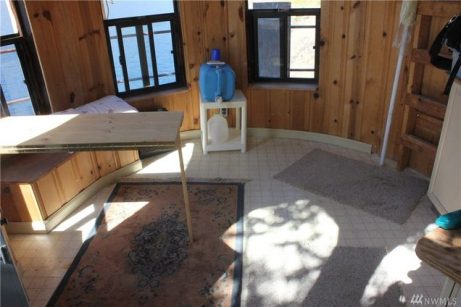
The castle’s interior is a little less than kingly, though the views seem nice.

tiny-castle-interiorview

And the castle is perfect for living car-free because it’s only accessible by boat. A dock is included. Manson, in case you were wondering, is a 3.5 hour drive from Seattle.

Taxes are a mere $421, but who would have the gall to collect from someone living in this place? Utilities are completely free, because there are none. It should be noted that the seller reports some fire damage (probably from hostiles).

Via Domain

Simple Bed Belies Complex History

We ran across the Stapelliege stacking day beds by Müller Möbelwerkstätten on Remodelista. They’re pretty great. They are made of plywood and available in a number of wood finishes, colors and several sizes. All of the corners are rounded to make them especially kid friendly. While two seems like a pretty ideal number to stack, they can go higher.

mueller-moebelwerkstaetten-stapelliege-01_zoom

As this is not a complicated piece of furniture, to expand on its functionality would be doing it a disservice. However, expanding on the design’s origins would be really interesting! Here’s what Smow, a German store that sells the bed, has to say about it.

The origins of Rolf Heide’s Stapelliege can be traced back to the mid-60s. A turbulent time in Germany and worldwide, in addition to the trouble spots of the Cold War and its counter movement of Flowerpower and the peace movements, the great destruction of World War II presented the European population with problems of housing shortage and a need for new solutions; consequently, the 1960s were marked by especially strong changes in cultural and social life. In terms of housing, one popular solution was large estates on the outskirts of cities; conurbations which more or less appeared out of thin air and had to meet especially one criterion: as many apartments as possible on as little space as possible – space for decorative flourishes or elaborate designs was simply not provided. In the broadest sense, the design and the concept of Rolf Heide’s Stapelliege therefore fits perfectly into this period, even if the bed is not reminiscent of the concrete blocks of the 60s.

Who knew this simple bed had such a complex history?

1966_cmyk_300_720x600

The bed is available for sale from a number of vendors, but mostly in Europe it appears. Individual beds range from €381 for kids models up to €1,130 for a large 160x200cm (full sized) bed. A bunch of snazzy, Heide designed storage units are also available.

Via Remodelista

SHTF Ready Housing Collective Pretty Sweet

Techno-urban utopianists predict a future where people will live in plant-covered high rises that spring up like natural organisms. All transportation will be on demand. Everything will be powered by completely clean fusion power. Goods will be shared and instantaneously accessed through sophisticated technology. All of these systems will cut down our workload, leading to a happier, healthier civilization. This is definitely a direction our planet could be heading in. Then there’s the other direction. In this future our infrastructures, financial systems and climatic balances will collapse, leading to massive energy and food shortages, mass migrations and so on. Should this latter scenario come to pass, we imagine there will be a long line to join The Long Spoon Collective. Located in Saugerties, NY, LSC is a small collective that grows its own food, constructs tiny houses for free for people who want them and is trying to start an economy based on giving instead of money.

The collective’s membership stands at six at the moment. The Saugerties Times explains how the sextet came together:

The collective got its start when founder and native Saugertiesian Chase Randell, a Skidmore graduate with a master’s degree in humanistic multicultural education, became involved with the Sustainable Saugerties Transition Town group last summer. He, along with Karuna Foudriat, a former Waldorf school teacher and current divinity school Ph.D. candidate, and a group of supporters, began to grow food on a local farm….Randell and Foudriat were joined by Frank O’Leary, who knew Randell from Skidmore, and recent émigrés from New York City Jared Williams and Lala Montoya, permaculture experts who recently returned from a year in Kenya. Collective members are committed to growing their own food and living as much as possible without using money.

More than mere backup plan for the collapse of the status quo, LSC has a larger goal of addressing “issues of poverty and environmental degradation by meeting the basic need for food and shelter directly.” As such, the food they grow–much of which is grown on once-derelict farms and private gardens–is given away.

LSChouse

Their off grid tiny houses, which some members live in, are made of salvaged materials. They even offer to tear down unused structures on properties in exchange for use of the scrapped materials.

The members do have money coming in from the conventional economy, but their participation is a bit like Peak Oil, i.e. taking the resources of the old way while they’re still available in order to lay the groundwork for the new way. Money is directed toward things like hosting free workshops, fueling trucks to support their projects and so forth. Their ultimate goal is to transition themselves from the normal economy to the giving economy.

Saugerties is a two hour drive from NYC, which the collective sees as a big plus. The proximity gives them access to tons of people who might join the movement. Speaking of, they’re looking for more members. Head on over to their website for more info.

A Guide to Buying a Refrigerator for Small Apartments

For the most part, American appliances, including refrigerators, fall into two categories: Big and nice or small and cheap. In other words, it’s tough to get small and nice if that’s what you’re after. But doing nice and small can be done, even in America. After a few years of research, we thought we’d create a general guide that might help you select the right fridge for your small space.

The Basics

Stating the obvious, what makes small space appliances suitable for small spaces are their size. We’re going to limit our discussion to 18” and 24” wide refrigerators, which are the two most common widths available. 24″ is far more common than 18″. 27” and 30” models, while suitable for some small spaces, are not your most compact option.

There are far more variations in height. Broadly speaking, there are counter height and standard height fridges. The former tend to run around 32-34” so they can fit under a standard 36” countertop. The latter usually range from around 60” to 80”.

Most fridges are counter depth, meaning their overall depth is around 24”, give or take, so they don’t protrude too much beyond the counter,.

Fridges can be Energy Star rated, which means they are 9-10% percent more energy efficient than models that meet the federal minimum energy efficiency standard. Most middle to high end fridges will have this certification, but low ends will not necessarily.

integrated

Perhaps the most important consideration is how the fridge will fit the layout and aesthetic of your kitchen. Most people buy a new fridge because theirs died or they are doing a larger renovation. If you’re in the former category, you might consider finding a model that roughly fits the dimensions of your previous model. If you’re redoing your kitchen, you’ll want to think about how the fridge fits in with your cabinetry (more on sizing in a minute). Especially important is what, if anything, you’re doing above the fridge (keeping it open, more cabinets, etc).

If you have the money, we’d suggest a panel ready fridge, which means it’ll accept custom panels matching the rest of your kitchen’s cabinetry. This is generally only found on premium fridges and the panels aren’t necessarily cheap either. But it creates very streamlined looking kitchen.

Down from panel ready are stainless steel clad appliances, which tend to look and clean up better than painted models, which are how the least expensive fridges are clad. 

Counter Height Fridges

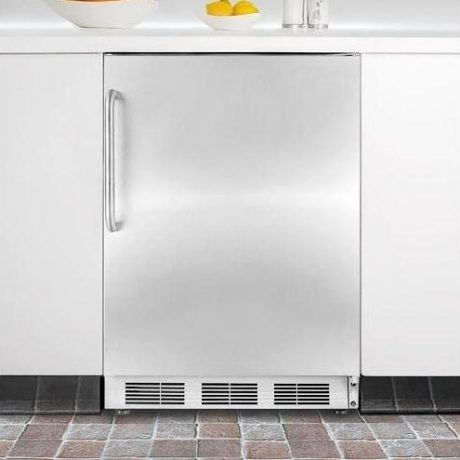
Counter height fridges are great if you want to save space. They take up minimal volume and permit more counter space as the surface isn’t interrupted by a fridge. But they have some notable drawbacks. The first is storage volume. A normal counter height fridge has around 5-6 cubic feet of storage. A fairly standard 60” high model will have two times that. This amount of volume might be fine for a single person who doesn’t cook often or shops every couple days, but for many people this amount of space quickly becomes limiting. 18″ models are available as well, but are mostly suitable for keeping last night’s leftovers cool.
summit-undercounter

The next issue is that most counter height fridges have manual defrost (all fridge models are available if you don’t need a freezer). This means every month or two you must let your freezer compartment thaw out. And up until that point, the compartment get smaller and smaller as layers of ice form around the interior of the compartment. It’s a pain. The Avanti RA3136SST is one counter height fridge with auto-defrost, but because of its size (3 cubic ft), it’s mostly suitable for people with Smurf-like appetites. The U-Line 1000 series will also do the trick…for $2K.

summit-interior

If you’re looking for other non-manual defrost fridge/freezer combo options, you can choose a drawer style fridge. We used the 27” wide Sub Zero 700 BCI in the first LifeEdited Apartment (pictured at top, since discontinued). It looked really nice as it accommodated custom panels. But its limited storage volume and height (you couldn’t stand a bottle of wine upright) limited its functionality. At around $2500, it was also very expensive. In fact, most drawer fridges are more expensive than their standard size equivalents, starting around $1500.

Our overall recommendation is to only go for a counter height if space is really limited and/or you are not a serious cook or you only like dealing with very fresh food. In terms of manufacturers, Summit probably makes the most number of models, though most manufacturers have counter height options.

Standard Height Fridges

If you have a bit more room to play with and you like keeping things on hand that you don’t cycle through very fast (condiments, wine, etc), we recommend going with a standard height fridge. With 10+ cubic feet of storage, they are far more practical for most people. And unlike counter height fridges, almost all have automatic defrost. Finding a model that works for you is mostly a matter of budget and aesthetics.
danby

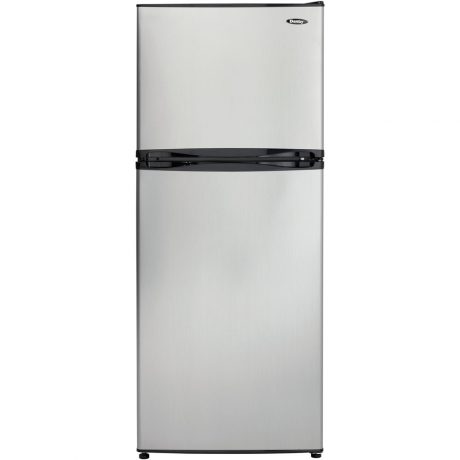
If you’re looking for an affordable 24” compact fridge, there are a number of options. You could pick up the Danby DFF100C1BSLDB for around $500. At 24” x 60”. These and others like it are the kind of fridges most landlords buy. They’re not sexy, but this level of fridge tends to have a reasonable 10 cubic ft of storage and it’ll keep your stuff cold. What more do you need?

Up from there you could get into some nicer stainless steel fridges like the LG LBN10551PS. It’s 24” x 68” and has 10 cubic feet of storage volume. At around $800-900, it’s a little more expensive, but it looks nicer than the Danby-level fridges.

Up from the LG are the more premium European style 24” models. These tend to be between 70-80” high and have more storage. They can be purchased panel-ready, allowing you to seamlessly integrate them into your kitchen.
fagor

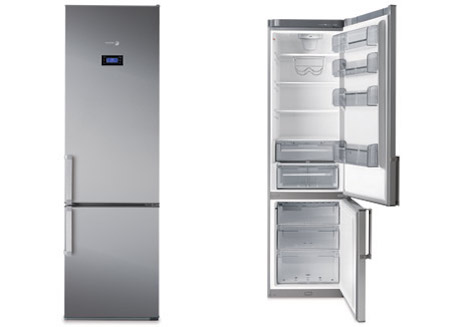
For one of our projects, we used a Fagor model and it’s worked out great. It measures 24” x 80” and has about 13 cubic feet of storage. Like most other tall skinny fridges, the freezer has pull out drawer which take a little getting used. For example, you can’t toss a big turkey in there and putting ice trays in there is can be trickier than one models with one open volume.

In this tier, there are a variety of nice options, though most will run quite a bit of money. On the bottom end is Blomberg BRFB1042WHN for around $800 (also available as panel ready for $1500) and on the high end is Liebherr BF1061, which is built in to custom cabinetry and will set you back $5700. For our next project, we chose the panel ready Smeg CB300U which retails for about $1900.