UberPool Makes it Easy to Pimp Your Ride

The world’s roads are littered with people driving the same way–people leaving when you’re leaving, from where you’re leaving, going to where you’re going (or, if not exactly same locale, at least getting on and off somewhere along points on the way). But until now there was no way of connecting those people–likely why 78% of American commuters end up driving alone. UberPool–a division of Uber–is trying to change that, connecting people who are going the same way. From their website:

With UberPool, you share a ride—and split the cost [of an UberX car-service ride]—with another person who just happens to be requesting a ride along a similar route. The beauty, though, is that you still get Uber-style on-demand convenience and reliability: just push the button like before and get a car in five minutes. When we find a match, we notify you of your co-rider’s first name.

Uber says an UberPool car would achieve 36.4 person trips per day (the number of people carried in a car multiplied by the number of trips that car makes in a given day) versus the average private car that only has 4.8. This high volume will theoretically make the service so cheap that it can realistically replace car ownership, halving the price of their UberX service, which they say is already 40% less than a traditional taxi. They think that UberPool’s convenience and thrift will make it compelling enough to eventually remove 1M cars off the road.
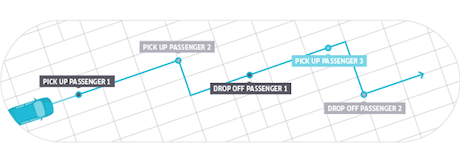
uber_NYC_infographic-02

The program has been rolled out in beta in Paris, San Francisco and New York City. A Newsweek article reports that some drivers are having trouble using the service and there are complaints about the service cutting into profits for the drivers. Uber has expressed that there are still many kinks in the system–which is why it’s in beta, duh–but that UberPool will ultimately benefit drivers as the service, by virtue of its convenience and low cost, will create ever-increasing volume of people looking for rides, keeping drivers busier than they are now. Like all new ideas, there is bound to be a ramp up period.

It’s pretty clear that we have more resources than we need, but sometimes distributing those resources to people who want them, when they want them can be difficult to say the least. UberPool is a great example of how tech can help us make the most of what we got. We wish the project the best of luck.
Why Your Next Car Might be My Next Car Too

Last week, Google Ventures invested $258M in the car service Uber raising the company’s value to $3.5B. If you don’t know Uber, you probably will soon. While the company’s bread and butter is an app that allows on-demand black car reservations from existing limo companies, they have also recently introduced UberX, which allows you to book a Prius limo in several major cities. For the future, they plan to move into non-taxi ride-sharing, cutting into services like Lyft, and some speculate that they might start their own fleet of taxis. TechCrunch waxed about the possibility of an Uber fleet of driverless vehicles supplied by Google.

Uber’s growth, as well as that of other car-sharing programs, would not be so interesting if not seen in light of a major shift in behavior and attitudes toward driving, cars and where people want to live. In short, people are moving to the city, driving less and caring less about cars.

Consider the following from a US PIRG (Public Interest Research Group) report:

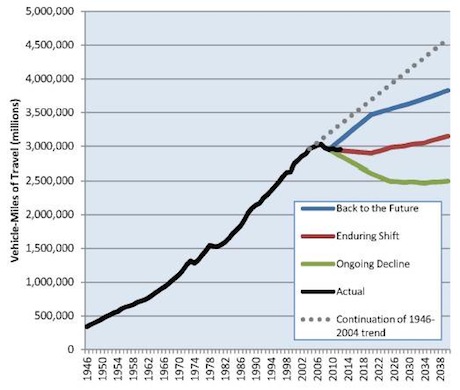
  • Americans drove more miles nearly every year between the end of World War II and 2004.
  • Americans drive no more miles in total today than we did in 2004 and no more per person than we did in 1996.
  • Americans took nearly 10 percent more trips via public transportation in 2011 than we did in 2005. The nation also saw increases in commuting by bike and on foot.
  • Young people aged 16 to 34 drove 23 percent fewer miles on average in 2009 than they did in 2001—a greater decline in driving than any other age group. The severe economic recession was likely responsible for some of the decline, but not all.
  • Millennials are more likely to want to live in urban and walkable neighborhoods and are more open to non-driving forms of transportation than older Americans. They are also the first generation to fully embrace mobile Internet-connected technologies, which are rapidly spawning new transportation options and shifting the way young Americans relate to one another, creating new avenues for living connected, vibrant lives that are less reliant on driving.

Further data supports this trend away from car use and ownership, such as the fact that kids are waiting longer to get their drivers license, and a study conducted by Zipcar found that most Millennials would sooner give up their car than their smartphone. The trend of less driving is expected to grow.

vehicle-miles-traveled

There are detractors who say that the dip in car ownership is a momentary blip before the economy improves and Millennials start having babies, but we think there’s more to it.

Following WWII, excess industrial capacity in America allowed cheap cars to flourish. In that same time fuel, excepting the OPEC blip in the 70s, was cheap and plentiful. The environmental impact of emissions was an abstraction. This low cost of ownership and operation and the perceived benign global impact of cars gave people permission to take more than they needed–more power, capacity, seating, etc (if you don’t believe this, go to Europe–or virtually anywhere else on earth–where most cars are significantly smaller). The car, invented as a tool, became a totem.

But today, the rising costs of car ownership and fuel, cultural shifts toward more centralized, urban living and technological means to access to cars without owning might be pushing the car back to its utilitarian roots. Cars may soon be seen as something to move us from point A to B, not something to move us ahead in life.

What do you think? Do you think car sharing can truly replace individual car ownership? Are we really giving up our cars or is this shift a momentary blip in automotive history?

Image credit: ChameleonsEye / Shutterstock.com