The World of the Super Frugal

Have you ever met people who seem fairly normal on the surface, only to find out they have a completely secret life? Perhaps you find out they’re a mixed-martial artist, compulsive gambler or superhero. Well you might know someone who dwells in the world of super-frugality (a common tipoff is the Ball jar mug). These are people who have made saving money into an art-form. Their goals, by and large, are to escape the workaday world and often enter retirement or semi-retirement at ages when most people are just ramping up their careers.

We’ve looked at one of these super-frugarians (frugaliens?) in the past: Mr Money Mustache. He’s a Coloradan cum Canuck who dispenses detailed and hilarious case studies in how to live well on a tiny budget. MMM, who lives off of $27K/year for himself, wife and child, is in his late thirties and functionally retired.

But MMM is just the tip of the iceberg. Their are scores of people preaching the gospel of thrift. We ran across the descriptively-named site called Early Retirement Extreme; on it were countless resources for starting your own retirement process such as a 21 Day Makeover that includes many suggestions we recommend here like “buying classics” and living in a walkable location. EME’s blogroll had numerous sites we’d never heard of but look forward to reading:

  • Brave New Life, written by a Colorado (does this mean something?) family man who got off the success hamster wheel and now is happier, working a low-stress job, made easier through a variety of passive income streams.
  • One Hundred Dollars a Month. Kinda like a ultra-thrifty Martha Stewart (meant in the best possible way).
  • To Simplify is written by Glenn, “a saxophonist, composer, arranger, orchestrator, full-time traveler, and big proponent of the simple life.”

They are all types of people in different locations with different flavors of frugality. Most of them point to “Your Money or Your Life,” by Vicki Robin, a bible of sorts for streamlining your finances and becoming financially free without making a ton of money. Most write about making your life more efficient: changing over to a cheaper cell-phone plan, buying food in bulk, etc. Most write about the societal pressures to “work > consume > repeat” and the spiritual discipline needed to escape that cycle and do your own thing. And given that the average American spends 30% of her income on housing (or 50% combined housing and transportation), most of these folks have figured out ways of significantly minimizing housing expenses, many by downsizing, almost all by owning their homes outright.

Many of the suggestions are not easy and require major paradigm shifts as to what constitutes success and a good life. On the other hand, working yourself to the bone, having no free time and constantly being pinched for money is no joyride either. It’s up to decide which is harder.

Piggy bank with belt image via Shutterstock
Company Makes Some Serious Coin

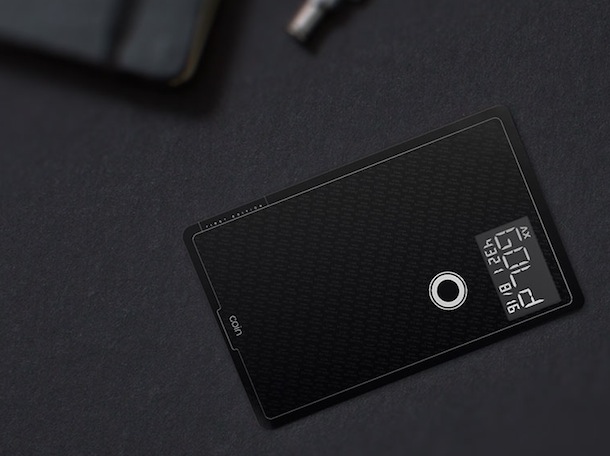
Many of us carry around several cards in our wallets: a personal credit card, debit card, business expense card, family account card, award card, etc. This stockpiling of cards leads to bloated and cluttered wallets. A startup called Coin has a solution to this wallet obesity epidemic. They make a slim little card that is programmable to act as all of your cards.

Via a smart phone card swiper and app, Coin takes information from your existing cards and loads it onto their card. You also take a picture of cards to have identifying pictures. When you’re ready to make a purchase, simply scroll through your available cards on your Coin device, select the one you want to use, and swipe.

Coin also features a Bluetooth signal that sends a push notification to your phone should you and the card be separated.

Coin is pretty cool, though we do have questions about its longterm relevance. We imagine it won’t be long before all of our spending power will be accessible via smartphone apps such as Google Wallet. We also think a great feature would be to show your balance, given that there’s an LCD screen. This might encourage more responsible card use, avoiding the “credit card premium” we mentioned the other day.

All that said, that fact is that most of us carry and use multiple cards, and Coin makes managing and storing those cards a bit easier. Coin will be delivering summer of 2014. Friday, December 13 is the last day to receive Coin’s half-off promotional pre-order price of $55. Visit their site for more details.

Freeze Funds for the Holidays

According to one source, money spent on Christmas gifts make up 3-4% of people’s total annual income. And few modern mechanisms make this yuletide spending–and overspending–easier than credit cards. The greater ease of spending is, at least in part, due to how convenient cards are to use. But there is also a psychological phenomenon called “credit card premium,” which is our willingness to spend more whilst using a credit card than we would with cash (have you ever paid $4 for a small bag of chips at a vending machine because it took cards?). A study that came out a couple years ago showed that people who spend with credit cards focus more on the benefits of their purchases (me want yummy chips!). Cash spenders focus more on costs ($4 for a small bag of chips! Are you nuts?).

Cash, perhaps because of its physical tangibility, activates emotional pain in the spender in a way credit cards don’t. Handing over cash is a physical representation of outgoing funds–something our brains can comprehend. The esoteric credit card transaction has no such representational value, thereby dulling the pain of spending and facilitating paying more than something is worth and buying things we can’t afford.

But just because you can’t feel the purchasing pain doesn’t mean the injury has not been inflicted. According to one source, the average American household carries around around $7K of interest bearing credit card debt; that same number increases to $15K if we only look at households that carry credit card debt.

If you’re one of the many Americans who struggle to keep your credit card spending in check, Trent Hamm from the Christian Science Monitor, has a few suggestions for creating barriers to use:

  1. Freeze your card. He means this literally: put the card in a block of ice to prevent throwing it in your pocket on the way out the door.
  2. Hide your card. Hamm put his cards in the attic, which required getting a ladder from the garage to get into. The point is to make it hard to retrieve.
  3. Wrap your card in pictures. Hamm made an envelope for his cards with pictures of his kids, who are the inspiration for his spending moratorium. This is the emotional barrier.

Unfortunately, none of these tactics handle online credit spending, where your card is usually on file (Hamm’s article is part of a series, so maybe he has some suggestions in the coming weeks). For that, we might suggest clearing your autofill settings and purchasing as a guest rather than registering for an online store; this way, you’ll need to enter all of your information every time you visit a site…let your laziness shape better habits.

But really, most of us won’t get rid of our cards, and after we’ve melted the block of ice, and after we’ve fetched them from the attic, we’ll probably just stick them back in our pockets. So the objective should become cultivating a relationship between spending and costs. Here are a few suggestions on how to do that:

  1. Spend cash wherever possible. Groceries, gas, coffee, etc. There are still plenty of places to use cash.
  2. Buy quality, sometimes expensive items. At least in this author’s experience, overspending tends to happen more often with small purchases than big ones. Paradoxically, buying less, but better stuff tends to curb the spending jones for smaller, insignificant purchases.
  3. Look at your credit card statements. Many of us (this author included) simply pay our credit card bill without looking at it. Take a sober look at where our money goes. We don’t necessarily have to do anything different, just start becoming aware of what’s happening.

Real World Micro Living

We are design wonks here at LifeEdited. We swoon at Parisian micro flats with experimental lighting schemes, lust over obtuse Japanese rental properties and dig all–well, “many”–varieties of experimental architecture and design. But we also know these things cost money to build; in fact, several of the most innovative small space designs we’ve seen are a rich client’s pied-à-terre. Concocting and consummating many of these designs also take time and attention some of us would rather direct elsewhere.

While furnishing, renovating and improving small spaces does take less money and attention because of their sizes, the fact is that for many of us, living in a simple unadorned, straightforward, un-renovated, inexpensive home is the essence of living an edited life.

ECity-051613-BedKitchen

To illustrate, we wanted to share reader Marya’s small Florida home. Here’s how she describes her it:

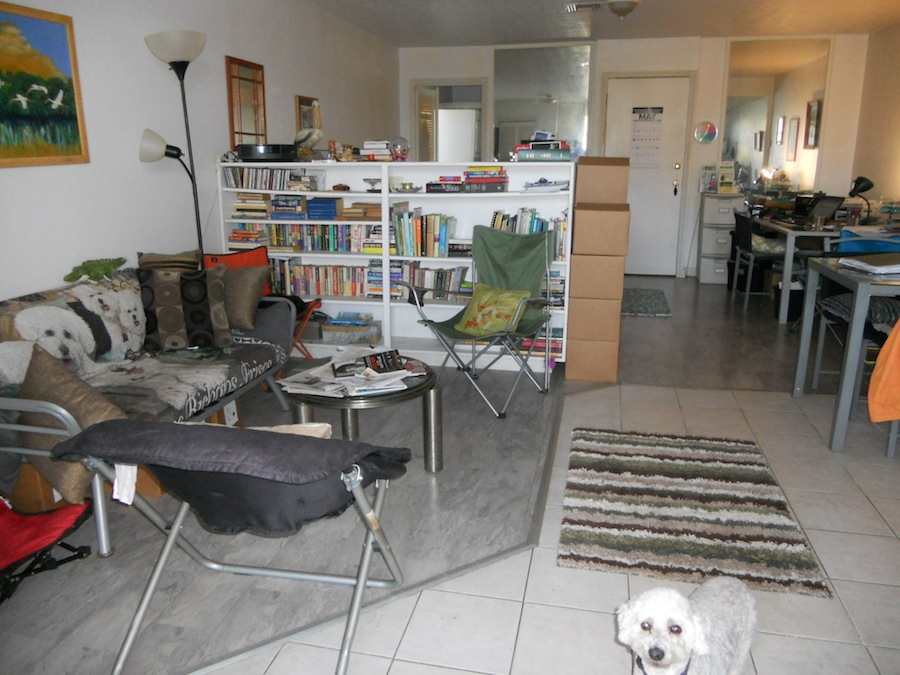
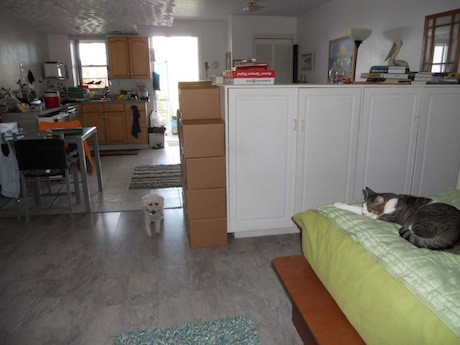
I live in one large room which serves as office, sleeping area, kitchen, and small sitting space. There’s a divider to separate off my bed from the rest of the room; it has bookshelves on one side and clothes closets on the other. My bathroom has a stall shower and a stacked washer/dryer. The kitchen area has under-counter fridge and freezer, 2-plate stove top, and a few built-in cupboards. I have a minimum of pots, pans, dishes but can entertain 4 people comfortably for dinner.

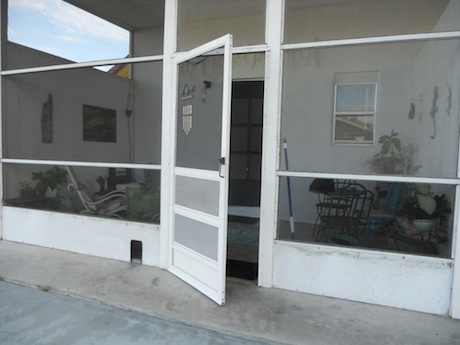
Marya’s home features virtually no architectural distinction excepting a screened-in porch. Most of the furniture was purchased at K Mart, she reports. Yet this is an edited home.

She occupies as much room as she, her two cats and one dog use. She lives with what she needs (the boxes and books are related to her work as a writer/publisher). She owns the place outright, paying only $350/month in condo fees, which include water, lawn, pool maintenance and any exterior structural maintenance. She describes this low financial and logistic overhead life as being “much simpler than when [she] had a ‘proper’ house,'” and that her current setup “gives [her] time to read and write and think.” As we read yesterday, isn’t that what most of us are striving for anyway?

The reason we say this is an edited home is because she lives an edited life–in other words, architecture and design didn’t strike her life simple.

ECity-080113-porch-outside

It’s true that we appreciate high design. And we do believe design can solve some technical and–let’s face it–aesthetic challenges. But to suppose that design is the end of the story misses the mark. Doing more with less is something anyone can do, in any financial circumstance, with any furniture or aesthetic, in most any space (we’re not sure about this one). Thank you Marya for the reminder.

Get Rich or Live Trying

It’s been said there are two ways getting rich: Make more or spend less. If you’re planning on incorporating the latter strategy–or combining it with the former–there are few better resources than a blog called Mr Money Mustache. MMM covers a range of financial topics from housing to insurance to diet to philosophy. MMM–the author’s pseudonym and site’s namesake–instructs readers how they can achieve financial freedom like he did, retiring at the age of 30 with his family.

Similar to the book “Your Money or Your Life“, the MMM blog dolls out doses of financial realism along with practical advice. Unlike the book, it’s doled out in easy-to-digest blog-post portions and written in a very funny prose style.

He lays out the problem, which is the common idea that:

Life is hard and expensive, so you should keep your nose to the grindstone, clip coupons, save hard for your kids’ college educations, and save any tiny slice of your salary that remains into a 401(k) plan. And pray that nothing goes wrong in the 40 years of career work that it will take to get yourself enough savings to enjoy a brief retirement.

Instead, he proposes that our lifestyles are the problem, saying:

Your current middle-class life is an Exploding Volcano of Wastefulness, and by learning to see the truth in this statement, you will easily be able to cut your expenses in half – leaving you saving half of your income. Or two thirds, or more.

He elucidates the particulars of this wasteful behavior and shares the tools that have enabled him to get his household expenses down to $27K/year. He also runs through case-studies submitted by his readers.

His prescription is more or less as follows:

Getting rid of your Debt Emergency if you have one. Live close to work. Move to another city if you enjoy adventure. Don’t borrow money for cars, and don’t buy stupid ones. Ride a bike wherever you can. Cancel your TV service. Stop wasting money on groceries. Give your kids the opportunity to achieve greatness without being pampered. Lose the overpriced cell phones. Learn to appreciate the life-boosting joy of using your own body to get things done. Learn to mock convenience. Practice optimism.

All of the above topics he expands on at length in his highly readable style.

If you don’t think MMM is on point, consider that the average American household carries $7,073 of debt, according to the US Census. If you just look households that carry credit card debt versus all households, that number rises to $15,162. Average household mortgage debt is $147,967 and average student loan debt is $33,445. These hefty numbers are coupled our current 3.7% personal savings rate; compare that to the 7.5% in the early 1950s and 10.5% percent in the early 1980s. Real incomes have increased over the last several decades, but the income distribution has been far from equal, with small populations enjoying the bulk of the increases, so many people find it hard to get in the black.

While rising costs for things like health insurance, housing and school surely account for much of the rising debt and falling savings, much of the blame–according to MMM–is attributable to our fiscally uninformed, lavish, consumer-obsessed lifestyles whose spending behavior is grossly mismatched with our income. It’s also mismatched with our values–spending money on stuff that has little bearing on our long-term happiness.

Check out more at www.mrmoneymustache.com

Image Rain of Money via Shutterstock