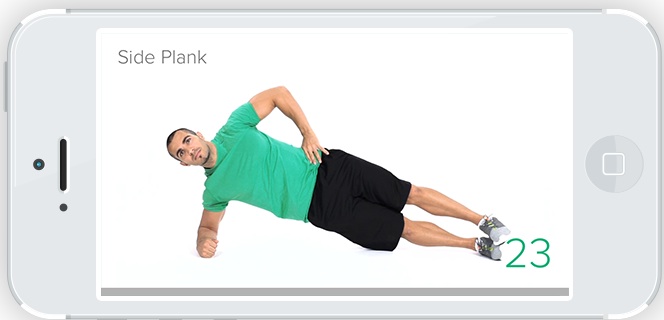
Get More Fit with Less Time and Equipment

There are few things that can reliably improve our health and happiness like regular exercise. But for many of us, exercise occurs as a chore–a boring, time and logistic intensive affair that we might have the same level of enthusiasm we would have for an all you can eat rice cake buffet. But the fact is we can get pretty fit in very little time with little or no equipment. A few months ago, I explained how you might be working out all wrong, focusing on duration rather than intensity of exercise. High intensity interval training (HIIT) is something I’ve practiced for the last several years, however I’ve almost always done it in a gym. But with two small boys occupying much of my free time, getting over to the gym, even for an hour, has been a far more complicated affair than days past.

Rather than totally resign myself to acquiring a “dad bod,” I decided to find ways of staying fit that didn’t require a round trip to the gym. The fact is there are many great exercises that involve little or no equipment or special spaces.

In the past, I wrote about the Seven Minute Scientific Workout app. The app and workout are solid (especially if repeated), but there’s not much variation in the workout. In my search for something more comprehensive, I discovered 12 Minute Athlete, a website that offers numerous HIIT workouts via Youtube videos, a free ebook and iOS and Android apps that guide you through simple, minimal or no equipment exercises and routines. There is also a subscription based intra-app training program called “Super Athlete.”

The workouts are not all 12 minutes; some are shorter, some a little longer and some are done to time, for example the first weekend of the month 12 Minute Athlete founder Krista Stryker puts out a 100 burpee challenge, which asks people to perform 100 burpees in as little time as possible (I’ve been a bit too chicken to take the challenge just yet).

I consider myself to be a bit above average fitness and I found that many of the exercises and routines, when done with proper intensity, were pretty challenging–a good thing if you’re looking to do a lot with little time. 

I emailed a few quick questions to Krista to ask her about her site and the philosophy behind it. Here’s what she had to say. 

David Friedlander: What motivated you to start 12 Minute Athlete?

Krysta Striker: I was one of those people growing up that never really considered myself athletic. Sure, I played team sports (basketball and soccer mainly), but I never really felt I was that great at them, and the moment I went off to college I pretty much stopped doing anything active at all and turned into quite the couch potato, assuming I was destined to be a bit pudgy and weak for the rest of my life.

Towards the end of college I was feeling pretty lost and hopeless with no idea of what to do with my life, and started exercising a few times a week partly because my mom told me it would make me feel better. It worked, and I surprised myself with my strength and how quickly I went from barely being able to do a single push up to working up to more difficult exercises like pull ups and triceps dips. I liked feeling strong, and my confidence levels skyrocketed in all areas of my life, which eventually led me to study for and receive my NSCA CPT certification [personal training].

At that point, I started working out for hours a day, diligently doing my cardio, weight training and sports-specific training every day until I was overtrained, injured, and had little time in my day to do anything else. But even though I was spending so much time working out, it felt like it was never enough.

That’s when I discovered HIIT training and everything I knew about fitness and exercise was turned upside down. Not only did I get leaner and fitter in a shorter amount of time, I got stronger and more confident than ever before. Before long, I was able to do feats of exercise I never before thought possible, such as handstands, pull ups, and completing 100 burpees in nearly six minutes flat—and still have the time and energy for a hike, bike ride or long walk later in the day.

It was after my own personal successes that I created 12 Minute Athlete so I could share these incredibly effective HIIT workouts with the world and help people of all fitness levels ditch their excuses and get in shape in as little time as possible.

DF: What would you say to people (like me) who are accustomed to going gym about doing app based workouts?

KS: Going to the gym is great if you enjoy it, but not everyone has the time, so doing app-based workouts like the ones in the 12 Minute Athlete app just give people more freedom to work out anywhere. You can still work out in the gym if you wish, but you can also work out in a nearby park, your apartment, or even a tiny hotel room if that’s all you have.

DF: Many of your routines are fairly advanced. what would you say to people looking to start out who might not be quite ready for a pistol squat [see below], pull up or burpee?
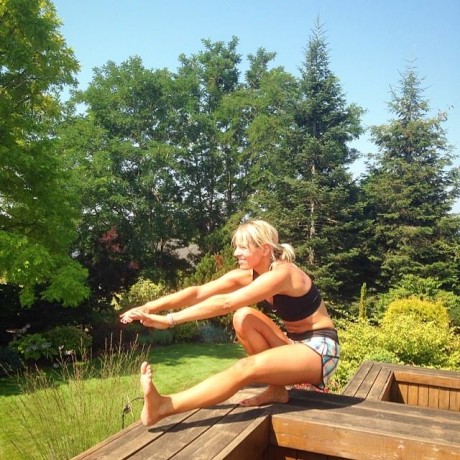
krista-pistol

KS: Everyone has to start somewhere! When I first started working out I couldn’t do a single push up, let alone a pull up or a pistol squat. If you can’t do a pull up yet, try flex hangs instead, where you’re simply holding onto a pull up bar for as long as you can to build up strength (it’s harder than it sounds!). The same goes for exercises like pistols and even push ups—simply find the hardest version of the exercise you can do now that still pushes you past your normal comfort zone. The key is to work as hard as you can and modify anything you need to in order to get started.  

See more at 12 Minute Athlete

Why You’re Probably Working Out All Wrong

When I was younger, my workouts were leisurely and mellow-tempoed: six to eight hours bike rides up the canyons around Boulder, CO, two to three hour workouts at the gyms, resting three minutes between sets and so on. These were days before work, marriage and children, days when I had the luxury of being inefficient. Today, I no longer have that luxury. I barely have three hours to sleep, much less ride my bike or hang out on the bench press for that long. But the funny thing is that today, even though my not-so-frequent workouts seldom last more than an hour, in many ways I’m in better shape.

What I know now that I didn’t know back then is that it’s intensity of exercise, not duration, that is the decisive factor in staying fit, strong and lean. A few years ago, I was introduced to (or rather I started incorporating) high intensity interval training, or HIIT. Most people know HIIT through Crossfit, the fitness craze conducted out of bunker-like gyms that involves high-intensity, short-duration calisthenics and olympic weightlifting. But the basic practice of HITT can be applied to any form of exercise. The core principle is to exercise in short, high intensity bursts, followed by short rest, then repeated. A HIIT workout often lasts less than a half-hour, but done right, can provide a better workout than a day spent on the treadmill.

NY Times Phys Ed columnist Gretchen Reynolds, one of the web’s more outspoken advocates of interval training, citing a study by a group of Canadian researchers reported “that 10 one-minute intervals—essentially, 10 minutes of strenuous exercise braided with one-minute rest periods between—led to the same changes within muscle cells as about 90 minutes of moderate bike riding.”

But low intensity exercise is not just a time suck–it might even be preventing weight loss. Studies by the European Journal of Applied Physiology have shown that when doing moderate-level cardio, our bodies actually learn to become more efficient in storing fat–a good thing when you’re out in the savannah with the nearest supermarket 15K years in the future, but pretty awful if you’re trying to shed a few pounds. They found that 20+ minutes of moderate cardio suppressed the hormone T3, essential for fat loss. It also increased cortisol and decreased human growth hormone levels, the former a fat loss inhibitor and the latter a muscle-producing inhibitor. No bueno.

None of this is to say that we should stop taking brisk walks, steady-paced bike rides and other moderate-level exercise we might label “cardio.” It is to say that that type of exercise alone is unlikely to lead to increased strength and weight loss or maintenance.

What should you do instead?

  • Get a timer and try to perform your exercise routine in a shorter amount of time than you normally do. If you go to the gym, take short rests between sets (I find less than 45 seconds best). If you’re a runner, throw some quick sprints into your mix to up the pace. Research has shown that even one minute of all-out exercise in an otherwise moderate half hour workout can produce positive physiological effects (note: a good indicator of intensity is elevated heart rate, sweat and being somewhat out of breath–or a lot if you’re able).
  • Try the 7 Minute Scientific Workout or similar routine that focuses on continuous, high-intensity exercise with short rest periods.
  • Try Crossfit, PX90, Insanity and other workouts that employ HIIT. They might seem like fads, but they are fads that will get you fit quickly. For safety reasons, this option is probably best for people who are reasonably strong already, but having a set routine can help wake up your body and get you out of any workout doldrums.
  • Get an app. I’ve recently started using the Tabata Timer. The Tabata Protocol is a four minute exercise methodology, where you have 20 seconds of high intensity activity followed by 10 seconds of rest, repeated eight times (i.e. four minutes). It’s hard as hell and pretty awesome. A quick scan through Apple’s iTunes store or Google Play reveal numerous apps focused on interval training–many of which can be done without any special equipment. Try one. What do you have to lose?

Whether you’re a youthful fitness god or greying couch potato–or some combination thereof–you can increase the intensity of your workouts. Start from where you’re at. It’ll not only make you feel better and make you trimmer, it’ll save you a ton of time.

Young man running image via Shutterstock

The Most Minimalist Furniture There Is

If you’re looking to de-clutter, streamline and create a home that feels open and minimal, Katy Bowman has a decorating tip: ditch the furniture. Katy, her husband and two children, ages 18 months and three years, have a home almost completely free of any furniture whatsoever. Their choice is less aesthetic than physiological. The Bowmans are consultants specializing in biomechanics which, according to Katy, is “the study of living structures (I study the body) and how the forces created by and placed upon them affect how they work.”

Their premise–one we’ve touched on when writing about using standing desks–is pretty straightforward: the human body and physiology did not evolve to sit on its ass nine hours a day. We are a species, like most, designed to be on the go more often than not. Bowman explains her choice in an interview posted on the SlowMama Blog:

I understand the relationship between musculoskeletal function and the immune system, bone robusticity (density and shape), and functions like digestion and breathing. Having furniture isn’t an option for us [her family], in the same way a cupboard full of junk food isn’t an option for many others. Furniture creates a development-crippling environment in that the stuff literally shapes our body, both in the now and in the future.

In their home, the Bowmans do have some “furniture”: some cushions on the floor, a low, traditional Japanese-style table and some mattresses. Katy says of the mattresses, “both my husband and I prefer the floor, and we noticed our kids sleep better on the ground as well, so we’ve just started phasing the beds out.” And they don’t even use the table, preferring to spread out their food on a platter placed on the floor middle-eastern style. Unlike many homes, the Bowmans have an indoor monkey bar set for the boys to play on.

monkey-bars

Their motivation to go furniture-less is health-related, but Katy does note the ancillary benefit that her home is “less cluttered, easier to clean, and instead of needing to go to yoga class for permission to get on the floor and sit cross-legged or do a twist, I do these things way more often.” She adds:

This makes all of us happier in general: As a kid, I dreaded all the chores I had to do, like dusting, simply because my mom liked lots of knick-knacks. Living on the floor has made it easy for my husband and I to stay strong and flexible because we’re essentially getting our “workout” all day long, in short and easy doses. It’s perfect for a working and stay-at-home mom and dad who, frankly, don’t have time to drive for 90 minutes to do something for an hour.

We think the Bowman’s choice an interesting and compelling one–one that is a significant deviation from conventional thinking. They beg the question, “what if the best designed furniture was no furniture at all?”

Read the full interview with Katy Bowman on SlowMama and find out more about Katy on her website.

Get Fit in 7 Minutes Flat

The combination of a recent move, a succession of junk-food-filled holidays and an unusually harsh winter have wreaked havoc on this author’s exercise regime and fitness level. A couple weeks ago, I ran across an app called Quick Fit, which promises mobile-ready fitness in a mere seven minutes. After two weeks of contemplation, I finally took this short journey to a better body.

The app’s workout was called the “scientific 7-minute workout” by NY Times and was developed by the American College of Sports Medicine. The routine is based on the growing body of evidence that suggests intensity, not duration, is the key to improved strength and cardiovascular fitness.

The workout includes all the staples of unweighted exercise: pushups, crunches, lunges, plank poses, etc. The only piece of equipment is a chair. While some of the exercises might prove challenging to some, they can all modified for less intensity: bent knee pushups and planks, partial lunges, etc.

Again, the key to the workout is intensity. Each of the 12 exercises last 30 seconds with only a 10 second rest. I consider myself moderately fit, and by the middle of the workout my heart-rate had noticeably increased. Had I pushed myself harder, it would have been all the more effective. Adding one or two circuits would have made it an even more complete workout and still kept the duration quite short.

The app has a nice clean interface with a semi-robotic looking personal trainer doing the exercise along with you. It has an exercise tracker and voice prompting, which can be turned off. The app costs 99 cents on iTunes. There’s an ab workout that costs and additional $1.99 (all a lot cheaper than a gym membership). There is also a free web-based version (above) if you want to give it a try or just plan to do it on your desktop.

A quick search after I made my purchase shows that there are a number of similar apps, many of which are free.

While many, author included, actually enjoy exercising, sometimes we don’t necessarily do it with the utmost efficiency. Likewise, our routines often get derailed–we’re away from our park or gym, we are particularly busy, etc. Quick, intense workouts like the one Quick Fit provides can both streamline our normal routines and provide an easy way to maintain fitness when time and circumstances are less than cooperative.

via Swiss Miss

Get Rid of Your Gym Membership, Naturally

Way back in the day exercise wasn’t an activity, it was life. Foraging for root veggies and tracking gazelle all day are not for the soft-of-belly. But the last 10-15K years of civilization have all but eliminated these types of grunt-inducing tasks whose performance was once required to survive. To compensate for this missing activity, we now find ourselves in climate-controlled rooms lifting heavy pieces of cast iron and spinning our legs in ellipses.

At least one Frenchman thinks this ain’t right. MovNat, an exercise philosophy and system created by Erwan Le Corre (the ripped dude up top), is, according to its mission, out to “revolutionize physical education and fitness on a global scale by teaching a real-world physical competency and conditioning system based on natural human movement skills, to support a lifetime of physical activity” (it’s a workout just reading that statement).

Le Corre et al call our modern world the “human zoo”, a place where technology, social conventions and commercial pressures have led to human disconnection “from the natural world and…universal biological needs” (tough to argue with him on that one). This zoo leads humans to mistakenly believe that chronic pain, obesity, depression, frequent illness and lack of vitality are conditions that are “normal and unavoidable.”

MovNat promulgates detailed philosophical, dietary and exercise principles designed to counteract the zoo human condition and return us to state of physical, mental and spiritual equilibrium.

MovNat offers a number of ways to practice. There is the MovNat website, which is filled with a bunch of good info. They offer intensive retreats held around the world. There are certification courses if you want to be a MovNat instructor yourself. They also offer free Movements of the Day (MOD), which run you through a series of movements based on their 13 MovNat Movement Skills; these include walking, running, jumping, balancing, crawling, climbing, swimming, carrying, throwing, catching, and combative skills like striking grappling–in other words, all the things humans used to do to survive. Equipment, if you can call it, are things like trees, boulders and human bodies (Live ones. For carrying or grappling with).

While this author has not done any official MovNat activities, I have participated in my local MovNat Meetup (I found a bunch on Meetup’s site). It’s a lot of fun and helped me shed my feeble attempts to look like a grownup; it is hard to take myself too seriously whilst bear crawling across a field and climbing trees at my local park.

Even though it appears as though MovNat’s is trying create a commercial juggernaut similar to the popular CrossFit, its programs still provide a lot of good stuff. It’s a cohesive and logical workout system that is infinitely portable and requires no gym or special equipment. If it helps the zoo human escape his cage, all the better.

Fidget Your Way to a Leaner, Longer Life

If you there was a simple, minimal-effort action that took ten minutes once an hour to do, one that added two years to your life, prevented several major diseases and kept you trim without any diet modifications, would you do it? As you might have gathered from the title of this post, there is an action, or rather actions and they are standing and/or fidgeting. A segment on NBC’s Rock Center news program that interviewed Mayo Clinic obesity expert Dr James Levine explained the myriad health dangers posed by remaining sedentary too long and the benefits of constant movement.

Visit NBCNews.com for breaking news, world news, and news about the economy

Of the dangers, Levine says prolonged inactivity leads to reduction in insulin effectiveness, an increased chance of developing Type 2 diabetes and even fat and cholesterol levels rise.

Unfortunately, all-day sedentariness is an equal opportunity killer, affecting everyone from couch potatoes to ultra-marathoners, as Levine explains:

Being sedentary for nine hours a day at the office is bad for your health whether you go home and watch television afterwards or hit the gym. It is bad whether you are morbidly obese or marathon-runner thin. It appears that what is critical and maybe even more important than going to the gym, is breaking up that sitting time.

Last year, we read how people who sat less than three hours a day lived on average two years longer than their seated counterparts and how sedentary behavior increases risk of certain cancers. This segment and Levine’s testimonial–given during an interview conducted on a treadmill–just provides more reasons to stand up for your health.

While sitting is an easy thing to blame for poor health, it doesn’t tell the full story. The segment show that it’s inactivity–seated or standing–that is the real enemy. To demonstrate this, the segment followed three women–the news anchor, a tv producer and a restaurant manager–and monitored their movements via sensors for a 24 hour period, including a workday. Interestingly, the tv producer, who thought she spent too much time at her desk in front of a monitor, was more active than the restaurant manager, who spent her workdays standing. The producer’s activity was attributed to constant fidgeting–crossing legs, going to the trashcan, etc. Meanwhile, the heavier set restaurant manager, while standing all day, showed lower intensity of activity. This lends itself to Levine’s finding that shows lean people tend to be active 2.5 hours more a day than obese people (though the restaurant manager was far from obese).

The segment does acknowledge the role genetics and diet play in keeping people thin, but it also makes the fairly universal claim that sitting and remaining sedentary shuts down our metabolism, or as Levine says, it “is like sort of owning a really cool sports car and letting it idle all day long.”

What to do? Levine would certainly recommend one of his treadmill desks, which keeps you constantly on the move. We’re not sure if this contraption is ideal for micro-apartments, so we might suggest a standing desk instead. Another one of his suggestions is to spend at least ten minutes of every hour not sitting and active. And we might add that when you are sitting, don’t be afraid to fidget.

Edit Your Workout with a Tabata Burpee Set

While there are some of us that relish working out–the chance to flex muscles, purge pores with sweat, gulp down air–there is surely an equal or greater number of us who do not enjoy it–who do it to keep weight off, keep some muscle tone, to offset an otherwise sedentary lifestyle. For the latter category, the question becomes how do you do as much good for your body as efficiently as possible? There is a one word answer for that question. It’s burpee.

A burpee is a single exercise that involves a squat, leg thrust, pushup and jump. Watch the video above to see it performed. It works every upper and lower muscle you have in one continuous–and grueling–calisthenic motion.

No equipment or gym required.

Think you’re not strong enough. Think again. There are a million variations to cut intensity: Do bent leg pushups, use a chair to reduce the depth of squat, do your pushup against a table, don’t jump…you could literally make a nonagenarian adapted  burpee (see one example of modified burpee below). There are also a million ways to add intensity.

One of the ways to truly maximize your burpee experience is to use the Tabata method. Tabata, named after Olympic trainer Izumi Tabata, is a form of high intensity interval training (HIIT), that requires 20 seconds of maximal effort, followed by ten seconds rest. You repeat this exercise/rest set eight times. Four minutes and you’re done.

One study (Gibala et al) showed that 2.5 hours of HIIT training had the same muscular and endurance benefits of 10.5 hours of specific endurance training. Another study reports that HIIT exercise is better at burning fat than aerobic exercises. (Note that HIIT can be performed with virtually any exercise and Tabata is just one form of HIIT.)

All of this runs counter to our aerobic-centric exercise world, where gyms are lined with elliptical machines and treadmills. Don’t get us wrong, aerobic exercise is great, and walking is still probably exercise supreme. But if you want to get stronger and leaner faster, nothing beats HIIT like Tabata. And if you want a complete exercise, few things outside of waterpolo do it like the burpee.

A proper warmup like a brisk walk, jog or jumping rope is highly recommended when doing HIIT to avoid injury. If you have health concerns, consult an expert. And consider adding something like a Tabata burpee set to your existing routine (maybe swap it for a cardio session) rather than replacing it altogether. See how it goes.