Improving a Classic

While the world can’t seem to get enough gadgets–smartwatches, fitness trackers, posture regulators–there’s a lot to be said for basic stuff done right. And few items are as basic as cast iron skillets. They distribute heat perfectly. A well seasoned one gives near stick free performance without you daily dose of vitamin T (Teflon). But cast iron skillets are heavy and some have rough cooking surfaces that make them less stick resistant and harder to clean. A Kickstarter project called the Field Skillet setting about addressing some of these issues in pursuit of crafting the ultimate cast iron skillet.  

The Field Skillet is a svelte (for cast iron) 4.5 lbs–lighter than a 13” Macbook Pro. The makers say it’s the minimum weight they could make it while retaining the heat distribution properties that make cast iron so loved as a cooking tool. Part of the weight savings is attributable to the fact that it’s been polished and machined to have a smooth surface, which improves cooking performance and makes cleaning a breeze. They say the pans will come pre-seasoned and pass the fried egg test.

The 10.5” outer diameter and 9” cook surface is designed to be big enough for most purposes, but not so big as to crowd out other burners. The skillet is made in the US out of 75-90% recycled iron and carries a lifetime warranty (not sure what could go wrong with a cast iron skillet, but can’t hurt we suppose).

We could go on about its features, but at its heart, the Field Skillet is a simple tool designed and made as well as it possibly can be. It’s a formula that seems to work very well on Kickstarter. Field Company, they firm behind the project, set out with a $30K goal to start up production. As of this writing, they’ve raised $1.4M. You can still order one of their skillets for a $90 pledge. Delivery is projected for next January. Visit their campaign page for more info.
Cooking and Dining Kit with the Minimalist in Mind

The LifeEdited apartment could do seated dinners for 12, made possible by the Resource Furniture Goliath Table. While having the capability to entertain so many guests is remarkable, it is hardly normal for most people who live in small homes. On a day-to-day level, these people dine alone or with a couple other people at most. For them, having cooking and dining sets for more than a few people is more burden than luxury. What they need is a few staple items that can do double and triple duty and store compactly–exactly the idea behind K T C H N, “a concise kitchenware set designed for the challenge of small space living,” according to designer James Salisbury.

K T C H N was actually Salisbury’s master’s thesis project. He has this to say about the cooking and dining set:

Inspired by the minimalist movements, it focuses on combining effective use of space with sufficiency in selection of items, this set promotes a simplistic, efficient lifestyle. K T C H N contains a select cooking set for two. The product range allows gradual adaptation to more efficient small space living through the use of fewer, multipurpose items.

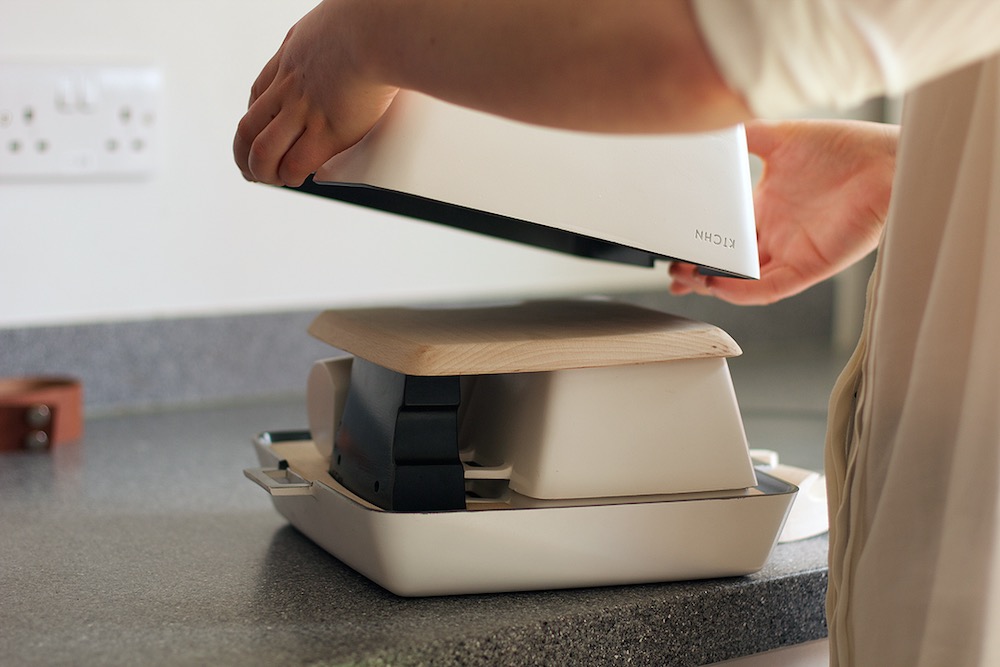
Most of the items in the compact unit are made of ceramic enameled stainless steel, so they can be used for dining or cooking. In the kit are two plates that also act as pan lids, two bowls that can be used as pans, a large sauce pan, a frying pan, two ceramic cups, two maple cutting boards and two maple removable handles for the pans and lid. Also included are two portable induction hobs, aka burners. All of the items fit together to make a portable unit that is held together by a leather strap.

The whole unit is very elegant and I like the fact that the plates and bowls can be used to cook as well, though I think if I were to use K T C H N at home, I would rarely strap it together. One of the best applications I can see is using the set in a very space deprived setting like a tiny house or RV. It has all the functionality and efficiency of a camping cook-set, but the heft, durability and design of something meant to stay at home.

If you’re wondering, Salisbury has no immediate plans to put K T C H N into production.

Eat, Strain and Store in One Bowl

Are you a big consumer of ramen noodles? Are you frequently miffed that there isn’t a simpler way of making this simplest-of-preparation foods easier to prepare? Yeah, me neither…but I still think a new product called the OneBowl is pretty genius.

The OneBowl is the brainchild of recent college grad Justin Herd, a frequent v of ramens and budding inventor. He was frustrated that it took so many components to prep a bowl of ramen: bowl, strainer, storage container (where applicabl vce). He wondered if there might be a simpler, more streamlined solution, one that combined those three components in one elegant (well “practical” might be a more apt term) solution. The OneBowl is his answer to that question.

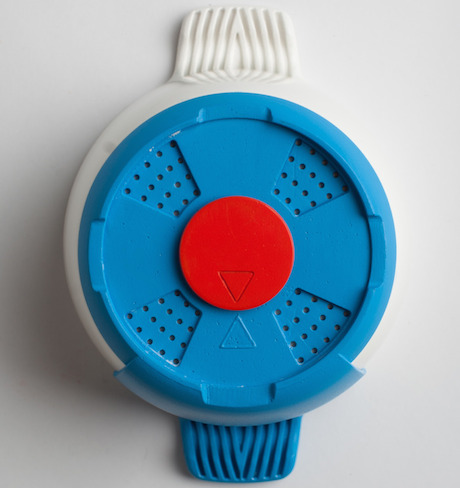
The OneBowl has three components. There’s a base that, when twisted, allows for the passage of water through the bottom acting as a strainer; alternately, the base can be locked out making it a water-tight bowl. There’s a BPA-free, dishwasher and microwave-safe bowl, also perforated to match the holes of the base, which is used for both food prep and eating. Lastly, there’s a lid that makes the whole thing into food storage.

OneBowl-base

The OneBowl is designed for ramens, but I’d imagine it would work great for other types of pasta, vegetables or even things like grapes, which often need to be rinsed in a strainer then transferred to a bowl. Besides dorm rooms (its most logical application) we think it’d be brilliant on camping trips.

Like many products worth having nowadays, the OneBowl is launching through Kickstarter. Herd is looking to raise $50K to start up production. They still have a $16 early bird special that’ll fetch you a OneBowl. $75 will get you a bowl and OneBowl cookbook.

We love stuff that doubles and triple duties, especially when that stuff is as simply executed as the OneBowl. Should it take off, we hope Herd considers making metal or ceramic versions that’d work on cooktops and ovens for the non-ramen set.

6 Tips for Creating an Edited Kitchen

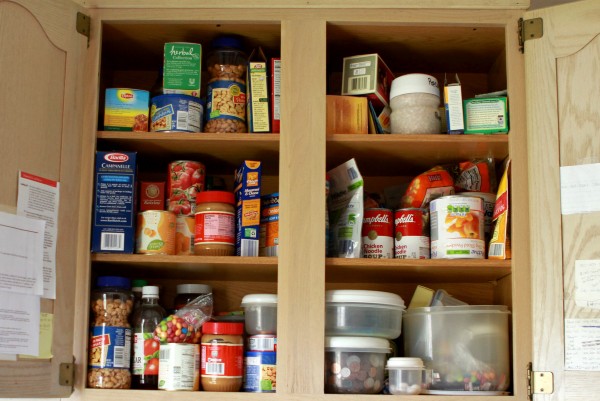
When we think about clearing out excess stuff, we tend to think about durable goods like clothes, electronics, furniture and so on. A cassette tape player we haven’t used in 15 years is an easy target for excision and reducing clutter. But there is another, more edible source of residential overcrowding: food. We might be far less likely to get rid of those 15 year old canned peaches crowding our pantries than we are the cassette player. We say to ourselves, “I might eat that someday.” But do we?

Many modern fridges, cupboards and pantries buckle under the strain of excess food stocks–food that takes up valuable household space; food that uses resources and money to produce and purchase; food that often gets tossed after a long, uneventful stay in our kitchens. Consider these food facts:

  • It’s estimated that 40% of America’s food supply ends up in the trash.
  • 10% of greenhouse emissions from developed countries is generated by the production of food that is never eaten.
  • According to the USDA, “In 2008, the amount of uneaten food in homes and restaurants was valued at roughly $390 per U.S. consumer–more than an average month’s worth of food expenditures.”
  • According to ABC news, between the years 1974 and 2004 the average American home’s kitchen doubled in size from 150 to 300 sq ft.

Cutting down on food waste can make it easier to live in a smaller space, reduce clutter in any kitchen, save money and reduce our carbon footprints. It may even improve our health. If you’re interested in editing your food stock, here are a few tips.

  1. Buy only what you need. This is a pretty obvious one, but try to buy the food and the quantities you know you’ll consume from one shopping trip to another. It’s okay to have an empty fridge before you go shopping. If feasible in your area, make more frequent, smaller shopping trips.
  2. Avoid “precious” food. How many times have you bought special cheese, meat, heirloom tomatoes–whatever–and waited to use it for a special occasion, only for that food to end up rotting? Have a plan for your food–either eat it at an appointed time or immediately. Food spoils. Make every day a special occasion.
  3. As a rule, try to purchase most food from the perimeter of the grocery store. Grocers put all of their perishables–fruits, veggies, fresh meat, dairy–on the outside of the store. Aside from their greater nutritional value, perishables have a finite amount of time you need to consume them, creating an urgency for consumption. On the other hand, food from the store’s interior can sit on their (and our) shelves for millennia–food that is often bereft of nutritional value or filled with preservatives. Real food goes bad. Eat more real food.
  4. If you’re trying to get rid of food you already have, create recipes using existing food and schedule meals. If you need to buy extra ingredients, go ahead, as long as it doesn’t add another wave of new, unused food. Not sure what to make? Try the Su Chef app. If there is food you’re sure you’ll never eat, drop it off at a local shelter.
  5. Compost wherever possible. Many local green markets and community gardens have drop off compost bins. Put food scraps in your freezer between drop offs to avoid bugs. Consider your own composter such as the NatureMill automatic composter used in the LifeEdited apartment.
  6. Don’t be afraid to toss. If something is not fit for eating, giving away or even composting, don’t be afraid to toss it. This is especially true of junk food. Some food is healthier in the trash bin. Just resolve to not buy the same stuff again.

image credit My Cooking Magazine

This Valentine’s Day, Become Smitten with Your Tiny Kitchen

This week we’ve looked at a couple teeny-tiny kitchens: Kitchoo’s modular, plug-and-play kitchen as well as Boston’s micro-unit mockup with its wisp of a prep area. Many of us who cook regularly might see these micro-kitchens and think them suitable for removing takeout from plastic bags, but little else. Well, Deb Perelman might have something to say about that.

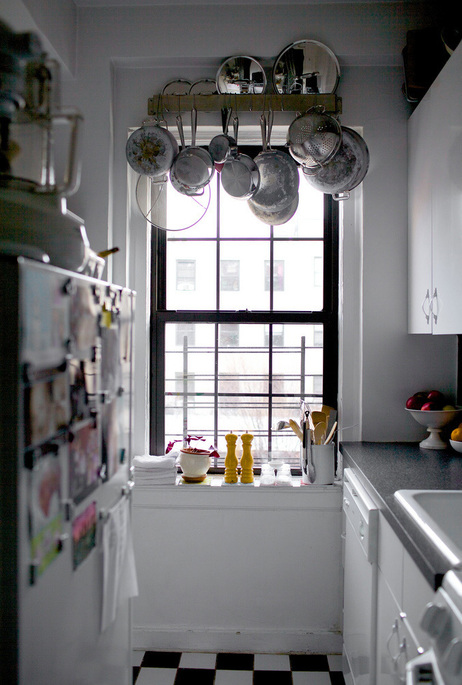
Perelman is the brains and brawn behind, Smitten Kitchen, who is, “Fearless[ly] cooking from a tiny kitchen in New York City.” From her 42 sq ft half-galley, single countered, tiny oven-ed, minimally-equipped kitchen, she whips out dishes like pancetta, white bean and chard pot pies and swiss chard and sweet potato gratin. She has hundreds of recipes spanning many different categories–from breakfast, dessert, veggie and meat. She also has a book.

Perelman is not a trained chef, but rather someone who loves to cook and creatively works within the contraints of her home’s kitchen.

We thought in honor of Valentine’s Day we’d offer Perelman’s “44-Clove Garlic Soup,” a simple soup recipe from her “budget” collection made of ingredients most cooks will have on hand. We thought it was a recipe that, after consumed, says to your beloved “I’ll love you no matter what.”

garlic-soup-deb-perelman

Serves 4

  • 26 garlic cloves (unpeeled)
  • 2 tablespoons olive oil
  • 2 tablespoons (1/4 stick) butter
  • 2 1/4 cups sliced onions
  • 1 1/2 teaspoons chopped fresh thyme
  • 18 garlic cloves, peeled
  • 3 1/2 cups chicken stock or canned low-salt chicken broth
  • 1/2 cup whipping cream
  • 1/2 cup finely grated Parmesan cheese (about 2 ounces)
  • 4 lemon wedges

Preheat oven to 350°F. Place 26 garlic cloves in small glass baking dish. Add 2 tablespoons olive oil and sprinkle with salt and pepper; toss to coat. Cover baking dish tightly with foil and bake until garlic is golden brown and tender, about 45 minutes. Cool. Squeeze garlic between fingertips to release cloves. Transfer cloves to small bowl.

Melt butter in heavy large saucepan over medium-high heat. Add onions and thyme and cook until onions are translucent, about 6 minutes. Add roasted garlic and 18 raw garlic cloves and cook 3 minutes. Add chicken stock; cover and simmer until garlic is very tender, about 20 minutes. Working in batches, puree soup in blender until smooth. Return soup to saucepan; add cream and bring to simmer. Season with salt and pepper.

Divide grated cheese among 4 bowls and ladle soup over. Squeeze juice of 1 lemon wedge into each bowl and serve.

Do ahead: Can be prepared 1 day ahead. Cover and refrigerate. Rewarm over medium heat, stirring occasionally.

Photo credit: Deb Perelman