The Unbearable Lightness of Tiny Living

Each week we are profiling real people who are editing their lives for more freedom and happiness. This week we hear from Jan, who lives in 98 sq ft tiny house. He shares his experience about the freedom of tiny, lightweight living as well as the difficulties of meshing different attitudes about stuff and space in relationships.

Tell us about yourself

My name is Jan. I am 45 and work as a photographer and videographer. I am separated with a 3-year-old boy.

My parents, both children in Germany during the WWII, instilled a non-consumptive, credit free life-style. They modeled buying quality over quantity and only paying cash for what you can afford.

Later, I backpacked for several years, and all through my twenties and early thirties never paid more than $100 rent per month. I learned to build and built my own shelter, or did work-trade for rent. For years I kept my possessions down to what would fit in the back of a small pick-up truck.

In my late thirties I fell in love with a beautiful woman who lived an unedited life. Stuff gave her a sense of security. Clutter was her art form. For six years and through the birth of our son, we tried to blend our lives, but could not. Accepting neither of us would change, I built a 6×9 foot shack in the backyard and moved out. We get on much better now.

What makes your life an ‘edited’ one?

I’ve always been self-employed, so I’m very aware how much effort it takes to earn each dollar. Not believing in credit, each purchase I make is a conscious decision. How much of my life does it take to afford this thing? I’m also aware how much effort is required to own stuff. Where to store it? How to store it? How to care for it? Unnecessary stuff and clutter simply makes my anxious. But that’s not to say I’m non-materialistic. I would argue that I’m hyper-materialistic. I love the look, feel and function of something well made that fits my life perfectly. A pair of shoes I wear every day. Two sharp kitchen knives. A bicycle. A camera. All these things, carefully chosen gives me great pleasure to buy and use daily.

How long have you been living this way, and do see yourself continuing to live this way?

I have always had a minimalist bent, but lately have been refining it with far more awareness. It merges many divergent interests, from macro and micro-economics, environmentalism, self-sufficiency, spirituality, design, art, parenting, and how we will make it as a species in a shrinking world. Presently, how I live is a personal choice. In the future that choice may be forced upon us.

What are the biggest advantages of living this way?

A profound sense of lightness in the world. Every time I discover a way to live more essentially, I feel a surge of freedom. When I refine an elegant solution to a vexing problem, I gain great pleasure each time I engage with that solution. Something as basic as placing a hook into a wall so I can hang my bag and not trip over it on the floor. Or building a composting toilet for a few dollars and taking personal responsibility for my own waste. Or lying in bed at night in a loft that fits me just so. Watching the moon rise and stars turn because I deliberately placed the windows in these precise locations. Or each month doing my bookkeeping and seeing my savings increase to a point where I could live comfortably without working for a few years. And not because I earn a lot of money, but because I have learned how to spend wisely.

What are the biggest challenges?

Trying to meld a minimalist lifestyle with someone who does not share the same interest. It is an exercise in futility and frustration. I had to learn to accept that I can neither change someone else’s life nor repress my own nature.

For families, how has this lifestyle affected the other members of your family?

Thankfully I have a young son who stops me from getting too anal. He helped build the shack and feels it is his as much as mine. He comes and goes as he pleases with his toys, muddy shoes and dirty fingers. I let him climb up ladders, on counters, light stoves, play with tools and knives, and in doing he learns respect, consequence and body awareness. He teaches me to let go and lighten up. If he breaks something we fix it together. If he gets something dirty, we clean together. After all, it’s just stuff. What’s essential is the respect between us.

In terms of partnerships, I think a minimalist lifestyle only works both partners already live this way. I also strongly believe in a shack of ones own. My home only cost me $5000 and three months of work. I’d rather help build a partner their own home than try to blend two incompatible lifestyles together.

What is the number one suggestion you’d give to someone looking edit their lives?

Read the book “Your Money or Your Life” by Vicki Robins.

What item(s) have made your lifestyle easier?

A good bicycle, good tools, a few comfortable clothes that fit well and can be worn in different settings.

Do you have any design or architectural suggestions derived from your lifestyle?

Consider curved rafters. That simple architectural detail made all the difference in turning my loft from a cramped triangle into a spacious cocoon.

This post was originally published November 28, 2012. 

Korean Designer’s Simple Solutions for Ditching the Fridge

Refrigeration for small kitchens can be tricky. Typically, you have your choice of a humongous full-size fridge or tiny dorm-room model. The former tend to be around 80″ and the latter 30″. Often people trying save space opt for the smaller one, whose size, if you cook a lot, is maxed out quickly.

In the quest to preserve perishables, the question may not be how to increase refrigeration capacity, but how to do without it. An article in Treehugger shows Korean designer Jihyun Ryou‘s systems for preserving food without refrigeration.

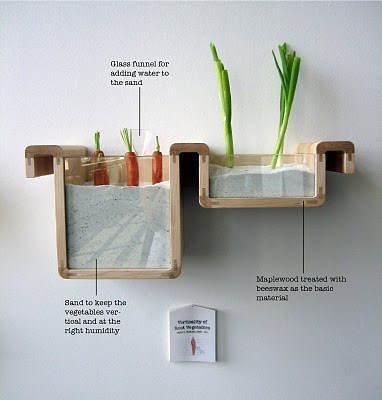
Many of her solutions are designed around how perishables actually behave–behavior that often runs counter to our suppositions about the need for refrigeration. For example, many fruits release ethylene when they ripen. When we put them in a refrigerator’s sealed box, it actually traps the ethylene and accelerates spoiling. Accordingly, Ryou’s apple storage system exposes apple tops to the open air so they release ethylene. The ethylene serves the other purpose of preventing sprouting in potatoes, so the bottom half of the apple faces a dark box where potatoes are stored.

According to Ryou, “keeping roots in a vertical position allows the organism to save energy and remain fresh for a longer time”–so she puts carrots and scallions in wet sand to keep them vertical and maintain optimal moisture.

Americans are about the only people who refrigerate eggs; Ryou’s egg storage leaves them out and features a bowl to submerge eggs to test their freshness (a fresh egg will sink).

In days of yore, necessity dictated that people learn how to preserve food without refrigeration. While refrigeration is a great thing for many varieties of food, there are many instances where traditional food preservation techniques are equal or superior to refrigeration. Now Ryou gives these techniques a modern spin. She shows how a dorm fridge might suffice for even the most ardent gourmand.

Do you have other suggestions for doing without refrigeration? Let us know.

This post originally published June, 5 2012.

Via Treehugger

Image credit Jihyun Ryou

Is Your Home Just a Place to Store Stuff…While You’re Getting More Stuff?

In this lecture, philosopher George Carlin expounds on such topics as the meaning of life (A: finding a place to put our stuff) and the nature of residential architecture (A: creating a place to put our stuff). He even makes the bold declaration that if we didn’t have so much [expletive] stuff, we wouldn’t need homes. We “could just walk around all the time.”

In this it’s-funny-because-it’s-true riff, Carlin highlights how our lives are often centered around the stuff we accumulate, begging the question: what would your life look like without so much stuff? If you had less stuff, could you have a smaller, more manageable, less expensive home? With that less expensive home, might you be able to choose the type of work you want rather than the type needed to afford the house and all its stuff? Might you have more savings and free time? As Tyler Durden from “Fight Club” puts it, might the stuff that you own, own you?

What do you think?

This post originally was originally published in March 2012.

3 Principles from Burning Man for Living An Edited Life

Unless you’ve been living under a big, not-so-black rock, you know at least something about Burning Man. Beginning the last Monday in August in the desert of northern Nevada, the week-long extravaganza has become synonymous for all things crazy and spontaneous.

But underneath the irreverence and incomprehensibility are lessons we can all take home–lessons that make life simpler, more functional and happier. Here are a but a few:

  1. Use what you need.  You think different about consumption when you have to port a week’s worth of stuff in and out of the desert. Ask yourself, “What if I had to pack everything I needed to live for a week into a car?” Would you take that apple peeler or might you use a pocket knife? On the other hand, we might decide that we can’t live without that 104 ft effigy. This use-what-you-need principle also applies to the amount of space we need. Personal space is a joke at BM, yet people live joyfully together. This is not to suggest we give up personal space altogether, but it might suggest that we often put too high a premium on it and undervalue personal connection via physical compression.
  2. We have what we need when we share. Burning Man is almost totally non-commercial, relying on a “gift economy.” People exchange food and wares (and many other things) without a single dollar changing hands. Back at home, your neighbors might get sick of you mooching dinner every night, but they might not mind lending you their muffin pans or power drill. Sharing enables human connection and less stuff to be used more.
  3. Architecture is anything you want it to be. You don’t necessarily want to live in a 120 ft hexagonal temple, but looking at the Burning Man structures shows that anything is possible with a little imagination. We are not bound to particular architectural rules and orthodoxies. We can create where and how we want to live in the future.

Are you a Burner? What have you learned from BM that makes your life simpler and happier?

image via JoJo Electro

This post was originally published on April 20, 2012  

Save Time, Be Happier, Eliminate Choices

Thewirecutter.com is an electronics buying site that presents what they consider the best option for various categories. You want a laptop? Buy a Macbook Air 13″. Want a cheap digital camera? Buy the Panasonic Lumix DMC-SZ7. And so on.

The site runs counter to the notion that more choices leads to more happiness. Whether we’re choosing a TV, car, job, home, husband or wife, there’s an assumption that more options means we can get the thing that’s just right for us. When we have that right thing, all of problems will disappear.

But what happens? There are 30 different 30″ flat-screen TV’s at the same price; 10 mid-sized sedans, all about the same price and performance; several attractive partners. Because there’s such a bounty of options, many of us get what is called analysis paralysis (also called option or choice paralysis). We either make no choice at all or take ages to choose. When we do choose, we are often beset with doubt, wondering whether we chose the right thing. In this way, more choices can lead to wasted time and misery, not a trouble-free, tailor-fit, happy life.

This phenomenon was made popular with Barry Schwartz’s book and subsequent TED talk called the “Paradox of Choice: Why More is Less.” In a nutshell, Schwartz asserts that the myriad choices modern life presents us more often lead to anxiety than liberation.

This phenomenon holds true even when the increased choices do deliver a better, more personalized product. In his TED talk, Schwartz uses fitted jeans to demonstrate the paradox of choice. Sure, the newer, tailored jeans fit better than the stiff, ill-fitting, one-size-fits-all variety of his youth, but the amount of time spent finding the new variety, the amount of mental energy used choosing them and the amount of money spent paying for them undermines, if not negates, their benefits. In other words, psychological expenses often outweigh material gains.

In the ever-changing, option-laden world of electronics, The Wirecutter is a great tool for sparing yourself from analysis paralysis. The items are curated by expert reviewers who do a ton of analysis and know this stuff way better than most of us. They do present alternatives in case their main suggestion is way off base for a particular user.

The fact is that with any choice, there will be multiple “right” choices. An iPhone or a Galaxy S III will both ably fulfill your smartphone needs. There is no one right choice. At a certain point we must accept opportunity costs and make the best decision based on the information we have at our disposal.

Are you confronted with a choice? Here are a few suggestions to avoid getting trapped in vicious choice circles:

  1. If what you currently have works, consider staying with that. Sometimes the best choices are the ones we already made. Like a particular type of shoes? Get another of the same type. Like your laptop, get the newer version. Sure, there might be better ones out there, but finding them might be more trouble than it’s worth.
  2. Consult the experts. If you don’t know what to choose, find a reliable, robust source of data like The Wirecutter or Consumer Reports. Amazon reviews can be helpful, though not always; be sure to check out the one and two star reviews to see why people don’t like something. Remember, nothing will ever be perfect.
  3. Decide a set amount of time you have to decide. This is important. Sure, bigger decisions might require more time. You might wait more than a week to propose to that girl. But eventually decisions must be made.
  4. Make a choice and live with it. As with any choice, there will be better options we can’t make for whatever reason (insufficient information, finances, etc.). All we can do is make the best choice we can in the moment and get on with our life. Often the best choice is the one that is made.

Via PSFK

This post originally posted October 24, 2012

6 Questions to Ask Yourself Before Doing Anything

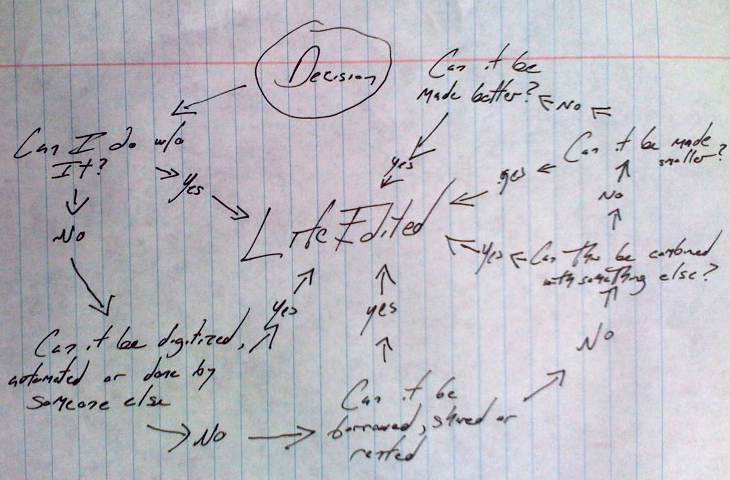
Life involves decisions: left or right, black or white, big or small, to be or not to be. While we don’t want to be too prescriptive as to what constitutes a “LifeEdited” decision consistent (it looks different for different people), we have some fairly universal questions to ask yourself when in decision mode.

Below are 6 questions that work for almost any decision–whether it’s about tasks, purchases, work, recreational activity, etc.

Note: the questions are sequential; if you answer yes to one question, you don’t need to answer the following ones. For example, question #1 is “Can I do without it?” If you answer “yes”, then it’s pointless to ask the following questions because there is no longer and decision to make.

Here they are:

  1. Can I do without it? This should be the gatekeeper for all decisions. Nothing simplifies like elimination. Do I really need this? Do I really want this? Do I really have to do this? Look at the full picture, e.g. you might want a Porsche, but don’t want to pay for it. You might want an opulent lifestyle, but don’t want to work so hard to get it. Doing without leaves us less to maintain, manage, clean, pay for, and so on. It also allows us to pay closer attention to the things we can’t do without.
  2. Can it be digitized, automated or done by someone else? This question removes spatial or temporal volume from our lives. You might need an item or something done, but ask if it can take up less space and time. Can your old tax returns be put on PDF’s? Can your bills be put on auto-pay? Might you be better off hiring someone to fix the toilet than doing it yourself? Our lives are often lost in teaspoons–small purchases and tasks that eventually create great mounds of clutter and confusion. Seize every opportunity to reduce volume.
  3. Can it be shared, borrowed or rented? For most of the 20th Century, ownership was the aim. But today, there are many great ways of accessing and using without the burden of owning. Ask yourself, is it totally necessary to have fulltime possession? If you only need a car once or twice a week, might it make more sense to use Zipcar rather than keeping a car on standby? Can you borrow a dress for that event? Possession requires maintenance, storage and money. Some things are worth that price. Many are not.
  4. Can this be combined with something else? Can that table also be my desk? Can I get a Murphy bed instead of a traditional one? Can I pick up my laundry and groceries? If we’re going to get or do something, why wouldn’t we make it as efficient as possible?
  5. Can it be made smaller? Assuming you need to have or do it, assuming it can’t be digitized, borrowed or be made multifuctional, can this be smaller–either spatially or temporally? Can I find bowls that nest or tables that stow? Can I spend less time paying bills, weeding through junk mail or email? Less space and less time equals more room to live.
  6. Can it be made better? You can apply this question to all fields. If you’re buying stuff, remember that something might be twice as expensive, but if it lasts 4 times as long, it’s half-priced. Wherever possible, get the good stuff you like. Same principle holds true for tasks. If you’re going to do a job, why not do a high quality job? It might take a little longer in the short-term, but save time and energy in the long. This question asks, “What would your life be like if everything you had and did was of excellent quality?”

This post was originally published on June 20, 2012

The Things We Carry

Last night at 2:32am the fire alarm in my building went off. This is not one of those get-the-ladder-and-press-the-button alarms, but a building-wide system, whose blare penetrated every square foot and eardrum in the building and requires the super to turn off. My wife and I threw some clothes on ourselves and infant son, tossed the cat into his travel box, I made sure I had my phone and wallet and we headed out the door.

The building’s residents congregated in the outside doorway, clad in their winter coats and pajamas. The fire department eventually arrived. They reported that there was no danger. After their coast-is-clear confirmation, we shuffled back to our apartments.

Beyond gratitude for the safety for all parties concerned (we appreciate that these situations can turn tragic), the experience revealed a few things about our relationship to stuff:

  1. We didn’t really consider stuff until after the incident ended; we were only concerned about making sure the baby and cat were safe.
  2. If we could only take what we could carry, my wife, who is a designer, said she would take her old photos, her computer, whose harddrive contains most of her professional portfolio and a vintage teddy bear. I would take my harddrive which holds all of my non-cloud stored files and some sculptures my father gave us. These were the only items we considered irreplaceable.
  3. Useful stuff trumps “valuable” stuff. When contemplating the second tier of things we would take from our smoldering home, both of us thought of the stuff we use everyday. My wife, who has a fondness for nice eyeglass frames, intuitively grabbed her most versatile pair, the ones with the neutral style and whose lenses tint in the sunlight. She would also grab her diaper bag/purse, a few pair of her favorite jeans and the designer peacoat she’s had for years. I would grab the Outlier pants I wear daily, my EMS soft-shell winter jacket that keeps me dry and thermoregulated from 25-70 degrees, my yellow waterproof Ortlieb backpack, my vintage Basso that has become my main commuter bike (both pictured above) and, if I could lift it, our cast iron pan. Expensive cocktail dresses, jewelry, wool suits, even most of our artwork, took backseat to the things we use day in, day out.

How about you? What would you take with you? Have you a been in a situation where you had to flee your home? What did you take, if anything? What did you learn about your relationship to stuff? We’d love to hear.

When Life Gives You Leftovers, Make Leftoverade

Few things say Thanksgiving like uneaten leftovers. The vats of cranberry sauce, the innumerable pans of stuffing and of course the poor, eviscerated bird. You have the best of intentions of upcycling this bounty, but it is often left barely eaten and trashed–possibly with an optional six month stint in the freezer beforehand.

An NRDC study estimated that 40% of America’s food supply is thrown away. That amounts to $2,275 into the trash for an average family of four every year. So in the quest to do more with less, your kitchen and its edible contents are a great starting point.

A site called We Hate to Waste gives ideas about how avoid the trash solution to your leftover food, including the soup recipe below, which transforms your likely-to-be-trashed turkey carcass into a tasty soup with a few common kitchen ingredients. The site includes a number of other similar “waste-watching” (get it?) recipes and tips for reducing waste in your home.

Site contributor Jocelyn Deprez has even written a book called “The Refrigerator Files: A Guide To Creative Makeovers For Your Leftovers,” which, as the title suggests, is a guide for making great food from common leftovers.

A big part of doing more with less is working with what you already got. Recipes like this–and the intention behind them–are great way of doing that.

  • 1 turkey carcass
  • 1 cup turkey meat, cut into half-inch cubes, for garnish, optional
  • 16 cups water
  • Leftover giblet gravy, if any, optional
  • 1 cup coarsely chopped onion
  • 1 bay leaf
  • Salt and freshly group pepper to taste
  • 2 whole cloves
  • 4 springs fresh parsley
  • 2 springs fresh thyme or ½ teaspoon dried
  • 3 whole carrots, trimmed and scraped
  • 3 whole ribs celery, trimmed and scraped
  • ½ cup broken vermicelli, cappelini or spaghettini*
  1. Pick over the carcass and reserve any tender morsels of meat. Use this if desired, for the cup of meat indicated, adding more meat as necessary.
  2. Place the carcass in a kettle and set the meat aside. Add to the kettle any jellied gravy that ay be accumulated on the turkey platter or dish.
  3. Add the water to the kettle. Add the leftover giblet gravy if there is any. Add the onion, bay leaf, salt, pepper, cloves, parsley, thyme, carrots, and celery. Bring to the boil and simmer one hour, skimming the surface as necessary.
  4. Strain the soup through a sieve lined with a clean kitchen towel or a double thickness of cheesecloth. Discard all the solids except the carrots and celery.
  5. Pour about two cups of the soup into a saucepan and add the vermicelli. Cook until just tender.
  6. Add this to the soup. Cut the carrots and celery into half-inch cues and add them. Add the one cup of cubed turkey meat. Bring to the boil. Serve piping hot.

What are you doing with leftovers? Let us know in our comments section.

Photo Credit: AnnArbor.com

Man Goes Into Deep End in Quest to Edit Life

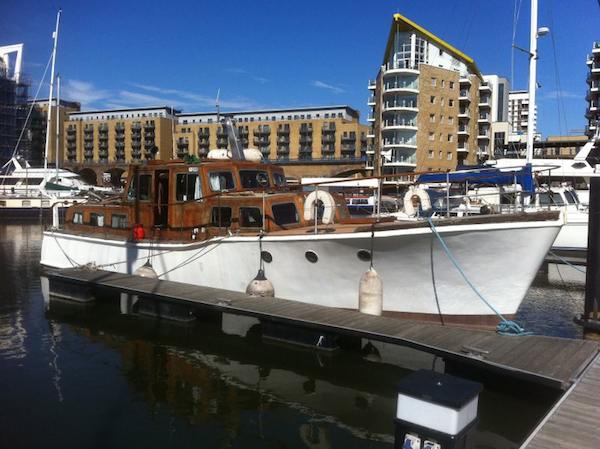
Each week we are profiling real people who are editing their lives for more freedom and happiness. This week we hear from Mike, who is giving up his spacious Bath, England flat to live out his dream, living aboard a 42 ft “Gentleman Cruiser” motorboat, while creating a simpler, more financially sane life.

Tell us about yourself.

My name is Mike. I’m 52. I work as an IT consultant, part time film extra (you can see me briefly in Harry Potter and The Order of the Phoenix) and occasional performance artist (Captain Teapot, I took part in a project on the empty plinth in Trafalgar Square in 2009). I’m single and currently living in the UK in the Georgian city of Bath.

What makes your life an ‘edited’ one?

My life is becoming an edited one due to my imminent move from a large apartment in Bath, ceiling heights nearly 12 ft, living room and bedrooms are both 18 ft x 14 ft, built in the late 1700’s. I’m moving to London and I’ll be living on a motorboat that is only 42 ft x 12 ft with a ceiling height of 6 ft. There is no room for freestanding furniture, but there is some built in furniture, a table and 3 bunks and of course a shower and galley kitchen.

living rooms now and later

How long have you been living this way, and do see yourself continuing to live this way?

I’ve been living in houses and apartments all of my life. I’ve never lived on a boat before, but have sailed a little. I see my move to the boat as a long term one, perhaps a permanent one. It was motivated by a long held dream of a life afloat and by the fact that property prices in the UK are too high.

What are the biggest advantages of living this way?

Advantages are more money and time, as most of my work in the past has been in central London I’ll be able commute using public transport and on good days I’ll be able to walk to work.

What are the biggest challenges?

The biggest challenges are the reduced space, plumbing aboard a boat is not as straightforward as it is in an apartment, water has to be pumped aboard. Also I’ll probably have to move the boat on a regular basis, residential moorings in London are difficult to find so I’ll have to relocate every few months for a while until I can find one..

Do you think you could maintain this lifestyle with a family?

It could be done with a family, but I’d need a bigger boat.

What is the number one suggestion you’d give to someone looking edit their lives?

Look carefully at what you think you need. If its been sitting in a box out of sight for years, you don’t need it. I had many items that belonged to my youngest brother who died several years ago, a castle and soldiers I bought him for Christmas when he was 8 years old, and some of his personal items. I was keeping them for sentimental reasons but realised that he wasn’t in them. He’s in my heart, in me and always will be. The things are ultimately not important and now someone else can enjoy them. Items that belonged to him I gave to local charity shops and I had a home sale that enabled me to sell most of the furniture and other items I’ve accumulated over the years and a poster for the film ‘Charade’ has gone to an auction in London.

What item(s) have made your lifestyle easier?

A computer has made a big difference, CD’s, DVD’s and even books are no longer neccessary now that they can be stored on a laptop that fits into a small bag. Also the fact that I’m currently single has helped. I’m the only one that I have to consider, it wouldn’t be quite so easy with a partner or family.

Do you have any design or architectural suggestions derived from your lifestyle?

A boat is made for a purpose, size is limited and there’s a purity to it that I like, also there is a little romance about life on a boat. I intend to do a little work to her and will have good quality fabrics etc on board and I can do that because the boat is small. I’ve lived in many different places over the years but could never afford to decorate them properly, corners were cut and the sheer size of the places meant that decorating was almost a never ending task. With the boat I can decorate easily and afford to do it well.

Anything else?

If your looking for boats for sale in the UK www.apolloduck.com. For information about moorings www.bwml.co.uk.

Debt Free and Loving It

Each week we are profiling real people who are editing their lives for more freedom and happiness. This week we hear from Sigrid, who shares her story of living simply, lightweight and debt-free.

Tell us about yourself.

My name is Sigrid. I am almost 40 years old. I am a medical technologist and getting my Master’s in healthcare administration. My husband, border collie mix and I live in Seattle in a 1800 sq ft 1914 bungalow, where we grow veggies, fruit and fresh flowers. We also make beer yearly from our hop vine. My interests include medicine, minimalism, gardening and crocheting.

What makes your life an ‘edited’ one?

I think I’ve been on the life edited path for a while, but it has taken back-steps at times. Throughout my life, I have found a tremendous pressure to live a conventional American life with its ideas of success like large houses, fancy cars and jewelry, and other forms of materialism. This way of life says you aren’t successful if you don’t make and spend a large income.

After college, I felt obligated to grow myself professionally which also meant monetarily. At first, this seemed a reasonable goal as, like most college grads, I had debt and little savings. There was no where to go but up. But after a while, I started to feel embarrassed when I didn’t have more clothes, better car, etc. So, despite the fact I was exhausted chasing this way of life, I felt I had to attain at least some of these items in order to be socially acceptable.

The seeds of living another way [expanded on below] were planted in my childhood. I was raised in a devout household, and always had an example of non-materialism to look at.

I spent my formative years living in a beautiful 4400 sq ft Victorian house, which made me realize at an early age the downsides of materialism. Although the house had gorgeous white oak floors and paneled doors with brass kick plates, it was an upkeep nightmare. I dreamt of living in the woods inside a hollow tree listening to the wind and rain falling instead.

How long have you been living this way, and do see yourself continuing to live this way?

The active process started about ten years ago. My husband and I became convinced that we didn’t want to spend our lives in the rat race. We made a goal of paying off his car and my student loans before our wedding. We did it, and then we made our next goal to pay off the house by age 40. We did this too. Then, we began saving money for a rainy day, other goals, and retirement.

For me, debt was a form of slavery, even though we ‘voluntarily’ acquired it. The more debt we had, the more a our lives existed to serve the debt. Shouldn’t money serve the needs of people, and not the other way around? The freedom of being debt-free is indescribable. The day we paid off our house was one of the happiest days of my life. I can’t see going back to the conventional way of life.

What are the biggest advantages of living this way?

Because we have so little overhead, we are free to do what we want when we want. This spring we decided to take some time off work before I started grad school. We loaded our small sedan with our suitcases and 10 year old border collie mix Lainie, and drove off into the wild blue yonder. We had a rough idea of what we wanted to do, visit the Grand Canyon and visit with family and friends, but no set itinerary. We covered six states, 7000 miles, and saw most of the national parks in the western US.

We lived in one room motel rooms, washed our clothes in the motel laundry, mostly ate at inexpensive restaurants or PB&J sandwiches from the local grocery stores. We couldn’t buy a lot of souvenirs because there was no room in the car for them. This automatically forced us to focus on the non-material aspects of the trip such as the large amount of free time we had to spend together. The trip was wonderful. It strengthened our relationship and created lasting memories.

What are the biggest challenges?

Even with the Great Recession, my husband and I deal with a lot of misunderstanding as to why we choose to be relatively frugal, which can be challenging. It just doesn’t fit with the American Dream or ideas of success endemic in our culture.

What many people don’t realize is that money saved is money earned toward living life more fully. Being disciplined can be difficult, and some people feel guilty and then angry when faced with this kind of self-limitation. They have been socially conditioned to feel deprived if they don’t spend money, rather than free from anxiety.

Do you and your husband think you could maintain this lifestyle with a family?

Yes, although raising children is a bigger drain on the family budget. It would take longer to save the money up for such a trip. It would probably also make more financial sense to buy a used camper to sleep in rather than motel rooms. The kids would probably enjoy it. If they had to be taken out of school for the trip, we would teach them ourselves so they wouldn’t fall behind in school.

What is the number one suggestion you’d give to someone looking edit their lives?

Set a goal and stick to it regardless of what other people think. After all, if you are burdened with debt, you are the one suffering from the debt and not the Jones down the street. Be creative in coming up with ways to get things done or have fun without spending money, but don’t skimp on important things like health insurance, or repairs to a home or car that could be dangerous if left undone. Spend wisely, not frivolously.

Remember, for every item you purchase you have to work some amount of time to pay for it. More money can always be acquired, but more time cannot. Once the time is spent, it is gone forever.

What item(s) have made your lifestyle easier?

We keep a few card or board games on hand to play. We substitute social interaction for material acquisition.

Do you have any design or architectural suggestions derived from your lifestyle?

Put size limits on your house, car, etc. It makes it easy to forgo impulse purchases. There is no place to put extra items. With no place to put things, you don’t go shopping without a list. We immediately throw catalogs in the recycling bin without looking at them.

Also, almost no one needs a 4400 sq ft house like I had as a child. Each room in your house can do double duty, kitchens and bathrooms excepted. Specific architectural style is less important than using the space inside the home wisely.

Anything else?

For anyone serious about getting out of debt or downsizing, I recommend reading “Your Money or Your Life” by Vicki Robin and Joe Dominguez. It very eloquently demystifies money and our relationship to it. Then, the book presents a 9 step program to get out of debt and live your life more fully. Following a frugal lifestyle is easier knowing that others have done the same thing.