How Coworking is Changing the 21st Century Workplace

Freelancers and small businesses are increasingly proving themselves 21st Century economic powerhouses. Their small sizes allow them to flow with the currents of technological and cultural change in a way their larger, corporate counterparts can’t. They are cost-effective because they can keep a small core staff, bringing on specialists depending on their needs.

But where do they work? Many find themselves too big or busy to work from home, or too small to afford their own office.

For these homeless freelancers, small businesses and entrepreneurs, co-working spaces provide a great option. Individuals and small organizations can rent a desk or small office in a space filled with like-minded industries. Tenants share things like boardrooms, printers and other resources. Rent depends on your use of the space, e.g. NYC-based Green Spaces charges anywhere from $20/day to $550/month for a dedicated desk.

Because most are formed based on industry–e.g. there might be a tech, non-profit or ethical business co-working space–the environments foster community formation and collaboration. Many host events with dedicated spaces like this one in Zurich.

One of the best known co-working spaces is The Hub, whose mission is, “To become a global network of connected communities that enable collaborative ventures for a better world.” Formed in 2005 in London, they now have 25+ locations, 4K+ members, 50+hubs in formation, spread across 5 continents.

Coworking is a great form of edited workplace for a number of reasons:

  • If you travel a lot, you can pay and use the space only when you need it, cutting overhead and overall space use.
  • Shared office equipment cuts clutter and saves money.
  • Human interaction promotes happiness.

If you’re interested in finding a coworking space in your area, visit the coworking wiki directory, which contains a list of spaces around the world.

images via Hub Westminster and Hub Zurich.

eBooks and the Bibliophiles Dilemma

This is perhaps the most taboo topic in life editing. Even extreme editors, living in their ultra-organized cubbies, often find themselves unable to get rid of these. That’s right, we’re talking about books.

We love our books–the feel of paper, the dog-eared pages, the cover art, the smell. We display them like trophies. When people come over to my house, they will know I read “The Brothers Karamazov.”

But let’s face it: books are space hogs, and few inventions help the process of editing one’s life as much as the eBook. For example, consider the basic Kindle eReader stores up to 1400 eBooks and weighs 6 oz., which is about the same size as one paperback copy of “The Great Gatsby.”

We know there are many eBook converts out there already, but for the others, who can’t quite make the leap, who are dubious of electronic ink, who love their paper-cuts and dewy thumbs, we put out a challenge: try it. 

Today we present an easy, zero-risk way of seeing if eBooks are for you.

  1. Download the Kindle app. It’s a free application that allows you to read Kindle eBooks on a variety of platforms: Android, PC, iPhone, iPad and Mac. Install it on whatever device you find yourself using the most, preferably a portable one like your phone or tablet, which better replicate a book’s utility.
  2. Download an eBook you want to read. This could be one of the millions of paid Kindle titles on Amazon, or if you don’t want to pay, download one of their 1M+ free eBooks to make this a truly zero risk experiment.
  3. Read book and see if you like it.

Mind you, this is not a perfect experiment. EBook readers like the Kindle and Nook have eye-saving electronic ink, which for many (like the author) make it possible to read for long periods of time. But others, like Graham Hill, have read many books without issue on their back-lit phone screens.

Either way, the idea is to try. Give it a shot and let us know what you think.

image via Apartment Therapy

Live, Eat, Breathe IKEA at Strand East, an IKEA-Designed City

After yesterday’s post on IKEA homes, we learned that single, prefab homes and small developments were not quite enough for the furniture giant: IKEA has entered the business of city-making.

LandProp, IKEA’s property development arm, is developing a city called Strand East outside of London. According to Fast Company Co.Exist, the development:

Will feature 1,200 homes, 480,000 square feet of commercial office space, a ‘hub area’ with shared space for the community, a creative zone intended for creative-minded businesses to take root, a restaurant, a hotel, pedestrian walkways, cycle routes.

Other features include winding, car-free streets, similar to old European cities (and IKEA stores), and underground parking that will provide ample pedestrian space and safety. There will be a strong focus placed on culture, community, food and other quality-of-life boosters. Click on infographic below for other community features.

Like its furniture, IKEAville, um, Strand East, is focused on middle class affordability and lifestyle. 40% of homes will be family-friendly.

Project Manager Andrew Cobden told The Globe and Mail this:

We would have a fairly firm line on undesirable activity, whatever that may be. But we also feel we can say, okay, because we’ve kept control of the management of the commercial facilities, we have a fairly strong hand in what is said in terms of the activities that are held on site.

Similar to yesterday’s conversation about IKEA homes, where owners might trade personal touches for affordability, function and simplicity, residents of Strand East might trade ownership for a great living experience largely governed by LandProp.

The idea of housing-as-service runs counter to the American Dream, which is inseparable with home ownership, even when home ownership, on balance, is more headache than opportunity.

Strand East also presents the idea of privatized urban planning. IKEA is creating an ideal urban structure where government might not have the audacity or resources to do so.  But given that it’s a business, might their instinct to make money trump their civic responsibility?

We’ll have to wait and see. While the land has been purchased, the company is still getting their permits in order. LandProp is hoping to begin construction in 2013.

Via The Globe and Mail and Fast Company Co.Exist

Could You Live in a 90 Square Foot Apartment?

New York City is filled with small apartments. With an average home price of nearly $1.2M, New Yorkers quickly learn how to live to with less space. But even in this squeezed city, Felice Cohen’s 90 sq ft apartment is extreme.

Cohen is a professional organizer, writer and artist (whose medium is appropriately Shrinky Dinks). She pays $700 rent for the micro-apartment, which might sound like a lot to non-New Yorkers, but consider that the average rent in her neighborhood is over 5 times that amount. By keeping her overhead low (literally and figuratively), she explains that she is able to be financially responsible while making a career through her creative pursuits.

This space might be too tight for many of us. In fact, it turned out to be too small–and illegal–for Cohen, who was evicted because the apartment was being illegally subletted. Nevertheless, she gives some great tips for living happily in a small space:

  • Regularly weed through possessions, getting rid of what you don’t need.
  • Her membership at a collective workspace is an economical way to expand effective real estate.
  • Using the city’s libraries, parks and cultural centers as extensions of her home.

Do you think you could live in such a small space? What tips would you add to Cohen’s for living more with less?

via Fair Companies

Take Your Neighbor’s Stuff Without Getting Arrested

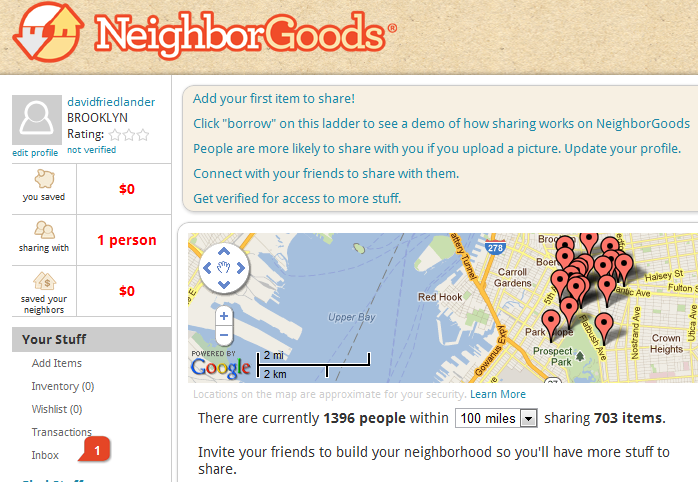
screenshot via neighborgoods

Long ago people didn’t have a lot of personal possessions. Not everyone had their own power-drill, cookie pans or tripod. And because the nearest Target was 30 years away, rather than not assembling that desk, eating raw cookie dough or shooting blurry shots, people used the only store around: their neighbors.

Well those days might be upon us again…but better. Rather than bugging your neighbors, services like NeighborgoodsSnapgoods and Share Some Sugarconnect you online with people in your area who have the stuff you need. Neighborgoods is free and has a pretty deep inventory of stuff (for our Brooklyn-based author at least); I found a Wii, a glue gun and a cat carrier–all things that might come in handy once in a while, but hardly necessary all the time. Share Some Sugar charges a nominal rental fee for household items, while Snapgoods focuses on high-tech gear; e.g. I found a CAD M179 Large Diaphragm Studio Condenser Microphone with Shockmount (Continuously variable pickup pattern!). I have no idea what that is or does, but am sure $9/day is a good deal.

We live in an age of abundant and cheap consumer goods. So much so that we end up buying stuff we don’t really need. But as Dave Bruno put it,”Stuff is not passive. Stuff wants your time, attention, allegiance. But you know it as well as I do, life is more important than the things we accumulate.” With aforementioned sharing systems, you can have the stuff you need, but only when you need it, allowing us to focus on other, more important stuff.

How Much Space Do We Really Need?

When my parents were kids, their parents slept in the dining room. These were not poor people. They just figured the dining room was so seldom used, why not put it to use?

Fast forward 60 years and for many Americans it’s unimaginable for parents to be without their own room (or in many cases, a child). Suburban sprawl and cheap construction has changed our view of what constitutes an acceptable amount of square footage. The above figure shows the average new home size in the US near its peak in 2006, as well as sizes for several other modernized countries. Keep in mind that these other countries aren’t slumming it; many (if not most) of them are believed to have higher standard of living standards than the US. It’s clear that the space we need is as much cultural as functional.

What if we started fresh and looked at what we actually need from our homes? We would probably end up with much smaller homes, which have the advantage of being less expensive, consuming less energy and being easier to upkeep. Also, by incorporating smart architectural and product design, we can pack amazing utility in small footprints. See this gorgeous 620 sq ft apartment that houses a family of 4 for a perfect example of this new/old way of living (via Dwell).

5 Shopping Tips for Buying Less Stuff

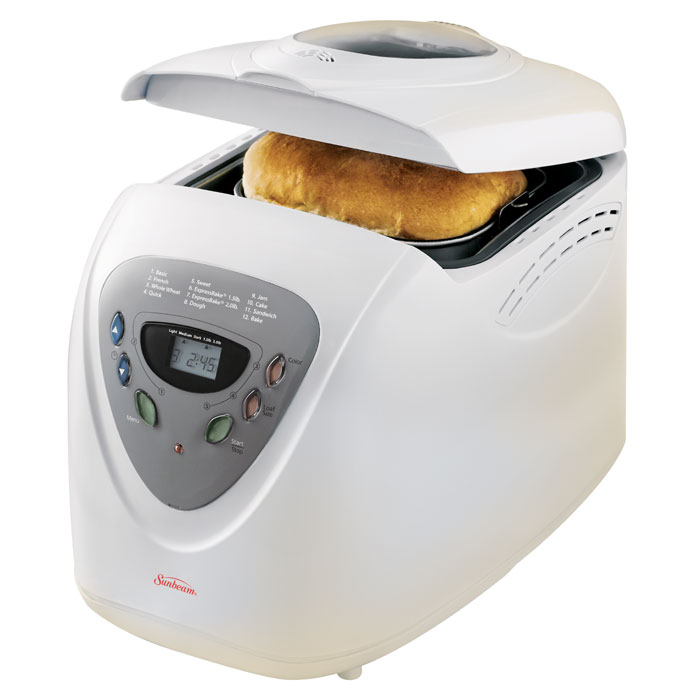
Bread Machine

The world seems determined to sell us more stuff. If buying were the end of the story, that would be OK. But it’s just the beginning. Besides buying stuff, you must store it, charge it, clean it and look at it before ultimately tossing it. We’ve come up with 5 simple actions for combating stuff-a-holism:

  1. Use what you got. Specialty items are the enemy of the edited life. Bread-makers, tie-racks, Snuggies–you probably can handle the task with something you already have.
  2. Take care of what you got. Most of us only get 1/3 of our stuff’s actual life-cycle because of neglect. Fix, mend, patch, oil, repair, clean and generally respect your stuff. The earth and your pocketbook will thank you.
  3. Don’t be lured by the latest model. Yes, the new version with the angular corners is much cooler than the older one with the rounded ones. But be honest: do you really need the utility of the new version? Probably not.
  4. THINK before you buy. Unless you are buying a tourniquet, it’s unlikely you need to buy stuff immediately. Waiting a day or two generally quells the urge to buy stuff you might not need.
  5. Buy better. If you must buy stuff, make your stuff great, well-designed and repairable. And don’t be penny wise and pound foolish. As LifeEdited founder Graham Hill put it, “Stuff that costs twice as much, but lasts 4 times longer, is half-priced.”