The Wheels of These Homes Go Round and Round

Have you ever thought you understood the world around you, then all of sudden discover hidden subcultures right under your nose? You thought you knew your colleagues and neighbors and then find out they are really, deeply into things like Dungeons and Dragons, trainspotting and Hummels. Well, I thought I had a pretty broad understanding about small space housing. I know tiny houses, yurts, micro-apartments and many things in between. I thought I knew it all until I discovered Skoolie.net, “The School Bus Conversion Network.” Unbeknownst to me, there is a whole population of people turning old school busses into live-in dwellings.
skooklie2skoolie1

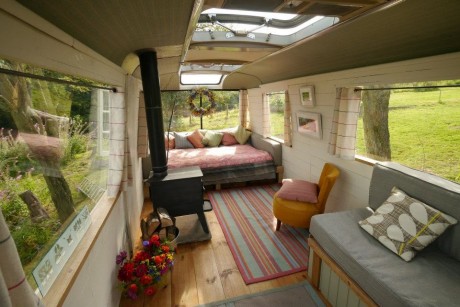
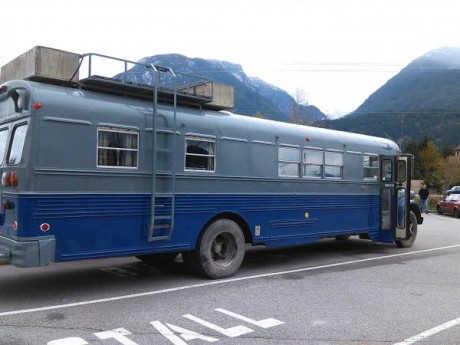
Converting school busses makes sense in many ways. School busses are house sized, measuring up to 45’ long and 8 ½’ wide, giving ample room for living space (you can get smaller ones if so desired). They lend themselves to customization with nice open floor-plans. Their simple structures makes them easy to seal and insulate. They have ample light. They run on stout diesel motors and their mechanicals are engineered for daily use and are appropriately repairable and robust. And they can be had for cheap. You can pick up a used school bus in decent shape for $5-10K. Compare this to a tiny house, whose trailer might cost $5K–and you still need a decent-sized vehicle to port it around.
skoolie4 skoolie5

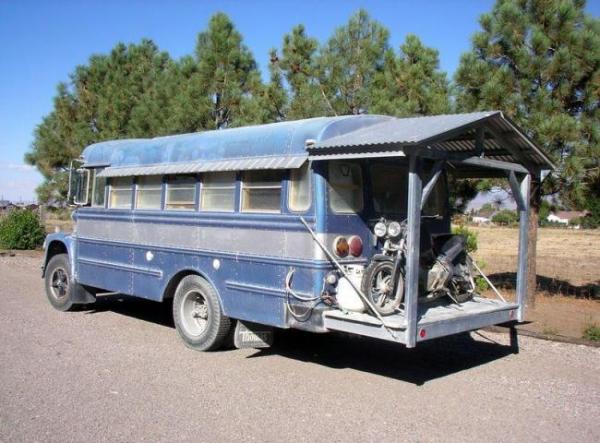
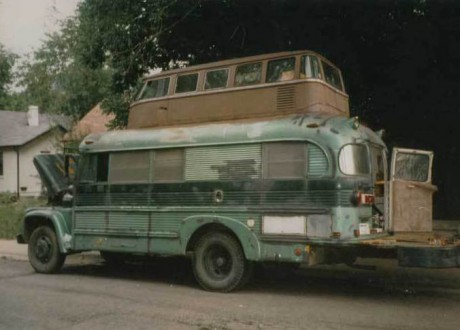
Because they are not purpose-built for habitation, school bus aficionados are more inclined to DIY-ing. In fact if you want a cheap, turnkey mobile place to live, a class C motorhome can be had for less money–and a lot less effort–than a converted school bus. However, a cheap motorhome will, in all probability, be cheaply built, with crappy finishes, fixtures and appliances. And the odds of standing out at the campground in a Winnebago are minimal relative to pulling up with a school bus with a VW Bus grafted to the roof.
skoolie8

School bus conversions do have some drawbacks, as Shawn from Schoolbusdriver.org points out. Standing room usually caps out at six feet in the middle, which is less than ideal for some such as this author. Transmissions are typically geared for stop and go driving, not highway cruising, which can make long trips slow and thirsty. And “Scraping years of petrified boogers and gum from under the seats is less fun than it sounds.”

It’s not entirely clear whether all of the busses on Skoolie are lived in or just a secondary dwelling. Either way, the site and its members present another interesting, mobile form of compact housing from which to choose from.

Images via Skoolie.net

Just Keep Truckin Home

We’ve covered a number of mobile homes here on LifeEdited, and we must confess a little judgment about this mode of living transport. While their interiors are always paragons of efficiency and clever design, their dependence on fossil fuels and association with the somewhat reviled car tend to diminish their edited cred.

This judgment is pretty misplaced. The fact is almost every home uses fossil fuel for electricity, heating, etc. And while we can’t say this for sure, we suspect the inefficiencies inherent in most stationary homes far outweigh the overall inefficiency of a chassis-mounted home. Mobile home dwellers don’t take long showers, leave lights on any longer than they are used or have any extraneous bit of stuff.

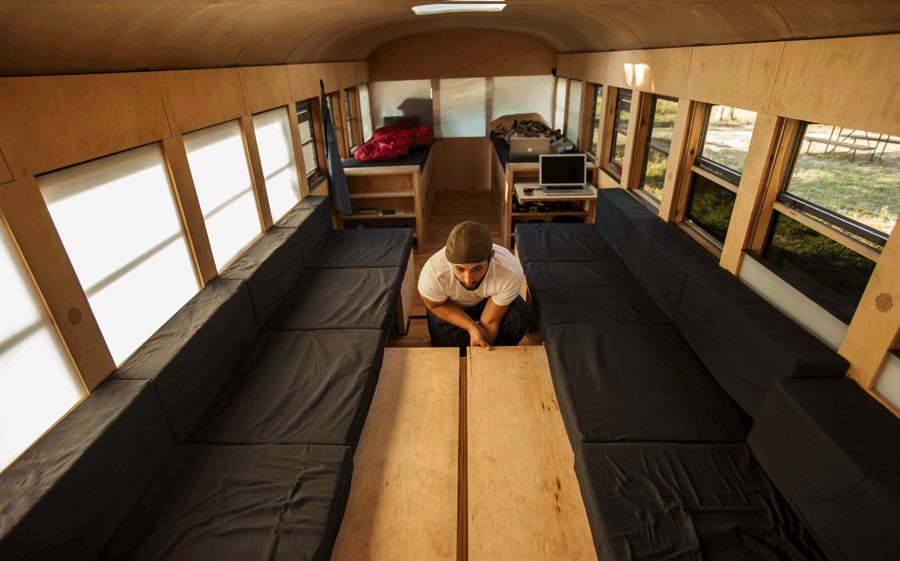
All this is a longwinded intro for one very cool bus-based home built by a guy named Hank. The bus was actually Hank’s Master’s project. Wanting a project that was more applied than theoretical, Hank bought the bus on Craigslist for $3000. Over the course of 15 weeks, he and his brother Vince constructed the bus’s interior. Material costs were $9000.

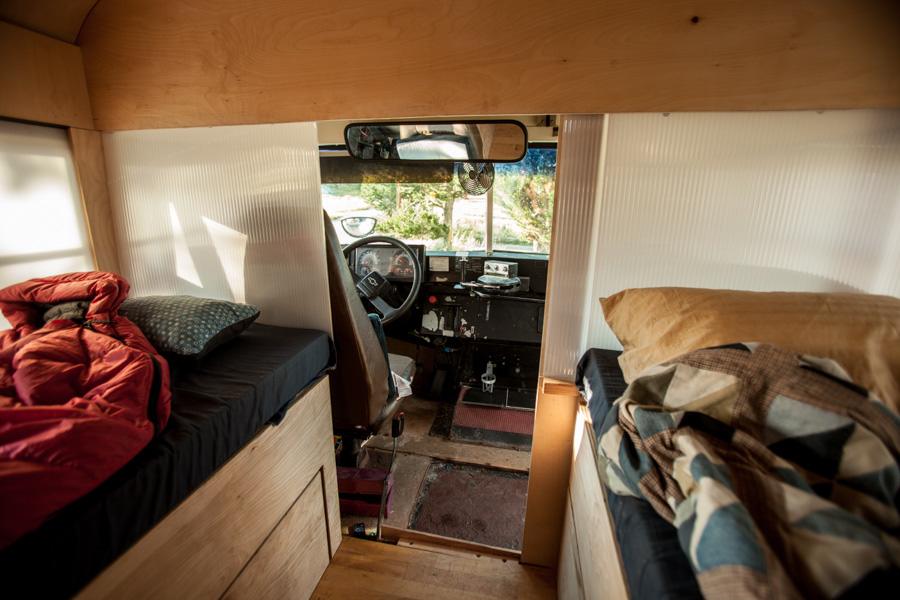
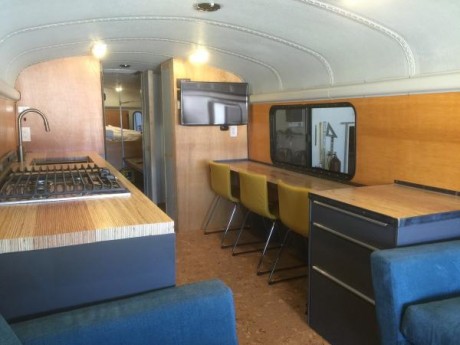
Unlike the other bus home we looked at a while back, Hank’s rig has an architectural feel. Its bent plywood ceiling and reclaimed gym flooring give it a cohesive look. Unlike the other home, Hank’s bus isn’t a fully functioning home, though he is living on the bus during a month long road trip that he chronicles on his blog.

The bus has a kitchen, a non-plumbed bathroom, a couple work stations, a removable dining table and modular furniture with built-in storage that can sleep up to six depending on how pieces are arranged.

We applaud Hank’s design. Even though most of us might not need or want to live life on the road, the project demonstrates a level of DIY small space design innovation applicable to any home.

Photos by Justin Evidon

via Colossal

More Mobile Living: Video of Couple’s DIY 3 Story School Bus

This video from Fair Companies takes an extensive tour of Richard and Rachel’s school bus home. Unlike René Agredano and Jim Nelson’s mobile living we looked at yesterday, this project is decidedly DIY; most evidenced by the decapitated VW Vanagon that makes up the top 2 stories. Just like the latter couple, Richard and Rachel tout the advantages of living mortgage-free as one of their principle motivations for living this way.

They also liken the project, which has taken them about 6 years so far, to the cardboard forts kids make. They fabricated most of their furniture and even included things like a projection “room” on the second floor. They claim there’s a level of connection and imagination that comes from a hand-built home not usually found when you buy something already built.

There seem to be some concessions to this hacker home, e.g. no plumbing; they use grey water to shower and wash their dishes every few days. They also don’t have RV status, which I suspect is why they didn’t specify their last names or location (though the bay they look upon looks suspiciously like San Francisco Bay).

The upsides they report are many. The have a minimal carbon footprint, using a composting toilet, solar power and even a solar-powered fridge. The bus only cost $12K to build, including a $1200 fridge. They live debt free with only $100/month living expenses. And they enjoy freedom that comes from not living to pay for their lifestyle. This is a common theme from yesterday’s couple and the Tiny House Family we looked at last week.

Do you think you could live on the road like either one of these couples? Have you? What was your experience? Is this something that can be done for longer than 6 years or is this more of a phase? Could a family live like this? Is a mortgage inherently a bad thing? We’d love to hear what you think in our comments section.