The World’s Smallest Home and DIY Bauhaus Furniture

What does a 1 square meter home look like? Actually, it doesn’t look like much–it’s an A-framed box on casters that could easily be mistaken as a dog house.

German designer Bo Van Le-Metnzel made this 1 square meter home not so much as a practical exercise, but as a riff on the concept of home. As a Laotian refugee whose sense of place may be more mutable than most, this concept is near to his heart. His structure asks what does home mean? Are there strictures that dictate what home is and is not? Can a home be rotated on its back?

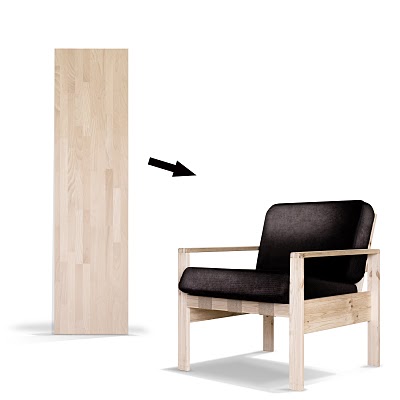
Just as interesting as the nano-home is Le-Metnzel’s website where he gives instructions on how to build high quality, Bauhaus-inspired furniture. The name of the site, Hartz IV Möbel, alludes to the German welfare system (Hartz IV) and furniture (Möbel)–i.e. welfare furniture. Le-Metnzel’s tagline is “Build More, Buy Less.” He aims to offer high-quality design to anyone who wants it; his designs are meant to require minimal skill and tools. Some of his plans include the €24 Chair—an elegant Bauhaus-style chair that can be made for €24 —and the Berlin Stool, which is a modular stool, storage container or toddler desk (both below).
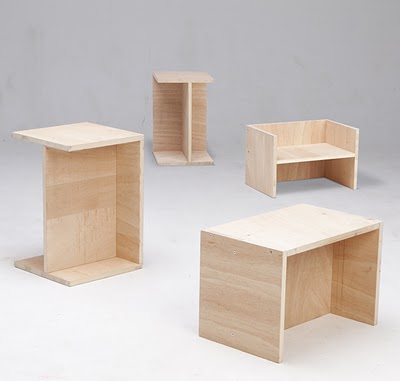
Le-Metnzel’s work is both aesthetic and social, as he explained to BMW/Guggenheim Lab website:

When I did the blueprints for the furniture, for me it was clear that the issue of furniture—a chair—this is not an issue of design. This is a social issue. If you have less money, does it mean that there’s no chance to live largely with nice furniture? My answer to this is no. The smallest apartment can be very fine if you know how to display it, and you know how to put the furniture inside.

Unfortunately for the Anglophonic, most of—if not all—of his plans and his book are in German. Though a good translator link might get you pretty far.

If you have any experience with Le-Metnzel’s designs (or similar DIY projects), let us know.

Images credit: Hartz IV Möbel

Reinventing the Dress Shirt with NASA Technology

In a certain way, men’s business suits are pretty great. They have barely changed in the last 100 years. A man can get away with wearing a decent suit over and over, washing it a few times a year.

Men’s dress shirts are different story. They wrinkle in moments. The nice ones tear like tissue. They stain easily–either getting the ring around the collar, pit stains or showing the slightest splash of coffee.

A company called Ministry of Supply is seeing if they can improve upon this fickle article of clothing. The company, which started as a Kickstarter project, has already raised $430K of its $30K goal–leading us to think that guys are looking for superior dress shirts.

The shirts use a “phase change material” similar to that used in NASA space suits. The material stretches, has an anti-microbial coating to cut the stink, resists stains, breathes and wicks moisture and is wrinkle free. The shirts are 100% made in the USA. They look pretty good to boot.

As they have exceeded their Kickstarter goal, Ministry of Supply is taking orders for August and September deliveries. Available are two dress shirts: the Apollo for $105 and the Agent, at $85. There is a t-shirt and base layer available as well; $40 and $30 respectively.

Like the Outlier dress pants we looked at a while ago, Ministry of Supply is bringing smart design and technology to products we all need and regularly replace. While both companies’ prices might seem expensive to some (Outlier pants range from $135-240), consider that their products will last much longer, can be worn more than once, will be more versatile and comfortable than traditional models. A little extra dough up front seems like a good investment to us.

What is Heirloom Design?

A few years ago, inventor Saul Griffith gave his newborn son a Rolex and a Montblanc pen. Why? Because he wanted these items to be the first and last watch and pen his son needed.

The gifts were a demonstration of what he calls “heirloom design”–the principle that we should design, produce and consume timelessly designed stuff that lasts and can be repaired rather than faddy, disposable stuff with built-in expiration dates.

Heirloom design can sometimes seem counter-intuitive. For example, it’s nice to think that the recycled/refurbished/upcycled product is always the right choice, but often this is not the case. Oftentimes it’s better to use things with higher embedded energy (the collective amount of energy it takes to produce a product) that lasts 5-10 times longer than the “eco” product that’ll wear out in a year or two. In this way, a luxury product like a Rolex can be the smartest, most eco watch you buy.

We think the above Le Creuset pot/pan combo is a perfect demonstration of Griffith’s principle: its cast iron construction surely has a high embedded energy, but its durability and function make it worthy of passing from multiple generations.

Some other products he cited to Good Magazine a couple years ago as heirloom quality are:

Bialetti or Bodum coffee makers, Iittala glassware, Vespa motor scooters, the Citroën 2CV, the Volkswagen Beetle, Lego toys, Zippo cigarette lighters, Montblanc pens, the Land Rover (the old aluminum ones before the queen bought one), the older KitchenAid products

The vast majority of stuff Griffith believes shouldn’t be made at all. He says:

The principal and only way to make an heirloom product is to design something that people will need not just this year, but for the next 50 or 100 years. Choose good materials that will last that long; but in essence, don’t even bother making fad products. If you have to design something, choose things that we need as opposed to frivolous things that we might just want for a month or two for bragging rights. In many respects, designing heirloom products means saying no to designing consumer crap that you know will not last very long.

Griffith was also trying to address the issue of electronics, which have notoriously short-lives. For example, he believes things like upgradable firmware can extend the life of our electronics considerably.

Of mechanical items, an heirloom product should be durable and repairable. This iron by designer Samuel Davies–part of a concept he calls “RepairWare”–is a perfect demonstration of that.

Every piece of it is replaceable and repairable. It can be disassembled with a quarter. Bad news is it’s only a prototype.

[divider]

Consider keeping the heirloom design ethic in mind with all you purchases. Ask yourself, “Is this something I would/could hand down to the next generation? Is this timelessly designed or something that will seem old in 6 months? Can I fix or repair this? Etc.”

If the answer is no to any or all of these questions, consider getting something worthy of handing down even if it costs more. If you can’t afford that expensive thing, look into used products–if something is old and still in working condition, it’s likely heirloom quality.

What are your favorite heirloom products?

Via Good

Image Credit: sjdavies.eu

Site Provides Real Estate Guide for Tiny Home Movement

In the market for a 300 sq ft geodesic dome in Seward, Alaska? Perhaps a 264 sq ft log cabin in Idaho? Or most any size yurt? If you answered yes, an appropriately-named website called Tiny House Listings has you covered.

If you’re not familiar with the tiny (or small) house movement, it is a movement by and for people who build and/or inhabit tiny (or small) homes–usually well below 500 sq ft. Many are so small as to be considered illegal for living; builders get around regulations by putting the structures on trailer carriages, thereby avoiding normal building code.

This is not merely an aesthetic or financial choice, but a philosophical one. Small house folk–because their homes afford no room for extraneous stuff–test the boundaries of what people really do and do not need to live happily. Freedom from mortgages, a contradictory stance to the McMansion status quo and the grey legality of the movement all make it all the more subversive.

Tumbleweed Houses out of California and Sarah Susanka, author of “The Not So Big House”  are the movement’s main exponents, though there are many others cropping up around the country.

If you’re considering joining the movement, the listing site has a good stock of tiny houses–some with land, some without, some on wheels, some out east, some west, some square in the middle. Few exceed $50K and many are well under that figure; prices seem to be more related to the land than the structure.

The site also links to small house plans (most, if not all, direct to Tumbleweed), builders (we found a company out of Maine that will make your own Hobit Hole), workshops and other resources.

While we tend to promote urban solutions to high density, small-space living, the small house movement shows how you can achieve simple, small footprint living further afield. If you’re considering a tiny house–either as a primary residence or part time one–The Tiny House Listing site is a good resource.

Any small house people out there? We’d love to hear your experience.

Help Design Jim’s Kitchen. Win Money.

A new competition launched by our friends over at Architizer is looking for the world’s best ideas in small kitchen design. The competition centers around New York media exec Jim Richardson’s 120 sq ft galley kitchen.

The current kitchen (pictured below) looks like it was defeated by the same foe we faced while building the LifeEdited apartment–i.e. the lack of high-quality appliances for compact spaces. There is very little middle ground between huge appliances and rinky-dink, dorm-room models. Jim’s fridge and stove look better suited for a McMansion than a compact NYC apartment. This results in limited counter space, a small sink and little room for people (small detail).

Whereas the LifeEdited competition encompassed the whole apartment, this one’s narrow focus might inspire some great ideas about kitchens. We might suggest going with a small fridge and using systems like we looked at yesterday to handle some of Jim’s perishables.

On the competition site is a brief about what Jim is looking for–ability to entertain, have 2 people prepare food, which appliances he wants to include, etc. The design should be no more than $30K to realize.

The first prize wins $5K and the 2 runners up $1K each. Submissions are due by July 9th, 2012.

What are your great ideas for making a small kitchen work?

The Past-Future of Space Saving Design

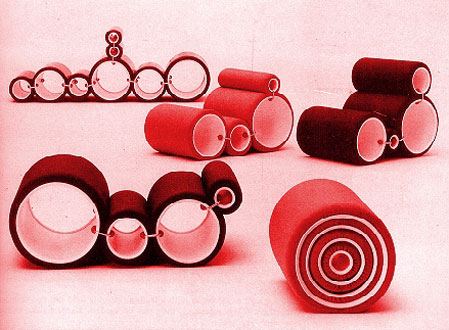
Joe Cesare Columbo was a prolific Italian Designer from the 50’s, 60’s and 70’s whose furniture designs were compact, modular and able to adapt to any space (versus a space adapting to them). It reminds us of the Metabolism design school, which created modular and adaptable architecture around the same time.

The “Tube Chair” (pictured above) uses the simple cylindrical form to make a highly adaptable and compactable lounge chair; each tube is attached with a U-shaped clip. Pictured below is Columbo’s Mini-Kitchen and Cabriolet Bed, both of which transform otherwise stationary and space-hogging parts of a home and turns them into light and mobile objects.

The Mini-Kitchen has recently been re-released by Italian firm Boffi Spa, making us wonder if Columbo’s prescient designs, which seem increasingly relevant to our mobile culture, will make a big return?

images from Design Boom

Fill Your Home with Fewer, Better, Beautifuler Stuff

We dig products like these Stelton Knives (so much so we got a set for the LifeEdited apartment). At around $300 for a set of 3, the Danish designed and manufactured knives are not cheap, though the set, which includes a chef’s knife, a serrated multipurpose knife and a small chef’s knife (a more versatile paring knife) cover most tasks a gourmand can throw at them.

Their one piece forged stainless steel construction feels great in your hand, and their heat-treated matte-black finish gives great grip (we do have some questions about the durability of the finish).

Of course, they’re simply beautiful. Their finish and gorgeous shape begs to be displayed, which is easy with Stelton’s accompanying white magnetic holder. This is quite a contrast to the counter-hogging knife block filled with 2-3 knives you use and a whole bunch you don’t.

Products like these beg the question, what if you could be psyched about everything in your home? What if everything in your home were used? With that mission in mind, what would stay from your existing stuff? What would go?

Let us know what indispensable stuff you have in your home—things that marry form, function and high quality?

Image courtesy of Stelton.dk

Stack It, Nest It, Put it Away: Finding the Best Products for the Edited Home

As we approach the completion of the first LifeEdited apartment, we are faced with the question of what products do we put in it? Already claiming a good portion of the apartment’s 420 sq ft are 2 bikes, 2 kite-boards (and a bunch of kite-board gear), 10 stacking chairs, a 30″ computer monitor and several other large items.

Every product added should have maximum utility, minimal footprint and great quality. Products that are multifunctional, stack, nest and fold help achieve those ends.

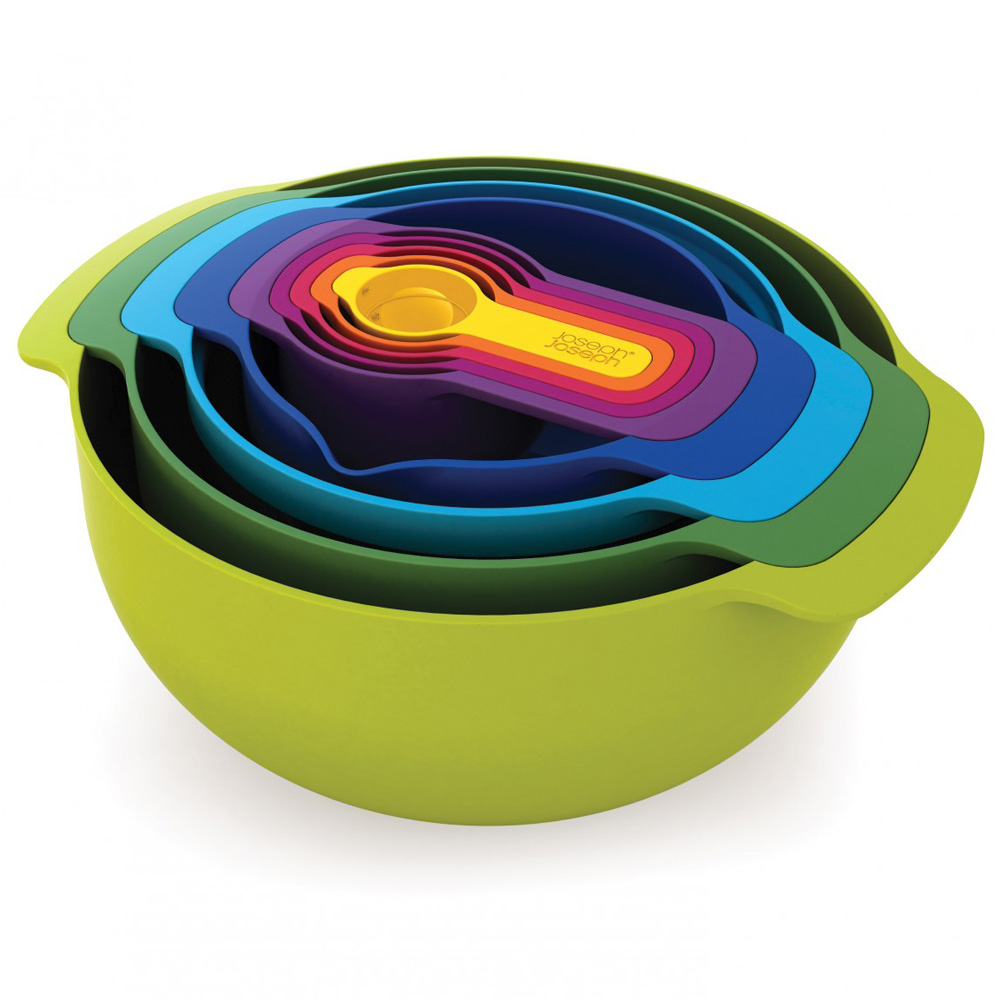
Joseph Joseph is British company that makes myriad cooking products that fulfill our objectives. Take for example their Nest™ 9 Plus, which nests bowls, a colander and measuring cups and spoons in one unit. Whereas most of us end up with mixing bowl set from one place, a colander from another, and measuring cups and spoons from yet other place, this unit designs these related things to work together, enabling significant reduction in clutter and space.

Other products include a fold-flat grater, a folding colander, nesting kitchen utensils and more.

As an added bonus, Joseph Joseph brings some needed color to our the apartment’s otherwise pale interior!


Home storage is often lost in figurative (and literal) teaspoons–gaps of space here, stuff splayed out in drawers there. Products like Joseph Joseph mind the gaps, mating like products in logical ways, making for a simpler, more compact home.

What other products would you put in the LifeEdited apartment? What multi-functional, stacking, nesting, folding or simply high quality product can you not live without? Let us know.

images via Joseph Joseph


Amazing Single-Serving Dishwasher

It’s bad enough that your parents keep urging you to meet a nice girl/guy. You shouldn’t have to take grief from your appliances as well–that huge, perpetually under-filled dishwasher reminding you of your parents’ petitions. No longer.

The Instant Dishwasher by Robert Lange and Bosch honor your singleness. The experimental, space-saving design provides enough room to clean a couple place-settings, which for most bachelors/bachelorettes (or couples who don’t cook a lot) is all that’s needed on a daily basis.
Via Yanko Design.