5 Tips for Breaking Up With Your Stuff

My wife and I are in the final phase of purchasing a home in Brooklyn, NY. In true LifeEdited spirit, the apartment is on the cozy side. The realtors call it 675 sq ft, but our tape measure says something quite smaller. In this space will live two work-from-home adults and one plays-from-home one-year-old boy. We chose the place for a number of reasons. It has a flexible square floor-plan (we’ll keep you posted on designs). It’s in a charming building filled with other young families. It’s near many of our friends. But the main reason is its location: it’s directly across the street from Prospect Park and in a very good school district.

Our little space requires all fat be trimmed from our lives–there is no room for backups or also-ran stuff. Our current place has ample closets and room for unused phones, computers, vases, photos, purses, etc. Our new place will have storage for what we love, need and use and not much more. In preparation for this new, leaner life, my wife and I spent the weekend editing our lives.

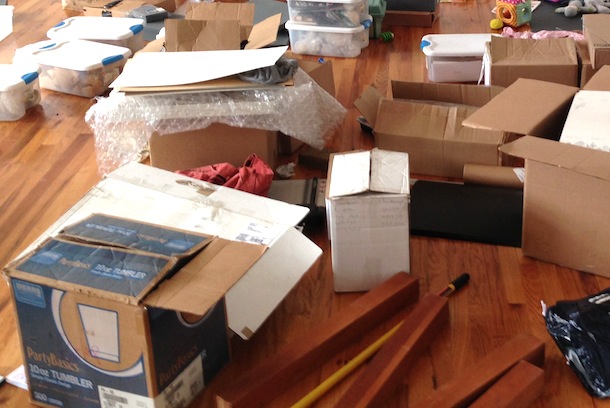
We always knew that our current home would be more pitstop than final destination, so we never fully unpacked, and many of the items considered this weekend were things that had been boxed up for the last year. Similar to Graham Hill’s 2011 TED talk, the question that kept creeping up was, “What’s in the box?” Not “what’s in the box” literally–we labeled them pretty well–but “what’s in the box” that’s so important that we can live a year (and often longer) without?

You’d think that things we hadn’t used in a year or more would be easy to get rid of–particularly for a guy who’s job is to promote the “luxury of less” and his wife who has strong minimalist leanings. You’d think we would edit with abandon. You’d be mistaken.

Weaving through years of accumulated objects brought up fond memories and appreciation for objects we once cared enough to bring into our lives. Gifts from loved ones. Pieces of art that we were either given, bought or made. Cherished books. Framed photos we no longer had the wall space to hang. Objects that were sure to be collectible one day like my first generation iPhone. Sports equipment I’d been holding onto for years, sure that I would eventually use it. But would I really? When? Most of these things made the chopping block and it wasn’t easy.

There were also tinges of regret–all of the things we now realize were far from necessary: that second water pitcher, that $1K watch–expensive things that we will attempt to sell on eBay or Craigslist for a fraction of their purchase price. We wondered if maybe we shouldn’t have got them in the first place?

Whether conscious of it or not, I wondered if this emotional process was the reason many people don’t downsize? Might the prospect of getting rid of stuff be enough to stay in a too large home or live in a less-than-ideal neighborhood?

If you are considering downsizing or just editing your life, here are several valuable lessons–both practical and emotional–I learned this weekend editing our stuff:

  1. Ebay is great for smaller, commodity items. I actually sold $600 worth of stuff this weekend, but it was name brand stuff (old phones, bike components, watches, etc.). No-name stuff hasn’t really moved.
  2. Etsy is best for selling curios, handmade art and other non-commodity stuff. My wife sold a miniature dollhouse couch on Etsy, which she never thought would move. If you have weird stuff, Etsy might have a weird buyer.
  3. Craigslist is good for the big stuff like furniture, but our experience is that people want deals. Also, the bigger stuff might take more time, so you need to stay on top of it. More tips here.
  4. Editing might be a little painful, but that’s okay. Comfort is not needed. As Graham Hill says, “edit ruthlessly.” In many ways, getting rid of stuff is like breaking off a relationship. If it’s a horrible relationship, ending it can be easy. But most relationships, like most stuff, have some elements that work and others that don’t, and the prospect of letting go of the things that do work can overshadow the preponderance of things that don’t. If you’ve made a decision to let go of something, stay firm in your decision, despite discomfort, and edit away.
  5. Focus on the other side. Many of the intellectual arguments for editing your life–less to deal with, store, clean, etc.–get lost when presented with a potential emotional loss. Try to create a stronger emotional connection to the other side. We are editing our lives because it allows us to move into a clean, amazing, albeit small, apartment in a neighborhood we couldn’t have otherwise afforded. We visualized a life where our son could hop over to the park on a moment’s notice; where we could walk to our friend’s houses; where we could reunite with our beloved Park Slope Coop (don’t believe the slander–it’s the best); where we would be living within our financial means and not have to stress out about high mortgage payments. Connecting emotionally to this vision proved far more powerful than a pro/con balance sheet of why we should hold onto the cheese knives.
Real World Micro Living

We are design wonks here at LifeEdited. We swoon at Parisian micro flats with experimental lighting schemes, lust over obtuse Japanese rental properties and dig all–well, “many”–varieties of experimental architecture and design. But we also know these things cost money to build; in fact, several of the most innovative small space designs we’ve seen are a rich client’s pied-à-terre. Concocting and consummating many of these designs also take time and attention some of us would rather direct elsewhere.

While furnishing, renovating and improving small spaces does take less money and attention because of their sizes, the fact is that for many of us, living in a simple unadorned, straightforward, un-renovated, inexpensive home is the essence of living an edited life.

ECity-051613-BedKitchen

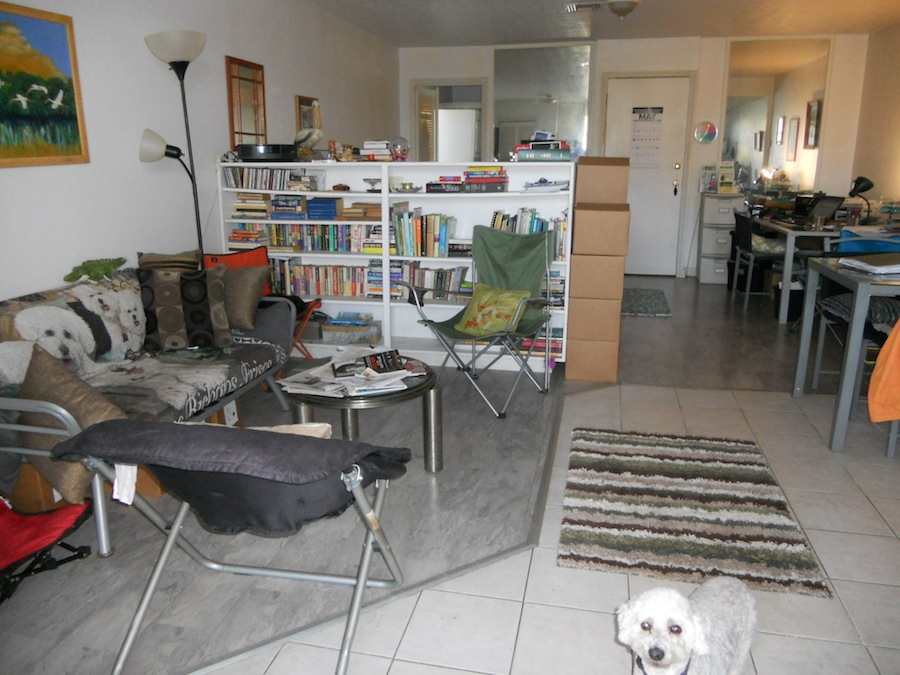
To illustrate, we wanted to share reader Marya’s small Florida home. Here’s how she describes her it:

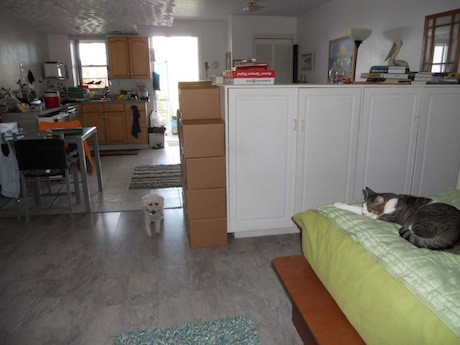
I live in one large room which serves as office, sleeping area, kitchen, and small sitting space. There’s a divider to separate off my bed from the rest of the room; it has bookshelves on one side and clothes closets on the other. My bathroom has a stall shower and a stacked washer/dryer. The kitchen area has under-counter fridge and freezer, 2-plate stove top, and a few built-in cupboards. I have a minimum of pots, pans, dishes but can entertain 4 people comfortably for dinner.

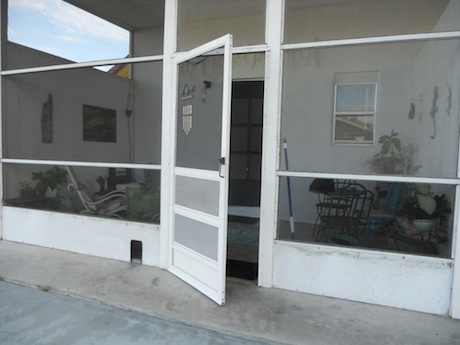
Marya’s home features virtually no architectural distinction excepting a screened-in porch. Most of the furniture was purchased at K Mart, she reports. Yet this is an edited home.

She occupies as much room as she, her two cats and one dog use. She lives with what she needs (the boxes and books are related to her work as a writer/publisher). She owns the place outright, paying only $350/month in condo fees, which include water, lawn, pool maintenance and any exterior structural maintenance. She describes this low financial and logistic overhead life as being “much simpler than when [she] had a ‘proper’ house,'” and that her current setup “gives [her] time to read and write and think.” As we read yesterday, isn’t that what most of us are striving for anyway?

The reason we say this is an edited home is because she lives an edited life–in other words, architecture and design didn’t strike her life simple.

ECity-080113-porch-outside

It’s true that we appreciate high design. And we do believe design can solve some technical and–let’s face it–aesthetic challenges. But to suppose that design is the end of the story misses the mark. Doing more with less is something anyone can do, in any financial circumstance, with any furniture or aesthetic, in most any space (we’re not sure about this one). Thank you Marya for the reminder.

The Things We Carry

Last night at 2:32am the fire alarm in my building went off. This is not one of those get-the-ladder-and-press-the-button alarms, but a building-wide system, whose blare penetrated every square foot and eardrum in the building and requires the super to turn off. My wife and I threw some clothes on ourselves and infant son, tossed the cat into his travel box, I made sure I had my phone and wallet and we headed out the door.

The building’s residents congregated in the outside doorway, clad in their winter coats and pajamas. The fire department eventually arrived. They reported that there was no danger. After their coast-is-clear confirmation, we shuffled back to our apartments.

Beyond gratitude for the safety for all parties concerned (we appreciate that these situations can turn tragic), the experience revealed a few things about our relationship to stuff:

  1. We didn’t really consider stuff until after the incident ended; we were only concerned about making sure the baby and cat were safe.
  2. If we could only take what we could carry, my wife, who is a designer, said she would take her old photos, her computer, whose harddrive contains most of her professional portfolio and a vintage teddy bear. I would take my harddrive which holds all of my non-cloud stored files and some sculptures my father gave us. These were the only items we considered irreplaceable.
  3. Useful stuff trumps “valuable” stuff. When contemplating the second tier of things we would take from our smoldering home, both of us thought of the stuff we use everyday. My wife, who has a fondness for nice eyeglass frames, intuitively grabbed her most versatile pair, the ones with the neutral style and whose lenses tint in the sunlight. She would also grab her diaper bag/purse, a few pair of her favorite jeans and the designer peacoat she’s had for years. I would grab the Outlier pants I wear daily, my EMS soft-shell winter jacket that keeps me dry and thermoregulated from 25-70 degrees, my yellow waterproof Ortlieb backpack, my vintage Basso that has become my main commuter bike (both pictured above) and, if I could lift it, our cast iron pan. Expensive cocktail dresses, jewelry, wool suits, even most of our artwork, took backseat to the things we use day in, day out.

How about you? What would you take with you? Have you a been in a situation where you had to flee your home? What did you take, if anything? What did you learn about your relationship to stuff? We’d love to hear.

Last Minute Gift Idea: Pooling Resources for Getaway

Today’s guest post is from Christine Hsu, a San Francisco-based organizational consultant (more info at Organized by Christine). She gives a great last-minute (or future) gift-giving idea for families who feel overwhelmed by the idea of finding the right gift. By focusing on experiences, not stuff, Christine shows how families can save time, stress and money while forging deeper connections with one another. 

In years past, I dreaded buying Christmas gifts for my husband’s parents and his brother and sister-in-law, all of whom live nearby.

Getting gifts for my niece and nephews was a no brainer. It was the adults that posed the challenge. My husband and I never knew what to get them. They already had everything they needed!

We didn’t want anything from them either. All three households were forever trying to get rid of STUFF, not accumulate it. We all felt like we had too much stuff as it was.

Worse yet, the time we spent trying to find that perfect gift was stressful and agonizing.

Last year, I wanted to do something different, but I was hesitant. Who was I, the newest member of their family, to suggest that we stop what had been a long time family tradition?

Then I read a NY Times article entitled “But Will It Make You Happy?”  which stated:

Current research suggests that, unlike consumption of material goods, spending on leisure and services typically strengthens social bonds, which in turn helps amplify happiness.

And that got me thinking…

Rather than six adults spending up to $100 on each person, why not pool our money together and go away during the holidays on a family retreat? We would be giving each other the gift of quality time together and great memories that will last forever. What could be better?

Not knowing how the family would react, I ran the idea by my husband first. His initial response, “I’m not sure…”, wasn’t too promising. So I decided against sending out a group email to avoid giving anyone an opportunity to shoot me down too soon. Instead, I reached out to my brother-in-law and sister-in-law first and included the link to the NY Times article to make my case. With their buy-in, I figured we could persuade the parents should they resist for whatever reason.

As it turns out, my “divide and conquer” strategy wasn’t necessary. Not only did everyone love the idea, they were as relieved as I was at the prospect of not having to look for gifts that none of us needed, thankful at not having to accumulate more stuff in our respective homes, and excited to be going away on a family trip!

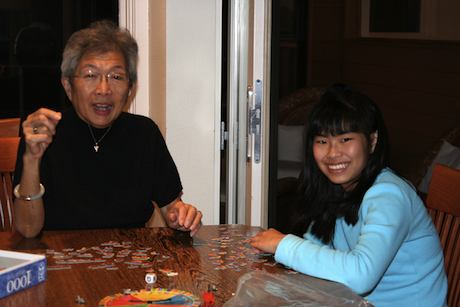
We found a beach house rental on VRBO [Vacation Rentals by Owner] within driving distance that had no Internet and no TV (imagine that). We stole away for 3 days and 2 nights over the holidays. We cooked together, cleaned together, played games together, worked on puzzles together and just hung out and spent quality time like we never had before.  In fact, we had such a wonderful time that we are doing it again this year and have made it a (new!) family tradition.

Hsu-Games

The idea of forgoing Christmas gifts with the adults in my husband’s family and spending quality time together on a getaway trip instead–for the rest of our lives–just thrills me to pieces.  “No more exchanging gifts, promise?!” I asked last year, in disbelief that this was really happening.  “We promise!” they exclaimed. And so it is.

I feel so strongly about life editing that I started a home organization business in the San Francisco Bay Area to help other people lead happier and more productive lives. I’d love to share my story. 🙂

Christine-HsuIn addition to her home organization business, Christine is also the founder of ORIENTED.COM, the largest network of its kind worldwide for international professionals interested in Asian business and partnerships.

www.ChristineHsu.com

www.OrganizedByChristine.com

Collector of Moments Has Lots of Storage Space

Each week we are profiling real people who are editing their lives for more freedom and happiness. This week we hear from Lucy, a grad student and an active proponent of a new, sharing-based economy and showing how we can all do and live more with less stuff.

Tell us about yourself

I am a 21 year old business school graduate from Toronto, Canada. I work at a Canadian telecom company and for a start-up organization called Unstash, a peer-to-peer platform for collaborative consumption. I am a strong believer in creating social change through sharing and collaborative living.

What makes your life an ‘edited’ one?

I don’t feel the need to be obsessed with stuff anymore. I used to be a mindless shopper, but then I learned about access over ownership, the idea that we don’t need to own everything, in fact, we don’t need stuff, we need the utility it provides. If we can get that utility through sharing, we can also save money, create less waste, deepen our relationships and live happier lives.

Before, I used to dream of having a large library filled with books. But during my editing, I realized that a book sitting idle on a shelf has no purpose. I thought to myself, do I really need to own this book when it’s available to me at any time from the library? This prompted me to donate over 40 books to my local library. I felt great knowing each book could get maximum utilization as more people now had access to them, allowing their content to be constantly shared.

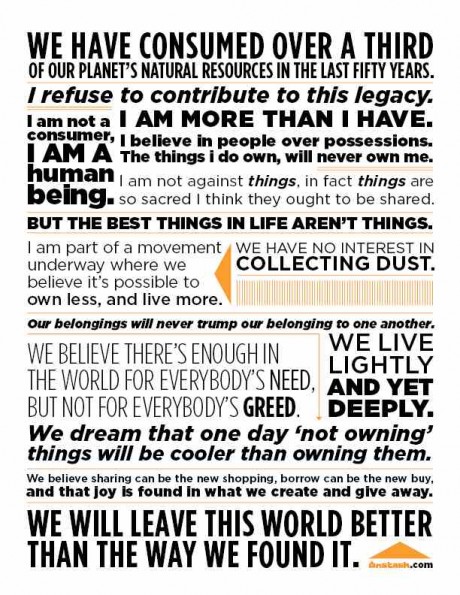
the Unstash Manifesto

Now, before I buy anything, I think to myself, do I really need this? Can I borrow it from someone else? For example, I borrowed a Halloween costume from a friend rather than buying one that I would only use once. And on the flip side, I am always open to lend or give my things to others. Sharing is a part of my life editing. Once I gather all the things that I can go without, I ask friends if they need any of the stuff I no longer need. I have given a dress to a friend who was looking for one to wear for her birthday. I gave away a large stack of post-its to a friend who uses them to organize her files. These actions allow me to share something that’s not useful to me with someone who needs them.

How long have you been living this way, and do see yourself continuing to live this way?

I started living this way in May of this year. I had watched the Ted Talks of Rachel Botsman and Graham Hill, where I began to learn about collaborative consumption and living minimally, namely, less stuff = more happiness. The ideas made a lot of sense to me, and I will definitely continue to live this way. Living an edited life is practical, efficient and a smarter way to live.

What are the biggest advantages of living this way?

The biggest advantage of living this way is being able to focus on experiences rather than things. I’m able to spend money I’ve saved on a night out with friends or on a memorable trip. I feel like I can spend my time on what really matters to me–with friends, family and doing things that make me happy. The less we are consumed with the stuff we own, the more time we have to collect those moments in life that really matter to us.

What are the biggest challenges?

For me, the biggest challenge is trying to explain the concept of sharing and minimal living to friends and family who don’t grasp the idea and label it as hippie, backwards thinking, or just a fad.

Do you think you could maintain this lifestyle with a family?

Definitely. With more stuff, there’s an even greater need for less clutter. There’s also a lot of stuff that can be shared when you have a family, like children’s clothes and toys.

What is the number one suggestion you’d give to someone looking edit their lives?

Start editing right away, even if it’s just a few things. Go through those old filing cabinets, closets and storage boxes. Once you actually get rid of stuff, you will feel amazing. That feeling will prompt you to continue editing and move towards a life edited lifestyle.

What item(s) have made your lifestyle easier?

My laptop and my smartphone, which include lots of easy-to-use apps like Airbnb and Orchestra. Everything is digitized, centralized and customized for my needs. Oh, and my library card 🙂

Do you have any design or architectural suggestions derived from your lifestyle?

Don’t buy a huge bookshelf or lots of storage because you will want to fill it and might end up hoarding or buying stuff just to fill those empty shelves or boxes.

Anything else?

Check out Unstash, a mobile app for life editing. Our belief is that every social circle has a huge overlap in consumer goods that don’t all need to be purchased, owned and maintained by every individual. We enhance the sharing experience, while helping people save money, deepen relationships and create a more sustainable future together.

Check out Unstahs’ blog as well as my personal blog, collaborativeliving.wordpress.com, where I write about anything collaborative that inspires me.

Man Goes Into Deep End in Quest to Edit Life

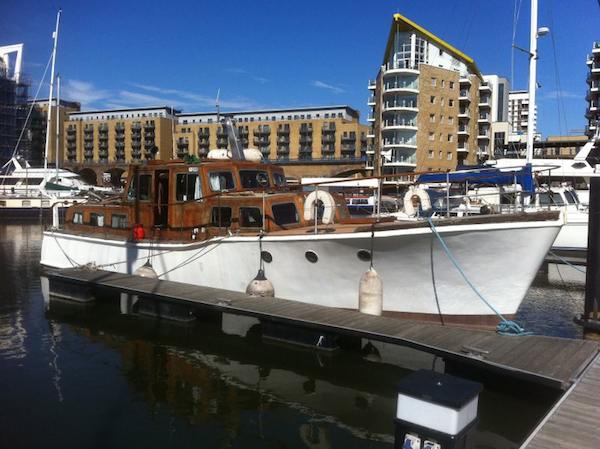
Each week we are profiling real people who are editing their lives for more freedom and happiness. This week we hear from Mike, who is giving up his spacious Bath, England flat to live out his dream, living aboard a 42 ft “Gentleman Cruiser” motorboat, while creating a simpler, more financially sane life.

Tell us about yourself.

My name is Mike. I’m 52. I work as an IT consultant, part time film extra (you can see me briefly in Harry Potter and The Order of the Phoenix) and occasional performance artist (Captain Teapot, I took part in a project on the empty plinth in Trafalgar Square in 2009). I’m single and currently living in the UK in the Georgian city of Bath.

What makes your life an ‘edited’ one?

My life is becoming an edited one due to my imminent move from a large apartment in Bath, ceiling heights nearly 12 ft, living room and bedrooms are both 18 ft x 14 ft, built in the late 1700’s. I’m moving to London and I’ll be living on a motorboat that is only 42 ft x 12 ft with a ceiling height of 6 ft. There is no room for freestanding furniture, but there is some built in furniture, a table and 3 bunks and of course a shower and galley kitchen.

living rooms now and later

How long have you been living this way, and do see yourself continuing to live this way?

I’ve been living in houses and apartments all of my life. I’ve never lived on a boat before, but have sailed a little. I see my move to the boat as a long term one, perhaps a permanent one. It was motivated by a long held dream of a life afloat and by the fact that property prices in the UK are too high.

What are the biggest advantages of living this way?

Advantages are more money and time, as most of my work in the past has been in central London I’ll be able commute using public transport and on good days I’ll be able to walk to work.

What are the biggest challenges?

The biggest challenges are the reduced space, plumbing aboard a boat is not as straightforward as it is in an apartment, water has to be pumped aboard. Also I’ll probably have to move the boat on a regular basis, residential moorings in London are difficult to find so I’ll have to relocate every few months for a while until I can find one..

Do you think you could maintain this lifestyle with a family?

It could be done with a family, but I’d need a bigger boat.

What is the number one suggestion you’d give to someone looking edit their lives?

Look carefully at what you think you need. If its been sitting in a box out of sight for years, you don’t need it. I had many items that belonged to my youngest brother who died several years ago, a castle and soldiers I bought him for Christmas when he was 8 years old, and some of his personal items. I was keeping them for sentimental reasons but realised that he wasn’t in them. He’s in my heart, in me and always will be. The things are ultimately not important and now someone else can enjoy them. Items that belonged to him I gave to local charity shops and I had a home sale that enabled me to sell most of the furniture and other items I’ve accumulated over the years and a poster for the film ‘Charade’ has gone to an auction in London.

What item(s) have made your lifestyle easier?

A computer has made a big difference, CD’s, DVD’s and even books are no longer neccessary now that they can be stored on a laptop that fits into a small bag. Also the fact that I’m currently single has helped. I’m the only one that I have to consider, it wouldn’t be quite so easy with a partner or family.

Do you have any design or architectural suggestions derived from your lifestyle?

A boat is made for a purpose, size is limited and there’s a purity to it that I like, also there is a little romance about life on a boat. I intend to do a little work to her and will have good quality fabrics etc on board and I can do that because the boat is small. I’ve lived in many different places over the years but could never afford to decorate them properly, corners were cut and the sheer size of the places meant that decorating was almost a never ending task. With the boat I can decorate easily and afford to do it well.

Anything else?

If your looking for boats for sale in the UK www.apolloduck.com. For information about moorings www.bwml.co.uk.

Have You Made a Life Edit? Let Us Know

Have you cut down the size of your home downsize or number of possessions? Do you have innovative architectural, design and product for optimizing your life? Have you experience making sharing an integral part of your life? Have you found ways of doing more with less? If so, we want to hear from you.

Nothing is better that hearing the experience of people walking the walk.

We’re looking for all demographics from young folks to seniors. We’d love to hear from families too.

Please email Ross Porter (info@lifeedited.com) to get the process started! We’d love to share your story.