Woman Plunges into Deep End of Downsizing

I stood staring at three framed documents: My veterinary school diploma, the certificate that acknowledges the completion of my residency and my board certification in small animal internal medicine. What was I going to do with them? I am nearing the end of a two year process of radical downsizing, starting as a big old house person, and now living in the smallest space of my life.

In the Beginning

The process really started in 2007 when I moved from upstate New York to Seattle. The two homes I had owned were a 1890’s Queen Anne, and a 1920’s colonial. As a lover of old homes I had collected a large amount of antiques, many of which I had restored myself and those countless hours made them feel like a part of me.

I knew I would never be able to afford the same size and style of homes in Seattle, and the cost of the moving truck had to be considered. It was initially a painful process to part with things that I had put so much sweat equity into, but it started to get easier as the moving date arrived and the need to clear the house was immediate. The majority of the antiques were sold, with only a couple of pieces with strong sentimental value retained.

A New Life and a Different Perspective

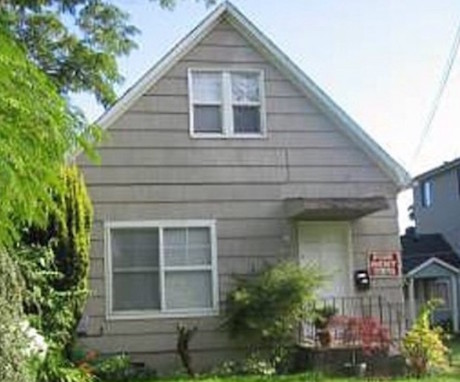
Despite liquidating rooms of furniture, I filled a rented two bedroom apartment to the brim, with barely any space to move around. Once I found a condo to buy, I purged even more items to lessen the clutter and I had created some space which felt good. I had gone from 2300 sf to 1200 sf, but was starting to realize it was still fairly large for a single person.
dana-house

Things changed in 2013 when I accepted a job that allowed me to work from home and have more free time. I also now had the freedom to choose to live wherever I wanted, which was closer to the marina. I had learned to sail since coming to Seattle and I was hooked. Moving into the city from the suburbs presented new challenges in affordability, and again a downsize was in order. There were more trips to Goodwill, items gifted to friends, shelves of CDs converted to digital music, and boxes of books donated. Parting with possessions had gotten a little easier, and living without as much clutter felt better. I was down to 1000 square feet.

I never thought that I would be buying my own little sailboat, but within a year of the move, I did.  I had been in a sailing club and chartered, which had been perfect for my needs. I loved overnight and multi-day trips, and now that I was so near the water all the time, the need to have my own was intense. The deal I made with myself was that I needed to make room in the budget for moorage, so that moorage and rent were no more than my current rent.

Apparently another downsize was in order and I found a 350 sf studio. I had some tough decisions to make. A family antique radio cabinet and an old barristers bookcase were placed with good friends. Couch, loveseat, patio and dining furniture were given away. Clothing and shoes had become very easy to pare down, but books were always far harder to let go, but I did it.

dana-books

Unplanned and the Biggest Change Yet

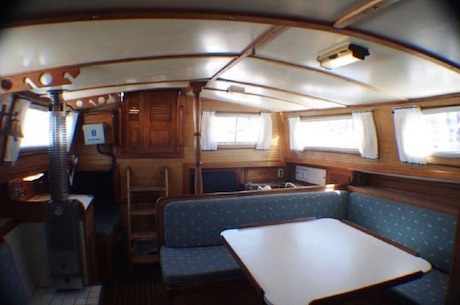
I loved my little studio, and I would have stayed there, but I liked my 32′ boat better. I found myself staying there more and more nights, and working there during the day. I didn’t want to go back to my comfortable studio. I preferred sleeping nestled in my cozy V-berth, even with the inconveniences that come with living on a boat. I was essentially living aboard, but with the safety net of a place on land which contained the last of my “stuff”. It didn’t make sense to pay for an apartment I wasn’t living in–it had to go.
dana-cabin

I am now down to less than 200 square feet with a 4′ x 4.5′ rented storage unit for boat related items, off season clothing, and some textbooks. The loss of my safety net is frightening, a little bit like a free fall, but at the same time it is exhilarating.

If I am very straight with myself, the diplomas and yearbooks serve no real purpose. When you live on a small boat, every item needs to have multiple uses and take up minimal space. Diplomas, yearbooks and old photos can be scanned.

I am more mobile and more free than I have ever been, and that is what I need to focus on. Yes, I’m walking into the unknown, but it is definitely not going to be boring.

Dana Brooks is an adventurer, veterinarian, sailor and cat-lover. You can find out more about her, her adventures, her boat and her cat at tinysails.com
Tossing X Is Easy If You Know Why

It’s hard to imagine 90 square feet reaching across the globe, but that’s what happened after I moved into that now infamous tiny Manhattan apartment. Prior to deciding whether to move into what some have called “one of the smallest apartments in the world,” I went through my list of living priorities:

  • Is the apartment located in the Upper West Side?
  • Is the rent reasonable?
  • Is it near places I frequent?
  • Will living there allow me to quit my demanding job and finish writing a book?
  • Will it satisfy my itch of wanting to experience living in NYC?

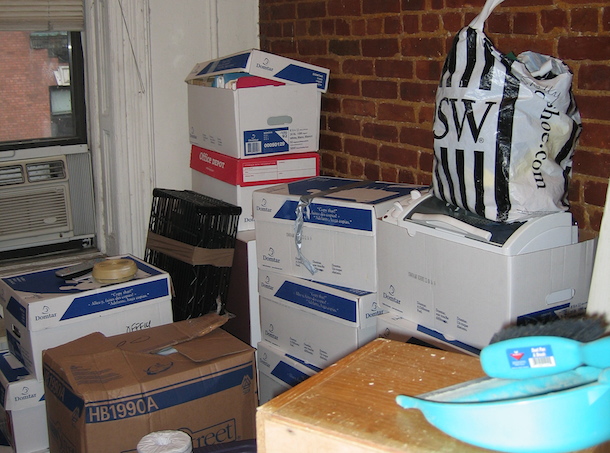
When the answers to all of the above came back a resounding “Yes!” the decision to move into that place was a no brainer. But then came the hard part: culling my possessions. These were items I’d lugged around for years never able to part with. However, now that I had found my “why”–to experience life more, write a book and not work my tail off to pay rent –I could get rid of “X” without a second glance. This included clothes, books and all my kitchen supplies except for a hot pot and toaster oven since the studio was kitchen-free.

I set my sights on living in New York City for just a year. After that I planned to move into a normal-sized apartment in the burbs.

Yet something happened inside those 90 square feet. My life got better. And bigger. And fuller. Did I really want to give that up for more closet space? With my overhead lower (no pun intended), I now had more time to write, ride my bicycle, read books, see theater, visit friends and travel. I was still working hard, but on my own schedule, and the stress was less. I also finished my book, something that had been on my To Do list for over a decade. I might have been living with less, but I had gained so much more. All because I had figured out my “why.”

After the video went viral and the landlord discovered I was subletting illegally, I was handed my walking papers. At first I was frightened. Apartments in my neighborhood, while larger, were more expensive. Would I have to get another 9-5 or move out of Manhattan? Granted it wasn’t the end of the world, but I had created a lifestyle I wasn’t so ready to give up.

felice-cohen-kitchen

My grandfather suggested I buy an apartment. Having been saving for years, I looked around. And I found. The one-bedroom was just two avenues away from the tiny residence, was in my price range, and happened to be five times larger (my kitchen pictured above). Not that I was looking for more space. People joke and ask what I do with all the extra space and the answer is simple. I fill it with family and friends.

It’s been almost three years since I moved out of that apartment, but I often think back on those years and smile. For such a minuscule space, it left an enormous impression.

Today’s post was written by Felice Cohen, a professional organizer, author, public speaker and blogger who currently lives in more than 90 square feet in New York City. Follow on Facebook and @FeliceCohen

Last Minute Gift Idea: Pooling Resources for Getaway

Today’s guest post is from Christine Hsu, a San Francisco-based organizational consultant (more info at Organized by Christine). She gives a great last-minute (or future) gift-giving idea for families who feel overwhelmed by the idea of finding the right gift. By focusing on experiences, not stuff, Christine shows how families can save time, stress and money while forging deeper connections with one another. 

In years past, I dreaded buying Christmas gifts for my husband’s parents and his brother and sister-in-law, all of whom live nearby.

Getting gifts for my niece and nephews was a no brainer. It was the adults that posed the challenge. My husband and I never knew what to get them. They already had everything they needed!

We didn’t want anything from them either. All three households were forever trying to get rid of STUFF, not accumulate it. We all felt like we had too much stuff as it was.

Worse yet, the time we spent trying to find that perfect gift was stressful and agonizing.

Last year, I wanted to do something different, but I was hesitant. Who was I, the newest member of their family, to suggest that we stop what had been a long time family tradition?

Then I read a NY Times article entitled “But Will It Make You Happy?”  which stated:

Current research suggests that, unlike consumption of material goods, spending on leisure and services typically strengthens social bonds, which in turn helps amplify happiness.

And that got me thinking…

Rather than six adults spending up to $100 on each person, why not pool our money together and go away during the holidays on a family retreat? We would be giving each other the gift of quality time together and great memories that will last forever. What could be better?

Not knowing how the family would react, I ran the idea by my husband first. His initial response, “I’m not sure…”, wasn’t too promising. So I decided against sending out a group email to avoid giving anyone an opportunity to shoot me down too soon. Instead, I reached out to my brother-in-law and sister-in-law first and included the link to the NY Times article to make my case. With their buy-in, I figured we could persuade the parents should they resist for whatever reason.

As it turns out, my “divide and conquer” strategy wasn’t necessary. Not only did everyone love the idea, they were as relieved as I was at the prospect of not having to look for gifts that none of us needed, thankful at not having to accumulate more stuff in our respective homes, and excited to be going away on a family trip!

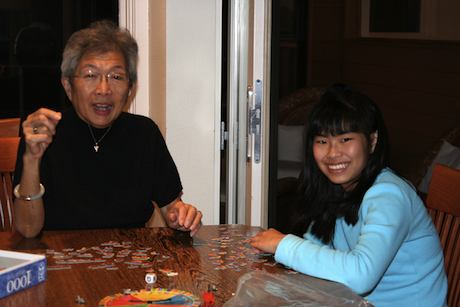
We found a beach house rental on VRBO [Vacation Rentals by Owner] within driving distance that had no Internet and no TV (imagine that). We stole away for 3 days and 2 nights over the holidays. We cooked together, cleaned together, played games together, worked on puzzles together and just hung out and spent quality time like we never had before.  In fact, we had such a wonderful time that we are doing it again this year and have made it a (new!) family tradition.

Hsu-Games

The idea of forgoing Christmas gifts with the adults in my husband’s family and spending quality time together on a getaway trip instead–for the rest of our lives–just thrills me to pieces.  “No more exchanging gifts, promise?!” I asked last year, in disbelief that this was really happening.  “We promise!” they exclaimed. And so it is.

I feel so strongly about life editing that I started a home organization business in the San Francisco Bay Area to help other people lead happier and more productive lives. I’d love to share my story. 🙂

Christine-HsuIn addition to her home organization business, Christine is also the founder of ORIENTED.COM, the largest network of its kind worldwide for international professionals interested in Asian business and partnerships.

www.ChristineHsu.com

www.OrganizedByChristine.com

Frank Lloyd Wright’s Take on Small Homes

At a lecture given to Princeton students in the spring of 1930, Frank Lloyd Wright described the interior of the typical American home as being a stomach “ever hungry – for ever more objects – or plethoric for over plenty.” Not long afterwards, he began a series of experiments in small home design intended to tackle this overindulgence of the typical suburban home.

[imagebrowser id=6]

Known as Usonian houses, the designs were small, affordable, and built with materials that made sense in their environment. Beyond simple practicality, Wright also wanted to show that small spaces could be achievements in aesthetic beauty. Examples of these homes built between the 1930’s and 50’s display a startling range of efficiency-oriented features that make the most of space with innovative design – and all at a time when most architects were building as large as possible.

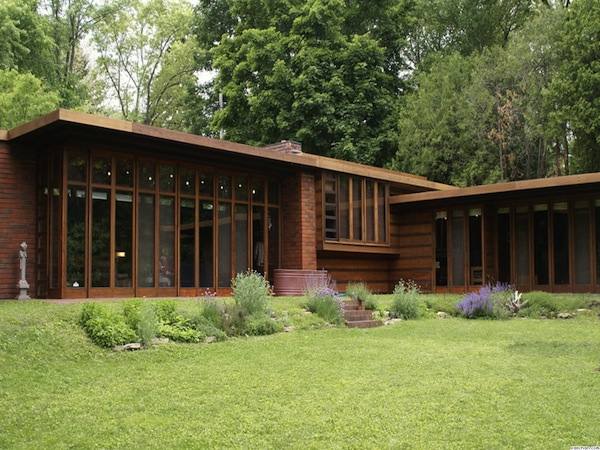
The best elements of Usonian architecture can be seen in the pair of houses that Wright designed at different times for Wisconsin journalist Herbert Jacobs and his family. The first of these houses was designed and built for $5,500 – a modest sum even in today’s dollars, and affordable on a journalist’s salary. The two-bedroom family house is built on an L shape, with a living area along one axis and bedrooms along the other. Where they intersect, and in close proximity to all areas of the house, is a small bathroom and an area for cooking and cleaning. In this 1,500 square feet of space is contained everything required for an ordinary sized family to live comfortably – without the space for the unnecessary accumulation of “over plenty”.

Almost immediately visitors began arriving to admire the Jacobs’ home; a testament not only to the practicality of the plan, but also to its beauty and broad appeal. The Jacobs’ claim that so many visitors arrived to view the house that when they began charging a 50-cent fee for tours, they were able to recoup the cost of the cost of their architect’s fee by the time the house was sold.

When the family relocated, they again contacted Wright to build their next house, which would prove even more ambitious in its aims. While still remaining small in scale, the second Jacobs house was also built to utilize passive solar heating via a roof that lets in sunlight during the cold winter months when the sun is low, and blocks it during hot summers. The rear of the house is burrowed into the prairie hillside; on the opposite side, south facing windows curve around a central outdoor garden that is sheltered from the strong winds that blow around the house.

Perhaps what is most significant about the homes is the foresight required to create these early solutions to oversized and inefficient housing. The spaces are large enough to be quite comfortable, but not so large as to facilitate the excess consumerism of most suburban households. And by building with local materials in a way that complements rather than conquers the landscape, these Usonian homes also create a more harmonious relationship with the spaces around them. While these homes do not provide solutions to all of the problems facing modern housing, they do show how appealing and efficient living spaces can be created even within relatively modest means.

Guest contributor Brian Bruegge studies Journalism at Fordham University and has had work published for both Fordham’s paper and Bill Baker’s blog on the WNET website.

image credit Residential Architect, Arkitectos and Savewright.org