Tetris-Like Office Creates Space, Grants

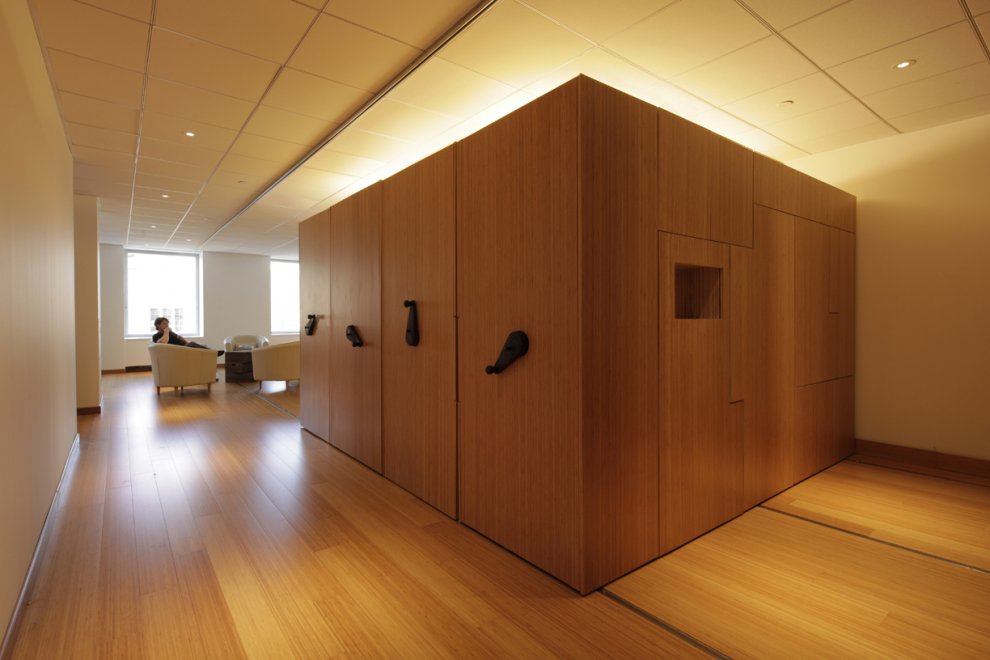
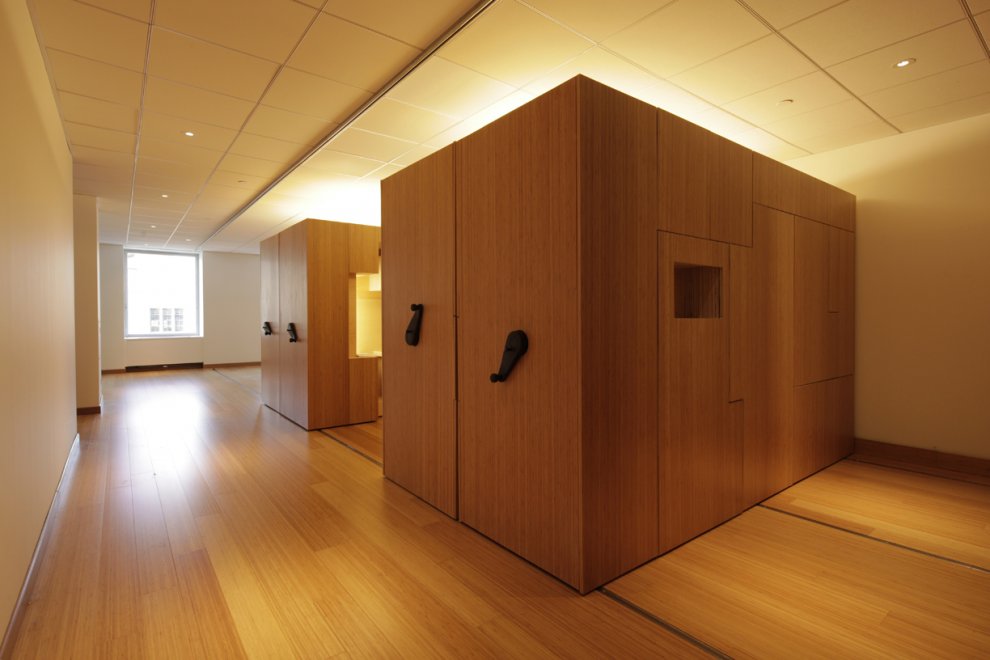
A couple weeks ago, we talked about how your office will disappear. Well, the office for Environmental Grantmakers Association (EGA) takes that concept literally. Its designers Taylor and Miller Architecture and Urban Design incorporated collapsible walls that make the office disappear.
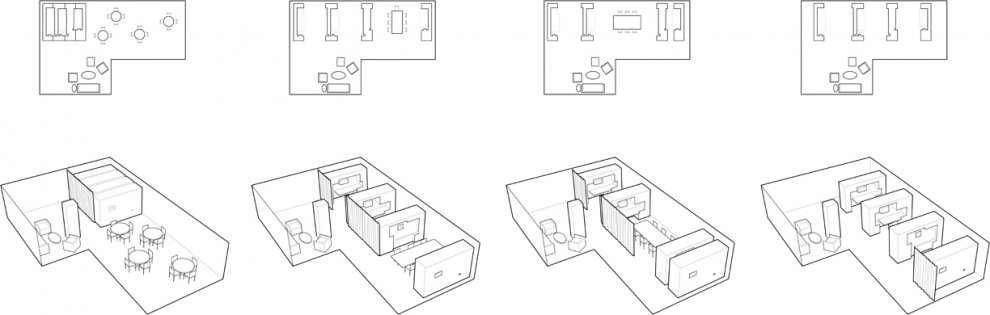
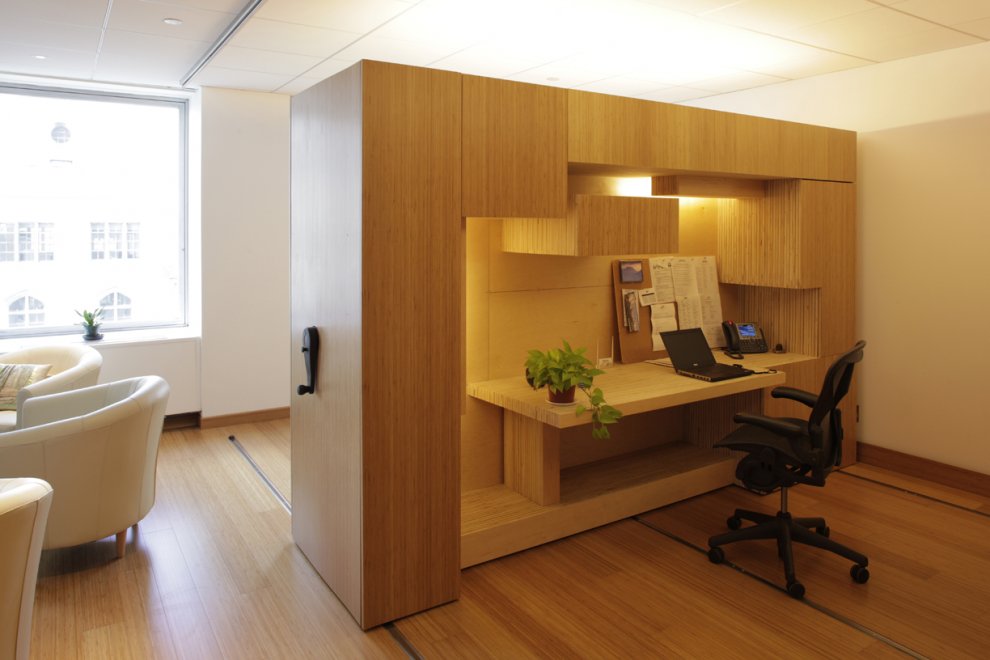
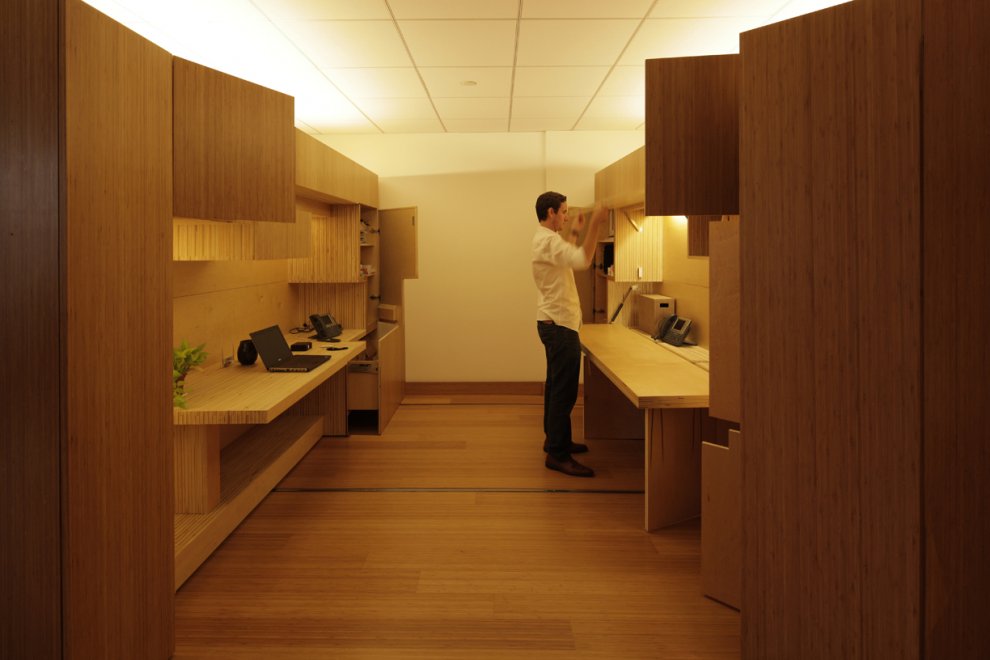
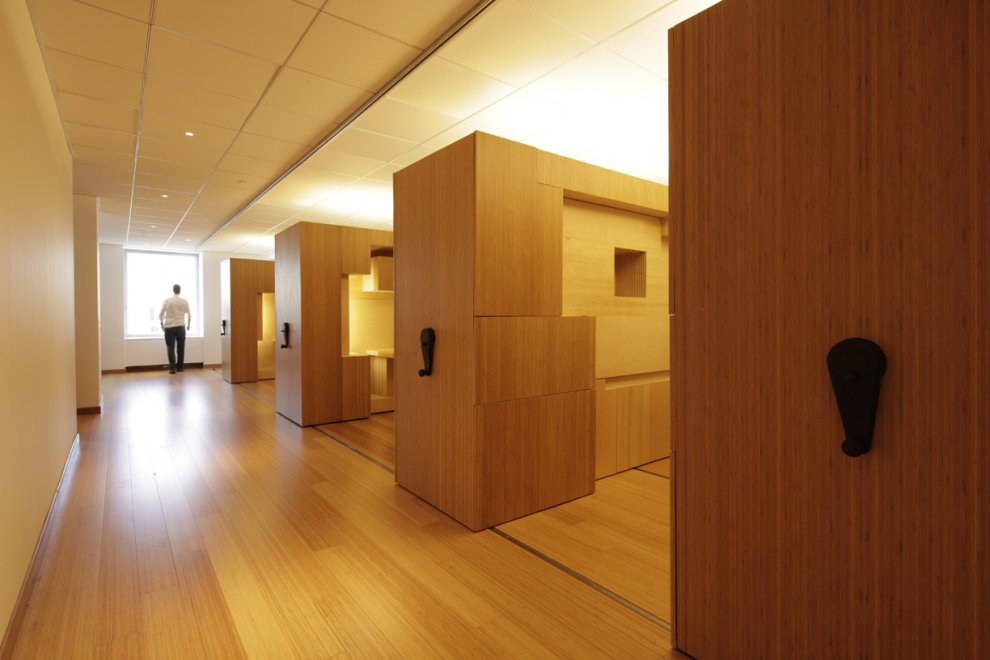
The office’s four interlocking walls house seven work stations and ample storage. When opened, they can be configured as workstations or even a boardroom. When compressed, they create an open floorplan for events and various other purposes. You can compress some of the walls and extend others to create a highly dynamic space.

The walls have an innovative way of working together. From Taylor and Miller:

When occupying the space between two partitions, one can see that the inward faces of each has been excavated with the same shape. In other words, what is a storage box protruding on one side is a recessed storage cubby hole on the other. In this manner, the partitions are bound together spatially; the relationship between them becoming stronger and stronger as they are compressed together… until finally they are collapsed completely concealing the carved space within.

The design is very similar to the LifeEdited Apartment‘s moving wall, which rests on a track and carriage manufactured by Modern Office Systems, whose primary business is large file storage systems. Taylor and Miller sourced their track from Pipp Mobile. Our unit cost about $4500 for just the track and carriage (i.e. not including the cabinet above). Additional reinforcements had to be made to the floors to support the concentrated weight of the wall. While this is a fair amount of labor and money, they’re invaluable in small spaces, where access to all the space all the time makes a huge difference. Why have a guest room 365 days a year when you only use it 20 nights? Why have a boardroom all the time when you only use it a few times a week for an hour or two? The financial and environmental costs of maintaining unused spaces quickly makes a compelling argument for incorporating more systems like these in our interior designs.

Photos by Emile Dubuisson

Via Architizer

After You Vote, Take a Break

After a hurricane, a seemingly never-ending election campaign and the miscellaneous stressors that attack us daily, you deserve a break (same goes for our readers not ravaged by hurricanes or campaign promises).

Actually, there countless reasons to take regular breaks. This infographic from www.learnstuff.com lists many of them such as increased productivity, reduced odds of contracting certain types of cancer, better sleep and vision and a bunch of other stuff. Take a look, then take a break.

Thanks Kayla!

Loosecubes and the On-Demand, Go-Anywhere Office

Loosecubes is a network made up of companies and individuals that swap and use desk space. We’d call it the Airbnb of offices, but we’re getting a little tired of comparing things to Airbnb.

You join the network either as a host or individual. Hosts are typically organizations that provide desk space; members of that organization can access desk space of the other network members–in other words, the whole company can tap into the network. Individuals can access the network and book desk space whenever they want. According to their site, Loosecubes got some solid funding and consequently, joining the network is totally free.

All members are required to connect their Loosecube profiles with their Facebook and LinkedIn accounts to avoid unseemly characters. There is a $50K protection policy for hosts against theft, and hosts can decide the level of guest access to their office. Hosts can impose a maximum number of days a guest can work at the space to avoid office squatters.

Wifi and a comfortable place to sit are what’s provided, which for many of today’s professionals is all you need. If you need a printer or conference room, you have to work that out with the host.

The network is huge with locations in most every major, and many not-so-major, cities in the world. If you’re on the road, all you need to do is book a desk in the city you’re visiting, meet with the host and start working.

Beyond the practical aspect of having a free, temporary office in most any city in the world, Loosecubes has the potential to transform offices from static, closed spaces into coworking spaces, filled with a stream of new faces and ideas. Likewise, it promotes getting maximum use of existing resources; office spaces that would otherwise be vacant are filled by people who need a place to work. This might be bad news for many coffee-shops, but it’s good news for today’s light-traveling professional.

Have you used Loosecubes? What was your experience? Let us know.

Does Working From Home Boost or Kill Productivity?

Working at home has many perks: no additional office space needed, no commute, no fancy work clothes, less water consumed because you don’t need to take a pesky shower…the benefits go on and on. But are those of us who work from home actually working or are we “shirking” our professional obligations?

A recent study by Stanford University suggests that home-workers are actually more productive and satisfied with their jobs than their officed counterparts. The study involved 13K call-center employees of a Chinese multinational corporation. They found a 13% increase in productivity as well as increased job satisfaction of the study’s subjects. Here is what they said about those findings:

9.5% is from working more minutes per shift (fewer breaks and sick-days) and 3.5% from more calls per minute (quieter working environment). Home workers also reported improved work satisfaction and their job attrition rate fell by 50%.

These are pretty impressive numbers. Impressive enough that the company decided to let all of its employees opt-in to a work-from-home situation. Strangely, of those who volunteered for the study, only half decided to work from home. But those who did opt-in reported a doubled performance impact. This, the study says, highlights “the benefits of choice alongside modern practices like home working.” In other words, people who choose working from home are most likely to be the best home workers.

We wonder how these numbers hold up with different professions. Whereas a call center worker’s work is somewhat dictated to her (i.e. people calling), other professions–writers, designers, salespeople, etc.–require a bit more self-starting. How to they fare at home? Might environments with people around create a social incentive to work?

Even if the home-worker has only the same level of productivity as his office-going counterpart, the exclusion of things like commutes, meal breaks and other small ways traditional workers lose time make working from home a compelling alternative. Saving money and resources on office space shouldn’t be overlooked as well.

Are you one of the 10% of Americans who work at least one day/week from home? Or the 4.3% who work full-time from home? What is your experience? Do you think you are more or less productive? What are the perks and downsides? Let us know.

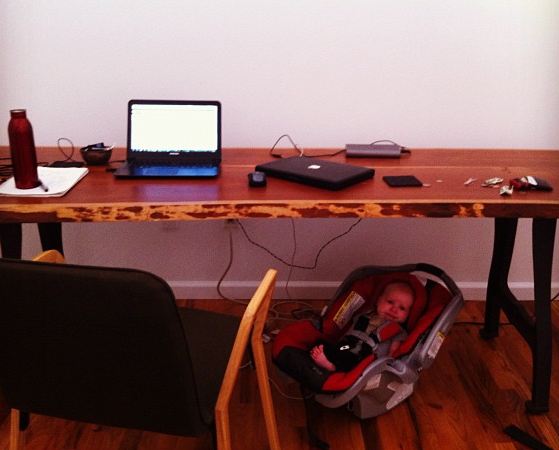
[Full disclosure: This post was written from home, by a full-time home worker, rocking his sleeping baby’s son with his foot. Pictured above.]

via Treehugger