Nature Inspired Panels Keep You Safe from Prying Ears

Lack of privacy is one of the more oft-launched attacks on small space living. In small dwellings where there are two or more people, people might not be afforded the room to retreat and be by themselves. But what is privacy really? Generally speaking, privacy has three varieties: spatial, visual and audio; all three can exist separately or together. In a small space, you might not be able to do a lot about spatial privacy as you will likely be near the person(s) you want a break from; in our experience, if you have visual and audio privacy, spatial is the least important type of privacy. Visual privacy is most often achieved with walls or curtains or, we suppose, masks and blacked out helmets (neither recommended for ongoing use). But in our experience, it’s audio privacy that trumps the other two. Quiet, more so than space or visual cover, is the thing that allows most people to feel a sense of retreat. We’ve discussed white noise and wall panels as tools for achieving this when space is tight. We just ran across these freestanding leaf-shaped panels by Japanese designer Jin Kuramoto which create flexible audio barriers for spaces small and large.

jin-kuramoto-room-dividers

Manufactured by Swedish company Offecct, who has a range of sound-canceling products, the “Wind” room dividers were inspired by natural shapes. They are constructed of noise-canceling fabric stretched across metal tubes. While Kuramoto mostly sees the panels as applicable to large “acoustically chaotic spaces” where noise travels unimpeded, we can’t see why they couldn’t be used in smaller spaces to create flexible audio dividers, creating the virtual space people seek when the actual space is lacking.

Via Dornob

Add Privacy to Your Small Space with White Noise

Let’s say, theoretically of course, that you live in a small two-bedroom apartment with your wife and two children. One child is a not particularly deep-sleeping newborn, the other is a toddler with a voice that sets off car alarms when he finds out his fire truck pajamas are dirty. Light-sleeping baby + yelling toddler = parents wishing they had a floor or two more or very long hallway between bedrooms. If it weren’t for our white noise maker, we’d totally lose our collective s@#t.

While white noise is not as effective as distance, solid walls or special soundproofing in terms of eliminating sounds, it is very effective given how easy it is to employ. Rather than eliminating sounds, it adds a layer of flat, neutral sound that dulls sharp, disturbing sounds.

In my home, we use the aptly named “White Noise” app by TM Soft. We have it hooked up to an old iPhone and typically use the white or brown noise settings, though there is a huge range of sounds available including hairdryer and grandfather clock (we sprung for the $1.99 premium version with a huge catalogue of sounds).

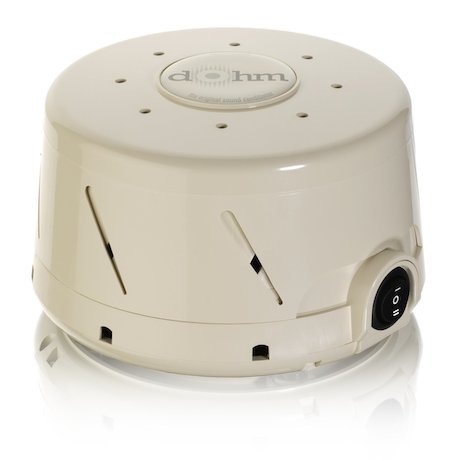
marpacIf you don’t have an old iOS device or want something non-digital, the Marpac DOHM-DS is the go-to device for psychologist waiting rooms around the globe. It’s a small fan wrapped in a case with small vents that, depending how open or closed they are, allow you to modulate the sound. I’ve used the Marpac extensively in the past and like it, though I find my old iPhone gets considerably louder.

Though I don’t have experience with them, there are numerous white noise makers specifically for babies as well as countless other apps for both iOS and Android. Should the tinny sound of your phone’s speaker be bothersome, pipe the sound through a set of Bluetooth, Airplay or desktop speakers.

White noise is not just for parents with small children. Use it when you need to make a private phone call and your roommate is in the other room or to dull out the sounds of noisy neighbors. Living in small spaces near other people has many perks, but sound separation is typically not one of them. Cranking up the white noise (to less than 85 dB apparently) helps create some of that separation and a little bit of sanity.