Know Where Your Smartphone Came From

Most smartphones are like sausages: we’re more than happy to consume them, but we probably don’t want to know where they came from. The Foxconn scandal a few years back and the well known environmental tolls of smartphone production illustrate some of the real costs of being on technology’s cutting edge. Given that smartphones don’t appear to be going anywhere anytime soon, the question we might start asking ourselves is how we can make smartphones in a smarter, more responsible manner. It’s a question a company called FairPhone is trying to answer. They are trying to ensure that every stage of their smartphone’s lifecycle is done in the most humane and environmental responsible manner.

Fairphone begins with materials. They claim that most smartphones use up to 40 different metals from all of the world. Many of the places where these metals originate have questionable (or just god-awful) humanitarian records. Fairphone only uses materials from conflict-free regions so they are supporting communities, not military juntas.

Next, they ensure that their manufacturing conditions are humane, paying workers a fair wage and work in safe conditions with proper labor-rights representation.
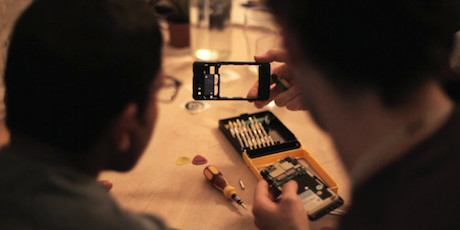
repair

Their Android phones are designed with durability, longevity and repairability in mind. They offer spare part kits and have partnered with iFixit who publishes online repair tutorials.

ewaste

Lastly, Fairphone has partnered with the nonprofit Closing the Loop to provide solutions for e-waste in countries without a formal electronics recycling sector.

The unfortunate truth of many of our consumer products is that if you don’t know where they’re coming from–whether it’s a vegetable, a garment or your smartphone–chances are they’re coming from not-so-great places. Given that smartphones have become such an indispensable tool for modern living and manufacturing them responsibly is trickier to pull off than a 100% organic cotton t-shirt, it’s nice to know that there are options for smartphones you can purchase with a clear conscience. (Of course, they do mention that the best phone is the one you already have.)

Currently, an unlocked Fairphone can be purchased for €310 and can only be shipped within the Europe. If you do get one over pond, the company warns that the phone will not get a 3G connection in North America. We hope they start making and selling a North American version soon.

Never Bend or Upgrade Your Smartphone Again

Are you sick of constantly feeling tethered to your smartphone? Are you sick of feeling like you must have the latest and greatest model…that if your phone has beveled versus rounded edges, you are somehow out of pace with the times? Are you worried about bending your smartphone? Are you looking to kick your smartphone addiction, but fear you’ll miss the weight of the phone in your pocket or having something to clutch? Well, look no further, because the NoPhone has you covered (no matter where you might roam). According to its Kickstarter site, the NoPhone is a “technology-free alternative to constant hand-to-phone contact that allows you to stay connected with the real world.”

nophone-selfie

The NoPhone has no pesky battery to wear out, it never needs upgrading, it’s completely shatter and waterproof, we suspect it’d take a lot to bend (take that iPhone 6 Plus) and it’s totally unlocked. And best of all, the NoPhone can be yours for a mere $12 Kickstarter pledge. Another $6 will buy you a selfie upgrade, which allows you to share candid self-portraits with friends, assuming they’re standing right behind you looking over your shoulder.

Social Media Professor Bans Social Media in his Class

If you’ve been around the social media, new media sphere for a while, you probably know the name Clay Shirky. Perhaps best known for penning, “Here Comes Everybody: The Power of Organizing Without Organizations,” he is a Fellow at the Berkman Center for Internet and Society at Harvard, and was the Edward R. Murrow Visiting Lecturer at their Joan Shorenstein Center on the Press, Politics, and Public Policy in 2010. He holds a joint appointment at NYU, as an Associate Arts Professor at the Interactive Telecommunications Program (ITP) and as an Associate Professor in the Journalism Department. Shirky is about as authoritative and outspoken as they come regarding the power of new media–which makes his ban of technology in his classrooms all the more interesting.

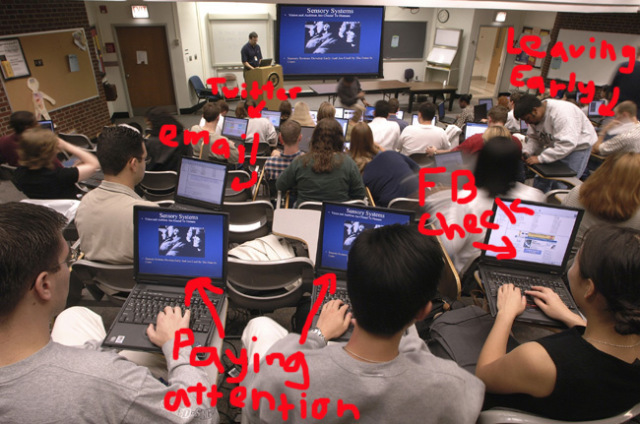
In a lengthy essay in PBS’s Mediashift, Shirky writes about precisely why he imposed the ban. For one of new media’s greatest proponents, it wasn’t a an easy decision. For many years, Shirky wrote that the inclusion of technology–specifically laptops, tablets and phones–seemed organic, as the devices related directly to the topic at hand. But he said, “The level of distraction in my classes seemed to grow…The change seemed to correlate more with the rising ubiquity and utility of the devices themselves.” In other words, a 2002 Sidekick in the hands of the few was like a musket compared to a Galaxy S5 in everyone’s palm, an AK-47 of distraction-inducing firepower.

Point by point, Shirky highlights the perils of ubiquitous tech, especially in the classroom, and why he decided to ban, not just admonish, their use in his classrooms. He points the myth of multitasking–how it negatively impacts our productivity, our ability to retain information and ability to choose what to focus on.

He writes about the uncontrollable gravitation toward certain emotionally triggering content. As an example, he writes: “‘Your former lover tagged a photo you are in’ vs. ‘The Crimean War was the first conflict significantly affected by use of the telegraph.’ Spot the difference?” One has an immediate emotional payout, the other is more slow-release. The coupling of this content with images makes it doubly distracting. He writes:

Our visual and emotional systems are faster and more powerful than our intellect; we are given to automatic responses when either system receives stimulus, much less both. Asking a student to stay focused while she has alerts on is like asking a chess player to concentrate while rapping their knuckles with a ruler at unpredictable intervals.

In one section, he uses the metaphor of the elephant and the rider, where the emotions represent the elephant and our intellect the rider. Traditionally, the classroom’s focused environment allowed the deliberate rider–i.e. the intellect–to lead. But more and more, the emotional elephant, spurred by a thousand emotionally-gratifying prods from technology, is leading the way and isn’t quite sure where he’s going.

And lastly, he talks about the contagious effects of technology–how studies have shown that not only do people who overuse technology in class perform poorer, but so too do the people who sit near the over-user. It’s second-hand distraction.

The essay is highly informative for people in and outside the classroom. Technology is a many splendored thing, but it also has the capacity to wreak a great deal of havoc on our ability to focus and get stuff done and even enjoy life. We might all take a cue from Shirky and consider not just the potential of technology, but its actual effects on our daily lives. Sure, our phones and other devices can theoretically connect us to vast troves of useful and empowering information, but if we use them in practice to read about the top ten plastic surgery disasters, a lot of the theory’s potential is nullified.  More than anything, Shirky’s mandate has one very obvious implication: that we should put away our tech and tech with greater frequency and pay attention to the subject at hand.

Image credit: the active class

Distracted, Dangerous and Dumb: Why it Might Be Time to Check Our Cellphone Use

Chances are, unless you’re living deep in the mountains or at a geriatric home (located deep in the mountains, staffed by fellow geriatrics), your world is populated by people glued to cellphones and other technology. A while back, we wrote about a survey that found the average American spends 2 hrs 38 mins every day on his or her phone or tablet…doing pretty inane stuff: mostly checking Facebook and playing games. A further while back, Joe Kraus cited research that suggests cellphone use is making us stupid. We lose 10 IQ points when we multitask–what we’re doing when we pingpong between checking our Facebook status and filling out that spreadsheet for work every few minutes. This loss is no small sum for us non-Mensa members. Worse still, the more we multitask, the worse our ability to monotask–i.e. focus on one thing–becomes.

Here are some other awesome consequences of our tech obsession:

  • A Kent State University study found that of the 500 students observed, “high frequency cell phone users tended to have lower GPA, higher anxiety, and lower satisfaction with life (happiness) relative to their peers who used the cell phone less often.”
  • According to the National Safety Council, there is a cellphone related car accident every 30 seconds (~335K this year alone). The NSC reported 3331 distracted related deaths in 2011; 12% (350 fatalities) were explicitly attributed to cellphones. Experts believe that number is far higher given that 50% of fatalities were for reasons unknown.
  • Studies conducted at the University of Essex found that the presence of a cellphone, even when not used, affected subject’s ability to connect on a deep level and find empathy for his or her partner.
  • University of Maryland study found that people who used a cellphone, even for a short period, were less likely to engage in “prosocial” behavior, which is defined as behavior intended to benefit another person or society as a whole.
  • A Boston Medical Center study observed how cellphone use affected parenting. They found that 40 out of the 55 caregivers studied used their phones during meals, and that children were more likely to act out with caregivers in direct proportion to the level of the caregiver’s absorption with the phone.

If the constant use of our cellphones and other tech is such a time suck, if it’s making us stupid, if it’s compromising our safety, if it’s making us lousy friends and parents, why the hell do we do it?

Louis CK has a couple theories.

In the above video, CK tells Conan O’Brian why he doesn’t want to buy his daughter a cell phone even though other parents do it. “Just because the other stupid kids have phones doesn’t mean that–oh, my kid has to be stupid otherwise she’ll feel weird.” He explains why doing so is particularly deleterious to a chid’s ability to develop empathy. He says:

I think these things are toxic, especially for kids…they don’t look at people when they talk to them and they don’t build empathy. You know, kids are mean, and it’s ’cause they’re trying it out. They look at a kid and they go, ‘you’re fat,’ and then they see the kid’s face scrunch up and they go, ‘oh, that doesn’t feel good to make a person do that.’ But they got to start with doing the mean thing. But when they write ‘you’re fat,’ then they just go, ‘mmm, that was fun, I like that.’

An assertion that accords with the University of Essex study.

Social acceptability, unfortunately, is not the end of the story. There is a growing body of evidence indicating that our overuse of technology is no mere habit, but a symptom of an addiction. Studies have found that people sleep with their phones, get panicked and go into withdrawal without them. The addiction, like one to heroin or Oreos, might be salving that existential hole, that fear of being still and alone with our mortality, Louis CK alludes to. (Or maybe we’re waxing a bit too grandly).

So what do we do?

In his quest to kick heroin, Miles Davis was said to have locked himself up in his dad’s barn for a week, sweating and struggling it out. Fortunately, there might be a more incremental way to stop chasing the technological dragon:

  • Cultivate awareness. Check yourself frequently to see if your use of technology is taking you away from the present moment. Sometimes the present moment calls for a phone call or checking your GPS. But quite often, what’s going on around us in our immediate environment–talking to friends, being with our children, walking in the park, doing a work task, doing nothing–is more important than whatever we’re doing on our phones. If you’re mindlessly using technology, stop.
  • Go techless. Leave your phone at home. Don’t pack a tablet. Get away from backlit screens. It might feel uncomfortable for a while. Your brain is detoxing. If people like your spouse are accustomed to reaching you at any time, let them know you won’t have your phone. It’s okay. The world will not fall off its axis.

What’s So Damn Important Anyway?

According to one survey, the average American “consumer” spends 2 hrs 38 mins on his or her smartphone and tablet per day. If you think that time is spent working and moving the wheels of progress forward, you’d be wrong. 80% of that time is spent inside apps, with games and Facebook making up the bulk of the app time–50 and 30 of total minutes respectively. The other 20% is spent on mobile web browsers. And as much flack as it tends to get, email makes up a mere three minutes of the daily total (no figure is given for time spent speaking to others on the phone, though we imagine it’s a similarly small amount).

The above video gives a great illustration of what a world looks like when people spend 2:30 hours+ on their smartphones. It’s a world of distractedness, extraneous documentation and general lack of presence. For many of us, it is our world.

Today, before we reach for our smartphones, before we interrupt our conversations, before we take a picture or video to “save” a moment, before we check in with our friends on Facebook or fly with Angry Birds, we might ask ourselves, “is what is on my smartphone or tablet more important than what’s in front of me?”