Take a Tour of Steve Sauer’s 182 Sq ft Triplex

A while back, we looked at Steve Sauer’s 182 sq ft, self-built “pico-dwelling” in Seattle. The tiny triplex, built in a converted storage area, has the level of intricacy you’d expect from a Boeing engineer (Sauer’s day job). Though we have yet to check out Sauer’s digs in person, thanks to Fair Companies, we have a video tour providing the next best thing.

Beyond its outsized features–e.g. a soaking tub and ability to entertain 17–what shows through in Sauer’s space is quality. With butcher-block cabinets and stainless steel fixtures everywhere, the space looks like it could withstand a simultaneous hurricane and tornado. The space was designed and fabricated by Sauer and is a real feat of engineering. Definitely worth a watch.

Via Fair Companies

Micro-Apartments Stir Not-so-Micro Controversy in Seattle

Lest we think all micro-apartments are high-end, high-tech, highfalutin, transforming thingamabobs, one should go to Seattle to see another, decidedly modest and analogue take on tiny living. That city has seen a great deal of development–and controversy–surrounding the spread of affordable micro-apartment developments. In particular, a couple companies, aPodment and Mini-Suite, have been making high-density apartments with shared amenities, with rents starting around $500.

One aPodment development, the Solana, has units that average 170 sq ft according to Seattle Mayor Mike McGinn, who has expressed his support of the developments (some units in other building are as small as 100 sq ft). The units come furnished (with no murphy beds so far as we know) and have their own bathroom and shower. Instead of a proper kitchen, they feature a fridge and microwave, with available communal kitchens. All utilities including wifi are included.

There are 47 such developments currently permitted throughout Seattle and their popularity seems to be growing. And herein lies some of the controversy: Neighbors are complaining that because the buildings are so dense, they are bringing in more people than the neighborhoods can support. One oft-cited fear is that the influx will result in inadequate parking. There is also the complaint that the buildings are not subject to a “design review” which would entail greater bureaucratic and community scrutiny; developers only need a building permit to build these buildings.

Though not always explicit, critics seem to imply that the micro-apartment demographic–often young, low-to-moderate income singles–might not jive with some of the more family-oriented communities they’re infiltrating (note: the communities they’re moving into are zoned for multi-family development, but most buildings are far less dense than the micro-apartment buildings). One man trying to sell his home near an impending micro-apartment development was a bit more blunt, telling The Stranger:

Anyone who can scrape up enough money for month-to-month rent can live there…I don’t think most people want to live next to a boarding house with itinerant people living in it.

While we don’t live in these communities ourselves, the micro-apartment trend in Seattle has a tinge of NIMBY (not in my backyard), with threats seeming more imagined than real. The various articles we scanned reported of young Microsoft employees, recent college grads and divorcees on a fixed income occupying these apartments–not thugs looking for launchpads for heists. In terms of parking, Jim Potter, chair of Kauri Investments who owns Mini-Suites, says that only 10% of his tenants own cars. Most of the developments are located along transit lines, making cars less essential.

One commenter on The Stranger put it more starkly:

Either we embrace affordable housing close to downtown Seattle…or we embrace suburban flight, with the cultural and environmental ramifications thereof. I applaud Mulhair and Calhoun properties [aPodment] for providing private-sector solutions to public/governmental policies.

What do you think? Is this true? Can there be smart growth in our cities without major neighborhood demographic shifts? Do neighbors have legitimate complaints or a case of xenophobia that might inhibit a more affordable, sustainable city?

images by Mariana Kajlich for Seattle Magazine

Edited Housing Guide: A Look at 4 Compact Housing Developments in North America

While building small is big in many places around the world, it’s still pretty novel in North America. Our abundance of space and affection for cars have made our architectural disposition similar to a big yawn after Thanksgiving dinner.

New American home footprints have been north of 2K sq ft for a while, and have even spiked to 2550 sq ft in the last year because credit scarcity has limited new home ownership to the cash-flush.

But that’s not what we’re going to talk about today. We are going to talk about the little guys. These are developers at the vanguard, building small, efficient, awesome homes.

And if we missed anyone, please let us know in the comment section.

1. Cubix SF (née Cubix Yerba Buena)
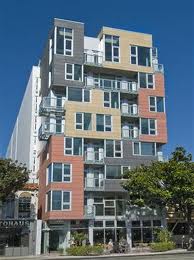
If you go to San Francisco’s SoMa district and see a Rubik’s-cubey-looking building, it’s probably the Cubix SF. The 98-unit building has floorplans ranging from 250-350 sq ft. Prices are in the low-to-mid $200’s, which is about a 1/3 of the area’s median price.

The building features nice finishes (see main image above for interior pic), modern appliances, a big roofdeck and groundfloor cafe. Their focus is on creating a low purchase price for people who still want a high quality, stylish apartment in a great neighborhood.

2. Vancouver Micro Lofts

Okay, so it’s not the US, but these micro units epitomize edited living. There are 30 units, which range from 226-291 sq ft and average $850CAD/month rent, which includes cable and internet.

The tasteful decors feature folding beds and tables, big windows and small, high quality appliances. With considerably lower rents than neighborhood average, the building proved very popular and rented out almost immediately.

via cbc

3. Apodments

In Seattle, Calhoun Properties has developed 9 building featuring their Apodments™, which are more like boarding rooms than standard apartments. Buildings have shared kitchens and living rooms. Some rooms have shared bathrooms and can be as cheap as $350/month including utilities, while the majority have private bathrooms, kitchenettes and some furniture and are as cheap as $495/month including utilities.
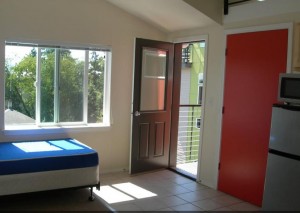
The units themselves are as small as 90 sq ft with fairly spartan decors compared to the other developments in this profile. Calhoun seems to be focused on young people who make low, hourly wages and/or don’t spend much time at home.

image via Facebook

4. Olympic Studios and Studio Lofts
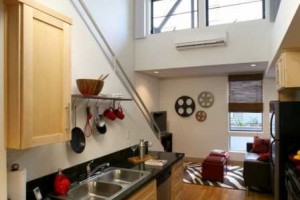
In posh Santa Monica, CA, NMS Properties offers compact living for moderate income households (<$60K/year for singles and <$68/year for couples).

The units range anywhere from 360-448 sq ft. One of the cooler features is their furniture organizer, which allows you to drag and drop furniture pieces to pre-configure your furniture to the spaces somewhat tight quarters. We particularly like the loft layout, whose high ceilings give the small footprint a cavernous feel.

image via Olympic Lofts

graph via treehugger and Builder Online