What is the Experience Economy?

If we are to believe a recent study by the company Eventbrite, there may be an emerging paradigm shift in terms of our relationship to stuff. Eventbrite, a ticket selling and event promotion site and service, is pretty invested in knowing how people prioritize experiences. Their study, conducted by Harris, looked squarely at Millennials, a population that make up a quarter of the US population and have $1.3 trillion of annual purchasing power. What they found was that Millennials place great importance on experiences. Here’s specifically what the study had to say about the Millennial’s relation to experiences:

  • 78% would choose to spend money on a desirable experience or event over buying a desirable thing, and 55% of millennials say they’re spending more on events and live experiences than ever before.
  • 82% attended or participated in a variety of live experiences in the past year, ranging from parties, concerts, festivals, performing arts and races and themed sports—and more so than other older generations (70%).
  • 72% say they would like to increase their spending on experiences rather than physical things in the next year, pointing to a move away from materialism and a growing demand for real-life experiences.
  • 77% of millennials say some of their best memories are from an event or live experience they attended or participated in. 69% believe attending live events and experiences make them more connected to other people, the community, and the world.
  • 69% of Millennials experience FOMO [fear of missing out]. In a world where life experiences are broadcasted across social media, the fear of missing out drives millennials to show up, share and engage.
  • Americans are dedicating more income to experiences: Millennials don’t hold the exclusive: the demand for live experiences is happening across the generational board. Since 1987, the share of consumer spending on live experiences and events relative to total U.S. consumer spending increased 70%. People want to experience more, and businesses are evolving and entering the market to meet that demand.

These findings support contentions made James Wallman, author of the book “Stuffocation” (who tipped me off to the Eventbrite survey). He sees a growing weariness of stuff as well as an emergent “experientialist” economy (as opposed to our current materialist one)–all of which supported by social media and mobile tech. Perhaps the parents of Millennials wanted to be seen driving down the drag in a GTO, their children want pics of themselves seen at the Taylor Swift show on Facebook or Instagram.

Of course, Eventbrite can’t be considered a neutral source of information. Experience is their chief product and they want to people to buy–the survey supports that end.

But anecdotally, the survey checks out. As more and more of our realities get outsourced to online repositories, the social capital of yore–cars, clothes, etc–loses some of its value. There’s also a stagnant economy, growing consciousness about the impact of stuff on the planet, a newfound definition of ownership, where the ability to use something is more important than possessing it, as well as a general weariness about the merits of having a ton of stuff. All of these factors could tip our collective consciousness toward an experience economy.

What do you think? Could the experience economy make appreciable inroads into the materialist one? Or is the survey market speak–a way for one company to make a buck off their core competency? Let us know what you think in our comments section.

Silhouettes of concert crowd image via Shutterstock
Give the (Digital) Gift of Gratitude with Tribute

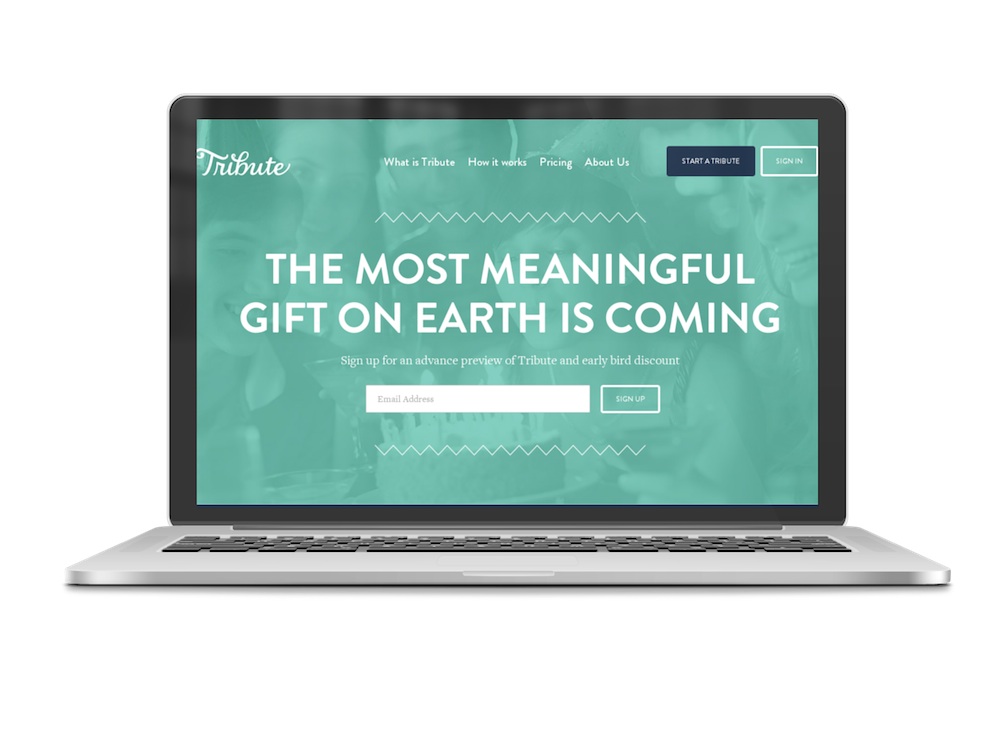
Imagine being honored and recognized by your family, closest friends and colleagues, each outpouring their appreciation and love for who you’ve been for them. While this kinda thing occasionally happens at various celebratory events, the main event that tends to spur people to get clear about their feelings for you is a memorial service–an event that for many of us is hard to fully appreciate (depending on your perspective on life-after-death). A new service called Tribute is trying to make pre-mortem expressions of love and appreciation a little easier to organize and give.

Tribute starts when an organizer sends invites to various “tribe” members of someone they want to honor. Invitees are asked to create short videos about that someone. These videos are then put into a pool, which are then available to edit and create one master video montage. Invitees can make their videos on their desktops, smartphones or any other video devices. Invitees are given regular reminders to make sure they do their videos in a timely manner.

tribute-compile

For an extra $100, you can have a Tribute concierge handle the whole process aside from providing email addresses and some basic info. When all the videos are received, compiled and edited, Tribute makes a HD mp4 file that can be given as-is or uploaded to Youtube, Vimeo or any other video service.

I watched a few Tribute videos given for various reasons: birthdays, sickness/injury recovery, wedding, etc. And while some people were clearly better at expressing themselves than others, the overall effect was moving. I would be very pleased if I received one as a gift.

Tribute is currently raising money through Kickstarter to get their website and mobile app refined and launched. When live, a standard Tribute will cost $49 and a concierge-assisted one $149 (you can still buy a $29 “Cyber Monday” promo pledge that will get you the standard Tribute).

What’s great about Tribute is that it really puts technology to good use. Whereas e-cards can sometimes feel like a lazy version of a handwritten note, Tribute does something analog tech can’t. It’s a sharable, visual, no-clutter distillation of gratitude–something that has actually been clinically proven to make people happy, something that can’t be said of most of the stuff we buy as gifts.

Study Shows the Best Things in Life Aren’t Things

Quick quiz. Employing all stereotypical notions of an average American child’s desires, which event would make him or her mentally salivate more: an upcoming trip to Disney World or the anticipation of opening Christmas presents? If we are to believe a recent Cornell study, the prospect of meeting Mickey and gang would whoop whatever wares jolly old St. Nick could whip out of his bag. We’ve written here about how buying experiences over stuff has been shown to be more satisfying. A new study goes one step further, showing that anticipating an experience is more satisfying than anticipating the acquisition of stuff.

The study’s main author, Thomas Gilovich, is no stranger to the topic. He had previously done research on retrospective enjoyment of experiences versus stuff. He found that whereas our enjoyment of stuff dissipates with time, our enjoyment of experiences tends to increase. In other words, that trip we took to Cancun in 2005 is faring much better in our minds than the iPod we bought that same year.

Gilovich et al’s new study looked at our anticipatory enjoyment of experiences and material stuff. They discovered that people reported higher levels of happiness for things like a vacation or concert than they did for things like clothes or electronics.

The even found that people reported being happier waiting in line for experiences versus stuff. Study co-author Amit Kumar said this to Science Blog:

You sometimes hear stories about people rioting, smashing windows, pepper-spraying one another, or otherwise treating others badly when they have to wait. Our work shows that this kind of behavior is much more likely in instances where people are waiting to acquire a possession than when they’re waiting for tickets to a performance or to taste the offerings at their city’s newest food truck.

The authors speculate about the reasons for all of this. It might be that people have less specific expectations of an experience versus stuff, leading to less disappointment. Or it could be that people think of experiences less competitively–getting a better or worse seat at a concert is not as big of a deal as getting or not getting one of a limited quantity of 72″ flatscreen TVs.

Regardless of the reasons, this study lends further credence to the idea that our time and dollars are best spent on things that don’t make our closets overflow. Gilovich said this, “Our research is also important to society because it suggests that overall well-being can be advanced by providing an infrastructure that affords experiences–such as parks, trails, beaches–as much as it does material consumption.”

Via Science Blog

Live Concert image via Shutterstock

Extreme Risk of Stuffocation

Forgive us if we’ve been harping on about the experience versus stuff subject. Tis that time of year. Every scene of our lives seems set to the drunk-on-eggnog caroling of marketeers, urging us to get more stuff. And we talk about it so much because we believe it’s one of the most important topics of our times. This tightly wound knot, where retail value has become inseparable with emotional value, must be undone–for the sake of our planet, wallets, closets and lives. Anyway….

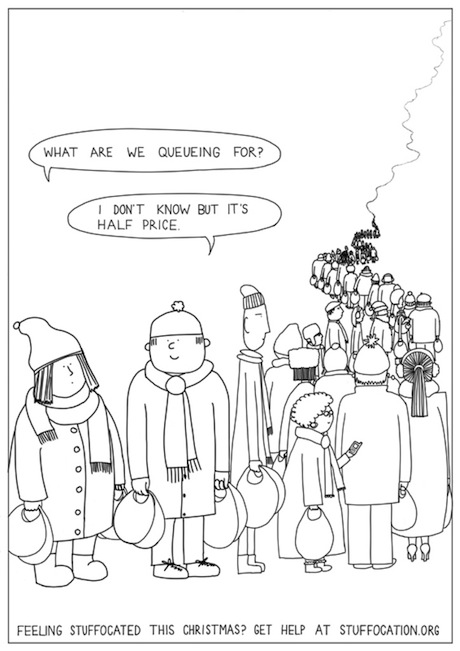
This leads us to James Wallman, a British trend forecaster who has defined and named this global material and existential crisis. He calls it “Stuffocation”–an apt name for the asphyxiating quality our addiction with stuff has produced in our planet and lives. He has penned a book of the same name, and in this short talk at the Royal Society of Arts, he outlines some of its concepts (note: the actual talk is the first 20 mins or so of video).

stuffocation

He touches on the now-familiar ecological and psychological problems that stem from stuffocation. But he also provides solutions. Rather than dissolving the world economy and moving to primitive, agrarian societies, Wallman suggests the movement from materialist to experientialist values. He envisions and predicts a new economy that supports the experience of living great lives, not the accumulation of the symbols we’ve been trained to believe denote them. To give an idea of what an experientialist economy would look like, he challenges the RSA audience to spend the same amount of money they would normally spend on stuff on experiences. E.g. take that money you’d spend on a Rolex and go on a vacation.

The book is already available in the UK. It’s US release is January 20, 2014 (full review coming soon). In the meantime, watch Wallman’s talk, check out his website and let us know what you think.

6 Gift Ideas for a Stuff-Free Mom’s Day

As you may know–or should know–this Sunday is Mother’s Day. Like most holidays, Mother’s Day can present a challenge to the full-fledged or aspiring life editor/minimalist. You want to acknowledge and show appreciation for the mother in your life, but you don’t want give a perfunctory gift that’ll end up clogging her closets with useless or ephemeral stuff. This holds true whether she’s a minimalist herself or not…actually, it’s true especially if she’s not.

We’ve said it before, but giving experiences–not stuff–is the best bet for a memorable gift. Beside the benefit of having no physical volume, giving experiences won’t seem like a political statement when given to the more maximalmist mom.

Here are a few experience-based gift ideas to create memorable, clutter-free Mother’s Day (Note: Wherever possible/logical, share the experience with mom by doing it with her. It’s about honoring her, not getting rid of her):

  1. Give a class. Cooking, yoga, sewing, woodwork…heck, Photoshop or HTML. Nothing is as durable or lasts as long as knowledge. It’s fireproof, waterproof and takes up very little space…as we saw the other day, learning something new might even extend her life.
  2. Give a walking tour. Almost every city has them on a variety of subjects; many non-urban areas have through places like gardens, parks, historical sites, etc. It’s a great way to get to know where you live while getting some exercise. Bring some food and make it a picnic.
  3. Pamper her. Send her to a day spa, purchase a professional massage, set up a fancy haircut, give Reiki sessions or a mani/pedi, depending on mom’s idea of pampering.
  4. Go on date. This works best with a mom you’re romantically involved with–especially if you are both still in the trenches of child-rearing. Get a babysitter and take her out to someplace you think she’d want to go–dinner, movie, play, park, etc. Don’t ask her where to go if you don’t have to. Mothering is rewarding, but it’s also hard work filled with many decisions. Give her a break.
  5. Write her a letter/poem. I know it sounds kinda meager, but how often do you receive a thoughtful letter or poem (not just a card) that conveys how much someone loves and cares about you? Almost never, right? Trust us, this one is a winner.
  6. Ask her what she wants. This one is for a specific type of mom: One who will actually tell you what she wants. This may or may not entail getting stuff. However it is possible to get stuff that isn’t junk. If you think there’s something she’d like but might not be forthcoming in saying what it is, be persistent or ask around. And keep a receipt.

Do you have other Mother’s Day gift ideas that don’t leave a wake of clutter? Let us know in our comments section. Thanks!

Image: “Mom Tattoo” via Shutterstock