A Smartphone for All Seasons

About a year ago, we reported on a concept smartphone called Phonebloks. It was made up of modular, replaceable, upgradeable blocks that contained the various components of the phone (battery, processors, screen, etc). We thought the phone a revolutionary idea. The average American replaces his or her cell phone every 18 months. Phonebloks would allow people to repair damaged phones or upgrade outdated ones without getting a whole new unit. But like many great concepts from small firms–especially ones that might significantly undermine the lucrative planned-obsolescence trade–we weren’t going to hold our breath waiting for its release.

Project Ara is a phone very much like Phonebloks with a couple big differences. There’s a functional (albeit still buggy) phone in existence and it’s being developed by Google’s Advanced Technology and Projects (ATAP), who plans to release a fully functioning prototype by January of 2015.
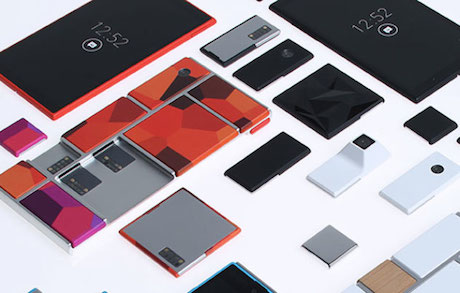
project-ara-pieces

The phone’s resemblance to Phonebloks is not coincidental. Project Ara began a few years ago over at Motorola, who was later bought by Google (who later sold Motorola to Lenovo, but retained the rights to Project Ara). Though Phonebloks released their project independently in September 2013, they started working collaboratively with the Motorola/Google team late last year.

Google’s intentions for the phone are twofold: 1. To offer an upgradeable phone that can last for several years, and 2. offer an inexpensive smartphone that can be both repaired and upgraded for the world’s vast populations. There’s no report on exact pricing, but Engadget reports that a “Grey Phone,” which includes a screen, wifi module and processor, will cost Google $50 to make. Compare that to a 16GB iPhone 5S, which costs Apple at least $199 to build according to CNBC. This basic phone would provide a platform for countless upgrades depending on user needs.

Google plans on making the phone in mini, medium and large sized versions, and because of the flexibility of its design, there will be the ability to add various different specialized “modules” like a credit card reader and pulse oximeter.

The smartphone has become an indispensable piece of equipment for billions of people, but with this ubiquity has come a major e-waste problem. While Project Ara might not be a cure-all to this problem, to us it represents a different type of design, where traits like repairability and longevity are ideals, not happy accidents. We hope to see many more products like this in the coming years.
The Smarter, Simpler Smartphone

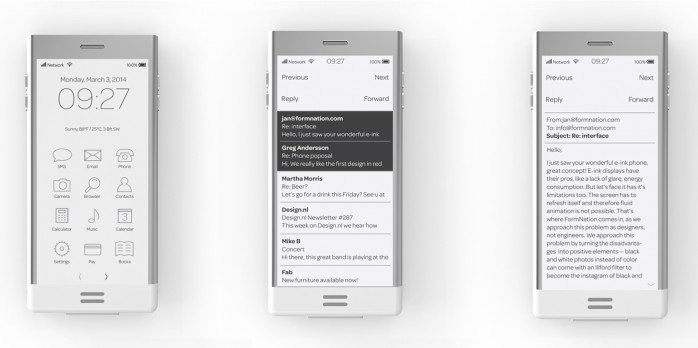
If you’re like me, you have a somewhat conflicted relationship with your smartphone. Features like GPS, email, basic web browsing and ebook reading have become indispensable. But I also find myself looking at screens filled with apps I’ll never use. And while I appreciate the Retina display on my iPhone, I don’t use it for watching movies or playing games–things that might justify its extreme energy sucking tendencies. In fact, I find myself constantly charging my phone with even the most moderate use. I would love a simple–but not too simple–smartphone that retains basic functionality but uses far less power than my iPhone. I want an E-PHONE by New York design consultancy FormNation.

The basic idea behind the concept phone is to retain most of the smartphone functionality, but use an e-ink display, which consumes a fraction of the power of LED models (the battery could last as long as a month on a single charge) as well as reducing the phone’s capabilities. It would still make calls, texts, have music, a GPS and web-browser–it would just do it in black and white and not have fluid motion graphics (video, games), which aren’t essential for many people anyway. Head designer Jan Habraken asks, “Do we really need angry birds or flying pigs?”

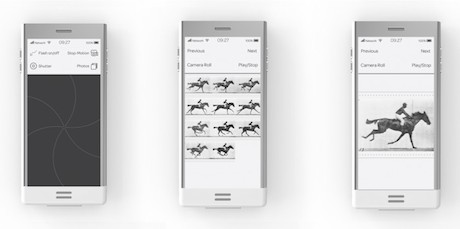
e-phone-camera

The phone would take pictures, but since the display is in black and white, it’s anyone’s guess how colors will appear in the shot when they’re downloaded. FormNation says users would enjoy “the suspense of waiting to see how their image develops,” akin to how we used to take pictures with 35mm cameras. And rather than taking videos, the E-PHONE will take stop-motion GIF’s.

To make the package even sweeter, FormNation says the E-Ink phone would only cost $175-200 dollars. Unfortunately, there are no immediate plans to manufacture the E-PHONE, but given its long battery life, nice styling and low price, we think it would have a lot of appeal.

Via PSFK

A Movement Masquerading as a Phone

A few months ago, I dropped my hand-me-down iPhone 4–a replacement for my hand-me-down first generation iPhone. Rather than forking over $80 to get my cracked screen replaced by a professional, I took the questionable suggestion from some dude at a party of fixing it myself–a procedure that took a surgeon’s hands and robotics engineering degree (my fingers don’t handle things much smaller than keyboard keys and I have a BA in English). During my “repair” I screwed something up, and when I put it back together, I had an unusable iPhone.

After a few unsuccessful attempts to get a new hand-me-down, I decided I’d get a new phone. I got on a family plan with my wife, which subsidized a new phone, forked over an additional $200 and got an iPhone 5, taking tech guru Brian Lam’s advice that if you’re going to replace your tech, might as well replace it with the latest tech.

Last week, Apple released their new iPhone 5C and 5S: phones that, if you’re to pay attention to the tech cognoscenti, are far superior to my phone. I realize in the race to stay current with tech, you can only pull ahead of the pack. You can never, ever win. But still, I thought my phone might be current for a year or so.

Of course my crappy old iPhone 5 works needlessly well for my purposes and I will not replace it until I have to, but my personal tech experience–where repair and upgrade is made virtually impossible–is the one that a project called Phonebloks is trying to address. Phonebloks is a fully customizable, upgradable, repairable, open-platform/source cell phone. The phone is designed around a grid where blocks are installed and configured depending on your needs: put a larger camera lens block if you’re a shutterbug; install a larger storage block if you like your data local; shrink it if you like your stuff in the cloud; and so on.

Unfortunately the phone is just a concept right now, but Phonebloks creator Dave Hakkens is asking for our support. Working off the crowdsource activism site Thunderclap, he’s asking that we all simultaneously express our interest in a product like Phonebloks to the mobile tech industry on October 29th. Find more info here.

While you could argue that your activism hours are better spent elsewhere, the would-be Phoneblok movement makes a statement that transcends introducing cool gadgets. It’s about a culture moving away from disposability and planned obsolescence. It’s about respect for natural resources. It’s about designing products–any product–to be usable for as long as it possibly can be. We think that’s a big deal.

via 9gag

Upgrade to the Latest Stationary Phone

We came across an interesting story by Lane Wood, a San Franciscan who, after taking an impromptu dip in a lake, accidentally drowned his iPhone 5. Rather than immediately replace the uninsured phone, Lane decided to try a month phone free–no small feat for this hyper-connected freelancer.

Though Lane did go without his phone, he didn’t go offline. He still had his computer and carried around an iPad mini rather than his phone. He used Skype, iMessage, Google+ Hangouts and other tech to keep connected. He scheduled important calls for when he knew he’d be available.

The iPad may strike some as a big cheat, but he described how pulling the tablet out to text or web-browse was far more conspicuous than the constant sneak peeks he had previously given his phone. He also pointed to the fact that he couldn’t throw the iPad in his pocket, where his phone used to sit waiting to distract.

He writes at length about his phone’s vibrate mode, which he called “the secret killer of mental clarity.” For many of us (such as this author), we think we’re being pretty considerate leaving our phones on vibrate. But even though they are inaudible to all but us, Lane accurately described how his previous insistence to heed the vibration was almost as insidious as an audible ring. The constant “temper tantrum” of a phone’s vibrator begs us to divert our attention from the present moment to see who’s trying to contact us (it’s never that important, is it?). Lane replaced the persistent pocket vibration for the blissful unawareness of incoming texts, emails and calls on his iPad stowed in his bag.

He also noted that he used the iPad for taking photos. Once again, pulling out the ungainly device made him more judicious about what was and was not photo-worthy.

Lane’s experiment is more interesting to us because he didn’t go totally offline; that proposition is a bit extreme for most of us. What his experiment does is call into question the necessity for cell phones at all. Many of wake up near our tablets. We commute to be in front of our work computers. Maybe we travel with mobile hotspots. We come home and are near our computers once again. Every one of these pieces of tech have the ability to make and receive calls, texts and emails (through Skype, Google Voice, iMessage, Facetime, etc). What if we thought used these non-phone-devices as our “landline” phones?

We won’t minimize the need for some of us to have cellphones. They’re necessary hardware for many professions. But for the rest, what are the real consequences of being unreachable for a few hours a day?

Also, from a historic standpoint, Lane’s experiment is really no different than the way we all lived 30 years ago–a dark age when we had to be at home or at work to make and receive calls, when we made plans in advance, when our every waking moment wasn’t subject to a cellular invasion. Remember, James Joyce wrote Ulysses without a cellphone and Stanley Kubrick directed “2001: A Space Odyssey” without one too (we assume). Life wasn’t so bad or unproductive back then.

All this said, Lane did buy a new phone, calling his experiment a “disruption for [his] family, friends and clients.” This author, despite the questions Lane evokes, feels no urge to ditch my phone.

For those of us not ready to lose our phone, Lane did offer a few “discipline hacks” to curb MPU (mindless phone use) without giving up your phone:

  1. Turn your screen brightness all the way up when you go out at night. You will be very painfully aware of the fact that you’re using a phone and it will drain your battery. These consequences will help you use your phone only when necessary, and your friends will be more likely to call you out for having your phone out.
  2. Experiment with using Do Not Disturb functionality and turn your notifications off. Don’t reward your phone for throwing tantrums.
  3. Make an agreement with family and friends to call each other out for MPU.

What do you think? Would you, do you live without a cellphone? Would you, could you use your computer and/or tablet as your landline? Let us know what you think in our comments section below.

Screaming angry woman image via Shutterstock