Find Joy with Less, Win a Book

We’ve long been fans of Francine Jay, the writer behind Miss Minimalist and the “One Less Gift Certificate.” Jay just released a new book entitled “The Joy of Less: A Minimalist Guide to Declutter, Organize, and Simplify” and we wanted to spread the good word. While applicable to all levels of minimalists, we found the book especially useful for those just getting started or perhaps looking to reach the next level of less-ness. In particular, she introduces reader to her “STREAMLINE” method of paring down. Streamline is an acronym:

  • S  Start over
  • T  Trash, Treasure, or Transfer
  • R  Reason for each item
  • E  Everything in its place
  • A  All surfaces clear
  • M Modules
  • L  Limits
  • I  If one comes in, one goes out N Narrow it down
  • E Everyday maintenance

In her clear prose, she expands on each of these topics and gives practical instructions on tackling big messes.

Many who start the process of decluttering are greeted by a pall of doom. Too often, their focus is on the hardship of getting rid of stuff: the emotional challenges of letting go of stuff we have strong emotional bonds with, the toil of purging. Jay does a good job of stressing the liberation one gets on the other side: the peace, ease and freedom of having fewer things to deal with. She even says that removing can get a bit addictive. She writes:

What I expected to be a tedious and rather onerous task turned out to be exhilarating. I was instantly addicted. I decluttered in the morning; I decluttered in the evening; I decluttered on the weekends; I decluttered in my dreams (really!). When I wasn’t actually decluttering, I was planning what I could declutter next. It’s as if I could feel the physical weight being lifted from my shoulders. After I’d been particularly productive, I’d twirl around in my newly empty space with a huge grin on my face.”

If you’d like to experience the joy of less firsthand, we are giving away a hardcopy of The Joy of Less. Leave a comment below if you’d like to be entered (you can also leave a comment without being entered by saying “do not enter”). We will draw a name at random (our commenting system takes your email address, so please do not leave your name or email). Drawing will close end of day Saturday April 30 2016.

Thoreau’s Walden, Made Readable

One of the–if not the–seminal texts of simple living is Henry David Thoreau’s Walden. It’s the tale of a man who moves alone to the woods, lives in a small cabin to find his truth. It’s also a treatise on simple living, connecting with the earth and oneself, of removing oneself from modern society’s misbegotten systems and ideals…or so we’ve heard. If you’re like us, you’re familiar with the many Thoreauvian axioms (“Most men live lives of quiet desperation [not the actual quote],” “My greatest skill in life has been to want but little” and so on), but, when pressed, must confess that you haven’t actually read the book. Take this passage from the first line of second paragraph of the book:

I should not obtrude my affairs so much on the notice of my readers if very particular inquiries had not been made by my townsmen concerning my mode of life, which some would call impertinent, though they do not appear to me at all impertinent, but, considering the circumstances, very natural and pertinent.

It goes on like this for 400 or so pages. It’s not a critique of Thoreau’s writing ability. The book was written almost 170 years ago. This was how people wrote and spoke back then. But its arcane prose–not to mention its sometimes offensive references–is damn near indecipherable to the modern reader. Good for soundbites, but not necessarily for sustained reading.

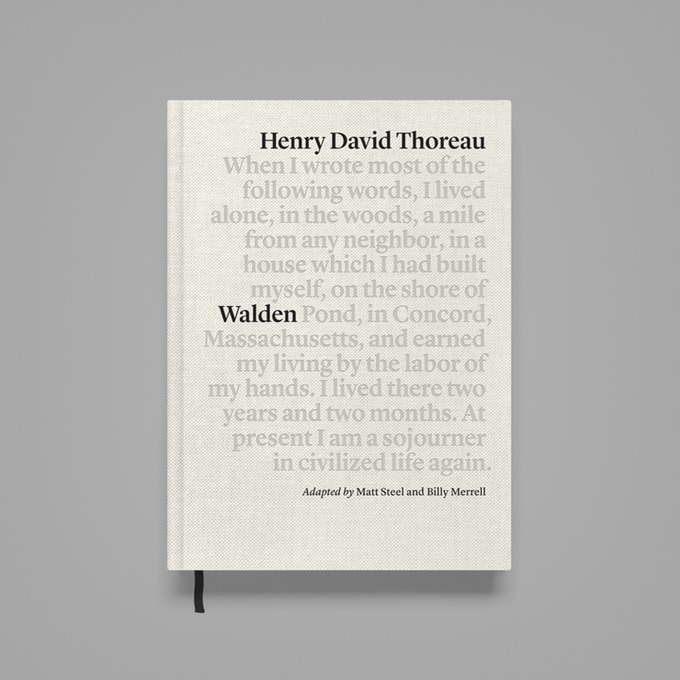
A new Kickstarter project seeks to translate Walden for the modern reader. Launched by designer Matt Steel along with writer and editor Billy Merrell and illustrator Brooks Salzwedel, The New Walden is a new take on Thoreau’s timeless wisdom.

In an essay on the site Medium, Steel explains his initial motivation:

The first time I tried to read Walden, I flunked out about halfway through the first chapter. Initially attracted by the concept of Thoreau’s experiment, I found myself quickly entangled in a dense thicket of language. I had expected to hear about the cabin he built in the first chapter; instead, I encountered an essay on economics and societal vice, with many twists and turns.

Eventually, he made it through the book and it rocked his world. He explains:

In Walden’s first chapter, Thoreau delivered the most eloquent and scathing criticism of consumerism that I’ve ever read. He saw that many of his fellow men and women were spending their best moments straining after far more than they needed; chasing after possessions and comforts that would never satisfy their deepest longings. He discovered that when we reject greed, simplify our lives, and pursue living in the present, a quiet revolution takes place inside the spirit and ripples outward into the lives of others.

The book’s impact inspired him to create a modern version, one that had updated language and was beautifully designed and illustrated.

walden-text

Steel is quick to point out that he is not changing the content of Walden, just the form. “This version will be neither abridged nor dumbed down,” he writes. “It will still read and feel like Thoreau; still set in the 1840s. I am not replacing telegraphs with emails, nor wagons with SUVs…Walden is dense, layered, and complex….So when I talk about removing literary obstacles from Walden, I’m only referring to structures, syntax, and words that have fallen out of use since 1854.”

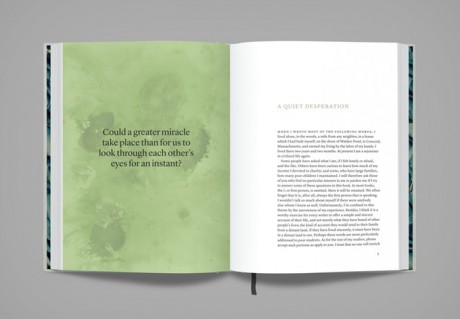
The beautiful hardbound book will not only rework the text, but will be carefully assembled, designed and illustrated, in an attempt to make it appealing to readers of today and 100 years from now. 

The campaign started today. A $15 pledge will get you a PDF version and $38 will get you a signed and numbered early bird copy. Visit the campaign page for more information. 

Read Faster

Some people devour words, reading books and articles at a breakneck pace. I am not one of those people. I am a slow reader. I mentally articulate every word, making reading a slow, if enjoyable, process. I have long lamented how my thirst for knowledge has never been served by my ability to drink it in. A nifty app called Spritz might just be an answer for my drinking problem.

Spritz is an app and browser extension that takes text and puts it into a dialogue box. The box shows each word, focusing on the “Optimal Recognition Point” or ORP, which is basically the physical location where the brain imbibes a word’s meaning. Spritz highlights that ORP–usually the middle letter in a word–and your brain to take in the rest of the word naturally. By keeping the flashing words in a box, your eyes don’t fish around the page for words. Spritz claims reading is 20% information processing and 80% eye movement. Words can be flashed at paces ranging from 40-1000 words per minute.

We are a bit leery of Spritz’s “Science” page, which introduced a number of pseudo-science, made-up terms like ORP. But casting aside the need for legit data about reading comprehension, having used Spritz on a number of longer-form web articles, I found I was able to power through text very quickly. In particular, the lack of eye movement made reading less strenuous.

The main application for Spritz is online text, where adding the “Spritzlet” is as easy as dragging a url into your bookmark bar. Spritz is pre-installed on the new Samsung Galaxy S5 and the Galaxy Gear 2 smartwatch and there are several apps for iOS and Android that use the Spritz technology, though it does not work with the Kindle app and other places we think it’d be ideal (sounds like they’re working on it). Even if it’s just for powering through digital content at a quicker clip, Spritz looks like it could be very useful tool.

Terror, Cold Showers and Living Life to Its Fullest

What is it that keeps us from doing the things we most want to do in life? On the surface, we have myriad reasons: lack of time, money, skill, natural aptitude, poor timing, a spouse, kids, etc. But when we dig a little deeper, we realize it’s usually garden variety fear that’s holding us back. Point of fact, we aren’t even afraid of doing stuff. Consciously or not, we are afraid of the discomfort we anticipate we will feel when we do that stuff–it’s basically that fear of fear FDR was talking about. Rather than enduring the few, brief, uncomfortable pinpricks necessary to confront our fears and move forward, many of us accept slow-drip fear, ongoing, mild discomfort, existential inertia and lives half-lived (sorry if that sounds harsh).

The capacity to act in the face of fear and discomfort is at the heart of a short (free!) eBook called “The Flinch” by Julien Smith (incidentally, the guy behind Breather).

The Flinch’s thesis is pretty straightforward: years of evolution have given humans the flinch, a biological mechanism designed to warn us of and keep us away from danger. Back in the day, we would flinch at an approaching animal, for example, because it might cause us bodily harm (this particular flinch might serve us in the present day, I suppose). We flinched at the novel and unknown, because in that unknown may lie danger. This evolutionary mechanism, so useful when being chased by a pack of hyenas, has become a total liability in the modern world where the vast majority of threats are more perceptual than actual. We flinch at having a tough conversation, starting a new project, asking for help, etc. Smith says this of our reaction to flinch-worthy stimuli:

When coming across something they know will make them flinch, most people have been trained to refuse the challenge and turn back. It’s a reaction that brings up old memories and haunts you with them. It tightens your chest and makes you want to run. It does whatever it must do to prevent you from moving forward. If the flinch works, you can’t do the work that matters because the fear it creates is too strong.

Yet these flinches and their associative fears of the unknown, the foreshadowing of danger based on memories of past injuries, have little or no basis in what’s going on in the present moment, much less real danger. Rarely does anything truly awful–or anything that can’t be reversed fairly easily–happen when we face the things that scares us. We are flinching at our imaginations.

All of this wouldn’t be that big of a deal were it not for the impact. In our avoidance of the flinch, we avoid our lives. As Smith writes, there are no good stories without overcoming our flinch mechanism. He writes:

Behind every moment of courage was a man or woman who faced a difficult internal struggle. When they face it, it becomes an amazing story. They become legends. But if they turn away from the flinch, their stories are unexceptional. They’re like everyone else. They vanish.

What Smith proposes is mastering the flinch. Rather than overcoming it through intellect and will power, he gives homework assignments that put you face-to-face with your flinch mechanism. By far the most provocative is the first assignment. He writes:

Walk up to your shower, and turn on the cold water. Wait a second; then test it to make sure it’s as cold as possible.

Do you see what’s coming? If you do, you should tense up immediately. You should feel it in your chest. You might start laughing to release the tension—and you haven’t even stepped inside. You’re predicting a flinch that hasn’t happened yet. You’re already anxious about it—about something that hasn’t happened and won’t kill you—anxious about something that barely hurts at all.

Ok, do it. Now is the time to step in the shower.

As the cold water hits you, you might shout or squirm. But the discomfort lasts only a second. You quickly get used to it. You get comfortable with cold, instead of trying to avoid it. You put yourself in the path of the shower to speed up the adjustment process.

This is not an exercise in masochism. It’s a way of training yourself, of “seeing the flinch and going forward, not rationalizing your fear and stepping away.” It’s a way to develop a physiological tolerance for facing the things that most scare us–things that pose no real threat (trust me, I have taken prescribed cold showers and lived to tell about it).

[divider]

Editing our lives means evaluating every facet of our lives, determining whether they contribute or detract from our ability to live to our fullest capacity. Extraneous possessions and too much space, in our opinion, can detract from that objective; in the act of managing, purchasing and paying attention to those things, we might take our eyes off the prize of connecting deeply with others, finding meaningful work, etc. But few things cheat us of the minutes, hours, days and years of our lives like fear. The Flinch, while not promising to rid us of fear, does provide a nice little set of tools for dealing and not being stopped by it.