Woman Plunges into Deep End of Downsizing

I stood staring at three framed documents: My veterinary school diploma, the certificate that acknowledges the completion of my residency and my board certification in small animal internal medicine. What was I going to do with them? I am nearing the end of a two year process of radical downsizing, starting as a big old house person, and now living in the smallest space of my life.

In the Beginning

The process really started in 2007 when I moved from upstate New York to Seattle. The two homes I had owned were a 1890’s Queen Anne, and a 1920’s colonial. As a lover of old homes I had collected a large amount of antiques, many of which I had restored myself and those countless hours made them feel like a part of me.

I knew I would never be able to afford the same size and style of homes in Seattle, and the cost of the moving truck had to be considered. It was initially a painful process to part with things that I had put so much sweat equity into, but it started to get easier as the moving date arrived and the need to clear the house was immediate. The majority of the antiques were sold, with only a couple of pieces with strong sentimental value retained.

A New Life and a Different Perspective

Despite liquidating rooms of furniture, I filled a rented two bedroom apartment to the brim, with barely any space to move around. Once I found a condo to buy, I purged even more items to lessen the clutter and I had created some space which felt good. I had gone from 2300 sf to 1200 sf, but was starting to realize it was still fairly large for a single person.
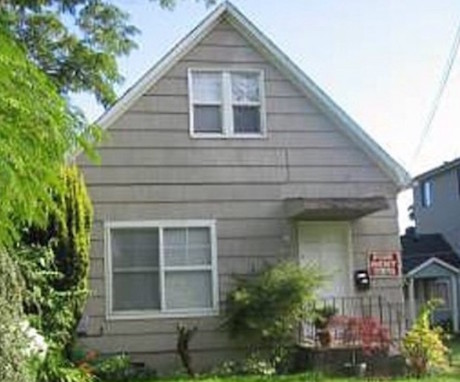
dana-house

Things changed in 2013 when I accepted a job that allowed me to work from home and have more free time. I also now had the freedom to choose to live wherever I wanted, which was closer to the marina. I had learned to sail since coming to Seattle and I was hooked. Moving into the city from the suburbs presented new challenges in affordability, and again a downsize was in order. There were more trips to Goodwill, items gifted to friends, shelves of CDs converted to digital music, and boxes of books donated. Parting with possessions had gotten a little easier, and living without as much clutter felt better. I was down to 1000 square feet.

I never thought that I would be buying my own little sailboat, but within a year of the move, I did.  I had been in a sailing club and chartered, which had been perfect for my needs. I loved overnight and multi-day trips, and now that I was so near the water all the time, the need to have my own was intense. The deal I made with myself was that I needed to make room in the budget for moorage, so that moorage and rent were no more than my current rent.

Apparently another downsize was in order and I found a 350 sf studio. I had some tough decisions to make. A family antique radio cabinet and an old barristers bookcase were placed with good friends. Couch, loveseat, patio and dining furniture were given away. Clothing and shoes had become very easy to pare down, but books were always far harder to let go, but I did it.

dana-books

Unplanned and the Biggest Change Yet

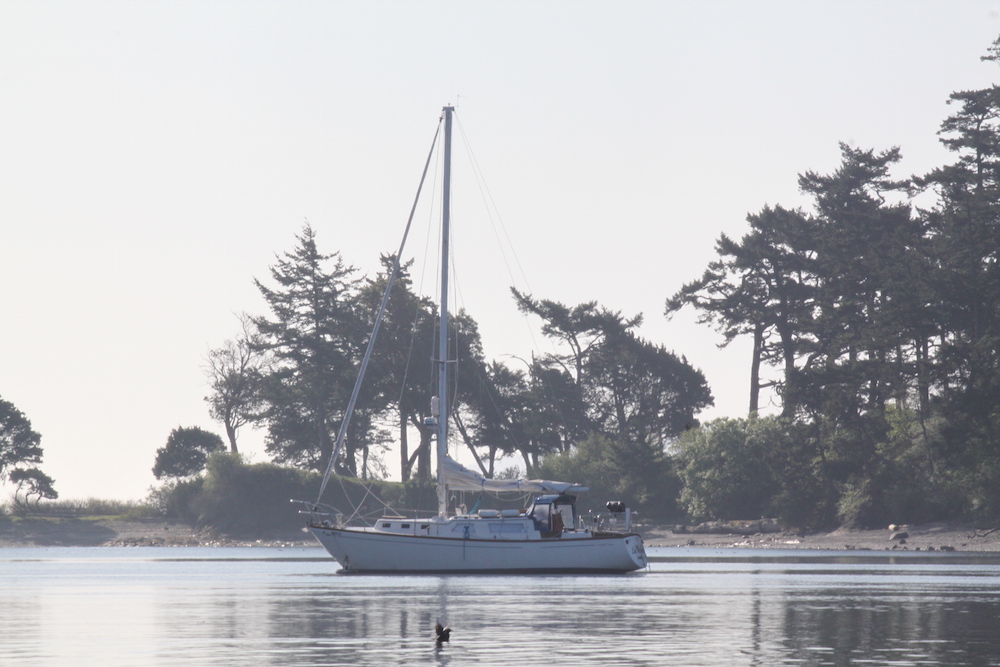
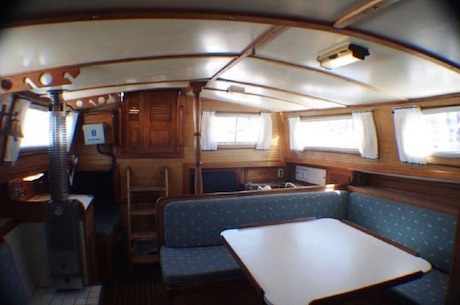
I loved my little studio, and I would have stayed there, but I liked my 32′ boat better. I found myself staying there more and more nights, and working there during the day. I didn’t want to go back to my comfortable studio. I preferred sleeping nestled in my cozy V-berth, even with the inconveniences that come with living on a boat. I was essentially living aboard, but with the safety net of a place on land which contained the last of my “stuff”. It didn’t make sense to pay for an apartment I wasn’t living in–it had to go.
dana-cabin

I am now down to less than 200 square feet with a 4′ x 4.5′ rented storage unit for boat related items, off season clothing, and some textbooks. The loss of my safety net is frightening, a little bit like a free fall, but at the same time it is exhilarating.

If I am very straight with myself, the diplomas and yearbooks serve no real purpose. When you live on a small boat, every item needs to have multiple uses and take up minimal space. Diplomas, yearbooks and old photos can be scanned.

I am more mobile and more free than I have ever been, and that is what I need to focus on. Yes, I’m walking into the unknown, but it is definitely not going to be boring.

Dana Brooks is an adventurer, veterinarian, sailor and cat-lover. You can find out more about her, her adventures, her boat and her cat at tinysails.com

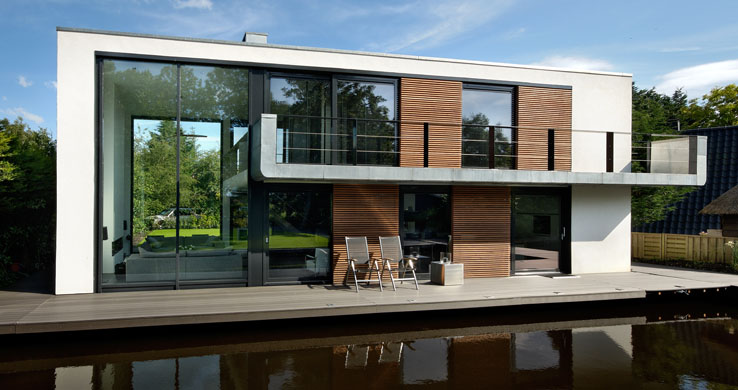
Hope, and Homes, Float with Houseboats

On this site we’ve heard tales of folks trading in their landlubber homes for sail and motorboat-based living. But most boats weren’t made to be inhabited fulltime–even we have to admit that living out of a 50 sq ft cabin might get oppressive. Houseboats, aka “floating homes” (a more succinct term), are another story. They are normally not boats that become homes, but rather homes that happen to be boats, or at least float.

Houseboats are found anywhere there’s a lot of watery real estate. We would consider them “edited” housing because, even though there are no size restrictions (look at cruise ships), they lean toward compact dimensions and efficient design. Limited mooring space, boat-based hulls and the practical realities of maintaining what is, for all intents and purposes, a boat, favor keeping things compact and shipshape. The below video of Tracy Metro’s 1975 Harbor Master houseboat is a nice example of that.

While there are active houseboat communities in places like Sausalito, Portland and British Columbia, the most popular spot for floating homes in the North America is Seattle (helped a lot by Tom Hanks and Meg Ryan). The city once boasted several thousand houseboats, which started off as crude housing for lumberjacks and seaside workers in the early 20th Century. According to the Seattle Floating Home Association (SFH), the Great Depression spurred a golden age for houseboat building and occupancy:

The real explosion of houseboats started in the 1930’s when people, desperately seeking cheap places to live, collected old cedar logs and debris floating around the lakes and fashioned themselves “temporary” quarters to last out the depression. The vast majority of the historic houseboats still floating today are from this period.

The following 70 years were not so kind to the houseboat. As the economy rallied, people moved back ashore. The houseboat holdouts were considered countercultural types and became unpopular with the city, who wanted to replace the houseboats and their inhabitants with over-the-water apartments and businesses (none of this was helped by a lack of proper sewage until the 1960s).

After a few decades of battles between houseboaters, the city and moorage owners, the Seattle houseboat community now has rights and a proper infrastructure. There are around 500 houseboats in Seattle, all located on Lake Union and Portage Bay. A recently opened exhibit at Seattles Museum of History and Industry (MOHAI) called “Still Afloat: Seattle’s Floating Homes,” celebrates the past and present of this quirky dwelling type.

Europe boasts a number of actively-lived-in houseboats as well (i.e. not recreational ones, which are plentiful). In the UK “narrowboat” houseboats–often only 7′ wide–float along the banks of the country’s inner canals. Other countries like Holland, France, Germany and Belgium have similar, canal-based, narrow barge houseboats. These housing types are becoming increasingly rare as the cost of mooring increases.

Moving beyond associations with boats, Holland is looking toward floating homes as a rising-sea level-proof housing solution. In fact, there is a whole school of floating architecture arising out of the need to future proof that elevation-deprived country. One of the more notable names is Waterstudios, which has created a number of structures for countries like Holland and the Maldives, that are particularly threatened by sea level change.

Whether motivated by hard times during the Depression or a precarious environmental pattern, they show how necessity is the mother of invention. Rather than being a hindrance to innovation, the restrictions inherent in houseboats, like other compact housing, seem to it.

images via MOHAI and Waterstudios

Man Goes Into Deep End in Quest to Edit Life

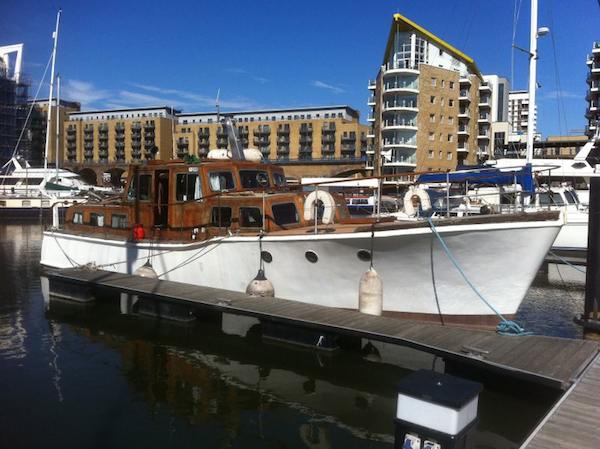
Each week we are profiling real people who are editing their lives for more freedom and happiness. This week we hear from Mike, who is giving up his spacious Bath, England flat to live out his dream, living aboard a 42 ft “Gentleman Cruiser” motorboat, while creating a simpler, more financially sane life.

Tell us about yourself.

My name is Mike. I’m 52. I work as an IT consultant, part time film extra (you can see me briefly in Harry Potter and The Order of the Phoenix) and occasional performance artist (Captain Teapot, I took part in a project on the empty plinth in Trafalgar Square in 2009). I’m single and currently living in the UK in the Georgian city of Bath.

What makes your life an ‘edited’ one?

My life is becoming an edited one due to my imminent move from a large apartment in Bath, ceiling heights nearly 12 ft, living room and bedrooms are both 18 ft x 14 ft, built in the late 1700’s. I’m moving to London and I’ll be living on a motorboat that is only 42 ft x 12 ft with a ceiling height of 6 ft. There is no room for freestanding furniture, but there is some built in furniture, a table and 3 bunks and of course a shower and galley kitchen.

living rooms now and later

How long have you been living this way, and do see yourself continuing to live this way?

I’ve been living in houses and apartments all of my life. I’ve never lived on a boat before, but have sailed a little. I see my move to the boat as a long term one, perhaps a permanent one. It was motivated by a long held dream of a life afloat and by the fact that property prices in the UK are too high.

What are the biggest advantages of living this way?

Advantages are more money and time, as most of my work in the past has been in central London I’ll be able commute using public transport and on good days I’ll be able to walk to work.

What are the biggest challenges?

The biggest challenges are the reduced space, plumbing aboard a boat is not as straightforward as it is in an apartment, water has to be pumped aboard. Also I’ll probably have to move the boat on a regular basis, residential moorings in London are difficult to find so I’ll have to relocate every few months for a while until I can find one..

Do you think you could maintain this lifestyle with a family?

It could be done with a family, but I’d need a bigger boat.

What is the number one suggestion you’d give to someone looking edit their lives?

Look carefully at what you think you need. If its been sitting in a box out of sight for years, you don’t need it. I had many items that belonged to my youngest brother who died several years ago, a castle and soldiers I bought him for Christmas when he was 8 years old, and some of his personal items. I was keeping them for sentimental reasons but realised that he wasn’t in them. He’s in my heart, in me and always will be. The things are ultimately not important and now someone else can enjoy them. Items that belonged to him I gave to local charity shops and I had a home sale that enabled me to sell most of the furniture and other items I’ve accumulated over the years and a poster for the film ‘Charade’ has gone to an auction in London.

What item(s) have made your lifestyle easier?

A computer has made a big difference, CD’s, DVD’s and even books are no longer neccessary now that they can be stored on a laptop that fits into a small bag. Also the fact that I’m currently single has helped. I’m the only one that I have to consider, it wouldn’t be quite so easy with a partner or family.

Do you have any design or architectural suggestions derived from your lifestyle?

A boat is made for a purpose, size is limited and there’s a purity to it that I like, also there is a little romance about life on a boat. I intend to do a little work to her and will have good quality fabrics etc on board and I can do that because the boat is small. I’ve lived in many different places over the years but could never afford to decorate them properly, corners were cut and the sheer size of the places meant that decorating was almost a never ending task. With the boat I can decorate easily and afford to do it well.

Anything else?

If your looking for boats for sale in the UK www.apolloduck.com. For information about moorings www.bwml.co.uk.