SF Startup Filling in Urban Cracks with Office Space

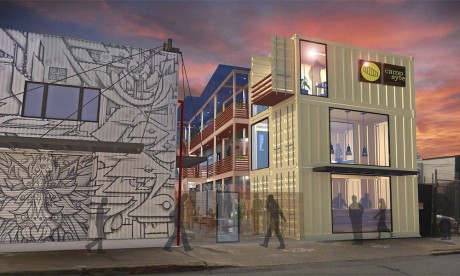
The small space conversation is generally in reference to housing size. Yes housing is the single largest category of a person’s spatial use, but it’s not the only one. In particular, our work environments can significantly increase our square foot counts and contribute to sprawl and large carbon footprints. San Francisco startup Campsyte has created a compact, modular, easy-install office solution that might help make more edited offices.  

campsyte-building

Similar to KASITA and other prefab housing solutions we’ve seen, Campsyte quickly sets up on unused or underused lots. Using shipping container modules, Campsyte can deploy insta-offices fully equipped with utilities, internet, furnishings, janitorial and coffee/drink service, all of which are included in rent. Campsyte CMO Allen Wong explained to SF Gate that they can set up offices in lots that landowners might not be able to afford to develop, adding income streams that would not otherwise exist. The rapid deployment, cheap construction and development costs are then passed on to the renter. And unlike conventional offices, which often require five year leases, Campsyte has short term leasing, perfect for startups.

A great deal of sprawl can be linked to the migration of office spaces away from city centers. By filling up urban land gaps, Campsyte promises to provide affordable office space and sprawl repellent. 

A Desk for the Lightweight Worker

The Ergotron Hub cabinet/desk is a slick little piece of furniture if you’re looking for an attractive, lightweight workstation. It comes in two varieties with two sizes: the Hub27 measures 27.3″ w × 20.3″ h and the Hub24 measures 24.8″ w × 16.5″ h. Both units are only 3” deep when closed, so they barely stick out of the wall. 3” is plenty to stow a laptop, phone, tablet, essential stationary and a few pieces of paper (which is all you really want anyway, am I right?).

Hub27-LS-dry-erase

The glass desktop, when closed, is lockable and doubles as a dry erase board. It is rated to hold 25 lbs, but a Ergotron rep told me, unofficially, that this is very conservative and that it can accommodate up to 100 lbs, though I wouldn’t want to try it, nor could I see a possible reason to load it with so much weight. The desk height can also be vertically adjusted several inches to accommodate different user-heights. Depending on where it’s mounted, the Hubs can serve as a sitting or standing desk.

Hub27-LS-lever

What’s coolest to me about the Hubs are they are responding to the changing nature of how people use desks. Most of today’s desks are designed around filing cabinets, stationery storage, printers and CPUs with monitors. While many people still use these things, more and more people (like me) only need a place to use and store our laptops and a few documents. For us, a minimal desk like the Hub is pretty perfect.

The Hub27 retails for $350 and has a heavy duty steel frame. The Hub24 is $200 and features a high quality plastic frame. Go to Ergotron Home’s website for more info.

Insta-Offices for the Remote Worker

Working remotely is great because you can cut out commuting time, it makes you less bound to 9-5 workaday hours, it often allows you to work from anywhere in the world, you can spend more time with family and so on. But it can also be isolating, your home can be a minefield of distraction and even if you want to get out, you might not live near a coffee shop that’s cool with people hanging out all day after ordering a small coffee. A new venture called SpareChair is offering an alternative to work-from-home isolation and all-day Starbucks loitering, hooking you up with other remote workers to create insta-offices.

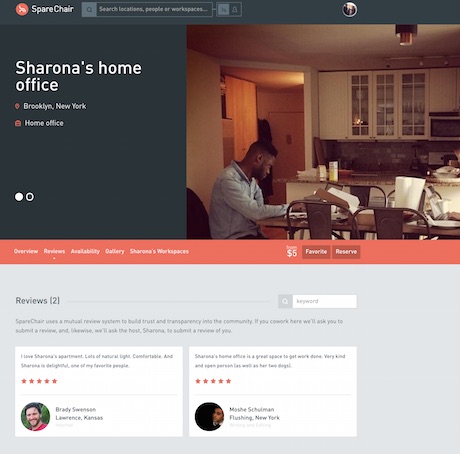
SpareChair works a lot like Airbnb, letting people open up their homes to the public for the purposes of coworking. Like Airbnb, SpareChair’s website has details about the space’s features (wifi, coffee, etc) and pictures of the space itself. There are peer reviews of both spaces and members to make sure everyone maintains a high level of quality and decorum.
spare-chair

To book a coworking session, you first make a profile with your personal info: profession, short bio, etc. Then search for a space and navigate to its page where there will be a schedule of available times and vacancies. From there, request a session (e.g. Tuesday, March 17 10am-1pm), enter payment info and check out. Like Airbnb, the site’s host has to confirm the reservation in case several people reserve at the same time or there’s an unforeseen scheduling conflict. Many of the private spaces are as cheap as $5 for an all day session and few are more than $15 (SpareChair charges a small fee). They also have numerous coworking spaces on their network; these tend to run around $30/day–still pretty cheap if this is your primary office.

SpareChair co-founder Sharona Coutts told us she started SpareChair because she needed it. “I work from home and while I like the concept of coworking spaces, I didn’t necessarily want to go into one every day, or even randomly, since you don’t necessarily get to interact with people when you’re there. Plus, at $35 a day, it can be pricey.”

SpareChair wants to be more than a space to work; they are out to create community and help people advance their careers. “We had a writer’s coworking session on Tuesday night, and our members were able to help each other work on drafts, refine ideas and focus on writing for three hours,” Coutts told us. “Because we know what field each of our members works in, we can curate specialized events like that, and we can also pair people with each other, and with the right host. So, for example, if you’re a freelance designer, you could search for hosts who are designers or design firms, and go and cowork with them for a day, week or month. It’s pretty potent networking, without the awkwardness.”

SpareChair is still in beta mode so you’ll need to request an invite, but the site is expanding quickly and already has locations in NYC, the Bay Area, Santa Cruz, LA, Chicago, Boulder CO, Nashville, Minneapolis and others. They’ve also got requests from more than 40 countries, including Brazil, Norway, the UK and Thailand. Coutts sees big things for this simple idea. “SpareChair will be the world’s biggest and most meaningful community–both online and off–of people who work from home. We are building a space for people to cowork and network, as well as to monetize under-utilized space. We haven’t paid for any marketing. Our community in the US has grown to 700 strong based solely on word of mouth and press!”

4 Pieces of Furniture that Mix Business with Leisure

For today’s work-at-home professional there’s often a fuzzy division between home and work life. Particularly in small spaces without dedicated offices, there’s an imperative to create some division lest we sleep through our workday or work through our sleep day. Multifunctional furniture can do this, creating distinct functions for different duties. Here are a few pieces that shift a room’s focus from work to leisure or vice versa.

BLESS

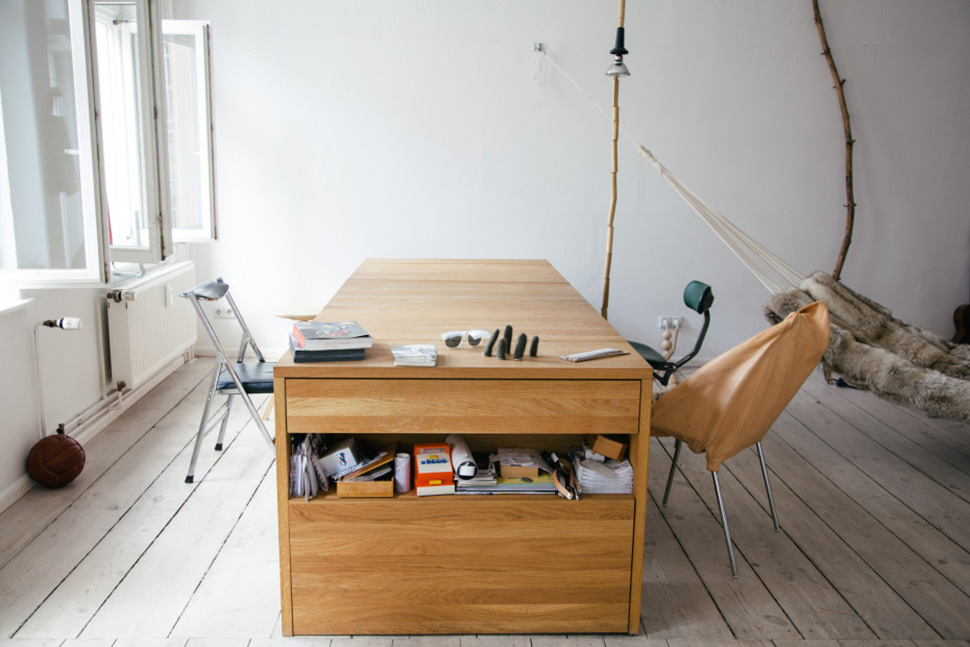
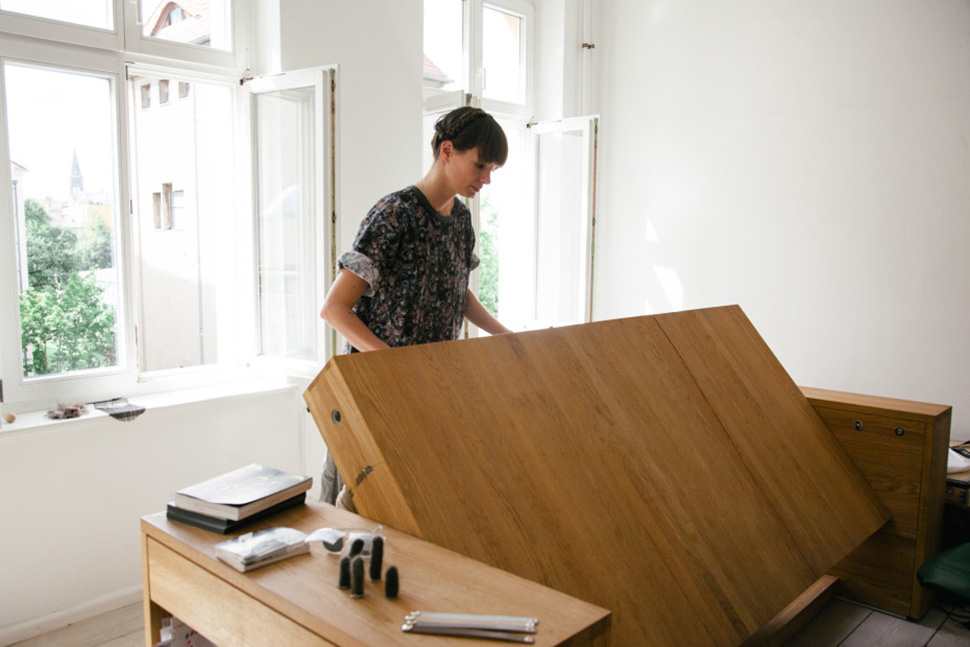
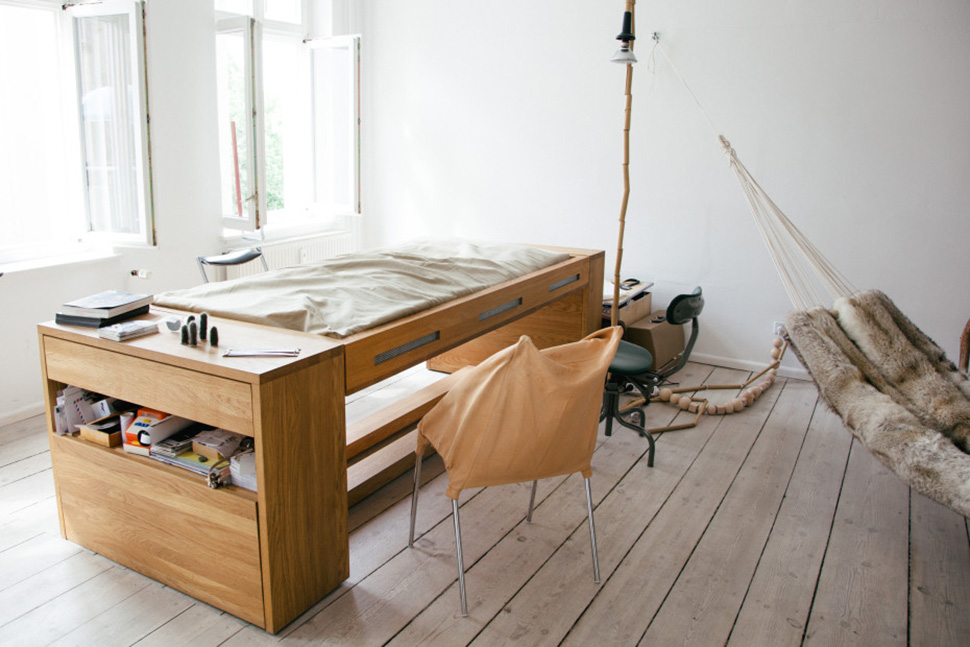
Berlin-based BLESS design studio made this table whose top flips over to convert into a single bed. The table/bed, which features a bunch of storage, would be great for artists who need large work surfaces or for people who have teams. It would also make a good dining table. (It might not be good for people with partners). Gizmodo reports that the unit is available through BLESS’s seldom-updated, confounding website. We’ll take their word for it.

Vitra

vitra

Venerated Swiss furniture maker Vitra will be showing off this cool cubicle concept at this week’s Orgatec tradeshow in Cologne, Germany. Inside the cube is a surface that can raised and lowered to be used as sofa, conventional desk or standing desk. While the piece does have a somewhat office-y vibe, we could imagine having one of these in the house as a dedicated office space. We could also see lengthening it to make a bed.

Resource Furniture Ulisse

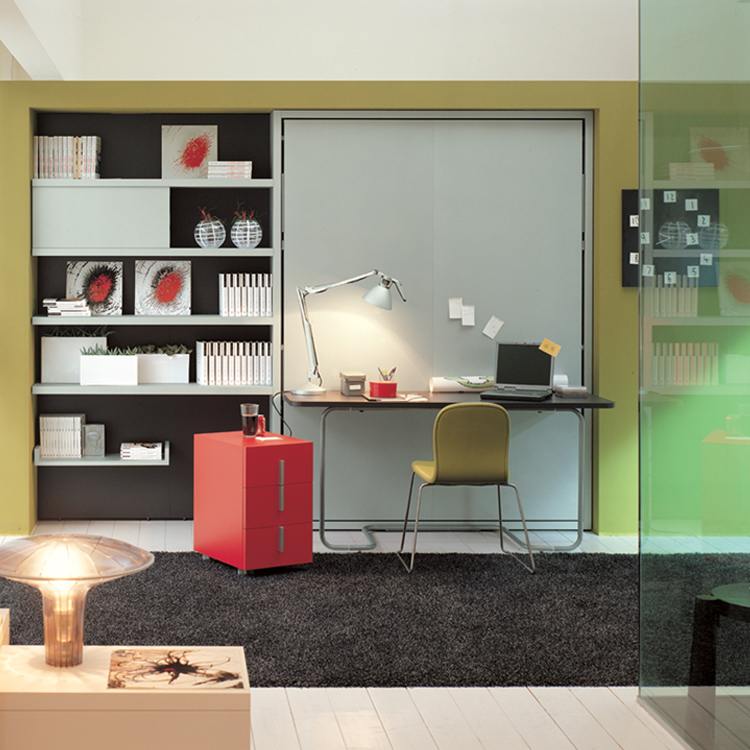
Resource furniture makes a number of wall-bed/desk or tables. It houses a queen size bed and has a desk on the front. Prices start at $4,150.

Studio NL

studio-nl-desk-bed-4 studio-nl-desk-bed

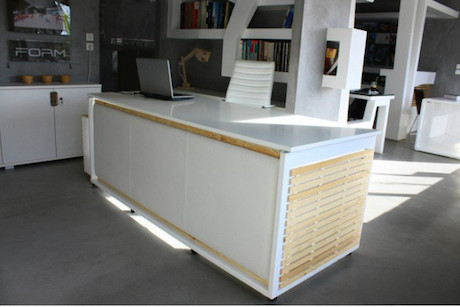
The George Constanza, ahem, 1,6 S.M. of Life line by Studio NL features a single bed underneath a desk top. They’ve included a place for a computer monitor/tv and the head of the desk/bed opens to provide ventilation or something. This design seems best suited for the office worker with a horrible home life.

Desk. Edited.

From pen and paper to standard typewriter to electric typewriter to large computers to tube monitors to LCD monitors–the loads our desks bear has changed a great deal in the last 100 years. But today many of us have done away with almost all paper and we can get by with a tablet or laptop for a good portion of our work duties. If that’s the case, why use a desk designed to carry reams of paper and a big CPU and monitor? We found a few desks that better accommodate this new lightweight office.

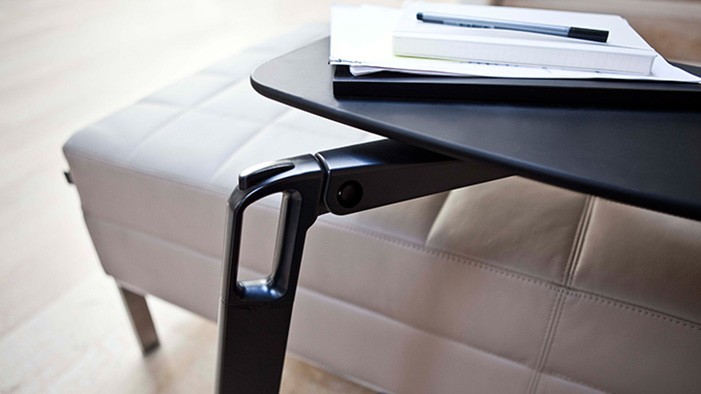
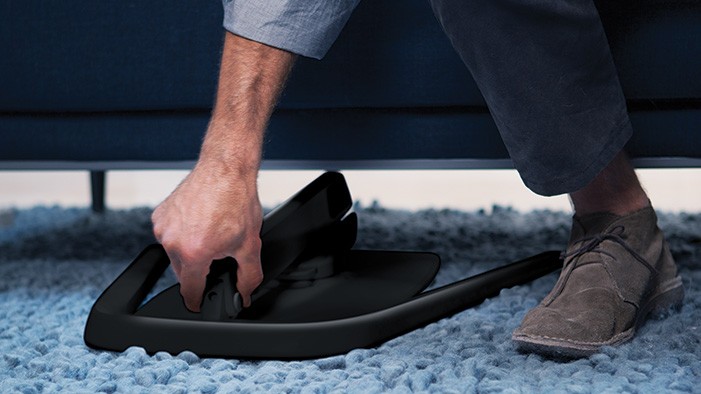
The Free Stand by Stephan Copeland is the ultimate expression of the lightweight desk. It’s a stand that is just big enough for a tablet or laptop. Its height is adjustable from 19.5-27″ and can be positioned to fit over a normal chair, sofa or lounge chair. It can be folded and stowed away when not in use. The unit is scheduled to be available later this spring through Coalesse; no pricing info available yet.

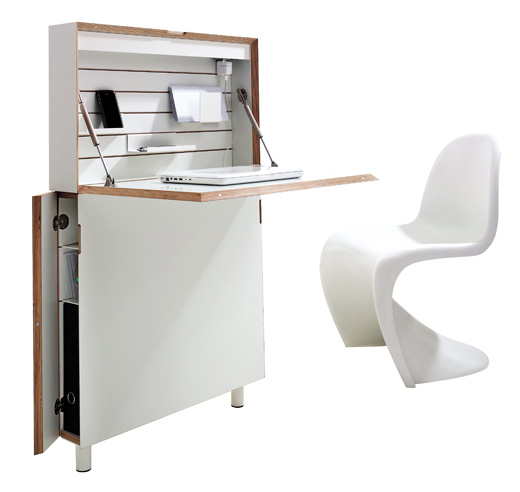
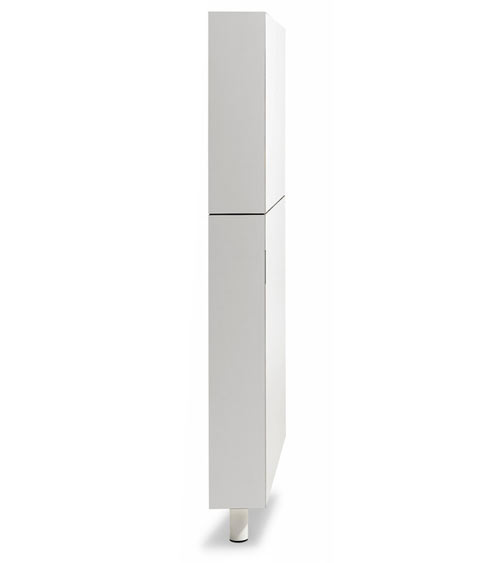
The Flatmate by Michael Hilgers is a bit more of a comprehensive unit–i.e. it has room for your elbows, some minimal storage and plugs for your devices. When closed, it’s a mere 5″ deep. The unit is attached to the wall to maintain stability. The Flatmate is available for $1850 from Resource Furniture.

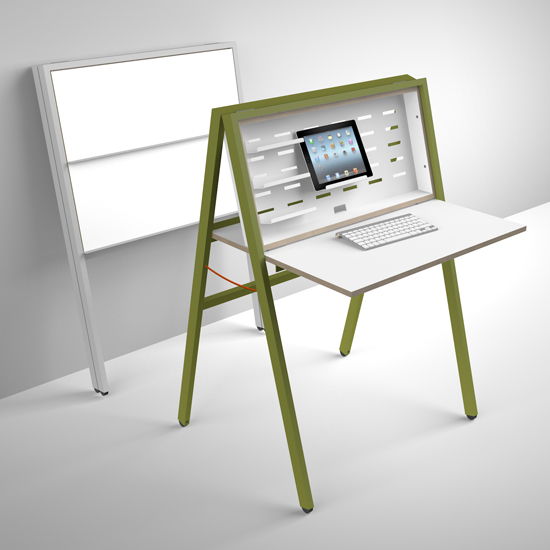
Michael Hilgers actually has several varieties of lightweight desk designs such as the HIDEsk, which is an easel-like desk, and the  balKonzept, a desk designed to fit over your balcony railing.

Of course, if you really want to stay lightweight, you can just use your dining room or kitchen table like this author does ;-).

image via coalesse and Michael Hilgers

Tetris-Like Office Creates Space, Grants

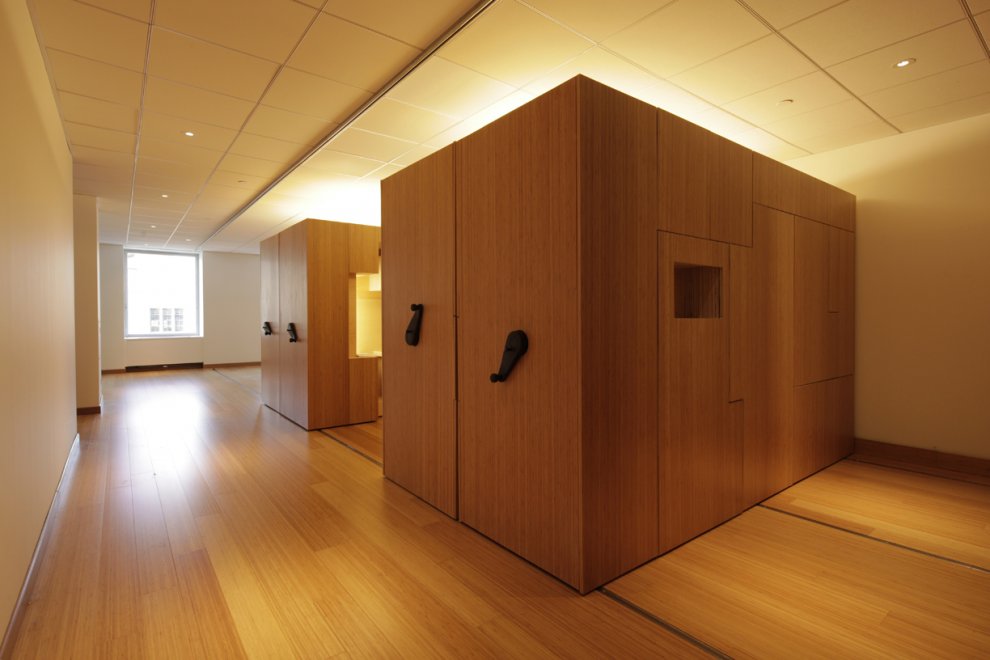
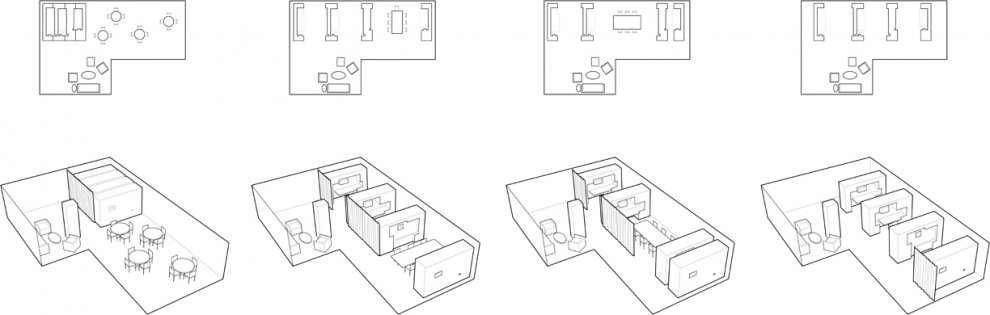
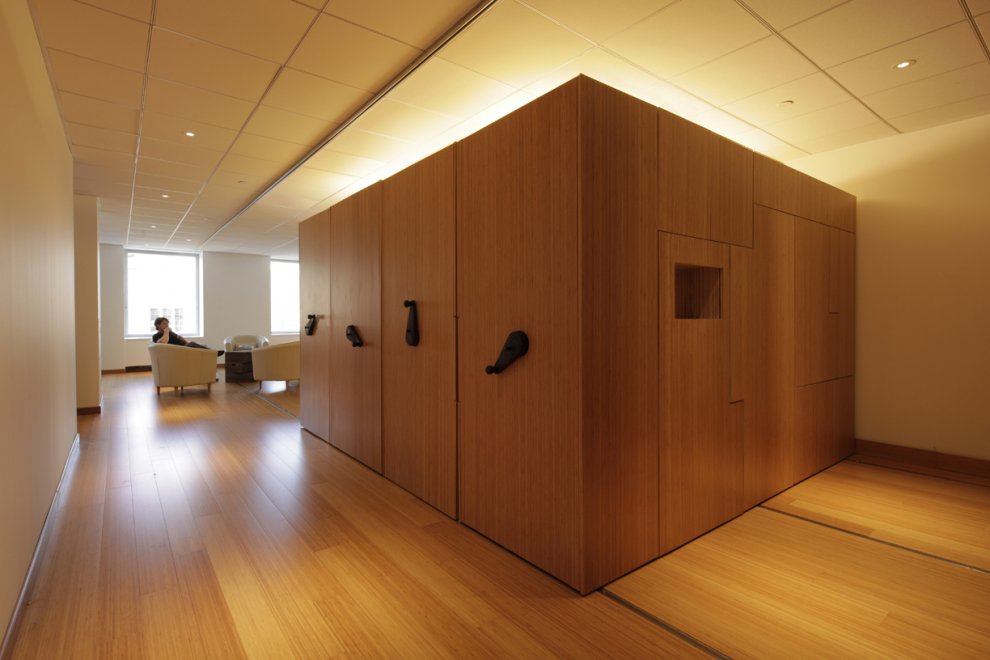
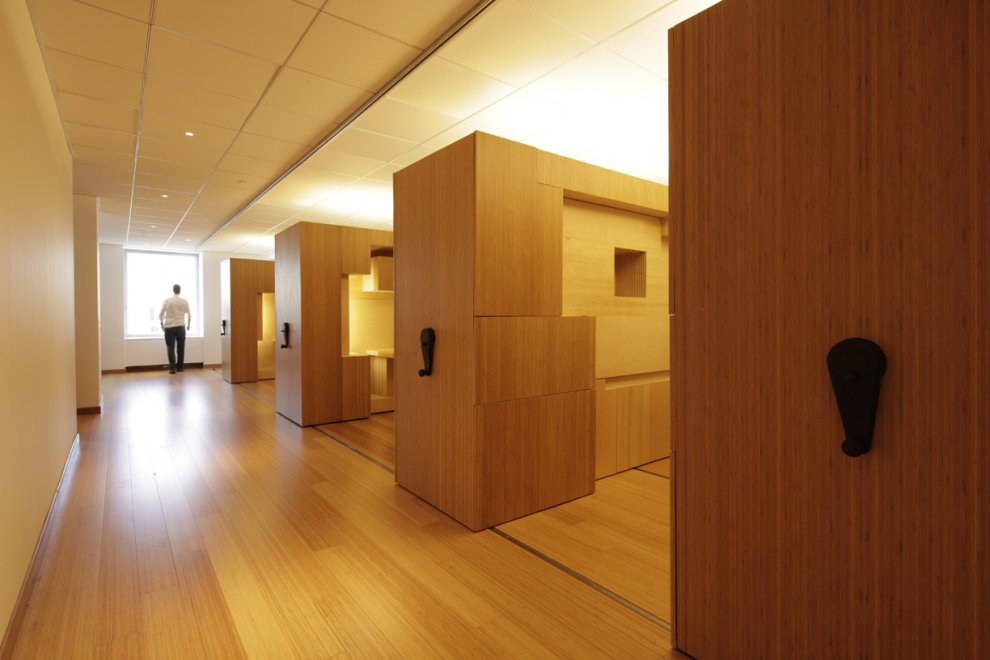
A couple weeks ago, we talked about how your office will disappear. Well, the office for Environmental Grantmakers Association (EGA) takes that concept literally. Its designers Taylor and Miller Architecture and Urban Design incorporated collapsible walls that make the office disappear.

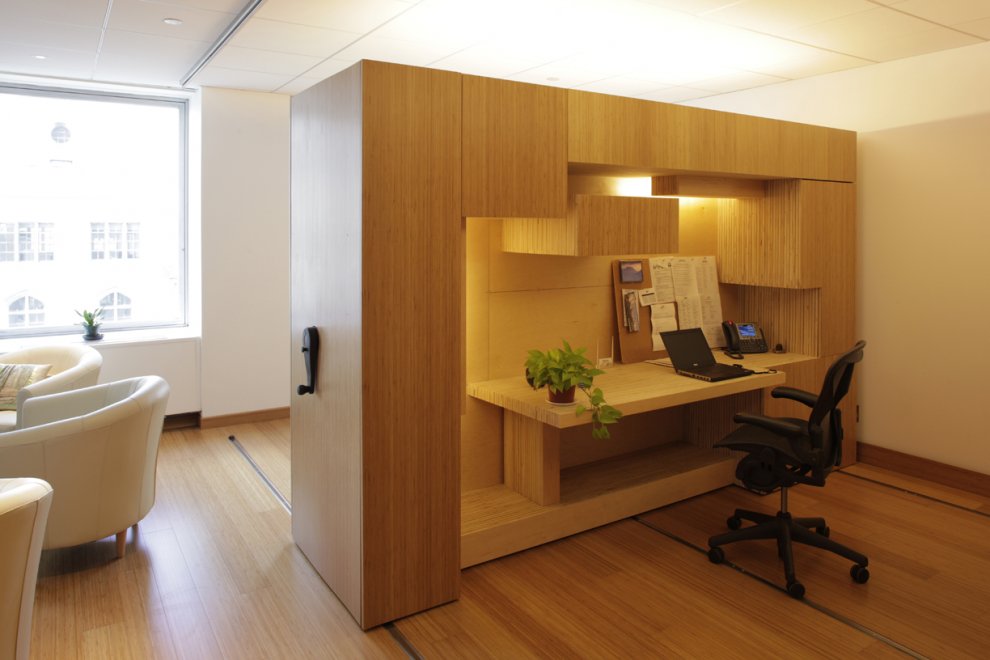
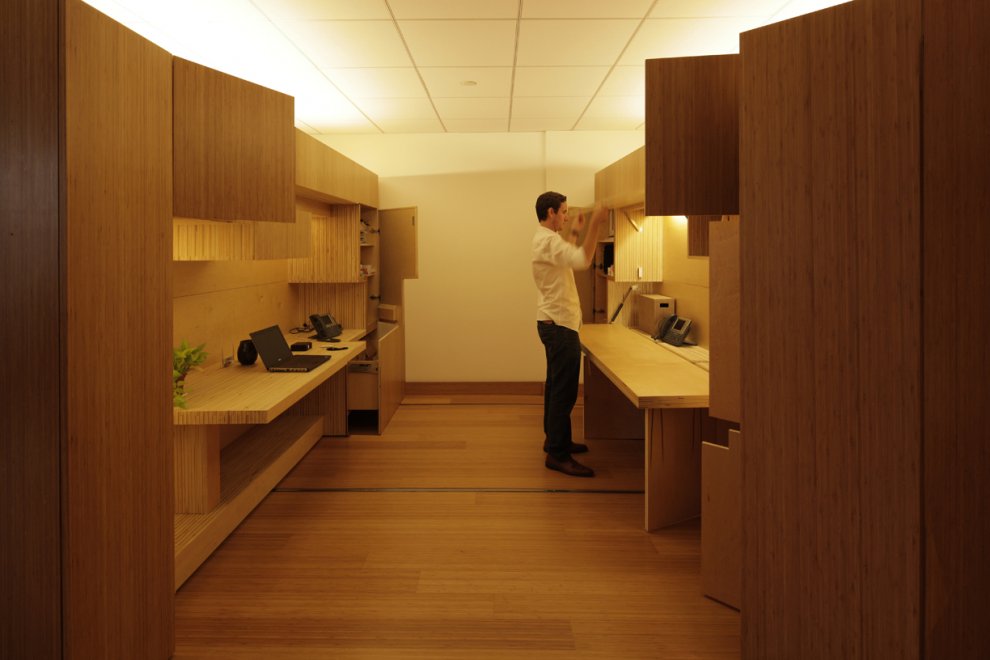
The office’s four interlocking walls house seven work stations and ample storage. When opened, they can be configured as workstations or even a boardroom. When compressed, they create an open floorplan for events and various other purposes. You can compress some of the walls and extend others to create a highly dynamic space.

The walls have an innovative way of working together. From Taylor and Miller:

When occupying the space between two partitions, one can see that the inward faces of each has been excavated with the same shape. In other words, what is a storage box protruding on one side is a recessed storage cubby hole on the other. In this manner, the partitions are bound together spatially; the relationship between them becoming stronger and stronger as they are compressed together… until finally they are collapsed completely concealing the carved space within.

The design is very similar to the LifeEdited Apartment‘s moving wall, which rests on a track and carriage manufactured by Modern Office Systems, whose primary business is large file storage systems. Taylor and Miller sourced their track from Pipp Mobile. Our unit cost about $4500 for just the track and carriage (i.e. not including the cabinet above). Additional reinforcements had to be made to the floors to support the concentrated weight of the wall. While this is a fair amount of labor and money, they’re invaluable in small spaces, where access to all the space all the time makes a huge difference. Why have a guest room 365 days a year when you only use it 20 nights? Why have a boardroom all the time when you only use it a few times a week for an hour or two? The financial and environmental costs of maintaining unused spaces quickly makes a compelling argument for incorporating more systems like these in our interior designs.

Photos by Emile Dubuisson

Via Architizer