Ever Want Your Own Restaurant? Here’s Your Chance

We’re loathe to call things the “Airbnb of…” dog-biscuits, chessboards, whatever. We are sure peer-to-peer marketplaces have a prelapsarian past, but few enterprises have made purchasing services from your friends and neighbors as easy as Airbnb. So unfortunately, we have to designate a great new venture called Feastly the, ahem, Airbnb of restaurants.

Feastly allows chefs and gourmands to transform their homes into their own restaurants without all that overhead and investment of a traditional restaurant. Conversely, it allows diners an alternative to the traditional restaurant.

It’s pretty simple: As a chef, you register on Feastly’s site. You determine the menu, the price, the date, how many feasters you can handle, etc. Feastly fills the seats, handles money and takes a modest administrative 12% cut.

As a diner, you browse and sign up for dinners in your area (right now, their main markets are Washington DC, NYC and San Francisco). More than just a restaurant, the Feastly experience awards diners with home-cooked meals and a unique social experience, or as Feastly cofounder Noah Karesh put it, “The dining table is the optimal social network.”

We’ve been using Feastly chefs to cater the LifeEdited dinner parties and are very impressed with the quality of food and service.

We asked Mr Karesh some other questions about how Feastly started and how it works.

Why did you start Feastly?

Feastly came from my travels to Lake Atitlan,Guatemala. I was struck by my inability to find authentic, local food there and convinced a local to invite me over for dinner. Sitting around his family’s table, I had my “a-ha” moment realizing that it shouldn’t be so hard to eat local food and meet people when traveling. Feastly was born over Start-Up Weekend DC in November 2012 and a year later, we’ve hosted hundreds of meals for thousands of Feasters. One of my many goals with the platform is to bring Feastly to Lake Atitlan.

Do you know ahead of time what will be served? Can you make requests?

Yes, our chefs post menus online ahead of time so that Feasters can search for their favorite dishes or chefs. For those with food restrictions, our chefs do their best to cater to any food issues. Thanks to our feedback forms, chefs can receive immediate feedback on their meals and get ideas from Feasters for future meals and how to improve the overall user experience.

How much do dinners typically cost?

Our meals range from ice cream tastings to brunch to seven course dinners and may range from $5-200 with the average meal costing $38.50 [booze is sometimes, but not always, included in price.]

Do you think your approach could replace going out to a standard restaurant?

Yes, but even more than just replacing people’s reliance on restaurants to “eat out,” we are increasingly serving as a social network for our Feasters. Our users come for the food, but increasingly stay due to the positive relationships they are building around the dinner table. We’ve helped to introduce couples, business partners, friends and activity partners over meals.

What about markets you don’t serve yet? How can people get involved?

We’ve been excited to see so much positive feedback in NY and DC and soon SF, and we get emails daily from people around the world encouraging us to open in their cities. Like our peers at Airbnb, we are eager and working to expand globally, so that we can bring the best of Feastly everywhere. We are also eager to bring on more chefs, and like to work with local partners eager to bring Feastly to their communities. We’re always open to new ideas and partnerships and it’s best to reach out at info@eatfeastly.com.
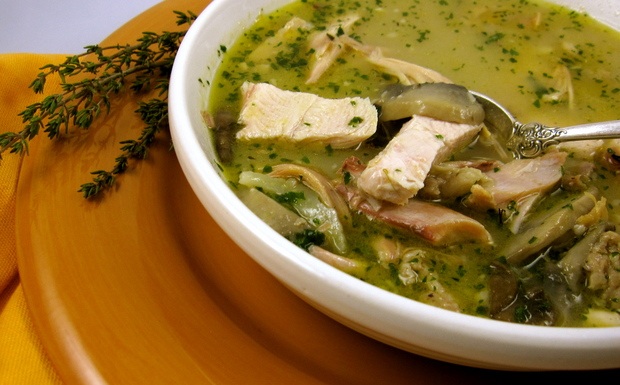
When Life Gives You Leftovers, Make Leftoverade

Few things say Thanksgiving like uneaten leftovers. The vats of cranberry sauce, the innumerable pans of stuffing and of course the poor, eviscerated bird. You have the best of intentions of upcycling this bounty, but it is often left barely eaten and trashed–possibly with an optional six month stint in the freezer beforehand.

An NRDC study estimated that 40% of America’s food supply is thrown away. That amounts to $2,275 into the trash for an average family of four every year. So in the quest to do more with less, your kitchen and its edible contents are a great starting point.

A site called We Hate to Waste gives ideas about how avoid the trash solution to your leftover food, including the soup recipe below, which transforms your likely-to-be-trashed turkey carcass into a tasty soup with a few common kitchen ingredients. The site includes a number of other similar “waste-watching” (get it?) recipes and tips for reducing waste in your home.

Site contributor Jocelyn Deprez has even written a book called “The Refrigerator Files: A Guide To Creative Makeovers For Your Leftovers,” which, as the title suggests, is a guide for making great food from common leftovers.

A big part of doing more with less is working with what you already got. Recipes like this–and the intention behind them–are great way of doing that.

  • 1 turkey carcass
  • 1 cup turkey meat, cut into half-inch cubes, for garnish, optional
  • 16 cups water
  • Leftover giblet gravy, if any, optional
  • 1 cup coarsely chopped onion
  • 1 bay leaf
  • Salt and freshly group pepper to taste
  • 2 whole cloves
  • 4 springs fresh parsley
  • 2 springs fresh thyme or ½ teaspoon dried
  • 3 whole carrots, trimmed and scraped
  • 3 whole ribs celery, trimmed and scraped
  • ½ cup broken vermicelli, cappelini or spaghettini*
  1. Pick over the carcass and reserve any tender morsels of meat. Use this if desired, for the cup of meat indicated, adding more meat as necessary.
  2. Place the carcass in a kettle and set the meat aside. Add to the kettle any jellied gravy that ay be accumulated on the turkey platter or dish.
  3. Add the water to the kettle. Add the leftover giblet gravy if there is any. Add the onion, bay leaf, salt, pepper, cloves, parsley, thyme, carrots, and celery. Bring to the boil and simmer one hour, skimming the surface as necessary.
  4. Strain the soup through a sieve lined with a clean kitchen towel or a double thickness of cheesecloth. Discard all the solids except the carrots and celery.
  5. Pour about two cups of the soup into a saucepan and add the vermicelli. Cook until just tender.
  6. Add this to the soup. Cut the carrots and celery into half-inch cues and add them. Add the one cup of cubed turkey meat. Bring to the boil. Serve piping hot.

What are you doing with leftovers? Let us know in our comments section.

Photo Credit: AnnArbor.com

5 Tips for Editing Your Diet

We tend to focus a lot on hard goods like knives and moving walls here at LifeEdited, but one of most urgent places to bring editing is our diets. According to the CDC, today’s average restaurant portion is 4 x’s larger than it was in the 50’s; a 26 lb increase in average weight is surely correlated.

We are always promoting the idea of less and better when it comes to products and architecture. Suffice to say, this principle works with food as well. Here are 5 tips for editing your diet at both restaurants and home:

  1. The CDC suggests ordering the smaller portion wherever possible (i.e. the pint vs the quart of Kung Pao chicken), sharing meals with a friend or wrapping up half your meal from the get-go. These strategies probably works best with higher quality meals that don’t excite your appetites like a Extra Value Meal from McD’s (see tip #5).
  2. Try not ordering a meal for yourself the next time you go out to a restaurant. In order to avoid being branded a mooch, explain your experiment to your meal-mates and get their approval first. Offer to offset the bill. Oftentimes, people either leave a big portion on their plates or eat that extra amount because they don’t want it to go to waste. By taking a portion of their food, you are helping keep their portions sane as well.
  3. Join the “Small Plate Movement.” Seriously, there’s a movement, which, as the name suggests, promotes using small plates to affect dietary habits. One challenge they offer is to eat off of a 10″ plate for a month. One case study they cite found that people ate 53% more snack mix when their bowl was bigger. At the LifeEdited apartment, we searched for a do-it-all plate, finally choosing one by Arzberg called the Tric soup plate. It is 8.3″ diameter with a 1″ rim, so it can work for virtually any course.
  4. You don’t need to be stuffed to be nourished. Many of us don’t consider a meal over until we feel uncomfortably full. Experiment with stopping short of that feeling. Eating fiber-rich foods like greens and other veggies help you feel fuller faster, without the bloat.
  5. Cut out junk food. It’s kinda obvious, but poor quality food is worse than poor design. You just don’t need it.

via Treehugger