Read Faster

Some people devour words, reading books and articles at a breakneck pace. I am not one of those people. I am a slow reader. I mentally articulate every word, making reading a slow, if enjoyable, process. I have long lamented how my thirst for knowledge has never been served by my ability to drink it in. A nifty app called Spritz might just be an answer for my drinking problem.

Spritz is an app and browser extension that takes text and puts it into a dialogue box. The box shows each word, focusing on the “Optimal Recognition Point” or ORP, which is basically the physical location where the brain imbibes a word’s meaning. Spritz highlights that ORP–usually the middle letter in a word–and your brain to take in the rest of the word naturally. By keeping the flashing words in a box, your eyes don’t fish around the page for words. Spritz claims reading is 20% information processing and 80% eye movement. Words can be flashed at paces ranging from 40-1000 words per minute.

We are a bit leery of Spritz’s “Science” page, which introduced a number of pseudo-science, made-up terms like ORP. But casting aside the need for legit data about reading comprehension, having used Spritz on a number of longer-form web articles, I found I was able to power through text very quickly. In particular, the lack of eye movement made reading less strenuous.

The main application for Spritz is online text, where adding the “Spritzlet” is as easy as dragging a url into your bookmark bar. Spritz is pre-installed on the new Samsung Galaxy S5 and the Galaxy Gear 2 smartwatch and there are several apps for iOS and Android that use the Spritz technology, though it does not work with the Kindle app and other places we think it’d be ideal (sounds like they’re working on it). Even if it’s just for powering through digital content at a quicker clip, Spritz looks like it could be very useful tool.

Terror, Cold Showers and Living Life to Its Fullest

What is it that keeps us from doing the things we most want to do in life? On the surface, we have myriad reasons: lack of time, money, skill, natural aptitude, poor timing, a spouse, kids, etc. But when we dig a little deeper, we realize it’s usually garden variety fear that’s holding us back. Point of fact, we aren’t even afraid of doing stuff. Consciously or not, we are afraid of the discomfort we anticipate we will feel when we do that stuff–it’s basically that fear of fear FDR was talking about. Rather than enduring the few, brief, uncomfortable pinpricks necessary to confront our fears and move forward, many of us accept slow-drip fear, ongoing, mild discomfort, existential inertia and lives half-lived (sorry if that sounds harsh).

The capacity to act in the face of fear and discomfort is at the heart of a short (free!) eBook called “The Flinch” by Julien Smith (incidentally, the guy behind Breather).

The Flinch’s thesis is pretty straightforward: years of evolution have given humans the flinch, a biological mechanism designed to warn us of and keep us away from danger. Back in the day, we would flinch at an approaching animal, for example, because it might cause us bodily harm (this particular flinch might serve us in the present day, I suppose). We flinched at the novel and unknown, because in that unknown may lie danger. This evolutionary mechanism, so useful when being chased by a pack of hyenas, has become a total liability in the modern world where the vast majority of threats are more perceptual than actual. We flinch at having a tough conversation, starting a new project, asking for help, etc. Smith says this of our reaction to flinch-worthy stimuli:

When coming across something they know will make them flinch, most people have been trained to refuse the challenge and turn back. It’s a reaction that brings up old memories and haunts you with them. It tightens your chest and makes you want to run. It does whatever it must do to prevent you from moving forward. If the flinch works, you can’t do the work that matters because the fear it creates is too strong.

Yet these flinches and their associative fears of the unknown, the foreshadowing of danger based on memories of past injuries, have little or no basis in what’s going on in the present moment, much less real danger. Rarely does anything truly awful–or anything that can’t be reversed fairly easily–happen when we face the things that scares us. We are flinching at our imaginations.

All of this wouldn’t be that big of a deal were it not for the impact. In our avoidance of the flinch, we avoid our lives. As Smith writes, there are no good stories without overcoming our flinch mechanism. He writes:

Behind every moment of courage was a man or woman who faced a difficult internal struggle. When they face it, it becomes an amazing story. They become legends. But if they turn away from the flinch, their stories are unexceptional. They’re like everyone else. They vanish.

What Smith proposes is mastering the flinch. Rather than overcoming it through intellect and will power, he gives homework assignments that put you face-to-face with your flinch mechanism. By far the most provocative is the first assignment. He writes:

Walk up to your shower, and turn on the cold water. Wait a second; then test it to make sure it’s as cold as possible.

Do you see what’s coming? If you do, you should tense up immediately. You should feel it in your chest. You might start laughing to release the tension—and you haven’t even stepped inside. You’re predicting a flinch that hasn’t happened yet. You’re already anxious about it—about something that hasn’t happened and won’t kill you—anxious about something that barely hurts at all.

Ok, do it. Now is the time to step in the shower.

As the cold water hits you, you might shout or squirm. But the discomfort lasts only a second. You quickly get used to it. You get comfortable with cold, instead of trying to avoid it. You put yourself in the path of the shower to speed up the adjustment process.

This is not an exercise in masochism. It’s a way of training yourself, of “seeing the flinch and going forward, not rationalizing your fear and stepping away.” It’s a way to develop a physiological tolerance for facing the things that most scare us–things that pose no real threat (trust me, I have taken prescribed cold showers and lived to tell about it).

[divider]

Editing our lives means evaluating every facet of our lives, determining whether they contribute or detract from our ability to live to our fullest capacity. Extraneous possessions and too much space, in our opinion, can detract from that objective; in the act of managing, purchasing and paying attention to those things, we might take our eyes off the prize of connecting deeply with others, finding meaningful work, etc. But few things cheat us of the minutes, hours, days and years of our lives like fear. The Flinch, while not promising to rid us of fear, does provide a nice little set of tools for dealing and not being stopped by it.

Store Your Books in the Cloud

Books are great. They are instigators of imagination, chroniclers of the ages, companions in meditation and erudition. They are also some of the clumsiest, heaviest, most space-intensive objects most of us carry. When this site first started, we presented what we called the “bibliophiles dilemma,” which explained the resistance many of us have in giving up our paper bound books for ebooks, a format where hundreds of volumes can fit on a device that fits in our pocket. The good news is that we don’t have to choose: we can have hybrid collections, retaining some of our favorite paper books while regularly circulating through ebooks.

Oddly enough, one of the ebook’s bigger drawbacks is expense. Because companies like Amazon are the gatekeepers of protected book files, it’s tough to buy titles for cheaper than retail without resorting to extra-legal tactics. Similarly, it’s near-impossible to share in the way you can with a physical book.

For the ebook-reading book lover, here are a few options for getting your book fix without breaking the bank.

  1. Amazon. The Kindle Owners’ Lending Library is offered as part of an Amazon Prime membership. With it, you can access one title per month from a library of 350K titles. It’s only available on Kindle devices, which for many is not a problem. There’s is also a loaning program, where you can send a title once in its lifetime to a friend for 14 day period (kinda lame). This program works on any Kindle app enabled device (iOS, Android, desktop). Amazon also has tons of free titles.
  2. Scrbd. For $8.99/month, this service gives access to “thousands of best-selling books” as well as user uploaded articles, stories, etc. They have been called “the Netflix of books.” Scrbd is browser and app based, so you can read on your desktop, iOS or Android devices (i.e. not Kindle or Nook).
  3. Public Libraries. Many libraries like the NYC public library are offering ebook checkouts to local members. Overdrive.com is a portal for over 27K libraries to see if your local library provides ebook lending.
  4. We ran across a number of other sites such as Open LibraryeFling and ManyBooks, but titles were often ones with expired copyrights (i.e. old). There were also sites like Lendle, an Amazon affiliate that makes Kindle lending easier, but the functionality didn’t seem that much better than Amazon’s lending program.

If you have further suggestions for great, legal, book sharing services, let us know in our comment sections.

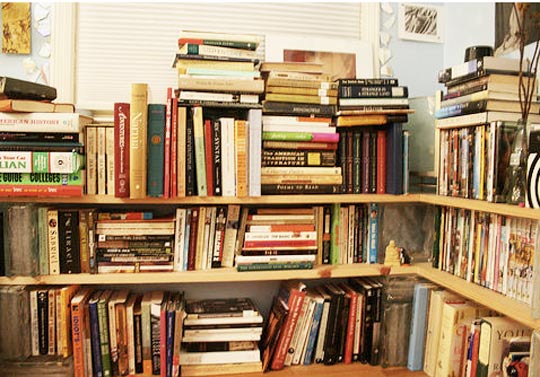
Pile of books image via Shutterstock

eBooks and the Bibliophiles Dilemma

This is perhaps the most taboo topic in life editing. Even extreme editors, living in their ultra-organized cubbies, often find themselves unable to get rid of these. That’s right, we’re talking about books.

We love our books–the feel of paper, the dog-eared pages, the cover art, the smell. We display them like trophies. When people come over to my house, they will know I read “The Brothers Karamazov.”

But let’s face it: books are space hogs, and few inventions help the process of editing one’s life as much as the eBook. For example, consider the basic Kindle eReader stores up to 1400 eBooks and weighs 6 oz., which is about the same size as one paperback copy of “The Great Gatsby.”

We know there are many eBook converts out there already, but for the others, who can’t quite make the leap, who are dubious of electronic ink, who love their paper-cuts and dewy thumbs, we put out a challenge: try it. 

Today we present an easy, zero-risk way of seeing if eBooks are for you.

  1. Download the Kindle app. It’s a free application that allows you to read Kindle eBooks on a variety of platforms: Android, PC, iPhone, iPad and Mac. Install it on whatever device you find yourself using the most, preferably a portable one like your phone or tablet, which better replicate a book’s utility.
  2. Download an eBook you want to read. This could be one of the millions of paid Kindle titles on Amazon, or if you don’t want to pay, download one of their 1M+ free eBooks to make this a truly zero risk experiment.
  3. Read book and see if you like it.

Mind you, this is not a perfect experiment. EBook readers like the Kindle and Nook have eye-saving electronic ink, which for many (like the author) make it possible to read for long periods of time. But others, like Graham Hill, have read many books without issue on their back-lit phone screens.

Either way, the idea is to try. Give it a shot and let us know what you think.

image via Apartment Therapy