The Minimalist Mogul

There can sometimes seem to be an inherent opposition between commerce and minimalism. The former would seem to demand increase and the latter, well, reduction. But even the most pared down minimalist needs stuff. And sometimes people who love to decrease get the desire to start businesses that sell stuff, thereby increasing. But as F Scott Fitzgerald wrote, “The test of a first-rate intelligence is the ability to hold two opposed ideas in mind at the same time and still retain the ability to function.” Nick Martin, founder of The Pro’s Closet, is a nice example of this first rate intelligence. He doesn’t like stuff, but he sells a lot of it.

The Pro’s Closet is the world’s largest reseller of bicycles and bike equipment. The store’s website describes its origin’s thusly:

While living in his Volkswagen Bus and only the task of riding a bike on his to-do list, Nick Martin began a simple mission: sell all of his worldly possessions on eBay. Minus his bike and his bus, Nick sold everything. Fast-forward 8 years to today and we present to you, The Pro’s Closet. The Pro’s Closet has become the nation’s premier eBay store specializing in reselling new and used cycling gear.

In a profile by Anja Semanco in Under the Flatirons, Martin explains the story in greater detail. Following his initial purge, he was living out of his bus, racing bikes and selling kombucha mothers. But this wasn’t providing sufficient funds for survival. The racing contract did however provide a ton of swag he didn’t or couldn’t use–clothes, components, etc. Martin started selling all of this stuff on eBay, and soon friends were asking him to do it for them too. When he got married, he started to take the selling more seriously, renting out his first of five commercial spaces, each of which grew with the scale of the business. Eventually Nick took on a partner, Pete Lopinto, and the shop now inhabits a huge warehouse in Boulder CO, employs 16 employees and sells around 200 items a day.

But at his heart, Martin remains a minimalist. Martin said, “I think material things hold people back,” and he says that he has given away a possession a day for the last three years. And he sees his business as consistent with his minimalist tendencies. The stuff they sell are things that people or companies already have–used part, unsold inventory, etc. So in a sense, they’re not increasing the amount of stuff in the world at all, but finding ways of equitably–and profitably and sustainably–redistributing it. 

HT Tim F

5 Tips for Breaking Up With Your Stuff

My wife and I are in the final phase of purchasing a home in Brooklyn, NY. In true LifeEdited spirit, the apartment is on the cozy side. The realtors call it 675 sq ft, but our tape measure says something quite smaller. In this space will live two work-from-home adults and one plays-from-home one-year-old boy. We chose the place for a number of reasons. It has a flexible square floor-plan (we’ll keep you posted on designs). It’s in a charming building filled with other young families. It’s near many of our friends. But the main reason is its location: it’s directly across the street from Prospect Park and in a very good school district.

Our little space requires all fat be trimmed from our lives–there is no room for backups or also-ran stuff. Our current place has ample closets and room for unused phones, computers, vases, photos, purses, etc. Our new place will have storage for what we love, need and use and not much more. In preparation for this new, leaner life, my wife and I spent the weekend editing our lives.

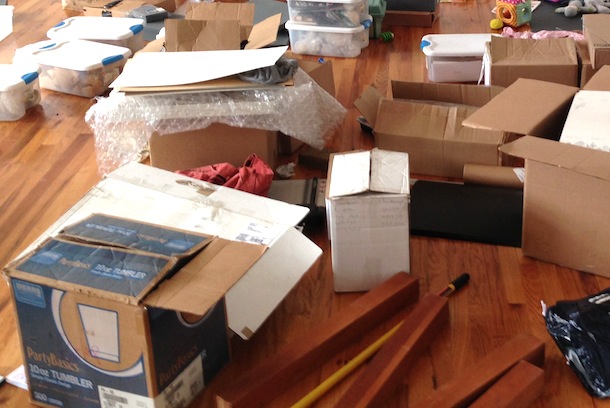
We always knew that our current home would be more pitstop than final destination, so we never fully unpacked, and many of the items considered this weekend were things that had been boxed up for the last year. Similar to Graham Hill’s 2011 TED talk, the question that kept creeping up was, “What’s in the box?” Not “what’s in the box” literally–we labeled them pretty well–but “what’s in the box” that’s so important that we can live a year (and often longer) without?

You’d think that things we hadn’t used in a year or more would be easy to get rid of–particularly for a guy who’s job is to promote the “luxury of less” and his wife who has strong minimalist leanings. You’d think we would edit with abandon. You’d be mistaken.

Weaving through years of accumulated objects brought up fond memories and appreciation for objects we once cared enough to bring into our lives. Gifts from loved ones. Pieces of art that we were either given, bought or made. Cherished books. Framed photos we no longer had the wall space to hang. Objects that were sure to be collectible one day like my first generation iPhone. Sports equipment I’d been holding onto for years, sure that I would eventually use it. But would I really? When? Most of these things made the chopping block and it wasn’t easy.

There were also tinges of regret–all of the things we now realize were far from necessary: that second water pitcher, that $1K watch–expensive things that we will attempt to sell on eBay or Craigslist for a fraction of their purchase price. We wondered if maybe we shouldn’t have got them in the first place?

Whether conscious of it or not, I wondered if this emotional process was the reason many people don’t downsize? Might the prospect of getting rid of stuff be enough to stay in a too large home or live in a less-than-ideal neighborhood?

If you are considering downsizing or just editing your life, here are several valuable lessons–both practical and emotional–I learned this weekend editing our stuff:

  1. Ebay is great for smaller, commodity items. I actually sold $600 worth of stuff this weekend, but it was name brand stuff (old phones, bike components, watches, etc.). No-name stuff hasn’t really moved.
  2. Etsy is best for selling curios, handmade art and other non-commodity stuff. My wife sold a miniature dollhouse couch on Etsy, which she never thought would move. If you have weird stuff, Etsy might have a weird buyer.
  3. Craigslist is good for the big stuff like furniture, but our experience is that people want deals. Also, the bigger stuff might take more time, so you need to stay on top of it. More tips here.
  4. Editing might be a little painful, but that’s okay. Comfort is not needed. As Graham Hill says, “edit ruthlessly.” In many ways, getting rid of stuff is like breaking off a relationship. If it’s a horrible relationship, ending it can be easy. But most relationships, like most stuff, have some elements that work and others that don’t, and the prospect of letting go of the things that do work can overshadow the preponderance of things that don’t. If you’ve made a decision to let go of something, stay firm in your decision, despite discomfort, and edit away.
  5. Focus on the other side. Many of the intellectual arguments for editing your life–less to deal with, store, clean, etc.–get lost when presented with a potential emotional loss. Try to create a stronger emotional connection to the other side. We are editing our lives because it allows us to move into a clean, amazing, albeit small, apartment in a neighborhood we couldn’t have otherwise afforded. We visualized a life where our son could hop over to the park on a moment’s notice; where we could walk to our friend’s houses; where we could reunite with our beloved Park Slope Coop (don’t believe the slander–it’s the best); where we would be living within our financial means and not have to stress out about high mortgage payments. Connecting emotionally to this vision proved far more powerful than a pro/con balance sheet of why we should hold onto the cheese knives.


Sell Stuff Easier with Sold.

We’ve said it once and we’ll say it again: Selling stuff can be a real pain in the butt. The relief of unloading is often more than offset by the grief of haggling, scamming and parting with your stuff at bargain basement prices. More often than not, giving stuff away is the most economic, least heartbreaking solution. But we know you might have some stuff that’s too nice and too new to give away. For that stuff, there is a new service and app called Sold. (the period is part of the name FYI).

With Sold.’s iOS app, you take a picture of the stuff you want to sell, answer a few questions and wait for Sold. to verigy that the pictures align with the questions you answered; they then give you a price they agree to pay you. They do the heavy lifting of selling. They find a place to sell the item (mostly eBay it would seem), determine a price, handle billing and even send you shipping materials.

They take a small fee and we would assume that if they fetch more than their quoted price, they take that money as well. Sure, you might be able to keep more money by selling yourself, or, just as likely, you’re apt to get less because you don’t know how to sell your items. In that light, a reasonable fee is probably well worth it.

Here’s the rub for all of you folks looking to unload aunt Six Flags shot glass collection: Sold. doesn’t want your junk. They’re looking for “things of value” like newer smartphones, computers, designer sunglasses, handbags and such. As many of us have those items, Sold. can be quite useful.

via Netted by the Webby’s

Kick Your Stuff to the Krrb

Selling stuff can be a pain. Most us use one of several channels: Word-of-mouth, yard/stoop sales, Craigslist or eBay. Word-of-mouth is okay for stuff we want to dump, but many us have issues selling stuff to friends, particularly if we want to make money. Yard/stoop sales are a pain in the butt (dragging your stuff in and out, weather, etc) and they hit a limited audience, most of whom want to pay pennies on the dollar. Craigslist has great outreach, but often buyers are super-bargain shoppers and then there are scammers galore. EBay, for most of us, is a intimidating bazaar filled with cutthroat dealmakers.

A site called Krrb provides an answer for the non-professionals and small local businesses to sell their stuff easily. The site describes themselves this way:

Krrb (pronounced ‘curb’) is a hyperlocal, curiously global classifieds made just for you. A most epic scavenger hunt at your fingertips where you can thrift, scavenge, rummage and discover local treasures – in your neck of the woods or over yonder.

With over 24K users in 1130 cities, it beats word-of-mouth and yard/stoop sales; you can also keep stuff posted as long as you want. Unlike Craigslist, there are thumbnail pics of objects to see what you might want to buy. Also, everyone on the site must become a member, which is a great scammer-deterrent. Unlike eBay, there is no bidding; members can civilly negotiate prices if they so choose, but none of that last-second-outbidding that turns so many folks off of eBay.

Other features include a mobile app that shows Krrb objects in your area, a digest of stuff for sale in your area and Krrb Meetups (only in Brooklyn and Paris right now). Posting works on credit system. One post is one credit. Credits cost anywhere from $.50-1.00 (depending on volume you buy) and there are numerous ways of earning free credits (you get 10 free just for signing up). Visit their site to sell your stuff or buy some preowned holiday gifts.

How to Sell Your Expensive Stuff on eBay

We come across many people who seriously want to get rid of their stuff and live simpler lives. But again and again, we hear the same refrain: “My stuff is too expensive to give away.”

It’s important to be honest about the value of your stuff. Often, giving stuff away for free–even expensive stuff–is a good idea. The loss of initial investment is usually offset by the hidden values of not living with clutter and not paying storage real estate.

But some of us have really expensive, valuable, high quality stuff–stuff we spent a lot of dough buying. Stuff we won’t give away for free. For that stuff, the question is, “How do I sell it?”

EBay is the resource most of us think of when selling our stuff. But if you’re like me, you don’t have the time or patience to navigate your way through the intricacies of establishing a seller profile, taking pics of your stuff, creating return policies and so forth.

For those of us with lots of valuable stuff and little patience, there is eBay’s Trading Assistant Program. Through the program, you can find individuals and storefronts who will take in–and even pick up–the stuff you want to sell. EBay provides a feedback profile so you know the TA is legit. TA’s offer insurance on your goods and many specialize in particular types of goods (which you specify in your search).

Of course none of this is free. Fees and commissions vary from seller to seller. Some charge standard commission rates ranging from 10-60% depending on the expense of the item–more expensive item = lower commission. Others charge flat fees. And read the fine print: you might have to incur PayPal fees, eBay fees, shipping, etc.

If this sounds steep, consider that we paid 100-200% above wholesale when we bought our stuff (didn’t seem to bother us then). Also, consider that our stuff isn’t very valuable sitting in our basement or storage unit, so getting a 30-40% return is 30-40% more than 0%. Lastly, because of the large volume of people who use eBay, you are much more likely to fetch a good price than you would selling the stuff yourself or at a local consignment store.

Have you used eBay’s Trading Assistant Program? Let us know if you have any tips or suggestions. If you have any other tips for easily getting rid of your valuable stuff, let us know that too.