Seeking Higher Ground with an Elevator Bed

Beds in tiny homes can be a hard to thing to deal with because they take so much space, and you’re not even using them during waking hours. Instead of a lofted option, Ana White of Spruc’d came up with an affordable solution to create more space without sacrificing comfortability. Enter the elevator bed. She constructed a mechanical sleeping system with the use of garage pulleys and sliding door hardware on a budget of $500. The full bed lifts when not in use and also makes enough room for a guest bed underneath.

The building plans for the bed as well as the entire tiny home are available here.

Simple Bed Belies Complex History

We ran across the Stapelliege stacking day beds by Müller Möbelwerkstätten on Remodelista. They’re pretty great. They are made of plywood and available in a number of wood finishes, colors and several sizes. All of the corners are rounded to make them especially kid friendly. While two seems like a pretty ideal number to stack, they can go higher.

mueller-moebelwerkstaetten-stapelliege-01_zoom

As this is not a complicated piece of furniture, to expand on its functionality would be doing it a disservice. However, expanding on the design’s origins would be really interesting! Here’s what Smow, a German store that sells the bed, has to say about it.

The origins of Rolf Heide’s Stapelliege can be traced back to the mid-60s. A turbulent time in Germany and worldwide, in addition to the trouble spots of the Cold War and its counter movement of Flowerpower and the peace movements, the great destruction of World War II presented the European population with problems of housing shortage and a need for new solutions; consequently, the 1960s were marked by especially strong changes in cultural and social life. In terms of housing, one popular solution was large estates on the outskirts of cities; conurbations which more or less appeared out of thin air and had to meet especially one criterion: as many apartments as possible on as little space as possible – space for decorative flourishes or elaborate designs was simply not provided. In the broadest sense, the design and the concept of Rolf Heide’s Stapelliege therefore fits perfectly into this period, even if the bed is not reminiscent of the concrete blocks of the 60s.

Who knew this simple bed had such a complex history?

1966_cmyk_300_720x600

The bed is available for sale from a number of vendors, but mostly in Europe it appears. Individual beds range from €381 for kids models up to €1,130 for a large 160x200cm (full sized) bed. A bunch of snazzy, Heide designed storage units are also available.

Via Remodelista

Don’t Call Me Murphy

The problem with most beds is that they do one thing: support your unconscious body for 6-13 hours a night depending on your employment situation. For the other 18-11 hours, mono-purpose beds just laze around the house, occupying a ton of space that could otherwise be used to good effect. And though we are unabashed fans of murphy beds, which can quickly transform a bed area into a something else area, they are not the only type of multipurpose bed. We ran across a couple different European bed manufacturers that pack a ton of utility in the same footprint that would otherwise be used for a bed alone.

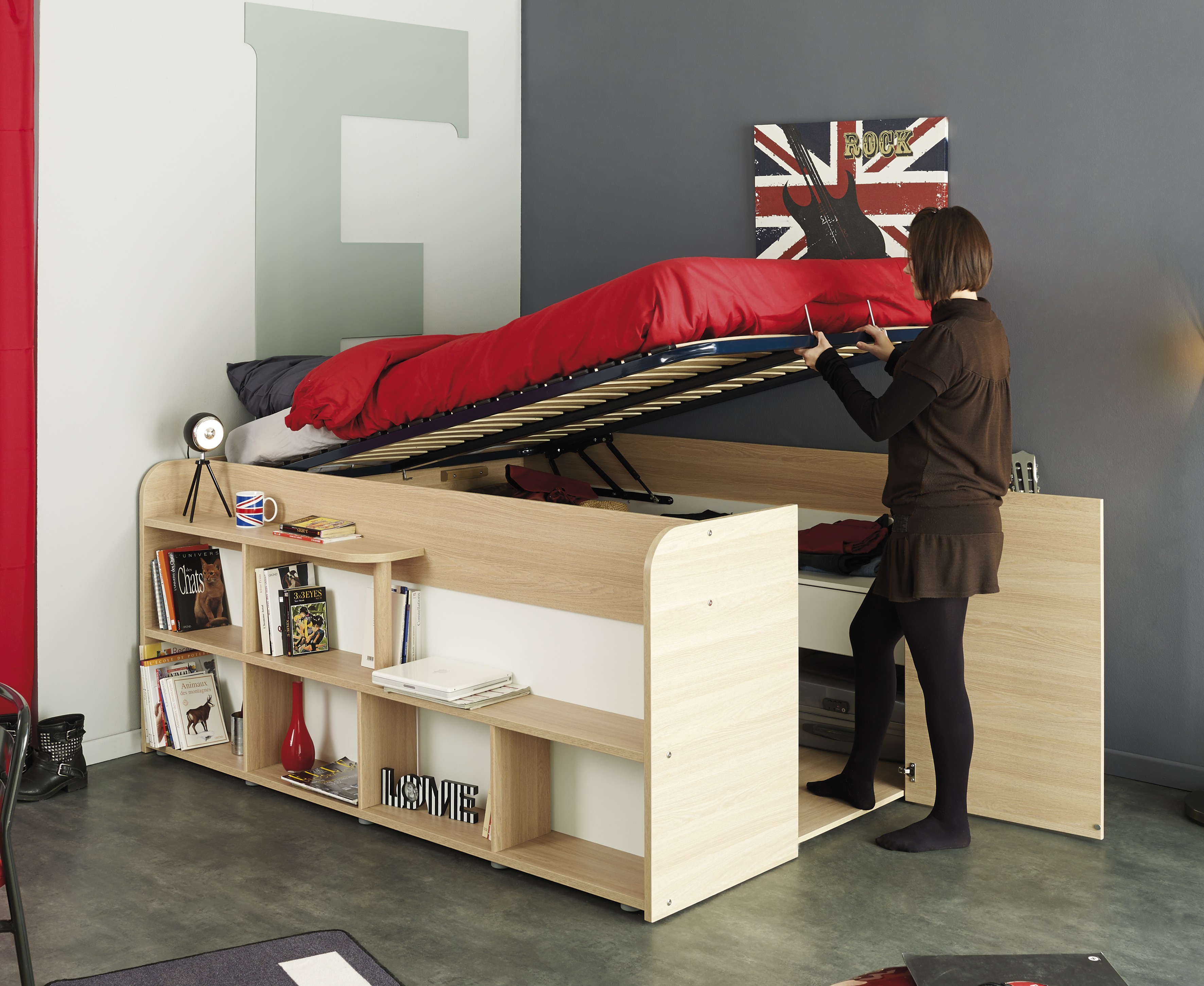
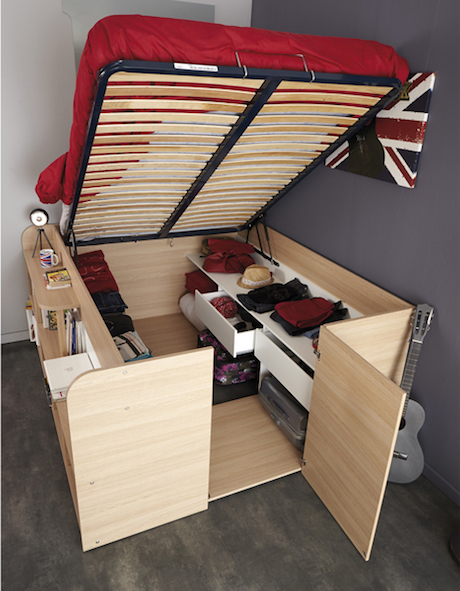
space-upThe Space Up bed (above) by France’s Parisot is a bed system with a closet’s worth of storage under its double-sized mattress. To access the storage, the mattress and its frame cantilever up, made possible by hydraulic pistons. The sides of the bed also features bookshelves, adding to its utility. With a low price point and no frills materials the Space Up seems mostly geared toward younger audiences.

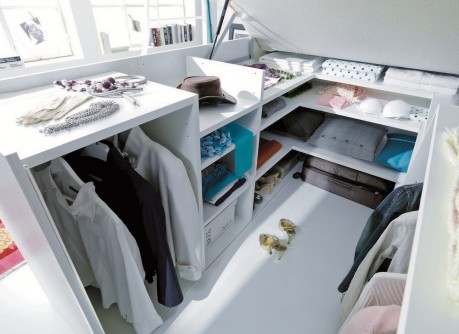
1347_z_Dielle Modus 0101350_z_Dielle Modus 012If you want something more high end, check out Italy’s Dielle Modus who takes the Space Up idea to 11. While they make a variety of bed and storage systems, the ones that caught our eye are their room systems featuring storage either under or above the bed. The storage volumes for both are considerably larger than Space Up. The below-bed systems work much like Space Up with a hydraulic lift for the mattress. The under-bed volume is big enough for a hanging rack storage; it’s also big enough to warrant stairs to access the bed. Those stairs double as drawers of course.

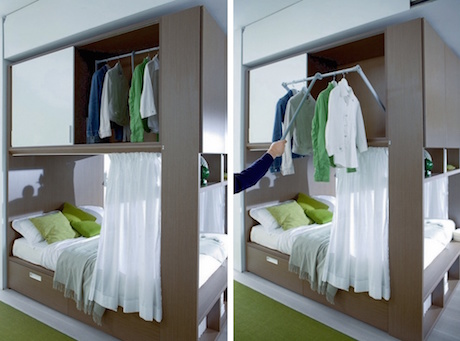
1252_z_Dielle Modus 002bdielleThe models featuring overhead storage are more practical than they might initially seem. The overhead cabinets have hanging racks that easily pivot down. There is captain bed type drawers underneath and tall cabinets at the head. The sleeping nook can also be closed off with curtains to fend off light and, we suppose, insects.

A Studio Apartment that Doesn’t Feel Like a Big Bedroom

Too often, entering a studio apartment feels like entering someone’s bedroom albeit with a few pieces of daytime furniture sitting around. No matter the size of the space, the presence of a bed tends to give the impression the room is for sleeping–an impression that is tough to shake without some sort of hiding bed (wall, sofa or trundle). A few years ago, Jordan Parnasse Digital Architecture, the same guys who designed this awesome East Village studio, created a clever way to make a small studio not feel like a bedroom.

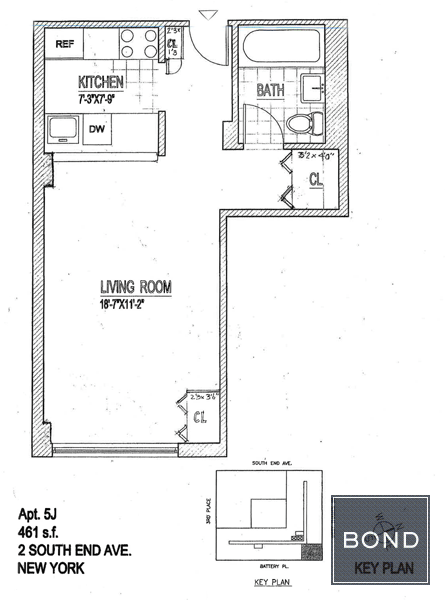
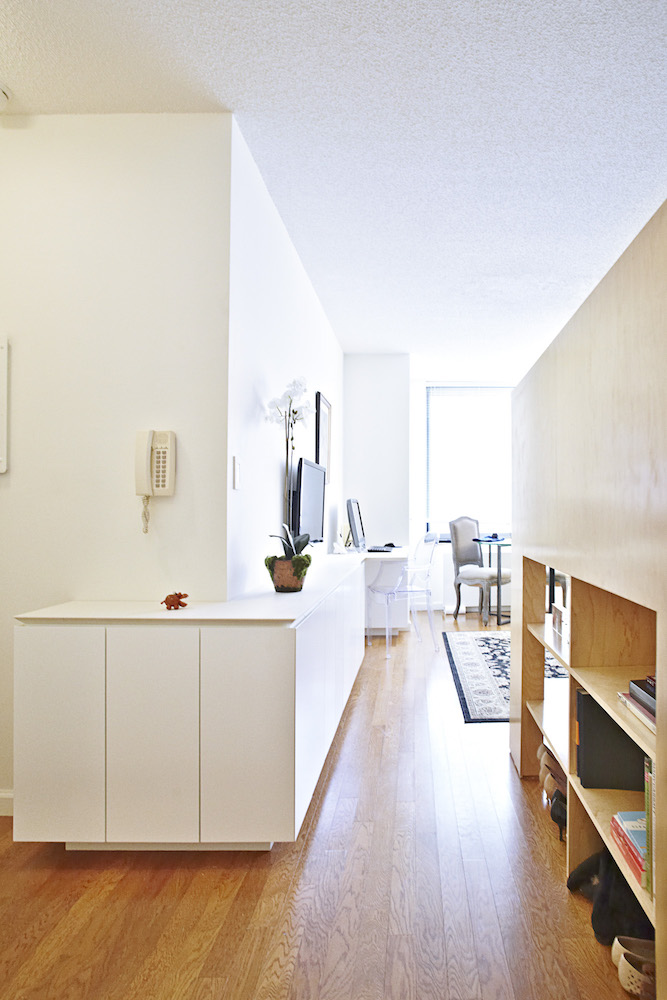
Aside from a separate kitchen, bathroom and closet area, the 461 sq ft studio was an open rectangle with one window bank. JPDA added two pieces of custom millwork. The first was a bank of storage along the space’s north wall. At the end of the bank was a cutout that made a desk area.

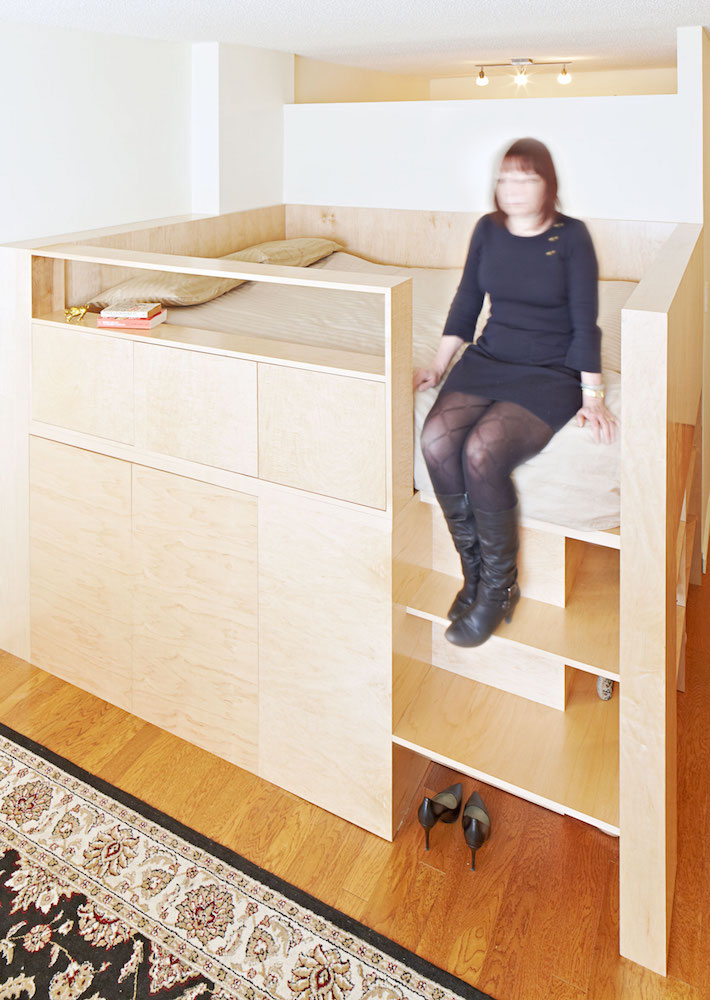
The other piece is a loft bed with built in storage. By concealing most of the mattress’s bulk, the wood volume creates a nice boundary between bed and living spaces. While it’s not a mystery that there’s a bed in the volume, it goes a long way to making the space feel less bedroom-y.

4 Pieces of Furniture that Mix Business with Leisure

For today’s work-at-home professional there’s often a fuzzy division between home and work life. Particularly in small spaces without dedicated offices, there’s an imperative to create some division lest we sleep through our workday or work through our sleep day. Multifunctional furniture can do this, creating distinct functions for different duties. Here are a few pieces that shift a room’s focus from work to leisure or vice versa.

BLESS

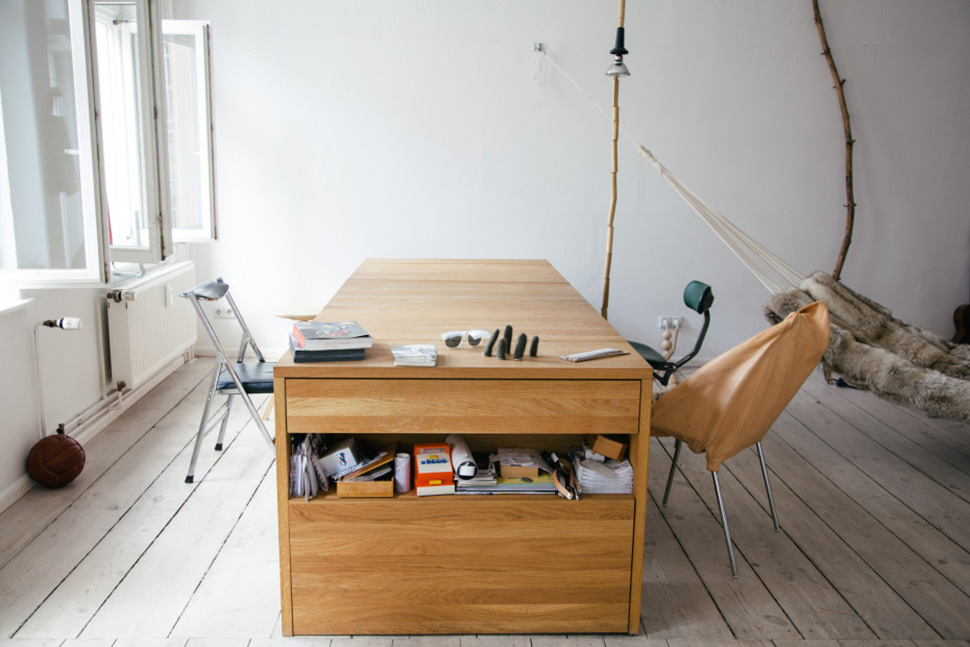
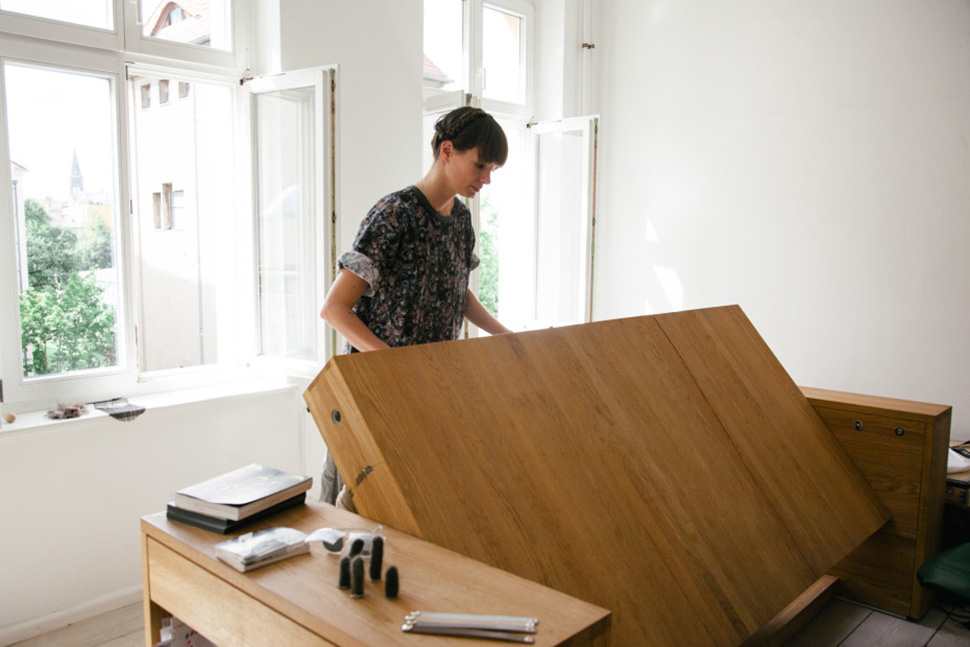
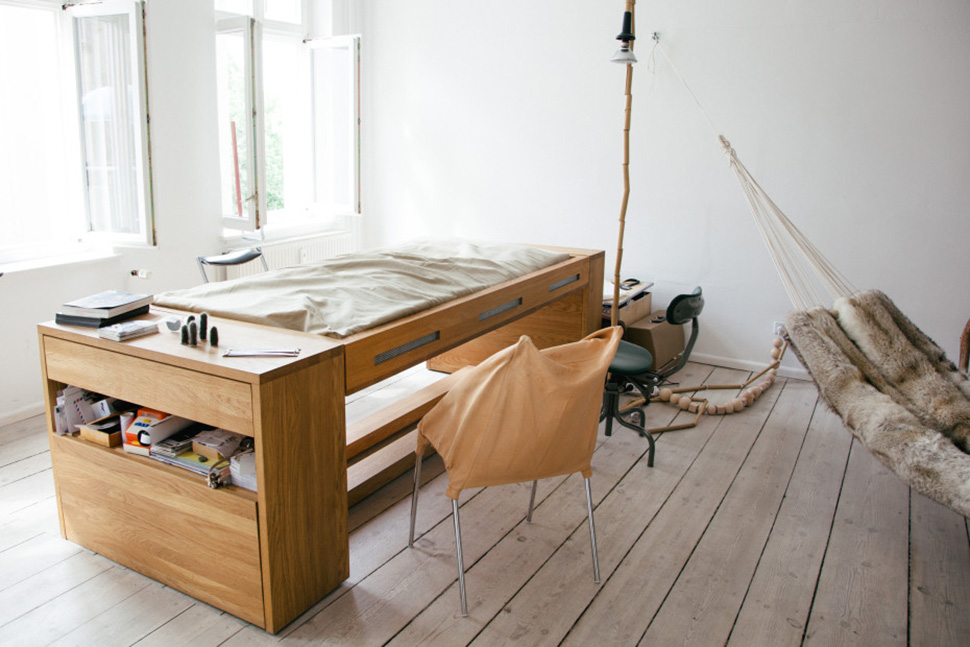
Berlin-based BLESS design studio made this table whose top flips over to convert into a single bed. The table/bed, which features a bunch of storage, would be great for artists who need large work surfaces or for people who have teams. It would also make a good dining table. (It might not be good for people with partners). Gizmodo reports that the unit is available through BLESS’s seldom-updated, confounding website. We’ll take their word for it.

Vitra

vitra

Venerated Swiss furniture maker Vitra will be showing off this cool cubicle concept at this week’s Orgatec tradeshow in Cologne, Germany. Inside the cube is a surface that can raised and lowered to be used as sofa, conventional desk or standing desk. While the piece does have a somewhat office-y vibe, we could imagine having one of these in the house as a dedicated office space. We could also see lengthening it to make a bed.

Resource Furniture Ulisse

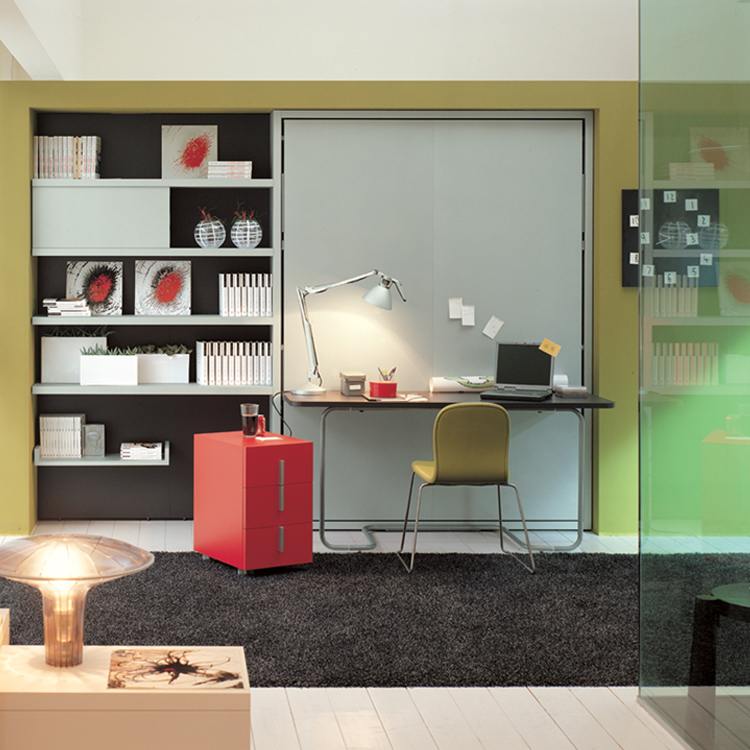
Resource furniture makes a number of wall-bed/desk or tables. It houses a queen size bed and has a desk on the front. Prices start at $4,150.

Studio NL

studio-nl-desk-bed-4 studio-nl-desk-bed

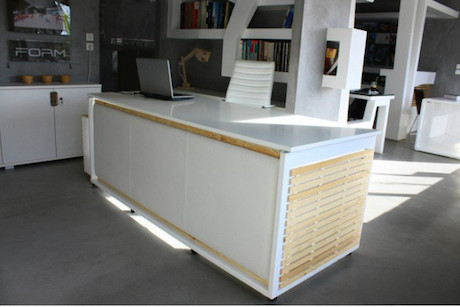
The George Constanza, ahem, 1,6 S.M. of Life line by Studio NL features a single bed underneath a desk top. They’ve included a place for a computer monitor/tv and the head of the desk/bed opens to provide ventilation or something. This design seems best suited for the office worker with a horrible home life.

Is it a Sleepy Living Room or Lively Bedroom?

In the coming months, we will be highlighting products and services we use in the LifeEdited apartment. Today, we’re looking at the Swing Sofa/Bed from Resource Furniture. 

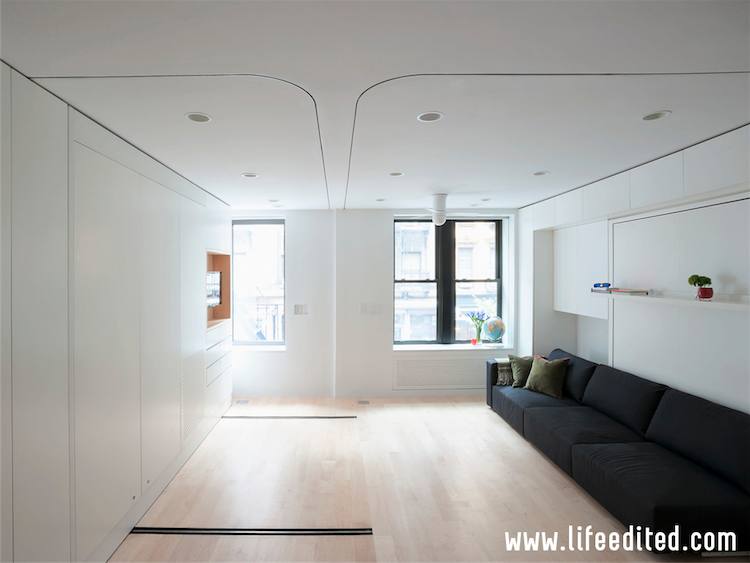
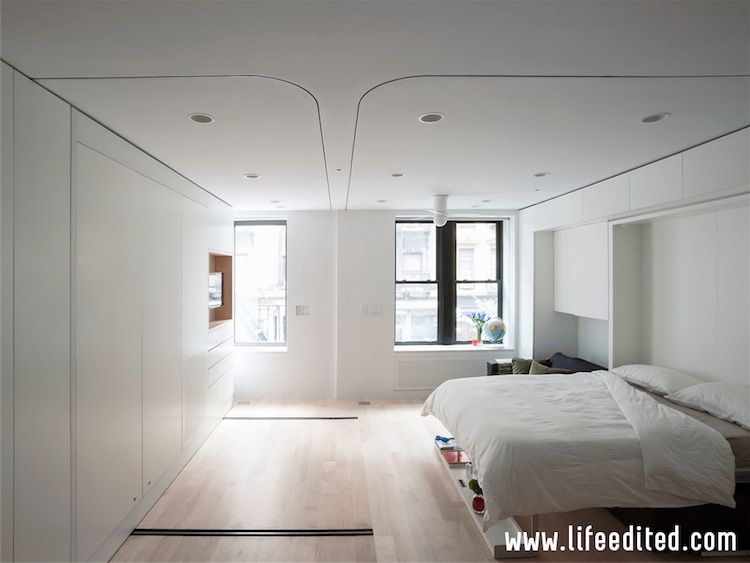
The Swing sofa/bed from Resource Furniture is probably the most important piece of furniture in the LifeEdited Apartment as the master bed and couch are arguably the two most important pieces of furniture in any home. It serves the vital function of easily converting our comfortable living room into a comfortable bedroom.

Standard Murphy beds require their front-sides to be clear before lowering their beds. The Swing utilizes this valuable frontal real estate because its bed, when lowered, is higher than the full-sized couch that sits flush with the frontside of the unit. This exploitation of all available space is crucial for small homes, where every unfilled gap cuts into valuable square footage.

The Swing is designed and manufactured by Clei in Italy. Here are some of its key features:

    • Easy, one-handed lowering of the bed.
    • An available chaise lounge, which can be attached to either side of the sofa. With the chaise, the sofa is 9′ 2″ wide.
    • The chaise version has an upper shelf that provides and additional 6′ of storage (note: The LifeEdited version does not include this feature).
    • An aluminum bedframe with steam-bent beech wood slat supports.
    • A bookshelf that holds up to 25 lbs and stays level when the bed is pulled down.
    • Storage under the sofa seat for bedding or other items.
    • A self-standing/self-supporting structure that requires no attachment to the walls or floor. It is a ‘wall-bed’ that makes its own wall and can be used as a room divider.
    • Available in more than 40 finishes, melamine, lacquer and wood veneers. Available in 30 CARB 2 compliant (California Air Resources Board) finishes.
    • Available headboard cushions that provide cushioning and eliminate the gap between mattress and backboard, ideal for reading or watching TV in bed.
    • Available in 100 different fabrics options.
    • Available LED interior lighting.

Amazingly, the entire depth of the system when open for sleeping is only 6.5” longer than a standard mattress.

Prices for the non-chaise version start at $9100 and $12,850 with chaise. Bank on an extra $800 or so for a mattress. No this is not cheap, but this is a quality piece of furniture you will have for years. Furthermore, consider the Swing could eliminate the need for a dedicated bedroom. How much does an extra bedroom cost? In a city like New York City, real estate can easily fetch between $500-$1000/sq ft. Let’s say a very small bedroom is 70 sq ft–in other words, 35K-70K!

The difference between a studio rental and a one bedroom, or between a one bedroom and two bedroom can easily be $1K/month difference. The Swing could pay for itself in a year and you’d have a great piece of furniture to take with you to your next place.

Looked at in either of these lights, the math becomes quite different.

For more information, visit www.resourcefurniture.com or stop by their New York City showroom.