My wife and I are in the final phase of purchasing a home in Brooklyn, NY. In true LifeEdited spirit, the apartment is on the cozy side. The realtors call it 675 sq ft, but our tape measure says something quite smaller. In this space will live two work-from-home adults and one plays-from-home one-year-old boy. We chose the place for a number of reasons. It has a flexible square floor-plan (we’ll keep you posted on designs). It’s in a charming building filled with other young families. It’s near many of our friends. But the main reason is its location: it’s directly across the street from Prospect Park and in a very good school district.
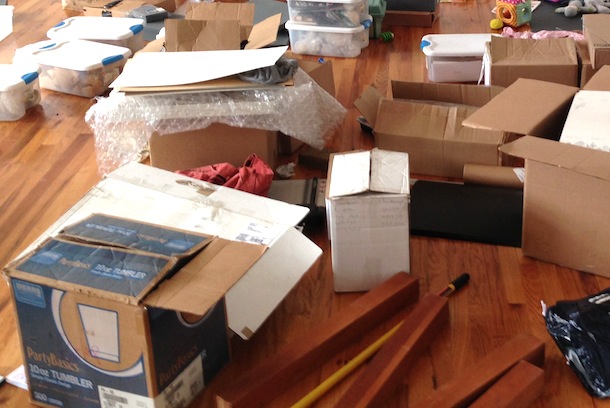
Our little space requires all fat be trimmed from our lives–there is no room for backups or also-ran stuff. Our current place has ample closets and room for unused phones, computers, vases, photos, purses, etc. Our new place will have storage for what we love, need and use and not much more. In preparation for this new, leaner life, my wife and I spent the weekend editing our lives.
We always knew that our current home would be more pitstop than final destination, so we never fully unpacked, and many of the items considered this weekend were things that had been boxed up for the last year. Similar to Graham Hill’s 2011 TED talk, the question that kept creeping up was, “What’s in the box?” Not “what’s in the box” literally–we labeled them pretty well–but “what’s in the box” that’s so important that we can live a year (and often longer) without?
You’d think that things we hadn’t used in a year or more would be easy to get rid of–particularly for a guy who’s job is to promote the “luxury of less” and his wife who has strong minimalist leanings. You’d think we would edit with abandon. You’d be mistaken.
Weaving through years of accumulated objects brought up fond memories and appreciation for objects we once cared enough to bring into our lives. Gifts from loved ones. Pieces of art that we were either given, bought or made. Cherished books. Framed photos we no longer had the wall space to hang. Objects that were sure to be collectible one day like my first generation iPhone. Sports equipment I’d been holding onto for years, sure that I would eventually use it. But would I really? When? Most of these things made the chopping block and it wasn’t easy.
There were also tinges of regret–all of the things we now realize were far from necessary: that second water pitcher, that $1K watch–expensive things that we will attempt to sell on eBay or Craigslist for a fraction of their purchase price. We wondered if maybe we shouldn’t have got them in the first place?
Whether conscious of it or not, I wondered if this emotional process was the reason many people don’t downsize? Might the prospect of getting rid of stuff be enough to stay in a too large home or live in a less-than-ideal neighborhood?
If you are considering downsizing or just editing your life, here are several valuable lessons–both practical and emotional–I learned this weekend editing our stuff:
- Ebay is great for smaller, commodity items. I actually sold $600 worth of stuff this weekend, but it was name brand stuff (old phones, bike components, watches, etc.). No-name stuff hasn’t really moved.
- Etsy is best for selling curios, handmade art and other non-commodity stuff. My wife sold a miniature dollhouse couch on Etsy, which she never thought would move. If you have weird stuff, Etsy might have a weird buyer.
- Craigslist is good for the big stuff like furniture, but our experience is that people want deals. Also, the bigger stuff might take more time, so you need to stay on top of it. More tips here.
- Editing might be a little painful, but that’s okay. Comfort is not needed. As Graham Hill says, “edit ruthlessly.” In many ways, getting rid of stuff is like breaking off a relationship. If it’s a horrible relationship, ending it can be easy. But most relationships, like most stuff, have some elements that work and others that don’t, and the prospect of letting go of the things that do work can overshadow the preponderance of things that don’t. If you’ve made a decision to let go of something, stay firm in your decision, despite discomfort, and edit away.
- Focus on the other side. Many of the intellectual arguments for editing your life–less to deal with, store, clean, etc.–get lost when presented with a potential emotional loss. Try to create a stronger emotional connection to the other side. We are editing our lives because it allows us to move into a clean, amazing, albeit small, apartment in a neighborhood we couldn’t have otherwise afforded. We visualized a life where our son could hop over to the park on a moment’s notice; where we could walk to our friend’s houses; where we could reunite with our beloved Park Slope Coop (don’t believe the slander–it’s the best); where we would be living within our financial means and not have to stress out about high mortgage payments. Connecting emotionally to this vision proved far more powerful than a pro/con balance sheet of why we should hold onto the cheese knives.