Large Lego-Like Blocks Can Make Anyone a Builder

Along with thrift and above average height, my father passed down an aversion for building stuff. I’ve often pondered if my minimalist tendencies are just the offshoot of this aversion–i.e. doing without requires zero carpentry skills. But EverBlock is a building system so simple, even a DDIY (don’t do it yourself) person like me could build stuff like a champ. EverBlock “is a life-sized modular building block that allows you to build nearly anything”–a description that bypasses Lego® brand building blocks, because, well, EverBlock are just really big Lego blocks.
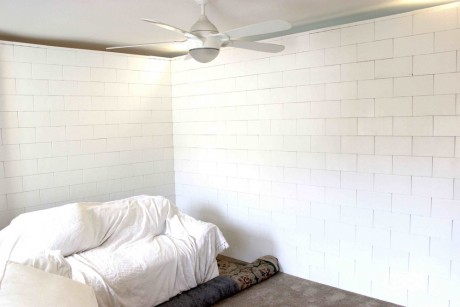
everblock-wall

Like Lego, EverBlock are plastic blocks that fit together, though EverBlock blocks are considerably more substantial. Details from their website:

The EverBlock™ System consists of four universal parts–a full sized 12″ block, a 6″ half-sized block, a 3″ one-quarter sized block, and a 12″ finishing cap that all interlock. Connector clips, hanging clips, and reinforcement rods are available for more structurally demanding applications and metal baseplates and feet can be used for additional stability.

This scale allows you to make some practical stuff: furniture, walls, various dividers, etc. Besides their obvious ease of construction, what’s best about them is that you can adjust them to changing spaces and needs. Need to chop your 1000 sq ft friendly sofa in half to fit into your new tiny house? Need to divide a room in your rental apartment without 2×4’s, sheetrock and paint? Need to convert your kid’s bed frame into an adult sized one? EverBlock has you covered for all of this.

everblock-tableeverblock-building

You might even be able to make a basic house using the blocks. EverBlock founder Arnon Rosan wrote me saying that the blocks are reinforceable via a channel that runs inside the blocks, accommodating a plastic or wooden dowel or rebar and making them suitable for permanent or semi-permanent structures. There are also plans to make reinforcement pins that slot inside the blocks for much more rigidly. Windows and doors can be framed out similarly to traditional construction and replacement windows can be installed by screwing the window right into the blocks using nailing strips around the perimeter. While he estimates the R-value of the stacked blocks to be around 1.5–about the same as a one inch thick plywood–this figure could be greatly improved with caulking and, of course, insulation. If you have CAD drawings, EverBlock will help you realize your design. Getting a building inspector to sign off on this structure is a conversation for another day.

The blocks come in a few different colors and can be purchased individually and in bulk. An 18 pack of the large blocks runs around $125. Rosan said that a 7.5 ft tall, 400 sq ft structure with an opening for a door and two windows requires about 1,000 blocks, or about $6,500.00 in blocks. Raw materials for a conventional building might still be cheaper, but EverBlock’s ease of use and reusability–for both furniture and construction–might create a compelling alternative for many.

Insulate Yourself with Art

Building materials seldom get a lot of love outside of trade rags. For example, the LifeEdited apartment’s insulation allowed us to go from four to one radiators, providing huge energy savings. But we’ve never posted about it because pictures of cellulose batt and air barriers are about as sexy as a head of lettuce.

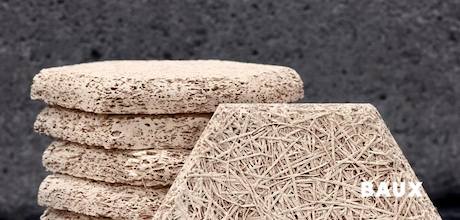
So when there’s sexy building materials, we get quite aroused (probably carrying this metaphor a bit far). Swedish firm Baux has invented one ingenious, super hot wall panel that adds three things that are often-missing from our homes. Their Träullit panels add acoustic and thermal insulation as well as gorgeous looks, all in an easy-to-install, eco-friendly package. Additional benefits include fire resistance and moisture retention.

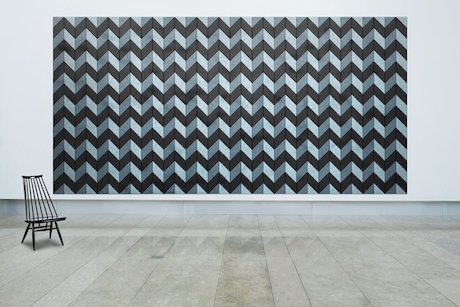
baux-chevron

The panels are made of a recyclable material composed of wood wool, cement and water. They come in six shapes and 20 different colors. Along with a downloadable design tool, you (or your architect) can make the panels into a custom wall hanging. We think they look great.

baux-panel

Compact living can be a bit wanting in the auditory isolation department. We imagine these panels would help muffle unwanted sounds from nearby family, roommates, neighbors, etc. The fact you can achieve all of this without tearing up the walls and adding acoustic batt or sound board is a huge plus, especially for renters who might not want to invest in their space. Lastly, they look good enough to be wall art–not a common charge for acoustic and thermal insulation.

If you love or just appreciate building materials, be sure to ‘like’ this post 🙂

Via Design Milk

Cosentino Stone and Why Surfaces Matter

On this site, the spotlight tends to shine brightest on sexy items like transforming furniture and architecture as they are the most conspicuous elements that make small spaces work in big ways. But there are other less sexy–though often beautiful–things that make small spaces work. One of those things is the choice of surface materials. Whereas large spaces can obscure cheap materials, small spaces shine a magnifying glass on them. It was for this reason that we chose Eco stone by Cosentino for many of the surfaces in the LifeEdited apartment.

We used Eco for a number of reasons. First, it looks great. We chose their polished Polar Cap color, a primarily white finish with a touch of blue-grey. It has a tight aggregate composition with a subtle sparkle in it. It matches the rest of the apartment without matching it too well.

Close behind aesthetics was its eco-cred. 75% of Eco’s composition is recycled mirror, glass, porcelain, earthenware and vitrified ash. The other 25% is natural stone and resins. Even 94% of the water used in its manufacturing is reused. Eco is LEED compliant and achieves the strict Cradle to Cradle certification, which seeks “to re-use every element, returning the product to the land as a ‘biological nutrient’ or to the industry as ‘technical nutrient’, so as to be recycled all over again.”

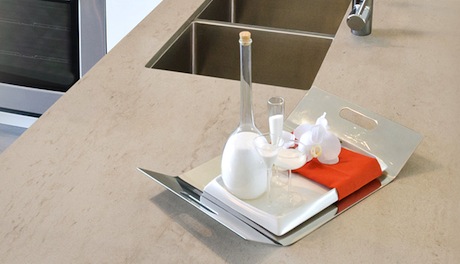
We used the material on the kitchen and bathroom sink counters, the walls of the toilet room and the window sills. Throughout the house, it’s maintained a nice finish and been stain free, and its sealed surface requires no upkeep.

Dekton

Cosentino North America invited us to the launch of their new product, Dekton. While it lacks Eco’s eco cred, Dekton has a very interesting story.

dekton

Using a process Cosentino calls Particle Sintering Technology (PST), they make Dekton essentially the way real stone is made. First, a blend of refined glass, porcelain, and natural quartz is heated to 1200 degrees celsius–a temperature equivalent to the core of the earth. The material is then cooled to the point where it becomes magma; they then apply 25,000 tons of pressure to this composition. According to Cosentino, this pressure is “six times more than what has been regarded as the world’s largest press up to now.” Because Cosentino was essentially trying to replicate the even force of a mountain bearing down on magma, the press and oven they use is the size of two football fields. In nature, this process takes 20-30,000 years. At Cosentino’s Spanish factory, it takes four hours.

The result is a material that’s virtually impervious to scratching, staining, UV light, water, cold and fire. It is so strong and versatile, Cosentino is touting it as much for exterior applications like building cladding as indoor ones like countertops and floors. It’s available in 12 white, grey, black, and natural stone hues and in three polished, matte, and slate finishes.

Cosentino, as part of NYC’s Archtober festival, created an exhibition called “Surface Innovation: Redefining Boundaries of Interior and Exterior Spaces.” As exterior and interior materials are seldom the same, Cosentino brought together several architects and asked them to conceptualize what they’d do with a material that could provide continuity inside and out of a structure (i.e. Dekton). Check out what they came up with at the exhibition, which runs through the end of the month (click here for details).

What does all this have to do with small space, minimal living you ask? We like to think that the concept of “less, but better” can apply anywhere–from a pair of pants to a countertop. We chose the Eco countertop because it fits that bill, matching aesthetics, function and responsible manufacturing processes. And while Dekton lacks the the green pedigree of Eco, the concept of a material impervious to most any abuse, that could seemingly last forever, that can be applied anywhere and looks great, seems to fit that bill as well.

[Full disclosure: Though we chose the “Eco” material independently, Cosentino provided sponsorship of our first apartment.]